
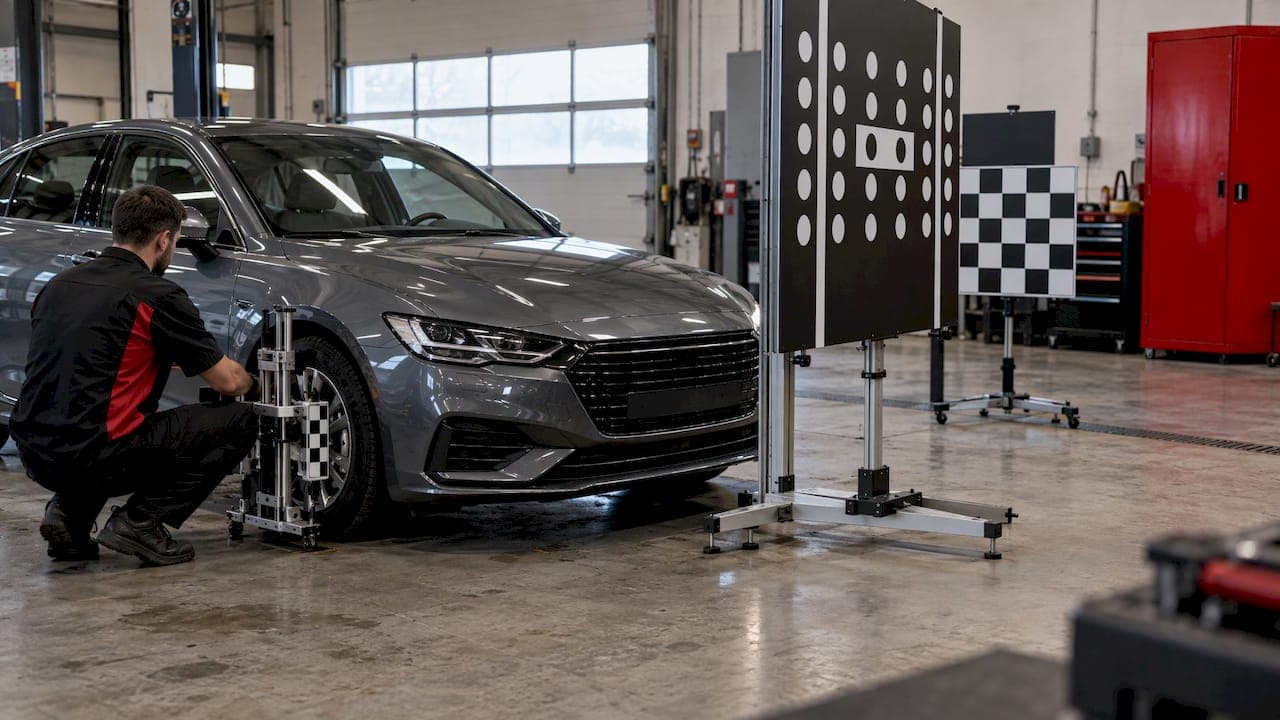
Most ADAS calibrations in the U.S. land between about $300 and $600 per system. The final bill depends on your vehicle, how many sensors need attention and who does the work. Industry data reported by CCC Intelligent Solutions shows average calibration fees reached about $500 per repairable vehicle by 2025, and that is before any damaged camera or radar part is replaced. This guide breaks down the numbers by system, explains why a BMW, a Porsche or a Range Rover tends to cost more than a compact sedan, and shows how to keep the repair from turning into a surprise.
TL;DR
- Expect roughly $300 to $600 for a single calibration, and about $500 on average per repairable vehicle once several systems are involved.
- Calibrating a windshield camera after new glass averages $360 according to AAA. Replacing a front radar sensor can cost $500 to $1,300.
- Backup camera costs split in two: a retrofit on an older car is cheap, while a factory camera tied to a surround-view system can cost far more.
- Premium and luxury vehicles usually carry more sensors and stricter procedures, so they sit at the high end of every range.
- Skipping calibration is the costliest choice. Sensors that are off can feed bad data to safety systems.
Table of Contents
- What ADAS calibration is and when you need it
- ADAS calibration cost by system
- What drives the price up or down
- Windshield camera recalibration and lane departure calibration
- Backup camera repair and replacement cost
- Costs by make: what to expect on popular and premium vehicles
- Can you calibrate ADAS yourself?
- Does insurance cover ADAS calibration?
- What happens if you skip calibration
- How to keep ADAS repair costs down
- A note from us
- Protect the tech before it fails
- FAQ
- Sources
What ADAS calibration is and when you need it
ADAS stands for advanced driver assistance systems: forward collision warning, automatic emergency braking, lane departure warning, adaptive cruise control, blind spot monitoring, parking sensors and backup or surround-view cameras. Each one depends on a camera, radar or ultrasonic sensor that must point exactly where the manufacturer intended.
Calibration is the process of teaching those sensors where they are again. It is usually required after a repair disturbs them. Typical triggers include:
- Windshield replacement on a car with a forward camera behind the glass.
- Bumper, grille or fender repair that moves a radar or ultrasonic sensor.
- Wheel alignment or suspension work that changes the vehicle's thrust angle or ride height.
- Removing, replacing or adjusting a camera, or a body part the camera is attached to.
Manufacturers publish the exact triggers for each model. For example, I-CAR's repair guidance for the 2024 Lincoln Nautilus says camera calibration or initialization may be required after the camera or its attached body component is removed, installed, replaced or adjusted, and a scan tool is required. The same logic applies across brands. If something that holds a sensor moves, the sensor may need to be re-learned.
ADAS calibration cost by system
The table below pulls together the U.S. figures that come from AAA's testing and from industry fee data. Treat them as ranges, not quotes. Your vehicle, your region and the shop decide the final number.
| Service | Typical U.S. cost | Source basis |
|---|---|---|
| Single calibration (general range) | $300 to $600 | Common shop estimate range |
| Average calibration fee per repairable vehicle | About $500 (2025) | CCC Intelligent Solutions |
| Pre- or post-repair scan | About $150 average | CCC Intelligent Solutions |
| Transfer and calibrate windshield camera to new glass | $360 average | AAA, 2023 |
| Front camera sensor repair (e.g., lane departure warning) | $600 to $800 | AAA, 2023 |
| Front radar sensor repair | $500 to $1,300 | AAA, 2023 |
| Front or rear ultrasonic parking sensors | $300 to $1,000 | AAA, 2023 |
The AAA numbers come from its 2023 ADAS repair cost fact sheet. Note that they cover repairs that include the part and the calibration, not calibration alone. That is why they sit above the typical $300 to $600 calibration range.
Older benchmarks are much lower. CCC data reported in 2019 put the average calibration fee at $219. The gap between then and now reflects more vehicles with more sensors, more required procedures and heavier equipment costs at the shop. AAA also warns that its 2023 estimates are not directly comparable to its 2018 study because standard equipment, labor costs and methodology changed.
Why the bill is bigger after a collision
In AAA's 2023 test, a minor rear collision on three 2023 vehicles produced an average repair estimate of $1,698.24. ADAS component replacement averaged $684.63, or 40.9% of that total. In other words, a fender bender that would once have been a simple bumper job now often includes sensors, scans and calibration.
What drives the price up or down
Two cars can need the same type of calibration and receive very different estimates. These are the factors that matter most.
Vehicle make, model and equipment
A base compact may have one forward camera. A well-equipped luxury SUV can have a windshield camera, front and rear radar, corner radar, surround-view cameras and a dozen ultrasonic sensors. Every added system adds procedures, and each procedure adds time and sometimes a separate fee. Manufacturers also set the procedure: some call for a static setup with targets in a controlled space, others for a dynamic drive on marked roads, and some for both.
Static versus dynamic calibration
Static calibration uses targets, mats or boards placed at measured distances around the car. It needs floor space, level ground and specialized frames. Dynamic calibration is done on the road with a scan tool, usually at set speeds, with clear lane markings. According to I-CAR, dynamic calibration may require specific instructions on speed, fuel level and road conditions. Static procedures usually cost more because of the equipment and shop time involved.

Equipment and training
The shop's investment matters. MOTOR reports that comprehensive ADAS calibration systems can cost well over $100,000, while standalone frames from major brands run in the high $30,000s to low $40,000s. That cost, along with technician training and facility space, is built into every calibration price. CCC lists the same list of pressure points: the number and complexity of procedures, outsourcing, specialized tools, training and facilities.
Labor rates and location
AAA's study used average labor rates of $75 per hour for body labor and $110 per hour for mechanical labor, with estimates prepared in Southern California and Michigan. A metro area with high shop rates will cost more than a small town, and a dealership will usually charge more than an independent shop. Some independent shops price at roughly 70 to 80% of dealership rates, though that varies by market.
Research and scan fees
Before any calibration, a shop scans the car and looks up the manufacturer's procedure for your VIN. Itemized estimates may show a pre-scan, a post-scan and a research fee. One industry source notes research fees often run $20 to $30, depending on whether the car is domestic or premium European. CCC reports that average scan fees have stabilized around $150.
Windshield camera recalibration and lane departure calibration
This is where most drivers meet ADAS pricing for the first time. A cracked windshield looks like a glass job, but on many cars the forward camera is mounted to the glass. When the glass comes out, the camera is transferred to the new windshield and must be calibrated.
AAA's 2023 report lists an average of $360 to transfer and calibrate a windshield-mounted camera to new glass. If the camera itself is damaged and has to be replaced, AAA's range for front camera sensor repairs such as lane departure warning is $600 to $800.
The glass matters as much as the calibration. AAA notes that windshields on ADAS-equipped vehicles must meet strict OEM specifications for clarity, shade patterns and mounting brackets, and non-compliant aftermarket glass can prevent a successful calibration. A cheaper windshield that cannot be calibrated is not a saving.
On many vehicles, lane departure warning and lane keeping share the same forward camera. That means one calibration usually covers both, rather than two separate bills. Ask for the camera calibration to be listed once and confirm which features it restores.
Backup camera repair and replacement cost
Backup camera costs fall into two different worlds, so be clear on which one you are in.
A built-in camera that has failed or been damaged. Factory rear cameras are often part of a trunk lid, liftgate handle or bumper assembly. On cars with a surround-view system, the cameras also work together to build the overhead image. AAA's 2018 study found that replacement of front, side-mirror or rear cameras used in around-view systems added $500 to $1,100 over ordinary collision work, and rear radar sensors added $850 to $2,050. Those parts were OEM, and AAA says make, model, sensor location and repair facility all affect the estimate. Because the study is older, treat the amounts as a floor for today's prices, not a ceiling.
Adding a camera to an older vehicle. Consumer Reports states that camera hardware usually costs $50 to $199, retrofit packages that use the existing infotainment screen cost $120 to $600, and professional installation costs $99 to $130. It adds that hardwiring a camera can be time-consuming and call for DIY skills. These numbers do not describe a replacement on a late-model luxury car.
If your backup camera shows a black screen, a distorted picture or a guideline that no longer matches the bumper, tell the shop up front. Some cars need the camera aligned or initialized after replacement, and some do not. The repair information for your VIN decides.

Costs by make: what to expect on popular and premium vehicles
Every manufacturer sets its own calibration rules, and premium brands tend to pack more sensors behind the glass, in the bumpers and around the body. The notes below describe where calibration tends to come up for owners of well-known models. They are general guidance, not price quotes. Always have the shop pull the procedure for your exact year and trim.
Ford and Lincoln
Ford trucks and SUVs, from the F-150 to the Explorer and Mustang Mach-E, carry a forward camera and radar for pre-collision assist, lane keeping and adaptive cruise. A windshield replacement or front-end repair on these models commonly triggers camera or radar work. Lincoln shows the pattern clearly: the repair guidance for the 2024 Nautilus says camera calibration may be needed whenever the camera or its attached body component is moved. A truck that gets a new windshield after a chip turns into a crack is a common story, and the calibration is part of the job.
Honda and Acura
Honda's Sensing suite, which includes a front camera and radar, is found across the Accord, Civic, CR-V and Pilot. These cars are often calibrated with a dynamic drive. GM has published a similar guide for its own vehicles, stating that front-view camera calibration can take three to five minutes with clear lane markings, a clean windshield and speeds of 35 to 56 mph. Short procedures can still cost a full fee, because the shop also has to scan, research and verify the result.
BMW and Mini
BMW's driver assistance packages combine a windshield camera with radar, and many models add surround-view cameras and parking assistants. A windshield replacement on a 3 Series, X3 or X5 often means camera calibration, and a bumper repair can mean radar work. Expect estimates toward the upper end of the $300 to $600 range per system, and higher when several systems are involved. Insist on OEM or OEM-equivalent glass with the right bracket and shade band so the camera can be set up correctly.
Mercedes-Benz
Mercedes combines camera and radar data for its Distronic and active brake assist features, and its S-Class, E-Class and GLE models often have multiple sensors in the grille, bumpers and mirrors. A cracked windshield or a small front-end bump can mean more than one calibration. Because the sensors work together, a misaligned one can affect several features at once, so the post-repair scan is worth reading.
Porsche
Porsche models such as the Macan, Cayenne and Taycan use radar and camera systems for adaptive cruise and collision mitigation, and many are fitted with sophisticated wheel alignment and ride height settings. Alignment changes can affect the way a front camera sees the road, so a performance alignment may be followed by a calibration check. Premium European cars also tend to have higher research fees and parts costs.
Range Rover and Land Rover
A Range Rover or Range Rover Sport combines forward camera, radar, 360-degree cameras and air suspension. Changing ride height, replacing a windshield or repairing a bumper can all require calibration, and the surround-view system depends on cameras in the grille, mirrors and tailgate. These vehicles are expensive to repair when sensors are damaged, which is a reason many owners look at protection plans before problems start.
Tesla, Toyota, Subaru and others
Camera-based systems on vehicles such as Tesla's, Subaru's EyeSight and Toyota Safety Sense depend on precise camera aim. The same rules apply: windshield replacement, alignment and collision repair are the usual triggers.
Can you calibrate ADAS yourself?
In practice, no. Calibration needs the manufacturer's procedure, a professional scan tool and, for many cars, floor targets measured to the inch. AAA says calibration requires special training, tools and information, so you should verify that the facility can repair and calibrate the damaged systems and ask for proof of the work.
Even dynamic calibration, which sounds like "just a drive," is not a solo job. I-CAR advises that a second technician should ride along to read instructions and operate the scan tool, because it is unsafe for one person to drive and use the tool at the same time.
How long does it take?
A simple dynamic calibration can be done in minutes of driving, as the GM example above shows, but the visit is longer once scanning, setup and a final check are included. Static calibrations and multi-sensor jobs on luxury vehicles can take a good part of a day. Ask the shop for a time estimate with the quote.
Does insurance cover ADAS calibration?
Often, yes, when the repair itself is a covered claim. If a collision or comprehensive claim pays for the windshield, bumper or sensor, the calibration required to complete the repair is generally part of the repair. Coverage, deductibles and glass endorsements differ by policy and state, so ask your insurer before the work starts. Request an itemized estimate that lists scans, research and each calibration, because itemizing gives your adjuster something concrete to review. Applied Automotive Technology also suggests that shops itemize pre-scan, post-scan, research and specific sensor calibrations for transparency.
Insurance does not help with wear and tear, age-related failures or a camera that simply stops working with no covered event behind it. That is the gap many owners discover after the factory warranty expires.
What happens if you skip calibration
A sensor that is slightly off can be worse than one that is switched off. AAA explains that miscalibrated sensors can provide faulty data, causing ADAS to operate improperly or not at all, which creates a safety hazard, and the car may also show warning lights, messages or diagnostic trouble codes.
Real-world signs include lane keeping that pulls the wheel, adaptive cruise that brakes for nothing or not at all, and blind spot alerts that miss a car. AAA's view is that replacing a damaged sensor is only part of the repair. Calibration restores proper operation, so ask for a printout or report that shows it was completed.
How to keep ADAS repair costs down
- Fix chips early. A small chip repaired before it spreads can avoid a windshield replacement and the calibration that comes with it.
- Ask what the quote includes. Scan, research, calibration, parts and glass should each be listed.
- Use the right glass. OEM-spec glass avoids a failed calibration and a second visit.
- Get two estimates. Compare a dealer with a qualified independent shop, and make sure both are quoting the same procedures.
- Ask for proof. A completed calibration report is your record if a system acts up later.
- Plan for the repair you cannot insure. Sensor failures from age and wear are not accidents, which is where a protection plan helps.
A note from us
We talk to owners of BMWs, Mercedes models, Range Rovers, Porsches, Hondas and Fords every week, and the pattern is the same. The car has more technology than the owner realizes, and that technology is not cheap to fix once the manufacturer's warranty ends.
A sensor, camera or control module is rarely a small repair. Add calibration, scans and the labor around them and a single event can turn into a four-figure bill. That is why we built our plans around components, not just engines and transmissions, and why our coverage conversations start with your actual vehicle: its year, make and model.
We keep the process simple: a consultation, a plan selection, customization and a final agreement, with terms laid out clearly and no hidden fees. Our claims process is designed for rapid approvals, and our coverage includes access to ASE-certified mechanics nationwide. If you drive a high-tech vehicle, you should look at protection before the repair estimate arrives, not after.
Kenneth
Protect the tech before it fails
Calibration and sensor repairs are part of owning a modern car, and the bills tend to arrive when the factory warranty has ended. Our Elite, Advanced and Essential plans are designed to protect key systems, including engines, transmissions, cooling, electrical, steering, suspension and high-tech electronics, with roadside assistance and rental reimbursement available. You can get a free quote based on your vehicle's year, make and model, then compare the Elite, Advanced and Essential protection plans and choose the level that fits your budget. Coverage varies by plan, so review the terms of the one you select to see exactly what is included.
Riding a motorcycle instead? Our Full Throttle motorcycle plan is built for bikes. To start with a quote, visit Rpmwarranty.
FAQ
How much does ADAS calibration cost?
Most single calibrations run about $300 to $600, and CCC reports an average of about $500 per repairable vehicle by 2025. A windshield camera transfer and calibration averaged $360 in AAA's 2023 report. Luxury vehicles with several sensors and static procedures cost more.
How much does it cost to recalibrate a windshield camera?
AAA's 2023 report puts the average at $360 to transfer and calibrate a windshield-mounted camera to new glass. If the camera is damaged and has to be replaced, AAA lists $600 to $800 for front camera repairs such as lane departure warning. Your quote may also include a scan and research fee.
How much does a backup camera replacement cost?
It depends on the car. Adding a camera to an older vehicle can cost $120 to $600 for a retrofit package plus $99 to $130 for installation, according to Consumer Reports. A factory camera in a surround-view system can add $500 to $1,100 to a repair, based on AAA's 2018 figures.
What happens if ADAS is not calibrated?
AAA says miscalibrated sensors can send bad data, which can make safety features work incorrectly or not at all. Warning lights or trouble codes may also appear. Ask your shop for proof that the calibration was completed.
Can I calibrate ADAS myself?
No. The procedure requires manufacturer instructions, a professional scan tool and often targets or a second technician in the car. Use a facility with the right training and equipment and ask for documentation of the work.
Sources
- AAA: ADAS repair costs fact sheet (2023)
- AAA: Cost of ADAS repairs report (2023)
- AAA: New vehicle technologies double repair bills for minor collisions (2018)
- CCC Intelligent Solutions: The current state of calibrations
- Repairer Driven News: CCC calibration data (2019)
- I-CAR: 2024 Lincoln Nautilus calibration
- I-CAR: Considerations for dynamic calibration
- I-CAR: GM Repair Insights, Fall 2025
- MOTOR: ADAS calibration cost barrier
- Consumer Reports: How to install a rearview camera in an older car
- Revv: How to price ADAS calibrations
- Applied Automotive Technology: How to price ADAS calibrations competitively