
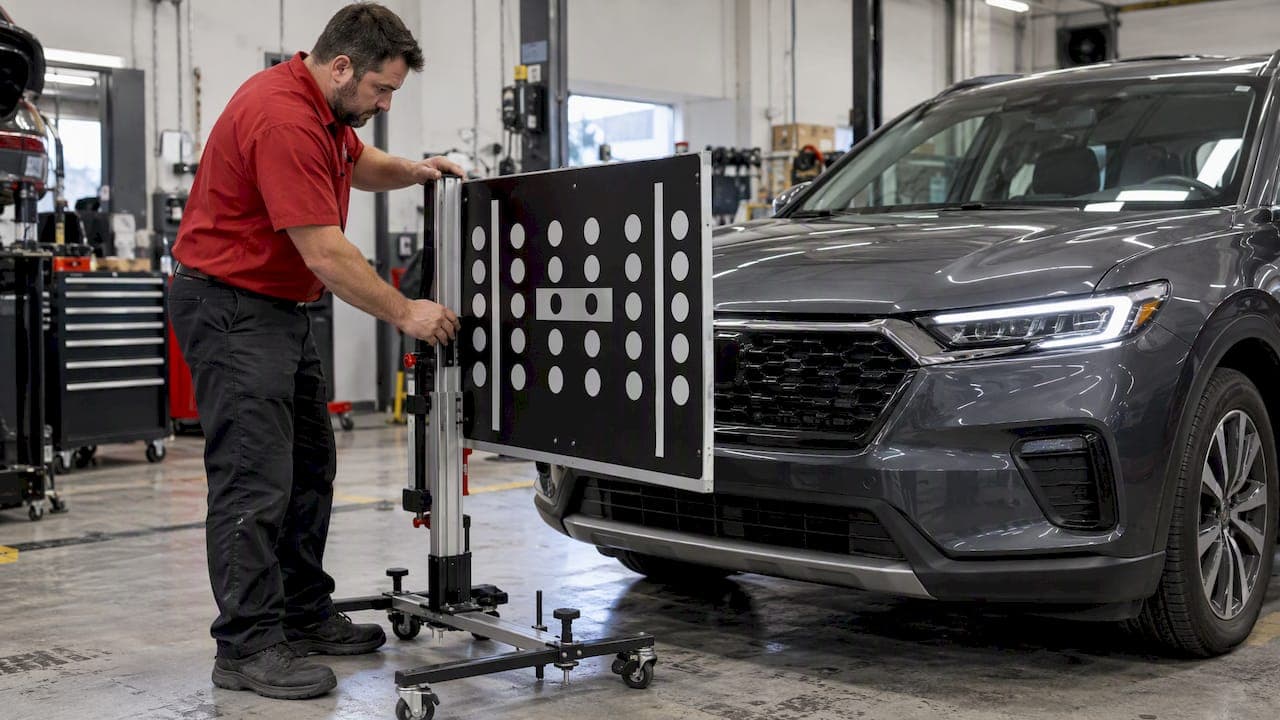
ADAS warranty coverage depends on the contract. A good extended warranty can pay to replace a failed radar unit, camera or control module, along with the calibration that comes with the repair. It will not pay for sensors damaged in a crash, because that is a collision-insurance claim. Many plans quietly exclude calibration or list sensors only under "electronics." Read the contract for those exact words before you buy.
This guide explains what ADAS repairs cost, what a service contract usually covers, which line items cause denied claims, and what to look for on luxury and mainstream vehicles alike, from a Range Rover or Porsche to a Ford or Honda.
TL;DR
- ADAS means the cameras, radar and ultrasonic sensors behind your bumpers, mirrors and windshield. They are expensive to replace and must be calibrated afterward.
- An extended warranty is a service contract for mechanical or electrical failure. Accident damage belongs to your collision insurance.
- Ask three questions before you sign: Are sensors and control modules named as covered? Is calibration paid? Can the repair shop you choose actually perform it?
- Higher-end vehicles carry more sensors per car, so the exclusion list matters more than the plan's name.
- Get the contract in writing and compare the covered-components list line by line.
Table of Contents
- What ADAS is, and why repairs cost so much
- Calibration is the line item people forget
- What an extended warranty does and doesn't cover
- Collision insurance and warranty: who pays for what
- Higher-end and mainstream vehicles: what to check
- How to read a contract for ADAS
- A worked example
- Our perspective
- Where our plans fit
- Protecting your ADAS beyond the warranty
- FAQ
- Sources
What ADAS is, and why repairs cost so much
Advanced driver assistance systems include automatic emergency braking, adaptive cruise control, lane-keeping, blind-spot monitoring, parking sensors and surround-view cameras. The hardware sits in exposed places: inside bumpers, behind the windshield, in the grille and in the side mirrors.
AAA's research puts numbers on it. In its fact sheet on ADAS repair costs, typical costs for damaged parts are:
| Component | Typical repair cost |
|---|---|
| Front radar sensor (emergency braking, adaptive cruise) | $500 to $1,300 |
| Front camera sensor | $600 to $800 |
| Side mirror with camera | $740 to $1,600 |
| Ultrasonic parking sensors | $300 to $1,000 |
The same AAA material says replacing ADAS components after a minor front-end collision averages $1,540, about 13% of the repair estimate. A windshield replacement on an ADAS-equipped car adds roughly $360 in calibration, about 25% of the glass bill.
AAA's broader study, summarized by AAA Oregon/Idaho, found that repairing the sensors and cameras can make up more than a third (38%) of the total repair cost on some vehicles.
Those figures are for parts and labor on a single sensor. Luxury vehicles tend to have more sensors, more modules and more expensive parts. Your own bill depends on your make, model and year.

Calibration is the line item people forget
A new sensor is not finished when it is bolted on. AAA's report on the cost of ADAS repairs explains that sensors need precise calibration after many repairs, including bumper work, windshield replacement and even wheel alignments. Out-of-calibration sensors can work improperly or not at all, and they may trigger dashboard warning lights.
The report also stresses that calibration is exacting, time-consuming work. A general body shop may not have the training or equipment. That matters for coverage in two ways:
- The contract has to pay for it. Some contracts cover a failed sensor but treat calibration as a separate, excluded service.
- The shop has to be able to do it. If your contract requires an approved facility, confirm that facility can perform the calibration your vehicle needs.
A wheel alignment can also upset the forward camera. Because the thrust line of the vehicle changes, a forward camera may need recalibration after an alignment. Ask your shop whether it will be needed before you authorize the work.
What an extended warranty does and doesn't cover
The FTC explains that what people call an extended warranty is usually an optional service contract sold separately from the manufacturer's warranty. The Consumer Financial Protection Bureau lists the differences: what it covers, how long it lasts, what it costs and whether you can cancel.
For ADAS, the practical split looks like this.
Usually in scope
- Failure of a radar unit, camera, ultrasonic sensor or control module from a mechanical or electrical fault, when that part is a covered component.
- Related diagnostic and labor charges, when the contract includes them.
- Calibration required by a covered repair, if the contract does not exclude it.
Usually out of scope
- Collision damage. A sensor cracked in a parking-lot bump belongs to your auto insurer. The FTC notes that these contracts typically do not cover accident-related damage.
- Wear, neglect and poor maintenance. A sensor failing because a bumper was patched with the wrong material, or because the car was never serviced as required, can be denied.
- Glass. Windshield replacement is normally a glass or comprehensive insurance matter, even though it triggers camera calibration.
- Software updates and recalls. Those are usually handled by the manufacturer.
The FTC page also tells owners to check the fine print for exclusions on labor, diagnostic fees and whether the provider requires specific repair facilities. That advice applies doubly to ADAS.
Collision insurance and warranty: who pays for what
A common misunderstanding is that either product covers everything. They split the work:
| Situation | Who typically pays |
|---|---|
| Radar fails with no impact, out of factory warranty | Extended warranty, if the part is covered |
| Bumper hit, sensor damaged | Collision insurance |
| New windshield, camera needs calibration | Glass or comprehensive coverage, depending on your policy |
| Front camera module fails after a software fault | Manufacturer, if still under warranty or recall; otherwise extended warranty if covered |
Consumer Reports warns that repairs cost more when ADAS parts are damaged or even jarred slightly, because the sensors live in bumpers and windshields. It also cautions that minimum-coverage policies may not be ready for the specialized labor involved. After a crash, its advice is to get an estimate that includes recalibration of any affected sensors or cameras.
A small bump can still matter. Radar behind a bumper cover sends signals through the plastic, and repair filler can interfere with them. Repair-industry trainer I-CAR notes that many automakers warn against repairing bumper covers near blind-spot sensors, with BMW among the brands it names. A job that once meant a touch-up may now mean a new bumper cover.
Higher-end and mainstream vehicles: what to check
We do not publish failure rates for individual models, and we will not guess at them. What we can do is tell you what to look for on each type of vehicle. Every system below is a different bundle of cameras, radar and modules, and a contract should name them.
Range Rover
Range Rovers combine adaptive cruise, surround cameras and parking sensors with air suspension and other electronics. Suspension work can affect camera alignment, as covered above. Ask whether your plan covers electrical and high-tech components by name, and whether calibration after a covered repair is included.
BMW
BMW's driver-assistance features depend on a forward camera and radar units tied to several control modules. Because BMW is among the brands that warn against repairing bumper covers near radar, expect replacement rather than repair after a hit. That is an insurance event, but a spontaneous radar fault is the kind of electrical failure a warranty can address when the part is listed.
Mercedes-Benz
Mercedes models often carry radar in the grille and bumper, plus cameras in the windshield and mirrors. Parts of that layout are exactly the ones AAA prices in the hundreds to over a thousand dollars each. If your plan lists only "engine, transmission and drive axle," none of this is covered.
Porsche
Porsche owners often buy cars with driver-assistance options added at the factory. Optional equipment is where contracts differ: some cover factory-installed options, others only base equipment. Ask about options directly, and have the covered list name your car's exact equipment.
Ford
Ford's mainstream trucks and SUVs put forward cameras and radar on high-volume vehicles, so independent shops see these repairs often. That helps when your contract lets you choose a shop, as long as the shop has calibration equipment. The fact sheet's price ranges apply across brands, so a Ford sensor is not a small bill either.
Honda
Honda's driver-assistance suite is standard on many trims, so even a base model typically has a windshield camera and front radar. A windshield replacement is the likeliest trigger for a calibration. Check whether a covered camera repair includes the aiming procedure.
Tesla and Volkswagen
Cameras and software play a bigger role on some vehicles. If you drive one of these, see our pages on the best extended warranty for Tesla and the best extended warranty for Volkswagen for the coverage questions specific to those brands.
How to read a contract for ADAS
Sit down with the sample contract, not the brochure, and look for these items.
- Coverage style. Does the contract list covered parts (stated-component) or list what is excluded (exclusionary)? With a stated list, find the words radar, camera, sensor, module and electronic. If they are missing, assume they are not covered.
- Calibration and programming. Look for "calibration," "aiming," "programming" or "initialization." If the contract is silent, ask in writing.
- Diagnostic fees. ADAS faults often need scan-tool time to find. See whether diagnosis is paid when the repair is covered.
- Factory options. Confirm that optional driver-assistance packages are treated like base equipment.
- Repair facility rules. Are you limited to certain shops? Can the shop do ADAS calibration for your brand?
- Pre-existing conditions. A warning light that appeared before the contract started is generally not covered.
- Claim steps. Know whether the shop gets authorization before work starts. Repairs done first and submitted later are often denied.
AAA's engineers advise confirming that the repair facility, whether dealer or independent, has the manufacturer-specific training and equipment to calibrate your vehicle. Make that question part of choosing a plan.
A worked example
Say your out-of-warranty SUV shows a "front sensor unavailable" message and the emergency braking feature shuts off. The shop diagnoses a failed front radar unit with no sign of impact.
Using AAA's published range, a front radar sensor could cost between $500 and $1,300, before any aiming labor or diagnostic time. If your contract lists the radar as covered and does not exclude calibration, the contract handles the repair, subject to your deductible. If the same unit was damaged in a low-speed bump, the claim goes to your insurer. If the contract lists only powertrain parts, you pay the whole bill.

The repair is the same in all three cases. Only the contract language changes who pays.
Our perspective
We see the same pattern again and again: owners shop for a warranty by looking at the engine and transmission, then discover at claim time that the technology they paid a premium for is the part with the gaps. A car with surround cameras, radar and a dozen control modules can produce a repair bill that rivals an engine problem, and the contract language rarely mentions it unless you ask.
Our approach is to make coverage easy to read. We lay out plans in a four-step process: consultation, plan selection, customization and a final agreement. Our Elite, Advanced and Essential plans cover components such as engine, transmission, cooling, electrical systems, steering, suspension, hybrid systems and high-tech parts, with roadside assistance and rental reimbursement. Repairs are performed by ASE-certified mechanics nationwide, and we aim to approve claims within 24 to 48 hours.
Our advice is simple. Before you pick any plan, including ours, ask for the covered-components list and look for sensors, cameras and calibration by name. If the answer is vague, treat it as a no. We would rather you know that now than at the shop counter.
— Kenneth
Where our plans fit
We offer three tiers, Elite, Advanced and Essential, so you can match coverage to your vehicle and your budget. Plan prices are not published, because they depend on your year, make and model. You can compare the tiers on our protection plans page and request a free quote. When you do, ask us which plan lists your car's electronic and high-tech components and how calibration is handled. Motorcycle riders can look at Full Throttle.
Protecting your ADAS beyond the warranty
A warranty does not remove every risk, so a few habits help.
- Choose repair shops for calibration capability. Ask what equipment they use and whether they follow your manufacturer's procedures.
- Ask about calibration before alignments and glass jobs. A quick-lube alignment can leave a warning light behind.
- Keep sensors clean. Mud, ice and dirt block radar and cameras and can trigger a fault with nothing broken.
- Do not accept a cosmetic repair on a sensor bumper without asking. Filler can interfere with radar, and automakers may prohibit it.
- Review your insurance. Make sure your collision and glass coverage reflect the cost of sensors and calibration, not just a plain bumper.
- Keep records. Service history helps if a claim is questioned.
FAQ
Does an extended warranty cover ADAS sensors?
It can, if the sensor is a covered component and the failure is mechanical or electrical. Contracts that list parts must name radar, cameras and modules. Damage from a collision is not covered by a service contract, per the FTC.
Is ADAS calibration covered?
Only if the contract says so, or if it does not exclude it when a covered part is replaced. Calibration adds real cost: AAA puts it at about $360 on a windshield job. Ask for the answer in writing before you buy.
How much does ADAS repair cost?
According to AAA's fact sheet, a front radar runs $500 to $1,300 and a front camera $600 to $800. Mirrors with cameras range from $740 to $1,600. Your vehicle's price depends on make, model and shop.
What happens if ADAS fails?
The affected features, such as emergency braking or lane-keeping, may switch off, and a warning light usually appears. The car still drives, but you lose the safety features. Have it diagnosed by a shop that can calibrate your brand's sensors.
Does a luxury car need a better plan for ADAS?
Usually it needs a plan with a more detailed components list, because luxury vehicles carry more sensors and modules. Check that factory options are included. Compare the contract language, not just the tier name.
Sources
- AAA: Advanced Driver Assistance Systems (ADAS) Repair Costs fact sheet
- AAA: Cost of Advanced Driver Assistance Systems (ADAS) Repairs
- AAA Oregon/Idaho: Advanced Driving Systems Elevate Safety and Repair Costs
- FTC: Auto Warranties and Auto Service Contracts
- CFPB: Manufacturer's warranty vs. extended warranty or service contract
- Consumer Reports: The Hidden Cost of Car Safety Features
- Consumer Reports: How to Handle Repairs From a Car Crash
- I-CAR: When ADAS Can't See, Blind Spot Monitoring System