

TL;DR:
- Essential coverage protects basic mechanical systems necessary for vehicle operation, while advanced coverage extends protection to high-tech, luxury, and electronic components. Advanced plans are generally recommended for newer, high-value vehicles to avoid costly out-of-pocket repairs, whereas essential plans suit older or simpler cars with lower repair complexities. Choosing the right plan involves assessing vehicle complexity, age, repair history, and personal risk tolerance to ensure optimal coverage and value.
The difference between advanced and essential coverage is defined by the scope of protection each warranty tier provides. Essential coverage protects the core mechanical systems your vehicle needs to operate. Advanced coverage adds protection for high-tech components, luxury features, and operational benefits that essential plans simply do not include. For owners of vehicles like BMW, Mercedes, Range Rover, or Porsche, that gap in coverage can translate directly into thousands of dollars in out-of-pocket repair costs. Choosing the right tier starts with understanding exactly what each plan covers, what it excludes, and when the higher cost of advanced protection actually pays off.
What is the difference between advanced and essential coverage?
The core difference between advanced and essential coverage comes down to breadth and depth of protection. Essential coverage acts as a foundational tier covering basic mechanical components and core compliance requirements. Advanced coverage layers on top of that foundation with protections for components that essential plans deliberately exclude.

Think of it this way. Essential coverage is designed to keep your vehicle legally and mechanically functional. Advanced coverage is designed to protect the full value of your investment, including the parts that make a Range Rover or Porsche 911 worth owning in the first place.
Essential tiers are designed for baseline compliance and low-cost entry points, not comprehensive coverage for complex needs. That distinction matters more as your vehicle ages and its repair profile becomes more expensive and unpredictable. A 2022 BMW 7 Series with a failing air suspension system or a faulty iDrive module will quickly expose the limits of a baseline plan.
What does essential coverage actually include?
Essential coverage, sometimes called a powertrain or stated-component warranty in the extended warranty industry, focuses on the mechanical systems your vehicle cannot run without. These plans are built for reliability and affordability, not breadth.
What essential plans typically cover:
- Engine internals: pistons, crankshaft, camshaft, and cylinder heads
- Transmission components: gears, shafts, and torque converters
- Drive axle and differential components
- Cooling system basics: water pump and thermostat
- Fuel delivery systems: fuel pump and injectors
What essential plans typically exclude:
- Advanced driver assistance systems (ADAS) and camera arrays
- Infotainment systems, navigation hardware, and digital displays
- Air suspension systems common on Range Rover and Mercedes S-Class models
- Turbocharger and supercharger assemblies on performance vehicles
- Cosmetic or interior components
Essential plans work well for owners of older, high-mileage vehicles where the priority is protecting against a catastrophic engine or transmission failure. A 2015 Honda Accord with 120,000 miles is a strong candidate. A 2021 Mercedes GLE 450 with active body control suspension is not.
Pro Tip: Before selecting an essential plan, pull your vehicle's repair history and identify which systems have already shown wear. If your vehicle has any electronics or suspension claims in its past, essential coverage will likely leave those exact systems unprotected.
The cost of essential coverage reflects its limited scope. Monthly premiums are lower, and the plans are straightforward to administer. For budget-conscious owners who drive reliable, lower-complexity vehicles, essential plans deliver real value without unnecessary cost.
How does advanced coverage expand protection beyond essential plans?
Advanced plans provide comprehensive protection adding high-tech, luxury, or supplemental component coverage and operational benefits that essential plans do not touch. This is where the coverage options comparison between the two tiers becomes most visible for owners of premium vehicles.
Advanced coverage at Rpmwarranty, for example, extends protection to the systems that define the ownership experience of vehicles like Porsche, BMW, and Range Rover. These include:
- Turbocharger and supercharger assemblies
- Advanced electronics: sensors, control modules, and driver assistance hardware
- Air suspension and adaptive damping systems
- Infotainment and navigation systems
- High-voltage hybrid and EV components on applicable models
The financial case for advanced coverage becomes clear when you look at real repair costs. A BMW air suspension compressor replacement runs $1,200–$2,000 at a dealership. A Range Rover Terrain Response module can cost $3,500 or more. A Porsche PDK transmission control unit replacement can exceed $4,000. None of those repairs appear in an essential plan.
Advanced plans frequently include features such as restoration of sum insured and higher coverage limits for significant events. In vehicle warranty terms, this means your coverage limit can reset or recharge after a major claim, so a single large repair does not leave you exposed for the rest of the plan period.
Operational benefits also separate advanced from essential plans. Advanced plans in commercial contexts reduce fees significantly and offer dedicated support, valuable above certain usage thresholds. In vehicle warranty terms, this translates to priority claims processing, access to a dedicated service advisor, and premium roadside assistance that goes beyond a basic tow.
For owners who drive high-value vehicles regularly and depend on them for daily transportation, these operational benefits are not extras. They are part of what makes the plan worth carrying.
How do cost, limits, and terms compare between the two plans?
The financial difference between advanced and essential plans is real, but the gap is smaller than most owners expect when you account for what each plan actually covers. The table below breaks down the key variables.
| Feature | Essential Coverage | Advanced Coverage |
|---|---|---|
| Monthly premium range | Lower cost entry point | Higher upfront cost |
| Components covered | Engine, transmission, drive axle basics | All essential components plus electronics, luxury systems, ADAS |
| Coverage limit reset | Not typically included | Restoration of sum insured available |
| Roadside assistance | Basic towing and lockout | Premium roadside with priority dispatch |
| Claims support | Standard processing | Dedicated advisor and faster resolution |
| Best suited for | Older, lower-complexity vehicles | Newer, high-value, or luxury vehicles |
| Out-of-pocket risk | Higher for complex repairs | Significantly reduced for high-cost events |
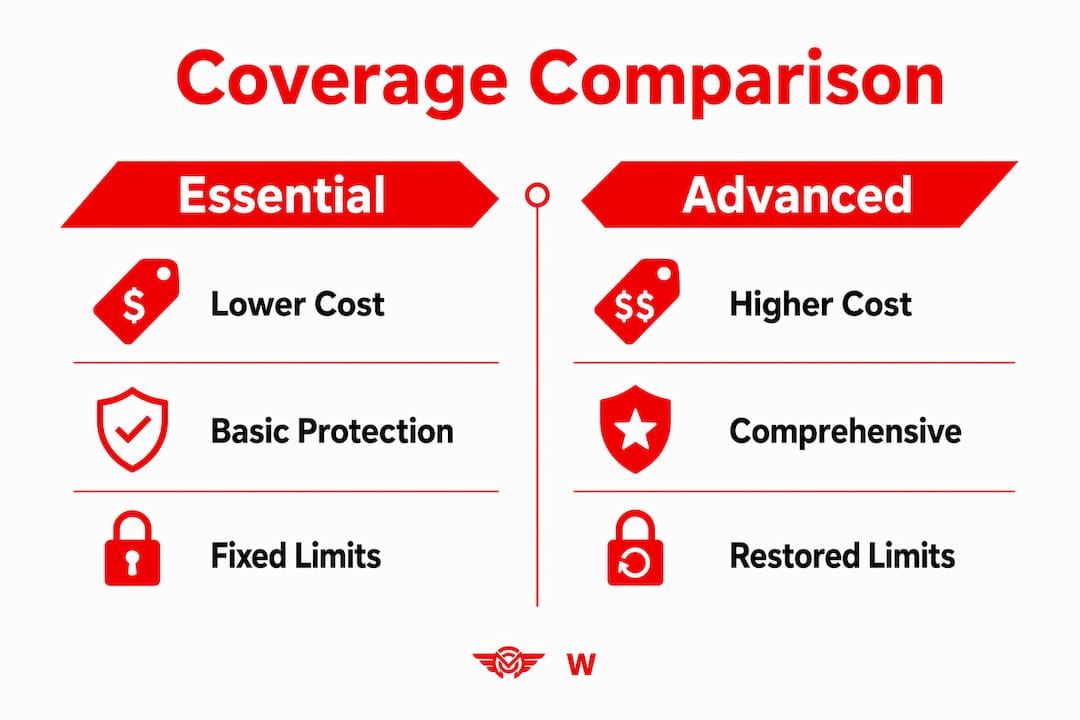
Advanced plans act as a hedge against significant out-of-pocket costs, providing add-ons like higher-limit reimbursements that essential plans lack. That hedge matters most when your vehicle's repair profile includes components that cost thousands of dollars individually.
The restoration of sum insured feature deserves specific attention. Most essential plans set a fixed coverage ceiling per contract period. Once you hit that ceiling, you pay out of pocket for every subsequent repair. Advanced plans that include sum insured restoration effectively reset that ceiling after a qualifying claim. For a Mercedes E-Class owner who faces a transmission repair followed by an air suspension failure in the same year, that reset can save $5,000 or more.
Upgrading to advanced coverage before exhausting essential plan capacity can result in paying for unused benefits. The practical implication is that timing your upgrade matters. If your vehicle is still under manufacturer warranty on its electronics, an advanced extended warranty plan may not deliver full value until that factory coverage expires.
Pro Tip: Request a full component exclusion list from any warranty provider before signing. The fastest way to identify the difference between advanced and essential plans is to compare their exclusion lists side by side. The shorter the exclusion list, the broader the coverage.
How do you decide which coverage plan fits your vehicle?
Choosing between essential and advanced coverage requires an honest assessment of four factors: your vehicle's complexity, its age and mileage, your financial risk tolerance, and how you actually use the vehicle.
-
Assess your vehicle's repair cost profile. A 2020 Ford F-150 with a naturally aspirated V8 has a very different repair profile than a 2021 Range Rover Sport with air suspension, terrain management electronics, and a turbocharged engine. The more complex the vehicle, the more likely an essential plan will leave critical systems unprotected.
-
Check your manufacturer warranty status. If your BMW or Mercedes still has active factory coverage on its electronics and powertrain, an essential extended plan may be sufficient as a bridge. Once factory coverage expires, the calculus shifts sharply toward advanced protection.
-
Calculate your out-of-pocket exposure. Look up the three most expensive repair items for your specific make and model. If those repairs fall outside essential coverage, price the difference between essential and advanced premiums against the cost of paying for those repairs yourself.
-
Consider your driving frequency and dependency. Owners who drive 20,000 or more miles per year and depend on their vehicle for work or daily life benefit most from advanced coverage's operational features, including priority roadside assistance and faster claims resolution.
-
Review your financial cushion. Advanced plans hedge against major repair costs; while pricier, their broad coverage can prevent costly out-of-pocket expenses. If a $4,000 surprise repair would genuinely strain your finances, advanced coverage is the more responsible choice.
For Honda Civic or Ford Escape owners who prioritize cost control and drive lower-complexity vehicles, essential coverage delivers solid value. For Porsche Cayenne, BMW X5, or Range Rover Defender owners, advanced coverage is the tier that actually matches the vehicle's repair reality.
Pro Tip: Review your warranty plan annually, not just at purchase. As your vehicle ages and accumulates mileage, the components most likely to fail shift from basic mechanical to electronic and luxury systems. Your coverage tier should shift with that risk profile.
Key takeaways
The right coverage tier is determined by your vehicle's complexity and repair cost profile, not just your monthly budget.
| Point | Details |
|---|---|
| Essential covers the basics | Engine, transmission, and drive axle are protected; electronics and luxury systems are not. |
| Advanced protects high-cost systems | Air suspension, ADAS, infotainment, and turbochargers are covered under advanced plans. |
| Sum insured restoration matters | Advanced plans can reset coverage limits after a major claim, reducing out-of-pocket risk. |
| Timing your upgrade is critical | Upgrading before factory warranty expires may mean paying for benefits you cannot yet use. |
| Vehicle complexity drives the decision | Owners of BMW, Porsche, Range Rover, and Mercedes benefit most from advanced coverage tiers. |
What i've learned after years of watching owners get this wrong
Most vehicle owners make their coverage decision based on the monthly premium, not the exclusion list. That is the single most expensive mistake I see repeated across every vehicle segment.
I have watched Range Rover owners carry essential plans because the monthly cost was $40 lower, then face a $3,800 air suspension repair that their plan explicitly excluded. The math on that decision does not work. The premium savings over two years did not cover half the repair bill.
The counterintuitive truth about advanced coverage is that it is not a luxury purchase. For owners of technologically complex vehicles, it is the baseline. Essential coverage is the luxury for those owners because it gives them the comfort of a low premium while leaving their most expensive systems completely exposed.
Where I see advanced coverage genuinely overpurchased is on older, simpler vehicles. A 2012 Honda CR-V with 95,000 miles does not need coverage for adaptive air suspension or ADAS cameras. It does not have them. An essential plan that covers the engine, transmission, and cooling system is the right fit.
My recommendation is to treat the coverage decision like a risk management exercise, not a budget exercise. List the five most expensive repairs your specific vehicle is known for. Check which plan covers them. Buy that plan. The monthly premium difference between essential and advanced is almost always smaller than a single uncovered repair on a premium vehicle.
Review your plan every 12 months. As your vehicle crosses 60,000 miles and then 100,000 miles, the failure probability of complex electronic systems rises. Your coverage should reflect that shift, not the risk profile your vehicle had when it was new.
— Kenneth
Protect your vehicle with the right Rpmwarranty plan
Rpmwarranty offers both Essential and Advanced extended warranty plans designed specifically for the vehicles you drive, from everyday Ford and Honda models to premium BMW, Mercedes, Porsche, and Range Rover vehicles. Every plan is built around your vehicle's year, make, model, and mileage so you are never paying for coverage that does not match your actual risk.
The process is straightforward: get a consultation, select your plan, customize your coverage, and finalize your agreement. Nationwide coverage, easy claims processing, and roadside assistance are included across all tiers. Whether you need foundational protection or a full advanced plan for a luxury vehicle, Rpmwarranty has a plan that fits. Get a free quote today and compare your options side by side before your next repair catches you without coverage.
FAQ
What does essential vehicle warranty coverage include?
Essential coverage protects core mechanical components including the engine, transmission, drive axle, and basic cooling and fuel systems. It does not cover electronics, luxury features, or advanced driver assistance systems.
Is advanced coverage worth the higher cost?
Advanced coverage is worth the cost for owners of complex or high-value vehicles like BMW, Porsche, Mercedes, or Range Rover, where a single uncovered repair can exceed the annual premium difference between tiers. For simpler, older vehicles, essential coverage often delivers better value per dollar.
What is restoration of sum insured in an advanced warranty plan?
Restoration of sum insured means your coverage limit resets after a major qualifying claim, so one large repair does not leave you exposed for the remainder of your plan period. Essential plans typically do not include this feature.
When should i upgrade from essential to advanced coverage?
Upgrading to advanced coverage makes financial sense once your vehicle's manufacturer warranty on electronics and luxury systems has expired, or when your vehicle's known repair risks include components that essential plans exclude. Review your plan annually as your vehicle ages.
Does Rpmwarranty offer coverage for luxury vehicles like range rover and porsche?
Yes. Rpmwarranty's Advanced and Elite warranty plans are designed to cover the high-tech and luxury components found in premium vehicles, including air suspension systems, infotainment hardware, and turbocharged engine assemblies.