

TL;DR:
- Factory warranties transfer automatically with the VIN and do not require paperwork or fees in most cases. Extended warranties need a transfer form, fee, and timely submission to remain valid for the new owner. When transfers fail, buyers can purchase immediate coverage plans from providers like RPM Warranty to ensure protection.
Yes, factory warranties generally follow the VIN and transfer automatically to a new owner, while most extended warranties and vehicle service contracts require a formal transfer form, an administrative fee, and submission within a strict deadline after the sale date. Before you hand over keys or cash, take these steps:
- Sellers: Locate the original contract, note the administrator's contact information and contract number, and initiate the transfer before the deadline closes.
- Buyers: Ask the seller for the contract number, call the plan administrator with the VIN, and do not assume coverage is active until you hold written confirmation in your name.
- Both parties: Treat the vehicle as unprotected until that written confirmation arrives. Plan administrators typically take a few weeks to process a transfer.
Table of Contents
- Are car warranties transferable, and which types actually move with the car?
- What documents do you need to complete a transfer?
- How to transfer an auto warranty: step by step
- Fees, mileage limits, and conditions that can block a transfer
- How a buyer confirms warranty status before closing the deal
- What to do when a transfer can't be completed
- North America legal and regional considerations for warranty transfers
- Seller-to-buyer transfer checklist
- Key Takeaways
- What RPM Warranty has learned about transfers
- Coverage when a transfer isn't an option
- Authoritative sources for verifying transfer rules
Are car warranties transferable, and which types actually move with the car?
Not all warranty types behave the same way when a vehicle changes hands.
- Factory/new-vehicle limited and powertrain warranties are tied to the VIN, so they transfer automatically without forms or fees in most cases. The new owner simply continues coverage until the time or mileage limit expires.
- Brand-specific exceptions matter. Hyundai, Kia, Genesis, and Mitsubishi market a 10-year/100,000-mile powertrain warranty to original buyers, but second owners typically receive only 5-year/60,000-mile coverage. BMW, Mercedes-Benz, Porsche, and Range Rover generally transfer their factory coverage without reduction, though terms vary by model year.
- Certified Pre-Owned (CPO) coverage is usually transferable, but individual program rules differ. Some require a formal transfer request or a fee.
- Third-party extended warranties and vehicle service contracts do not follow the car automatically. The seller must submit a transfer form, pay a fee, and meet the deadline. Miss the window, and the transfer right is gone.
- EV battery warranties are mostly transferable, but check the original contract for any original-owner restrictions, particularly on Ford Mustang Mach-E and Honda Prologue models.
- Free maintenance plans and promotional benefits (complimentary oil changes, tire rotations) almost always end with the original owner and cannot be reassigned.
What documents do you need to complete a transfer?
Gathering paperwork before the sale closes saves everyone time and prevents a denial on a technicality.
Core document checklist:
- Original warranty contract or certificate (with contract/policy number)
- Vehicle VIN
- Current title or bill of sale showing the sale date
- Odometer disclosure statement
- Valid government-issued ID for both seller and buyer
- Maintenance records (service receipts, dealer invoices)
Administrator-specific items:
- Completed transfer form (available from the administrator or manufacturer's website)
- Signatures from both seller and buyer
- Transfer fee payment (check, credit card, or online portal depending on the provider)
- Any required inspection report or dealer service order
Nissan's NESNA transfer procedure is a useful real-world example: it requires maintenance records, a transfer request within 30 days, title or bill of sale, signatures from both parties, and an administrative fee. If the administrator rejects the transfer, the fee is typically refunded.
Pro Tip: Sellers should hand the buyer a copy of the original contract and the completed transfer receipt at closing. That single step often prevents weeks of back-and-forth and gives the buyer immediate proof of coverage intent.
How to transfer an auto warranty: step by step
The sequence below applies to most private-party sales of extended service contracts.
- Confirm coverage status. Call the plan administrator with the VIN and contract number to verify the plan is active, payments are current, and the contract allows transfers.
- Gather all required documents (see the checklist above). Missing one item is the most common reason transfers stall.
- Complete the transfer form. Download it from the administrator's website or request it by phone. Fill in the VIN, sale date, odometer reading, and both parties' information.
- Submit the form and fee within the transfer window (14–60 days from the sale date, depending on the contract). Most administrators accept online submissions or certified mail.
- Wait for administrator review. Processing runs 15–30 days. Some providers move faster; a few take the full month.
- Receive written confirmation in the new owner's name. This is the finish line. Until this document arrives by email or mail, treat the vehicle as if it has no extended coverage.
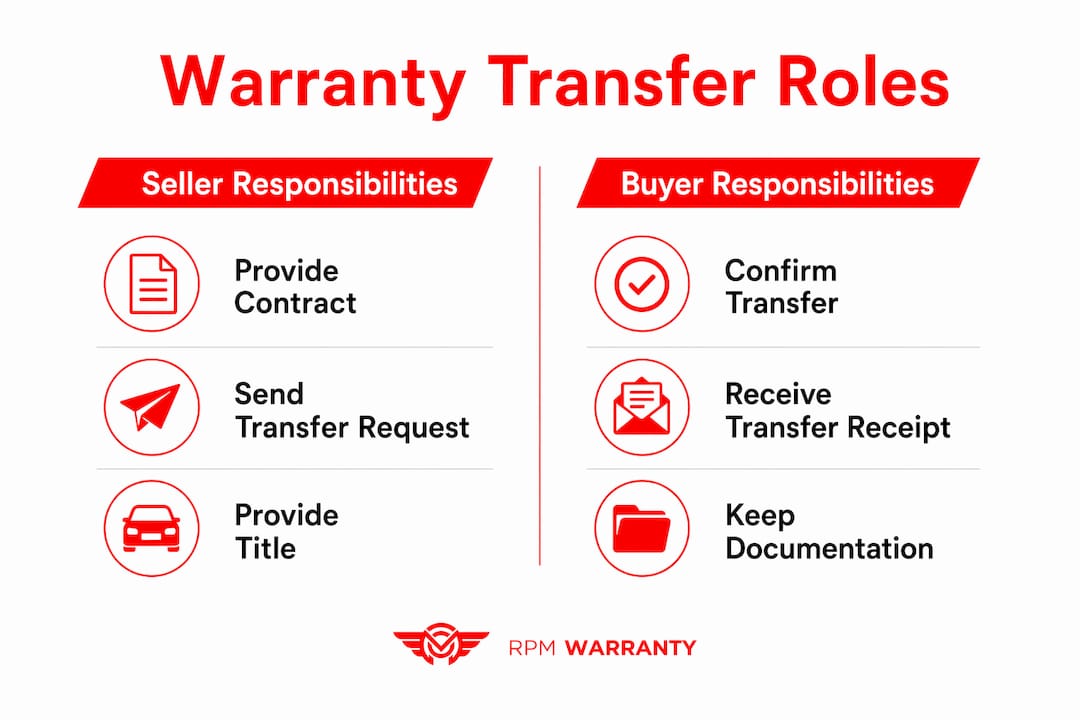
Seller vs. buyer responsibilities at a glance:
| Responsibility | Seller | Buyer |
|---|---|---|
| Provide original contract | ✓ | |
| Provide bill of sale / title | ✓ | |
| Sign transfer form | ✓ | ✓ |
| Pay transfer fee | Negotiable | Typically buyer |
| Submit transfer form | Either party | Either party |
| Receive new confirmation | ✓ |
Trade-ins vs. private sales: Service contracts are almost exclusively transferable in private-party transactions. Trading a car to a dealership typically forfeits the contract. If you plan to trade in, cancel the contract for a prorated refund before the trade rather than assuming the dealer will handle it.

Fees, mileage limits, and conditions that can block a transfer
The transfer window is the most overlooked detail. Missing the 14–60 day deadline is a hard cutoff for most administrators, leaving cancellation and a prorated refund as the only option.
- Administrative fees typically run $50–$100 for third-party contracts. Florida law caps fees at $40 and requires the transfer window to be at least 15 days from the sale date.
- Conditions that void transfer rights: salvage or rebuilt title brands, commercial or ride-share use, missing maintenance records, vehicle modifications, overdue contract payments, and contracts that explicitly restrict coverage to the original purchaser.
- Coverage reductions: As noted above, some brands shorten powertrain terms for second owners. Always read the original contract's transfer section before listing the car.
How a buyer confirms warranty status before closing the deal
Never take a seller's word that coverage is active and transferable. Verify it yourself.
- Ask the seller for the contract or policy number and the name of the plan administrator.
- Call the administrator directly with the VIN and contract number. Ask whether the plan is active, whether it allows private-party transfers, and what the remaining term and mileage are.
- For factory or CPO coverage, verify warranty status through an authorized dealer or the manufacturer's VIN lookup tool.
- Request written confirmation in your name before handing over funds. If the seller cannot provide it at closing, negotiate a price adjustment or escrow arrangement.
- If the transfer is uncertain, ask the seller to initiate the transfer before closing or to cancel the contract and apply the prorated refund toward the sale price.
Once the transfer is approved, save the confirmation email or letter, note the new contract number, and store it with your other vehicle documents.
What to do when a transfer can't be completed
Transfers get denied more often than buyers expect. Here is how both sides can recover.
For sellers:
- Cancel the contract for a prorated refund and reduce the asking price accordingly.
- Disclose the lack of transferable coverage upfront. Buyers who discover it later will negotiate harder.
For buyers:
- Negotiate a lower purchase price that reflects the missing coverage.
- Require the seller to cancel and apply the prorated refund directly to the sale.
- Purchase a new extended plan post-sale. Coverage can often start immediately, with no gap in protection.
Escalation options: If an administrator refuses a valid transfer or withholds a refund, file a complaint with your state attorney general's consumer protection office. The FTC also provides consumer guidance on vehicle service contracts. Many states require prorated refunds within a defined window (commonly 20–60 days) and limit cancellation fees.
North America legal and regional considerations for warranty transfers
Important: The information here is general guidance, not legal advice. Rules vary by state and Canadian province. For your specific situation, contact your state attorney general's consumer protection office or your provincial consumer affairs authority.
In the U.S., the FTC's Used Car Rule and state-level service contract statutes govern many transfer and cancellation rights. Florida's Chapter 634, for instance, mandates transferability for all motor vehicle service agreements sold in the state and caps assignment fees. Other states have similar but not identical protections. In Canada, provincial consumer protection acts (such as Ontario's Consumer Protection Act) set their own rules on service contract cancellations and refunds.
Salvage and rebuilt titles create complications in both countries. A vehicle with a branded title often loses transfer eligibility entirely, and some states require disclosure of the brand before any warranty or service contract is sold. Cross-border purchases add another layer: a contract issued in one U.S. state may not be honored by repair facilities in another state or in Canada, so confirm geographic coverage before assuming the plan travels with the car.
Seller-to-buyer transfer checklist
Seller handover items (at closing):
- Copy of the original warranty contract
- Signed transfer receipt or transfer form
- Bill of sale and title
- Maintenance records (all service receipts)
- Administrator name, phone number, and contract number
Buyer confirmation items (within the first week):
- Call the administrator with the VIN to confirm transfer submission
- Request written confirmation in your name
- Note the new contract number and effective date
- Save the confirmation email or letter
Follow-up timeline:
- Days 0–7: Submit transfer form and fee; confirm receipt with administrator.
- Days 8–30: Processing period. Follow up at day 14 if you have not received an acknowledgment.
- Day 30+: If written confirmation has not arrived, call the administrator immediately. If the transfer is denied, request the refund of the transfer fee and begin the prorated cancellation process.
Key Takeaways
Factory warranties follow the VIN automatically, but extended service contracts require a completed transfer form, an administrative fee, and submission within a strict deadline to remain valid for the new owner.
| Point | Details |
|---|---|
| Factory warranties follow the VIN | Coverage transfers automatically to new owners without forms or fees in most cases. |
| Extended contracts need paperwork | Submit a transfer form and fee within 14–60 days of the sale or lose transfer rights permanently. |
| Written confirmation is mandatory | Never assume coverage is active until you receive written confirmation in the buyer's name. |
| Salvage titles often kill transfers | Branded, rebuilt, or salvage-titled vehicles frequently lose transfer eligibility entirely. |
| Rpmwarranty covers the gap | If a transfer fails, Rpmwarranty's Elite, Advanced, and Essential plans offer immediate extended coverage through a fast online quote process. |
What RPM Warranty has learned about transfers
Most buyers walk into a used-car purchase assuming the coverage situation will sort itself out. It rarely does without someone actively managing it. The transfer window is the detail that catches people off guard most often. A seller lists a car with an active service contract, the buyer assumes it transfers automatically, and two months later neither party has submitted the paperwork. The window closes, the transfer right disappears, and the buyer is left with a BMW 5 Series or a Range Rover Sport and no extended coverage on a vehicle that can generate four-figure repair bills from a single electrical fault.
The fix is straightforward but requires intention. Sellers who hand over a completed transfer receipt at closing, alongside maintenance records and the original contract, close faster and at better prices. Buyers who call the administrator before signing anything avoid the most common trap in used-car transactions.
Rpmwarranty's process, consultation, plan selection, customization, and final agreement, exists precisely for the situations where a transfer was not possible or was never initiated. The nationwide ASE-certified technician network means coverage works wherever the vehicle is driven, not just near the selling dealer. For a Mercedes-Benz GLE, a Porsche Cayenne, or a Honda Pilot, that geographic flexibility matters more than most buyers realize until they need it.
Coverage when a transfer isn't an option
When a warranty transfer falls through, the practical move is a new plan that starts immediately. Rpmwarranty offers three tiers built for exactly this scenario. The Elite plan covers engine, transmission, electrical systems, hybrid components, and high-tech electronics. Advanced covers the major mechanical systems with a tighter scope. Essential handles the powertrain fundamentals at the lowest price point. Every plan includes roadside assistance and rental reimbursement, and all repairs go through ASE-certified mechanics nationwide.
The quote process takes minutes. Select your vehicle's year, make, and model, choose a coverage tier, and get a price. For buyers of higher-end vehicles like a BMW X5 or a Ford Expedition who just discovered the seller's service contract won't transfer, that speed matters. Browse the protection plans or go straight to a free quote to see what coverage costs for your specific vehicle.
Authoritative sources for verifying transfer rules
- Manufacturer VIN lookup tools (available on each brand's owner portal): confirm remaining factory or CPO coverage, coverage end date, and whether the vehicle has a branded title that affects eligibility.
- Plan administrator transfer pages: most administrators publish a transfer form and instructions on their website. Search the administrator name plus "transfer form" or call the number on the original contract.
- Florida Senate Chapter 634: a useful reference for state-level service contract transfer rights, fee caps, and minimum transfer windows. Other states have comparable statutes; search "[your state] motor vehicle service contract law."
- FTC consumer guidance on vehicle service contracts: the FTC's consumer information pages explain your rights when a provider refuses a refund or denies a valid transfer.
- State attorney general consumer protection offices: file complaints, get state-specific refund timelines, and verify whether a service contract company is licensed in your state.
- Rpmwarranty FAQ: covers coverage tiers, claims procedures, and the ASE-certified service network for buyers who need a new plan after a transfer fails.