
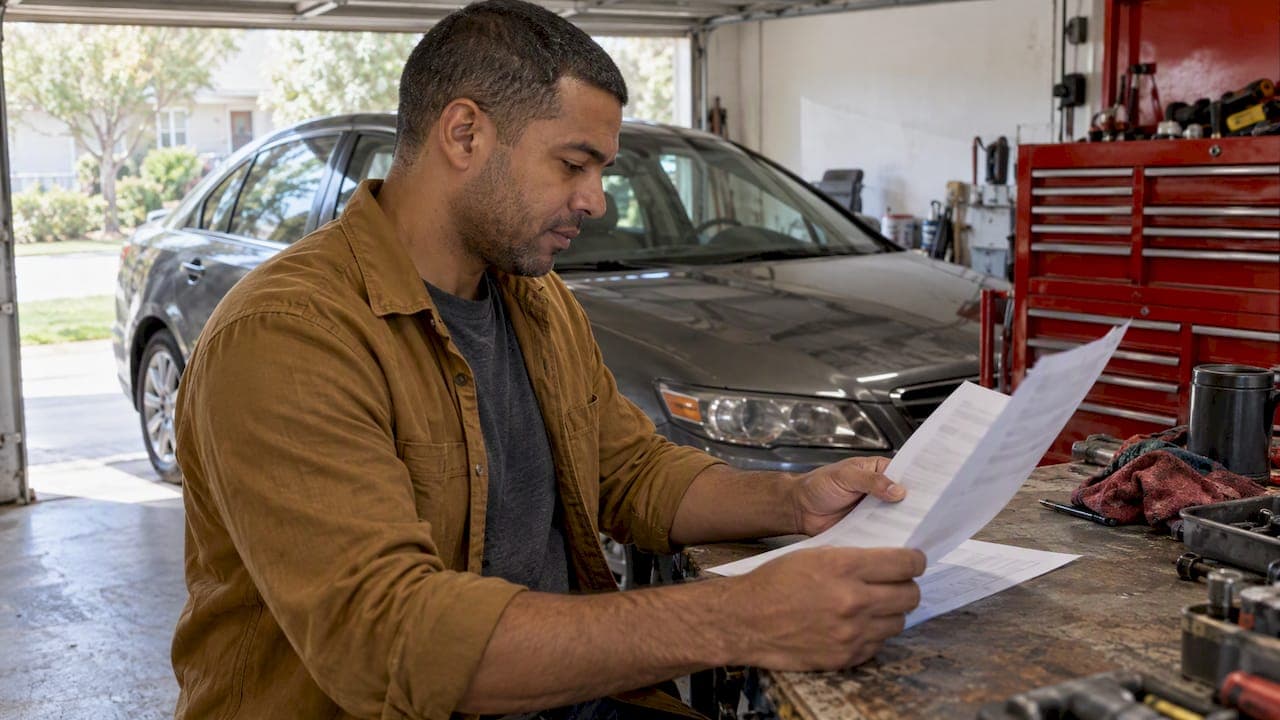
Financing a repair and buying an extended warranty solve two different problems. Financing lets you borrow money to pay a bill that already exists, and you repay it with interest. An extended warranty (technically a vehicle service contract) is bought before anything breaks, and it pays for covered repairs later. If your car is already broken, financing is usually your only option for that repair. If your car is running well and you want to avoid a future surprise, a warranty is the tool built for it.
The rest of this guide shows how each one works, what to compare in dollars, and how to decide, with a close look at the higher-end vehicles where repair bills hurt most.
TL;DR
- Financing pays for a repair you already need. You borrow, you repay with interest and fees, and you carry the full cost of the repair.
- A warranty pays for covered repairs you have not had yet. You pay for the protection up front or in installments, and covered failures are handled under the contract terms, usually with a deductible.
- They are not either/or. A warranty does not help with a breakdown that happened before you bought it, and financing does nothing to lower the cost of a future breakdown.
- Luxury and high-tech vehicles tilt the math toward protection, because one electronic or suspension failure can cost more than many drivers keep in savings.
- Read the contract before you sign anything. Check what is covered, what is excluded, the deductible, and who stands behind the coverage.
Table of Contents
- What each option actually is
- Side-by-side comparison
- What each one really costs
- Why higher-end vehicles change the math
- When financing makes sense
- When a warranty makes sense
- What to check before you sign either one
- Perspective: how we think about it
- Get a quote for your own car
- A practical decision path
- FAQ
- Sources
What each option actually is
Auto repair financing
Auto repair financing is borrowing to pay for a repair: a personal loan, a credit card, a shop's payment plan, or in the worst case a title loan. Credit Karma's overview describes it as a way to borrow money for repairs, often needed for wear and tear that insurance and warranties typically do not cover. Interest rates, fees and repayment terms vary by lender, which is why comparing them before you agree matters.
Shops differ in what they offer. Kelley Blue Book notes that dealerships and larger repair shops may offer payment plans, that smaller independent shops often do not, and that the interest rate on a shop plan can run higher than a low-interest credit card. So the first question at the service desk is not "Can I pay over time?" but "What is the rate, and what are the fees?"
An extended warranty
A manufacturer's warranty comes with the vehicle. The Consumer Financial Protection Bureau explains that extended warranties are optional add-ons covering defects or failures that the manufacturer's warranty does not. The Federal Trade Commission adds a technical point: because you buy it separately, an auto service contract is not a warranty under federal law. In everyday speech, though, everyone says "extended warranty," and so do we.
The contract covers the repairs it specifies. The FTC notes that these contracts typically do not cover accident damage or normal wear and tear, and that some require pre-approval before a repair starts. Some also include extras such as towing or rental car costs.
The one-line difference
Financing spreads out a cost you cannot avoid. A warranty tries to remove a cost you might face. That is why the comparison people search for is a little lopsided: they are not substitutes at the moment of breakdown, only before it.
Side-by-side comparison
| Question | Repair financing | Extended warranty |
|---|---|---|
| When do you use it? | After a repair is quoted | Before a failure happens |
| What do you pay for? | The full repair plus interest and fees | Coverage, plus a deductible per covered claim |
| Does it reduce the repair bill? | No, it only spreads it out | Yes, for covered failures |
| Does it cover a pre-existing problem? | Yes, you can borrow for anything | No, contracts cover what they list, going forward |
| What is the risk? | Debt on a car that may need more repairs | Paying for coverage you never use, or buying a contract with gaps |
| Credit check? | Usually, for loans and cards | Depends on how you pay |
| Best for | An emergency you must fix now | Planned protection on a car you intend to keep |
What each one really costs
Financing: the repair, plus the price of time
With financing, your total cost is the repair bill plus every dollar of interest and fees. A short-term 0% promotional card offer that you clear on schedule can make it cheap. A long payment plan at a high rate can add a meaningful percentage to a bill you already did not want. Capital One's guidance on repair loans makes one more point worth remembering: check whether the vehicle is still under any warranty first, because financing a repair that a policy would have covered is a costly oversight.
Warranty: premium, deductible, and exclusions
The FTC says auto service contract prices range from several hundred dollars to several thousand dollars. The California Department of Insurance explains that the price depends mainly on vehicle type, mileage at purchase, the repairs covered or excluded, and the length of the agreement. In practice that means a 90,000-mile luxury SUV will be priced differently from a 40,000-mile compact sedan, and a broad plan costs more than a narrow one.
Investopedia frames the decision as one of risk tolerance, noting it comes down to your comfort with uncertainty and your ability to absorb a premium on the order of $1,000 per year against the chance of a big bill. That is a fair way to see it: a warranty is a cost you choose in order to cap a cost you cannot predict.
Our plans carry no published prices on our site, because the price depends on your vehicle's year, make, model and mileage and on the coverage level you pick. The honest way to get a number is a quote for your exact car.
A simple worked comparison
These figures are illustrative, not a quote from anyone. Say a repair estimate comes to $3,200 and you finance it over 24 months at 18% APR. You would pay roughly $3,200 plus about $600 in interest, so close to $3,800 in total. Now imagine the same car had a plan with a $100 deductible that covered that failure. You would have paid the deductible and the plan's price, and the plan's price would have been spread across years of ownership, not one bill.

The catch is that the warranty only wins if the failure was actually covered and you bought the plan before it happened. If you buy a plan and the car never has a covered failure, you paid for peace of mind and nothing else. If you finance and the car has a failure, you pay everything. Neither is automatically cheaper. The question is how likely, and how expensive, your car's failures are.
Why higher-end vehicles change the math
The more complex the car, the wider the gap between a cheap repair and an expensive one. Luxury vehicles carry more electronics, more sensors, adaptive suspensions, turbocharged engines, and parts priced at brand premiums. Labor at specialist shops tends to cost more too. Below we go through makes our customers ask about and the systems worth discussing with a provider before you buy. We are not saying these systems fail more often than others; we are saying that when one does, the bill can be large, and that is exactly the situation a service contract is meant for.
Land Rover and Range Rover
Range Rover models are known for feature-rich cabins, adaptive air suspension that adjusts ride height, and sophisticated terrain and drivetrain systems. Those are the kinds of parts you want to see named in a contract, since air suspension components, control modules and infotainment screens are often handled differently from basic mechanical parts. If you drive one past its factory coverage, ask specifically whether suspension and electronic modules are covered.
BMW
BMW's appeal is a driving experience built on turbocharged engines, advanced transmissions and plenty of electronics. Cooling-system components, sensors, and engine and transmission parts are the categories to review in any contract. A plan that lists only a handful of covered parts can leave out exactly what you were worried about, so look for broad language.
Mercedes-Benz
Mercedes-Benz vehicles often combine comfort-focused features such as adaptive or air-based suspension, advanced driver-assistance sensors and large digital displays. That makes electrical and high-tech coverage a priority. Check whether the contract treats the infotainment and driver-assistance electronics as covered components or as exclusions.
Porsche
Porsche owners buy performance: high-output engines, dual-clutch or sport-tuned transmissions, and cooling systems under heavy load. If you use the car hard or on track days, read the vehicle-use section of your contract closely, because commercial use, racing and some modifications are commonly excluded in service contracts. The CFPB lists vehicle use among the things to review before you commit.
Ford
Ford spans everything from daily commuters to heavy-duty trucks and EVs and hybrids. Because the lineup is so broad, the right plan depends on the model: a diesel or turbocharged truck used for towing has different exposure than a family crossover. Ask how towing and work use are treated, and whether hybrid or electric components are included if you drive one.
Honda
Honda has a reputation for durability, which is exactly why some owners wonder if a warranty is worth it. The reasoning is fair: with a reliable car, you may prefer a narrower plan, or a savings buffer. Where Honda owners still want protection is on higher-mileage vehicles, hybrids, and cars with newer infotainment and driver-assistance electronics, which can be costly to fix regardless of the badge.
Other brands
We also build coverage for less common and exotic makes. Our site has dedicated pages for Hummer, Volkswagen, Lotus, Bugatti and Smart owners, and the same questions apply to any of them: what systems are covered, what is excluded, and how repairs get approved.
When financing makes sense
Financing is the right tool in a few clear situations.
- The car is already broken and has no coverage. A warranty will not pay for a failure that predates the contract, so borrowing may be your only route.
- You can get a low or promotional rate. Compare lenders, since fees, rates and terms differ. Kelley Blue Book also suggests that if you cannot afford a repair, you compare shop estimates, negotiate, and weigh financing while checking interest rates.
- The repair is a wear item. Brakes, tires and similar parts wear out on schedule, and contracts typically do not cover normal wear. That is a maintenance cost, not a warranty matter.
- The car is nearing the end of its life. Putting new money into protection for a vehicle you plan to replace soon rarely pays.
Before you borrow, run through five questions:
- Is the repair covered by a manufacturer's warranty, an existing service contract, or a dealer goodwill program?
- What is the APR, and are there origination or late fees?
- What is the total you will repay, not just the monthly payment?
- Can you get a second estimate?
- Will the repair actually restore the car's value and reliability?
When a warranty makes sense
A warranty fits when the following are true.
- You intend to keep the car well past the factory coverage.
- A single repair would strain your budget. If a $4,000 repair would force you into high-interest debt, protection has real value.
- The car is complex or expensive to fix, as with the luxury vehicles above.
- You value a predictable cost more than the chance of coming out slightly ahead without coverage.
The CFPB's advice here is practical: before buying, compare the extended warranty with the manufacturer's warranty you still have so you do not pay for overlapping protection. If your factory warranty still has time left, the best moment to shop is usually before it ends, so you are not left unprotected.
What to check before you sign either one
In a warranty contract
- Covered and excluded parts. The California Department of Insurance describes exclusionary contracts as covering all mechanical parts except those specifically listed as excluded, which is broader than plans that only name covered parts.
- Deductible. Is it charged per visit or per repair?
- Claim process. Does the contract need pre-approval, and who authorizes repairs?
- Where you can get repairs done. Can you choose a licensed shop, and are mechanics certified?
- Cancellation. Know the refund terms. The CFPB notes that if you buy an optional product like an extended warranty with an auto loan, you generally have the right to cancel during the loan term.
- The company behind it. The FTC reminds consumers that a contract is only as good as the company that backs it, so check its reputation.
One more point if you are buying a car: the CFPB is clear that you cannot be required to buy an extended warranty in order to get an auto loan. You can shop for the coverage separately and compare.
In a financing agreement
- The APR and whether it is fixed or promotional.
- Origination fees, late fees and prepayment penalties.
- The total repayment amount over the full term.
- Whether the lender pays the shop directly.
Perspective: how we think about it
We hear this question constantly, and our honest answer starts with timing. If your car is broken today, a warranty is not the answer to that bill. Compare estimates, ask about the rate, and borrow as cheaply as you can.
But the same owners often come back with a second question: "How do I keep this from happening again?" That is where we come in. We built our plans, Elite, Advanced and Essential, so a driver can match coverage to a vehicle and a budget instead of buying more than they need. Our process is four steps: a consultation, plan selection, customization, and a final agreement. You see the terms before you commit.

We pay particular attention to the cars that cost the most to repair. Engines, transmissions, cooling and electrical systems, steering and suspension, hybrid systems and high-tech electronics are the categories we talk through with owners of BMW, Mercedes-Benz, Range Rover, Porsche, Ford and Honda vehicles. Our network includes ASE-certified mechanics nationwide, and we aim for claim approvals in 24 to 48 hours. Our plans also offer roadside assistance and rental reimbursement, because a breakdown costs you more than the repair itself.
Our view: use financing for the repair you cannot avoid, and use protection for the repair you can plan for. If you can comfortably cover a $4,000 repair from savings, you may not need a plan. If you cannot, a plan is cheaper than the credit you would otherwise lean on.
— Kenneth
Get a quote for your own car
The fastest way to compare is with a real number for your own vehicle. You can see our Elite, Advanced and Essential plans, request a free quote by year, make and model, and compare coverage side by side. Riding a motorcycle instead? Our Full Throttle motorcycle plan is built for bikes. If you want answers first, our FAQ page covers the common questions about how plans work.
A practical decision path
- Is the problem here now? If yes, check for any factory warranty or existing contract, then compare shop estimates and financing rates.
- If not, how long will you keep the car? Under two years, protection rarely pays. Five or more years, it deserves a quote.
- Could you absorb a surprise repair? Pick a number you could pay without debt. If a likely repair exceeds it, protection starts to make sense.
- How complex is the car? Air suspension, turbocharged engines and screens full of electronics raise exposure.
- Read the contract. Coverage language beats marketing every time.
You can also combine the two. Some owners buy a plan and keep an emergency fund for the deductible, for non-covered wear items, and for maintenance, which no warranty replaces.
FAQ
Are a warranty and maintenance the same thing?
No. A warranty generally covers defects or failures, while maintenance covers regular upkeep such as oil changes and brake service. The CFPB makes the same distinction: warranties address defects, while prepaid maintenance plans cover regular service. Plan to budget for maintenance separately.
Can I finance a repair that a warranty would cover?
You can, but you should not before checking. Confirm whether any factory warranty or service contract covers the failure, because paying with a loan for a covered repair is an avoidable cost. Call the provider first and ask about pre-approval requirements.
Can a warranty cover a problem my car already has?
Generally no. Service contracts cover failures that occur after the contract starts, under the terms listed in the contract. If the car is already broken, your options are paying cash, using a card, or financing the repair.
Can a lender make me buy an extended warranty with my car loan?
No. The CFPB states that you cannot be required to purchase an extended warranty to obtain an auto loan. You can decline it, or buy coverage elsewhere.
Sources
- CFPB: differences between a manufacturer's warranty and an extended warranty or service contract
- CFPB: whether you must buy an extended warranty to get an auto loan
- FTC: auto warranties and auto service contracts
- California Department of Insurance: guide to automobile service contracts
- Kelley Blue Book: auto repair pricing and cost estimates
- Credit Karma: auto repair financing options
- Capital One: understanding auto repair loans
- Investopedia: extended warranty with an auto loan