

TL;DR:
- BMW protection plans vary from OEM coverage like BMW Platinum and Powertrain to third-party Vehicle Service Contracts for broader repair networks. Choosing the right plan depends on service preferences, ownership duration, and budget, with OEM plans offering dealer repairs and third-party options providing more flexibility. Careful review of coverage exclusions and timing is essential to maximize value and avoid denied claims.
A BMW protection plan is an extended vehicle service contract that either continues BMW-backed coverage through programs like BMW Platinum Coverage or BMW Ultimate Care+, or delivers comparable protection through a third-party vehicle service contract (VSC). The short version: if you want repairs done at an authorized BMW dealer using OEM parts, go OEM. If price flexibility, plan customization, or a wider repair network matters more, a reputable third-party VSC is worth a serious look.
Your top options at a glance:
-
BMW Platinum Coverage — the broadest OEM tier, covering most mechanical and electrical components beyond the powertrain
-
BMW Powertrain Coverage / Powertrain Plus — entry-level OEM protection focused on engine, transmission, and drivetrain
-
BMW Ultimate Care / Ultimate Care+ — BMW's prepaid maintenance program, not a repair warranty; covers scheduled services
-
BMW GAP, Tire & Wheel, and Lease-end Excess Wear — add-ons sold at signing, each with a specific use case
-
Rpmwarranty (Elite, Advanced, Essential) — a direct-to-consumer third-party VSC with tiered coverage, nationwide service, and a fast online quote process
-
When to wait: if your factory warranty still has more than a year left, the CFPB recommends comparing offers and considering a dedicated savings account as an alternative before committing
Table of Contents
- What are BMW's main protection plan options?
- What does each BMW protection plan actually cover?
- What add-ons are commonly sold with BMW protection plans?
- What are the eligibility rules, term limits, and transfer options?
- How much does a BMW protection plan cost, and is it worth it?
- BMW OEM plans vs. third-party VSCs: which one fits your situation?
- How do you buy a BMW protection plan and file a claim?
- Key Takeaways
- The case for reading the fine print before you sign anything
- Rpmwarranty covers what BMW's factory warranty leaves behind
- Useful sources
What are BMW's main protection plan options?
BMW's official protection program organizes its OEM products into distinct tiers, each targeting a different coverage need. Understanding the difference before you walk into a finance office saves you from paying for overlap or buying the wrong tier entirely.
BMW Platinum Coverage (BMW Extended Coverage) This is the top-tier OEM plan, sometimes called a "bumper-to-bumper" extension. It covers most mechanical, electrical, and electronic components beyond the powertrain. Think iDrive modules, sensors, fuel system components, and climate control systems. It's the closest thing to extending your original factory warranty.
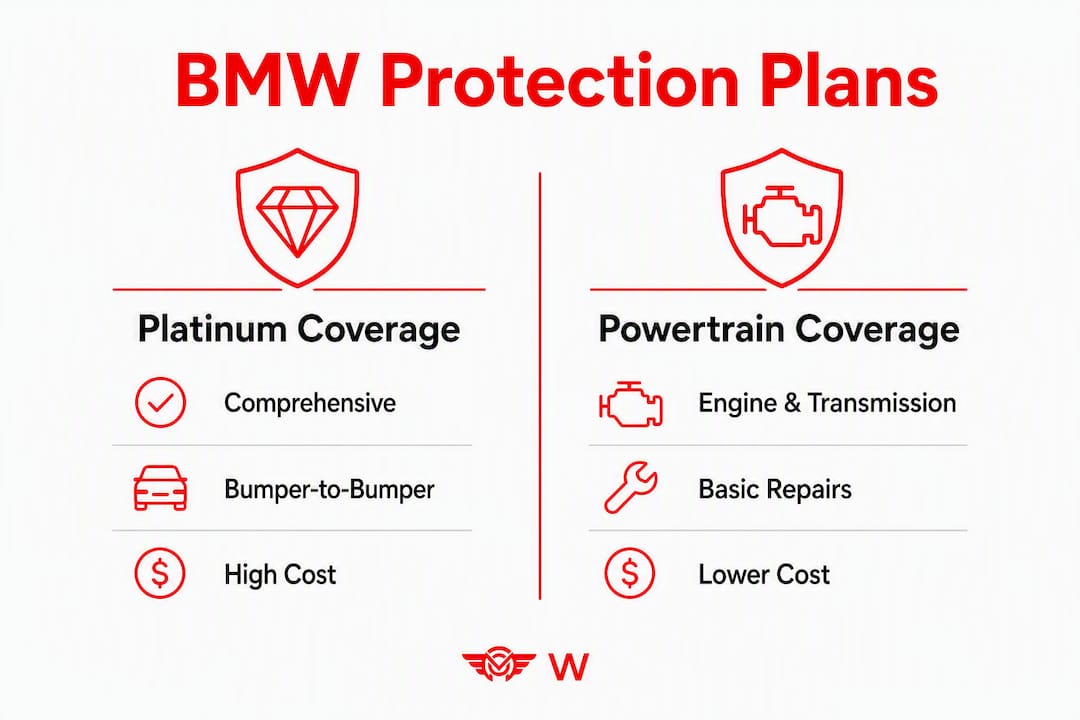
BMW Powertrain Coverage / Powertrain Plus The entry-level OEM repair plan. Standard Powertrain Coverage focuses on the engine, transmission, and drivetrain. The "Plus" version adds a layer of coverage for additional components like the cooling system and steering. If you're on a budget and primarily worried about catastrophic mechanical failure, this is the floor.

BMW Ultimate Care / Ultimate Care+ These are prepaid maintenance programs, not repair warranties. Ultimate Care covers scheduled services (oil changes, filters, brake fluid) for a set term. Ultimate Care+ extends that to include additional wear items like brake pads and wiper blades. Buyers sometimes confuse these with extended warranties. They are not. They won't cover a failed water pump or a cracked expansion tank.
Where GAP, CPO, and Lease-end coverage fit:
- BMW GAP (Guaranteed Auto Protection): Covers the gap between your vehicle's actual cash value and your remaining loan or lease balance if the car is totaled or stolen. Sold at the dealer finance office, typically at signing.
- BMW Certified Pre-Owned (CPO) warranty: CPO vehicles come with a remaining factory warranty plus a two-year/unlimited-mile CPO extension. If you're buying CPO, check whether you still have factory coverage before purchasing additional protection.
- Lease-end Excess Wear Coverage: Protects against end-of-lease charges for dings, interior damage, and tire wear beyond normal use. Relevant only for lessees.
BMW Financial Services and authorized BMW dealers handle enrollment for all OEM plans. You generally cannot buy them directly online without going through a dealer.
What does each BMW protection plan actually cover?
Coverage details are where most buyers get surprised, usually after a claim is denied. The table below maps the main dimensions across OEM tiers and a typical third-party VSC.

| Coverage Dimension | BMW Platinum Coverage | BMW Powertrain / Plus | Third-Party VSC (e.g., Rpmwarranty Elite) |
|---|---|---|---|
| Powertrain components | Yes | Yes | Yes |
| Electrical & modules (iDrive, sensors) | Yes | Limited (Plus only) | Varies by tier; confirm module list |
| Cooling system | Yes | Plus tier only | Yes (Elite/Advanced) |
| Steering & suspension | Yes | No | Yes (Elite) |
| Maintenance items | No | No | No |
| Wear & tear (brakes, tires, belts) | No | No | No |
| Pre-existing conditions | No | No | No |
| Who backs the contract | BMW Extended Service Corporation | BMW Extended Service Corporation | Third-party administrator/insurer |
| Repair facility | Authorized BMW dealer | Authorized BMW dealer | ASE-certified shops nationwide |
Common exclusions that catch BMW owners off guard:
- Fluids labeled "lifetime" by BMW (transmission fluid, differential fluid) are not covered as maintenance items. Independent specialists recommend servicing these between 40,000 and 75,000 miles, and a claim tied to neglected fluid service can be denied as maintenance neglect.
- Routine maintenance: oil changes, filters, spark plugs, and brake fluid are never covered under repair plans.
- Pre-existing conditions: any failure present before the plan's effective date is excluded. A pre-purchase inspection protects you here.
- Cosmetic damage: paint, trim, and upholstery are not covered under mechanical protection plans.
Pro Tip: On modern BMWs, confirm that your plan explicitly covers the electric water pump, the VANOS solenoids, the high-pressure fuel pump, and iDrive control modules by name or by component category. These are among the most common post-warranty failures on N20, N52, and N55 engines, and some plans exclude them under vague "electronic accessories" language. Ask the dealer or administrator to show you the component list in writing.
What add-ons are commonly sold with BMW protection plans?
Dealers bundle several add-on products alongside the core protection plan, usually during the finance and insurance (F&I) office visit. Each has a legitimate use case, but none are automatic must-buys.
- Windshield Repair / Glass Protection: — Covers chip and crack repair. Useful in regions with heavy road debris or gravel roads. Check whether your auto insurance already covers this before paying twice.
Most add-ons are sold at signing and cannot be added later. Read each contract separately. The pricing is often negotiable, and dealers sometimes bundle them at a discount to close the deal.
What are the eligibility rules, term limits, and transfer options?
Before you commit to any plan, the logistics matter as much as the coverage list.
Typical term and mileage windows:
- BMW Platinum Coverage can extend protection up to 7 years or 100,000 miles from the original in-service date, depending on the plan purchased and vehicle eligibility.
- BMW Powertrain Coverage typically offers shorter terms, often up to 5 years or 60,000 miles.
- Third-party VSCs from providers like Rpmwarranty can be structured around your vehicle's current age and mileage, giving more flexibility for used BMW buyers who missed the OEM enrollment window.
Eligibility checklist before you buy:
- OEM plans generally require enrollment while the factory warranty is still active. AAA notes that buying while under factory warranty usually gets the best rates and avoids a waiting period.
- Vehicle age and mileage caps apply. BMW OEM plans typically require the vehicle to be within a certain mileage threshold at enrollment.
- CPO vehicles already carry a warranty extension. Buying additional OEM coverage on top of a CPO plan creates overlap you're paying for twice.
- Pre-existing conditions are excluded universally. A mechanical inspection before purchase documents the vehicle's condition and protects your claim eligibility.
Transferability:
OEM BMW plans are generally transferable to a subsequent owner, which can increase resale value. Third-party VSCs vary. Rpmwarranty plans include transferability, which is a real selling point if you plan to sell before the coverage expires. Always confirm transfer fees and the process in writing before signing.
How much does a BMW protection plan cost, and is it worth it?
Pricing for BMW extended coverage varies widely based on model, engine, mileage at enrollment, coverage tier, deductible choice, and plan length. Consumer reporting places comprehensive extended plans in a ballpark range of roughly $3,000 to $6,000+ for top-tier coverage, though entry-level powertrain plans cost considerably less.
Key price factors:
- Vehicle model and engine: An M3 with an S58 engine costs more to cover than a 3 Series with an N20. Higher repair costs mean higher premiums.
- Current mileage: The closer you are to the factory warranty expiration, the lower the rate. Waiting until after the warranty expires typically raises the price and may trigger a waiting period.
- Coverage tier: Platinum-level coverage costs more than powertrain-only. The gap between tiers can be $1,000 or more.
- Deductible: A $200 deductible per visit costs less upfront than a $0 deductible plan, but you absorb more of each repair.
- Plan length: Longer terms cost more but spread the risk over more miles.
When a VSC is likely worth it: BMW engines like the N20 and N52 have documented histories of electric water pump failure ($900–$1,400) and timing chain guide wear ($1,800–$3,200). A single timing chain job can exceed the cost of a mid-tier extended plan. Long-term keepers planning to drive past 80,000 miles on these engines have a strong actuarial case for coverage.
When self-insuring may make more sense: If you own a newer BMW still under factory warranty with no known failure-prone components, or if you plan to sell within two to three years, the CFPB's guidance to set aside equivalent monthly savings in a dedicated account is worth taking seriously. NerdWallet similarly advises that VSC value rises most sharply for vehicles with a documented history of expensive electronic or mechanical faults.
BMW OEM plans vs. third-party VSCs: which one fits your situation?
Neither option is universally better. The right choice depends on where you get your car serviced, how long you plan to keep it, and how much contract flexibility matters to you.
OEM plan advantages:
- Repairs performed at authorized BMW dealers using OEM parts
- BMW Extended Service Corporation is the obligor, meaning BMW's own entity backs the contract
- Seamless integration with dealer service history
- No pre-authorization friction at a BMW service center
OEM plan limitations:
- You must use an authorized BMW dealer for covered repairs. If you prefer an independent shop or a trusted independent BMW specialist, OEM coverage won't apply there.
- Pricing is set by BMW Financial Services with limited negotiation room.
- Enrollment windows are narrow, typically tied to the factory warranty period.
Third-party VSC advantages:
- More pricing flexibility and plan customization
- Wider repair network, including ASE-certified independent shops
- Available for vehicles that have already exited the factory warranty window
- Transferable plans can add resale value
Third-party VSC limitations:
- The obligor is a third-party administrator or insurer, not BMW. Vet the company's financial stability and claims reputation before signing.
- Some plans use named-component contracts (only listed parts are covered) rather than exclusionary contracts (everything covered except what's listed). Named-component plans can leave gaps on complex BMW electronics.
Contract review checklist before signing anything:
- Who is the obligor? Is it the dealer, an administrator, or an insurer?
- Is this a named-component or exclusionary contract?
- Does the plan require pre-authorization before repairs begin?
- Is payment direct to the repair shop, or do you pay and seek reimbursement?
- What is the cancellation and refund policy?
- Are there caps on diagnostic labor or per-repair limits?
Pro Tip: Watch for contract language that separates "maintenance" from "repair." A plan that covers a failed water pump but excludes it if the coolant was never changed can deny your claim on maintenance-neglect grounds. Cooling system components on BMWs, including plastic expansion tanks and electric pumps, are recommended for replacement as a package around 80,000–100,000 miles. Staying current on that service protects both the car and your claim.
How do you buy a BMW protection plan and file a claim?
Buying: step by step
- Check eligibility while your factory warranty is still active. This is the single most important timing decision. Rates are lower, waiting periods are shorter, and OEM enrollment is still open.
- Get quotes from both BMW Financial Services and at least one third-party VSC provider. Compare coverage breadth, not just price. A $500 cheaper plan that excludes iDrive modules or the cooling system may cost you more in the first claim.
- Read the obligor section. This tells you who is legally responsible for paying claims. For OEM plans, that's BMW Extended Service Corporation. For third-party plans, confirm the administrator's financial backing.
- Confirm the deductible structure and claim process. Know whether the shop gets paid directly or whether you pay and get reimbursed.
- Enroll with written confirmation. Get the contract number, effective date, and a copy of the full terms. Do not rely on a verbal summary from the F&I office.
Claims flow:
When a covered component fails, the process typically runs: diagnostic at the repair facility → pre-authorization call or portal submission → repair estimate reviewed → repair performed → billing settled directly with the shop or reimbursed to you. The friction point most owners hit is the pre-authorization step. Some administrators require approval before any teardown begins. Skipping that step can void the claim.
Pro Tip: Keep a complete service record from day one. Stamped dealer receipts, independent shop invoices, and oil change records all matter. If a claim is disputed on maintenance-neglect grounds, documented service history is your strongest defense. It also supports a clean cancellation refund if you sell the car before the plan expires.
Key Takeaways
BMW protection plans offer the most value when matched to your ownership timeline, the specific failure risks of your BMW's engine and electronics, and your preferred repair network.
| Point | Details |
|---|---|
| OEM vs. third-party fit | Choose OEM if dealer repairs and BMW parts matter; choose a third-party VSC for price flexibility or a wider shop network. |
| Enrollment timing | Buy while the factory warranty is active to get the best rates and avoid waiting periods. |
| Module coverage check | Confirm electric water pump, VANOS, fuel pump, and iDrive modules are explicitly covered before signing. |
| Maintenance neglect risk | Keep fluid service records current; claims tied to neglected transmission or coolant service are routinely denied. |
| Rpmwarranty option | Rpmwarranty's Elite, Advanced, and Essential tiers cover engines, transmissions, electronics, and cooling with nationwide ASE-certified service and transferable plans. |
The case for reading the fine print before you sign anything
Most buyers focus on the monthly cost and the coverage tier name. The contract language is where the real decision lives.
BMW's OEM plans carry a genuine advantage that's easy to undervalue: the obligor is BMW's own service entity, not a third-party administrator whose financial stability you have to research. That matters if you ever need to dispute a claim. The repair experience at an authorized dealer is also more predictable, especially for complex electronics diagnostics on models like the 5 Series or 7 Series, where a single iDrive or chassis module replacement can run over $2,000.
That said, the OEM plan's biggest limitation is the repair network restriction. If you live somewhere without a convenient BMW dealer, or if you have a trusted independent BMW specialist who charges half the dealer labor rate, OEM coverage locks you out of that relationship for covered repairs. Third-party VSCs that allow ASE-certified independent shops solve that problem directly.
The overlooked issue in most buying conversations is the maintenance-neglect exclusion. BMW's "lifetime" fluid labeling has led a lot of owners to skip transmission and differential service entirely. When those components fail at 90,000 miles, the VSC administrator pulls the service history, finds no fluid changes, and denies the claim. The plan didn't fail. The maintenance record did.
The smartest move is to treat the extended warranty decision the same way you'd treat any insurance purchase: price it, read the exclusions, and match it to your actual risk profile. A long-term keeper with an N20 engine and a history of expensive cooling and fuel system repairs has a very different calculus than someone leasing a 3 Series for three years.
Rpmwarranty covers what BMW's factory warranty leaves behind
When the factory warranty ends, the repair bills on a BMW can move fast. A timing chain job, a failed high-pressure fuel pump, or a cracked expansion tank can each run well past $1,000 before labor. Rpmwarranty's three-tier plan structure, Elite, Advanced, and Essential, is built to cover exactly these scenarios, with protection for engines, transmissions, cooling systems, electrical systems, and high-tech electronics.
Every Rpmwarranty plan includes roadside assistance, rental reimbursement, and nationwide service through ASE-certified mechanics, so you're not locked into a single dealer network. Plans are transferable, which adds real resale value if you sell before coverage expires. The enrollment process takes minutes: get a quote online by vehicle year, make, and model, pick your tier, and you're covered.
Get a free quote and see which plan fits your BMW, or compare all three tiers side by side before you decide.
Useful sources
These are the primary references used throughout this article. Each covers a distinct aspect of BMW protection and extended warranty decisions.
- What is the difference between a manufacturer's warranty and an extended vehicle warranty? (CFPB) — Consumer finance guidance on shopping, comparing, and self-insuring
- What is an extended warranty? (NerdWallet) — Analysis of when VSCs deliver value and how to verify module-level coverage
- What Is an Extended Car Warranty and Do You Need One? (AAA) — Structural differences between named-component and exclusionary contracts, plus buying timing guidance
- Auto Warranties and Auto Service Contracts (FTC Consumer Advice) — Federal guidance on the legal distinction between warranties and service contracts