
A car repair emergency fund is a separate pot of cash, usually $1,000 to $2,500, that pays for brakes, batteries and other predictable failures so a repair bill never lands on a credit card. It does its job well for ordinary repairs. The trouble comes with the big ones: a transmission, an air suspension system or an engine on a higher-end vehicle can cost more than the whole fund. That is why the strongest plan has two layers: a fund for routine and mid-sized repairs, and extended coverage for the failures that would drain it. Below is how to size the fund, build it, protect it, and what to do if you are starting with nothing.
TL;DR
- Aim for $1,000 to $2,500 in a dedicated car fund, and add $500 to $1,500 if the vehicle is past roughly 100,000 miles.
- A monthly budget of about $100 is a reasonable reference for repairs and maintenance on a typical car, and $50 a month is a workable start.
- Keep the car fund apart from your general emergency fund, and refill it to target after every repair.
- Large failures on luxury and late-model vehicles can exceed any realistic fund. An extended warranty plan keeps those bills from reaching your savings.
- With no savings, shrink the bill first, then look for help, and borrow only the reduced amount.
Table of Contents
- What a car repair emergency fund is for
- How much to save for car repairs
- A worked example
- Where to keep the money and how to build it
- Why a fund alone runs short on higher-end vehicles
- How an extended warranty protects the fund
- Promo: coverage built around your vehicle
- When the car needs a repair and you have no savings
- Protect your savings with maintenance and planning
- Perspective
- A simple plan you can start this month
- FAQ
- Sources
What a car repair emergency fund is for
Your general emergency fund covers job loss, medical bills and the rest of life. A car repair fund has a narrower job: it pays for the vehicle problems you know will come, even if you do not know when. Brakes wear out. Batteries die. Tires need replacing. None of that is a surprise in kind, only in timing.
The reason to treat it separately is practical. The Consumer Financial Protection Bureau explains in its emergency fund guide that people with little savings often turn to credit cards or loans after a shock, and that interest and fees can make a one-time bill grow significantly. A fund that exists before the tow truck arrives is the simplest way to avoid that.
The gap is real. A 2017 AAA survey found that 64 million American drivers could not pay for an unexpected vehicle repair without going into debt. AAA's advice then was to save at least $50 a month and to identify a trusted repair facility before you need one.
How much to save for car repairs
There is no single correct number, and the CFPB says as much: your target should reflect your own most common unexpected expenses and what they cost. Still, published guidance clusters in a useful range.
A starting range
Auto Approve, an auto lender, suggests most drivers aim for $1,000 to $2,500. Its logic is to use your collision deductible, commonly $500 or $1,000, as the floor, then add a buffer for the largest repair your particular model commonly needs. It adds $500 to $1,500 for vehicles past about 100,000 miles.
If $1,000 to $2,500 feels out of reach, start smaller. The CFPB notes that even small amounts help if you live paycheck to paycheck, and a first goal of a few hundred dollars covers a battery or a set of brake pads.
A monthly number
AAA's Your Driving Costs study found maintenance, repair and tires on a new car averaged 11.04 cents per mile. AAA's own budgeting article turns that into about $3.43 a day, or $103 a month, at the 31.1 miles the average U.S. driver covers daily. Treat $100 a month as a reference point for the whole maintenance-and-repair budget, and $50 as the minimum for the repair cushion alone.
A personal check beats any average: add up what you spent on the car last year and divide by 12.
What the typical bills look like
The repair figures below are national ranges from published guides. Your local labor rate and your vehicle will move them.
| Repair | Typical cost | Source |
|---|---|---|
| Battery | $75 to $200 plus labor (lasts 3 to 5 years) | AAA |
| Alternator | $500 to $1,000 | AAA |
| Timing belt service | $400 to $1,000 | AAA |
| Brakes | $250 to $600 per axle | Auto Approve |
| Tires | $500 to $1,200 | Auto Approve |
| Catalytic converter | $1,000 to $2,500 | Auto Approve |
| Automatic transmission replacement | $2,500 to $6,000 | AAA |
Read the table from the top and a pattern appears. The first five rows fit inside a $1,000 to $2,500 fund. The last two do not, at least not without a long saving period. That break point is where the fund stops being enough on its own.
A worked example
Say you drive a five-year-old crossover with 70,000 miles and a $500 collision deductible. Your floor is $500. The largest common repair on your list is an alternator at up to $1,000, so a target of $1,500 covers it with room for a battery or brakes. Saving $75 a month gets you there in 20 months. Saving $100 a month gets you there in 15.
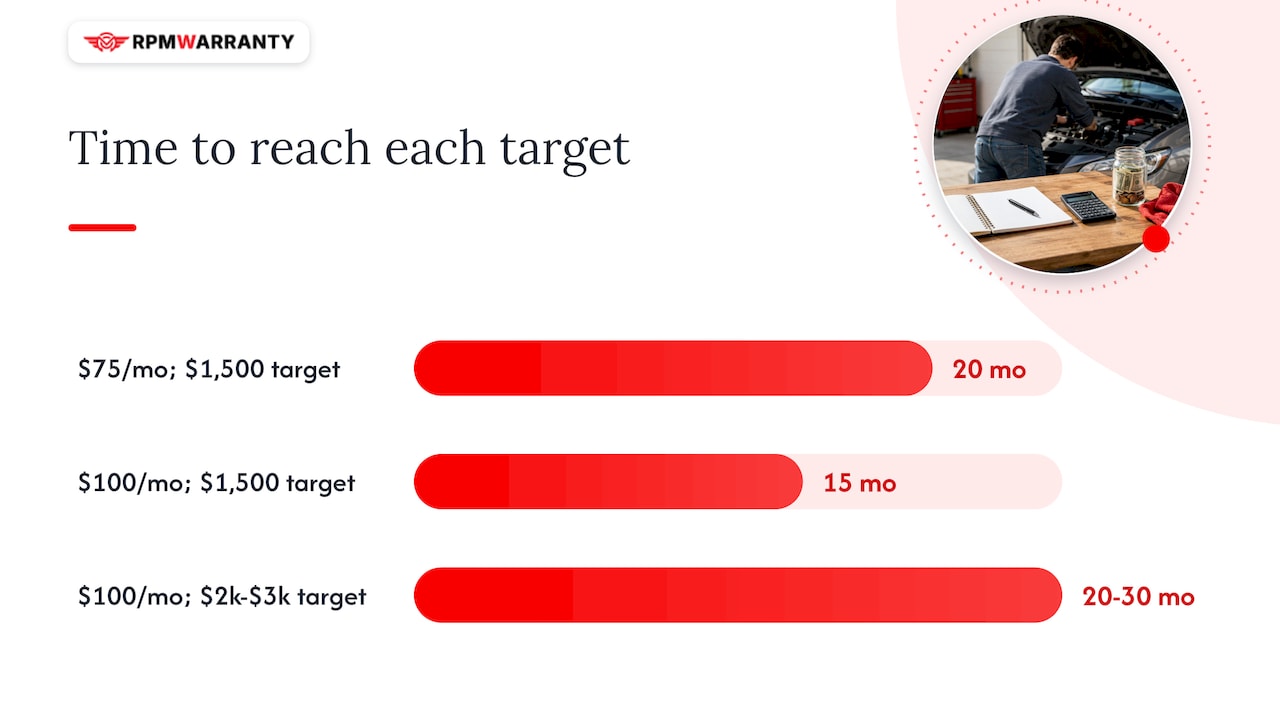
Now take a 2014 vehicle with 120,000 miles. Add the $500 to $1,500 buffer for age and your target becomes $2,000 to $3,000. At $100 a month, that is 20 to 30 months. This is the arithmetic that makes older and higher-mileage vehicles feel exposed during the years you are still saving.
Where to keep the money and how to build it
- Open a separate account and name it. A high-yield savings account labeled "Car Repairs" keeps the money out of everyday spending. MoneyFit's savings goal guide advises naming the goal, estimating the full cost including parts, labor, tax and transportation, and keeping it in its own account or labeled category.
- Automate the transfer. Schedule it for the day after payday. A monthly transfer of $25 to $50 is a realistic beginning, and you can raise it with each raise or when a car payment ends.
- Define what counts. Repairs and parts, yes. Gas, insurance, registration and car washes, no. Mixing them hides the real cost of keeping the car running.
- Refill after every withdrawal. Add a line to your budget until the balance is back at target. A fund that is spent once and never rebuilt gives you one emergency of protection, not a plan.
- Keep it apart from your main emergency fund. The general fund is for job loss and medical bills. Mixing the two makes it easy to spend emergency savings on something that is merely expensive.
Why a fund alone runs short on higher-end vehicles
Everything above assumes a repair that costs a few hundred to a couple of thousand dollars. Higher-end vehicles change the arithmetic, because more of the car is built from expensive, specialized parts. You do not need a list of horror stories to see this: look at what your own vehicle carries and ask what each system costs to replace.
- Range Rover and other luxury SUVs: air suspension, adaptive dampers, multi-zone climate control and large infotainment and driver-assistance electronics. These systems are part of what makes the vehicle comfortable, and they are also costly to replace.
- BMW and Mercedes-Benz: turbocharged engines, sophisticated automatic transmissions, adaptive suspension, and dense electronics and sensors. A single control module or sensor can carry a high-end price.
- Porsche: high-performance engines, dual-clutch or sophisticated automatic gearboxes and cooling systems built to handle serious heat. Parts and specialized labor are priced accordingly.
- Ford trucks and SUVs: turbocharged engines, multi-speed automatic transmissions, four-wheel-drive systems and towing hardware that work hard under load.
- Honda and Acura: reputable for longevity, yet at high mileage transmissions, air conditioning components, and electronics still wear, and they are still subject to the ranges in the table above.
Two habits help with any of these. First, look up your VIN on the National Highway Traffic Safety Administration's recall lookup, which LendUp points out as a way to check recall and warranty coverage before you pay for a repair. Second, ask an independent mechanic which components on your exact model and year are most expensive to replace, then compare that figure with your fund balance. If one part would take the whole balance, that is the exposure to cover.
How an extended warranty protects the fund
The fund and the warranty do different jobs. The fund handles the routine, predictable costs: batteries, brakes, tires and maintenance. A vehicle service plan is designed for the other end of the scale, the major component failures that arrive rarely but cost thousands. Together they mean that your savings are not the only thing standing between you and a $4,000 invoice.
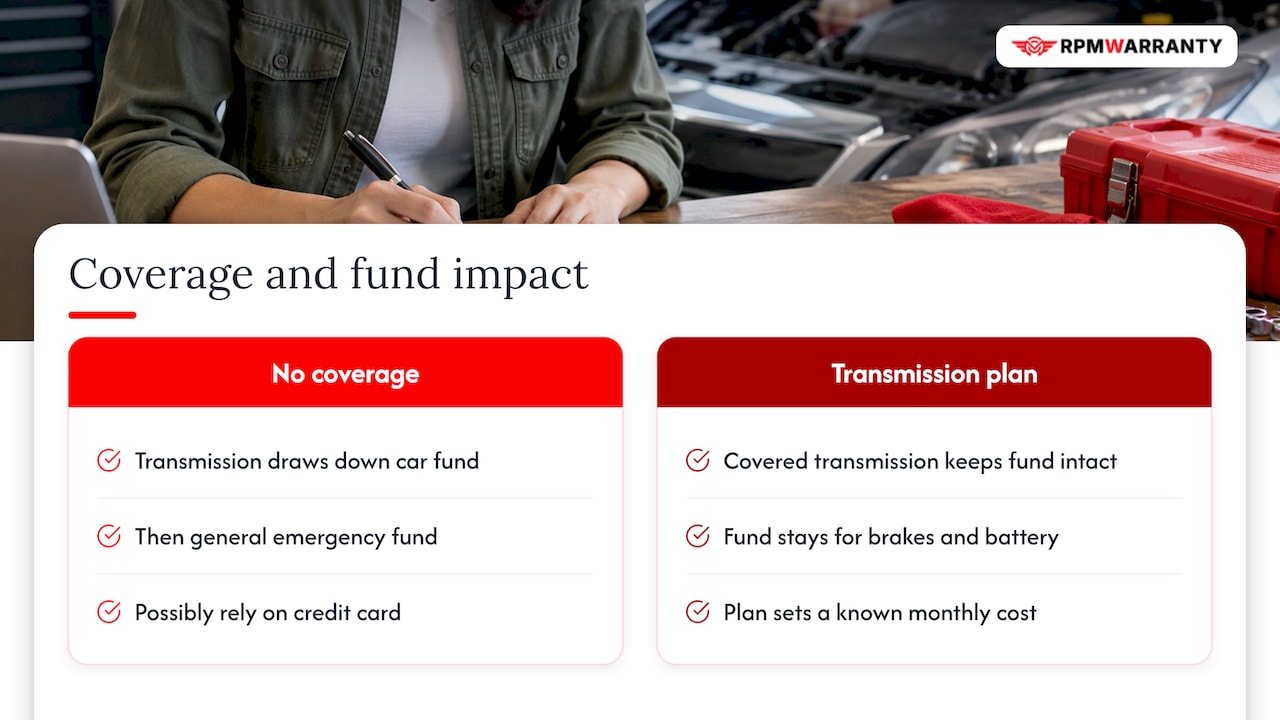
Here is how it looks in practice. Without coverage, a failed transmission on a vehicle that is out of its factory warranty draws down the car fund, then the general emergency fund, then possibly a credit card. With a plan that covers the transmission, the fund stays intact for the brakes and battery it was built for, and you are not choosing between a repair and your rent.
There is also a budgeting benefit. A warranty plan turns an unpredictable spike into a known monthly figure, and you can plan your fund contributions around it. You may find that you need a smaller fund target when the largest repairs on your list are covered, because the floor you are saving to cover is the deductible and the routine bills rather than the full cost of a gearbox.
Promo: coverage built around your vehicle
Our Elite, Advanced and Essential plans are designed so you can match coverage to your vehicle and your budget. Coverage areas include engines, transmissions, cooling systems, electrical systems, steering and suspension, and high-tech electronics, along with roadside assistance and rental reimbursement. Repairs are handled nationwide through ASE-certified mechanics.
Getting started takes four steps: a consultation, plan selection, customization and a final agreement. You can request a free quote based on your vehicle's year, make and model through our protection plans page, or look at our Full Throttle motorcycle plan if two wheels are what you need to protect. Our FAQ answers common questions about how plans work.
When the car needs a repair and you have no savings
Many readers arrive here with the bill already in hand. The order of operations matters, because every dollar you cut from the bill is a dollar you do not have to borrow.
Step 1: Shrink the bill
LendUp's guide to car repair emergencies suggests these moves before borrowing:
- Get a second written quote. The same source says differences of 20% to 40% between shops are common.
- Ask which work is needed to drive safely and which can wait.
- Ask about used or aftermarket parts. Original-equipment parts can cost two to three times more.
- Ask about a payment plan at the shop and get the terms in writing.
- Check whether a recall or a remaining warranty covers the problem, using the NHTSA's VIN lookup.
Step 2: Decide what truly cannot wait
USA Today's report on repairs mechanics say not to ignore offers a simple test from a mechanic: anything that affects steering, visibility or braking needs attention right away. That includes worn brake pads, a pulling steering wheel, bald tires, a brake warning light and a flashing check-engine light. Other problems can usually wait for a scheduled appointment, though waiting too long can make a small repair more expensive. If you have a safety issue, do not drive on it while you sort out money.
Ask the shop to split the job into the safety-critical part now and the rest later. That alone can bring an invoice into reach.
Step 3: Look for help before borrowing
CashPath's checklist, which draws on CFPB guidance, lists options to try before taking a loan: employer emergency assistance or paycheck advances, nonprofit or community organizations, small-dollar options at a bank or credit union, family or friends, and an arrangement with the biller. LendUp adds calling 211, the free community helpline, and asking a credit union about a payday alternative loan.
Step 4: If you borrow, borrow the reduced amount
Borrow the smallest sum that solves the problem, which is the figure after you have cut the bill, not the original quote. Interest changes the true cost quickly. Zable Loan's repair-loan page illustrates a $1,000 repair costing about $71 in interest over six months but about $201 over 18 months, at a 24% APR midpoint. It also warns that deferred-interest 0% offers can back-charge interest above 25% if any balance remains when the promotion ends. Read the terms and confirm the payoff date before you sign.
Then, once the emergency has passed, start the fund. Even $25 a month is a beginning.
Protect your savings with maintenance and planning
The cheapest repair is the one that never becomes a breakdown. Some habits that keep the fund intact:
- Follow the maintenance schedule for your exact model. Timing belt service, for example, runs $400 to $1,000 per AAA, and AAA notes that a failure can risk significant engine damage.
- Treat coolant leaks and slipping transmissions as prompt repairs. Repair Integrity's guide to what can wait notes that delay multiplies the bill on damage-prevention items, such as worn brake pads that go on to damage rotors, or a small cooling leak that leads to overheating and head gasket damage.
- Keep records. Service history helps you spot patterns and supports any plan claim.
- Find a good shop before you need one. AAA's advice is to identify a trusted repair facility in advance, so you are not choosing under pressure.
- Review your coverage when your factory warranty ends. That is the point at which the cost of a major failure shifts from the manufacturer to you.
AAA's Greg Brannon noted in 2017 that owning and operating a vehicle costs more than $8,500 a year and that many Americans do not set aside a car care fund. Budgeting for payments, insurance, fuel and maintenance together, rather than separately, is what keeps a repair from becoming a crisis.
Perspective
Most of the people who contact us have the same story. They built a little cushion, then a repair came along that was three or four times the size of it. The fund did not fail. It was simply sized for brakes and batteries, and the bill was for something else.
Our view is that a repair fund and a service plan are partners. Save for the routine and the mid-sized, and let coverage stand behind the big components: engine, transmission, cooling, electrical, steering and suspension, and the high-tech parts that make newer and higher-end vehicles so costly to repair. Our Elite, Advanced and Essential plans exist so you can pick the level that fits your vehicle and your budget.
We built our process to be simple: a consultation, plan selection, customization and a final agreement, with terms that are clearly outlined. Our claims process is designed for approvals in 24 to 48 hours, and our network of ASE-certified mechanics works nationwide, so you are not stuck in a waiting room wondering how the bill will get paid.
If you own a Range Rover, BMW, Mercedes-Benz, Porsche, Ford or Honda, we would encourage you to sit down with the repair costs of your own model and ask what happens to your savings if the most expensive system fails. Then get a free quote and see what it would take to take that risk off your fund.
Kenneth
A simple plan you can start this month
- Write down the three most likely repairs for your vehicle and what each costs locally.
- Set your target: your deductible plus the largest likely repair, plus $500 to $1,500 if the car has over 100,000 miles.
- Open the separate account and automate $50 to $100 a month.
- Request a quote for coverage on the repairs that would be larger than the fund.
- Set a calendar reminder every six months to check the balance against the target.
The point is not perfection. It is making sure the next repair is a line in your budget instead of a debt.
FAQ
How much should I keep in a car repair emergency fund?
A common range is $1,000 to $2,500, with the exact number set by your deductible and the largest repair your vehicle commonly needs. Add $500 to $1,500 once the car passes about 100,000 miles. If that is too much to start with, begin with a few hundred dollars and build from there.
Should the car fund be separate from my regular emergency fund?
Yes. Repairs are a recurring, known cost of owning a vehicle, while the general fund exists for job loss, medical bills and other surprises. Keeping them apart stops you from spending emergency savings on car costs, and it makes it clear how much the car really costs you each year.
What can I do about a car repair with no savings?
First reduce the bill with a second quote, a split between urgent and deferrable work, and a question about used or aftermarket parts. Then look for employer help, community programs or a credit union small-dollar loan, and borrow only the reduced amount. Once the car is running, start a small automatic transfer into a repair fund.
How does an extended warranty protect my savings from repairs?
A plan is designed to pay for covered major component failures, so a transmission or engine bill does not come out of your fund. Your savings then handle routine items and deductibles. You can request a free quote on our protection plans page to see which coverage level fits your vehicle.
Sources
- An essential guide to building an emergency fund, Consumer Financial Protection Bureau
- One-in-Three U.S. Drivers Cannot Pay for an Unexpected Car Repair Bill, AAA Newsroom
- How Much Should You Budget for Car Repairs?, AAA
- How to Build an Emergency Car Fund, Auto Approve
- How to Set Savings Goals, MoneyFit
- Build a Car Repair Emergency Fund, National Debt Relief
- Car Repair Emergency: What to Do Before You Borrow, LendUp
- Car repairs you shouldn't ignore, according to mechanics, USA Today
- Personal Loan for Emergency Expenses, CashPath
- Zable Loan for Car Repairs, Zable Loan
- Can I Delay Car Repairs? What Can Wait Safely, Repair Integrity