
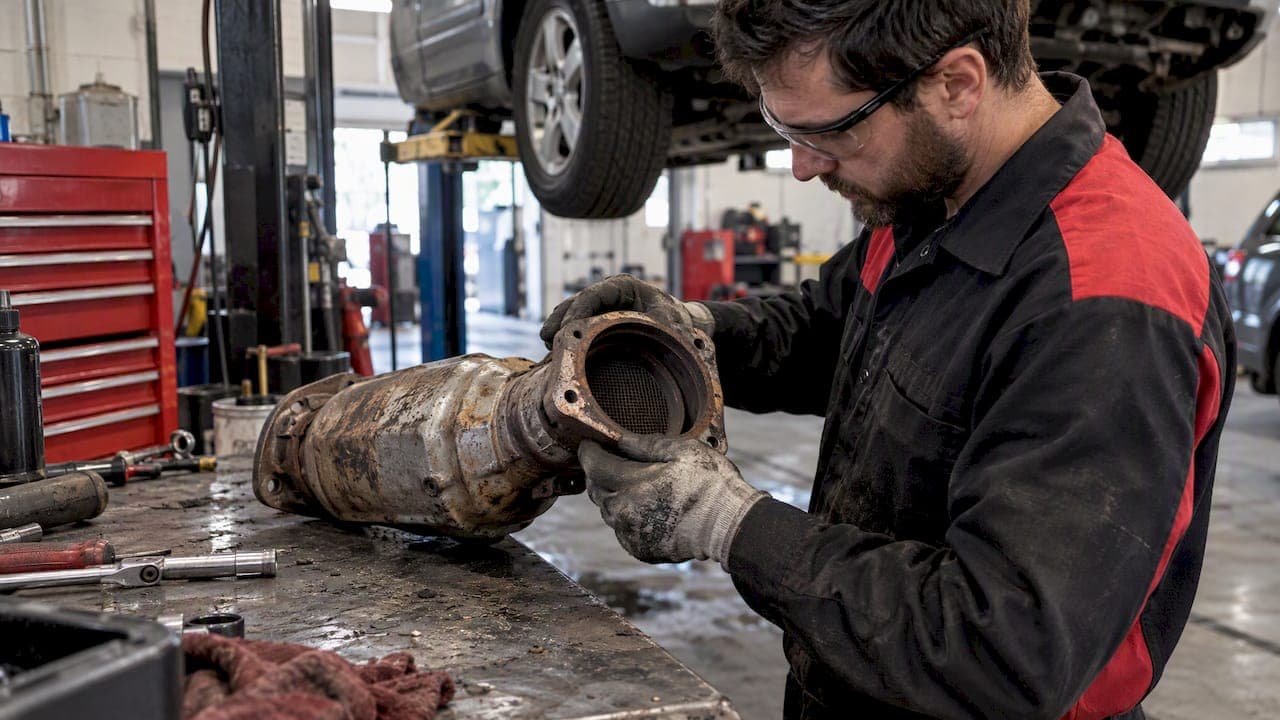
Most catalytic converter replacements run between $450 and $4,450 total, and the biggest swing factor is simple: which part you buy. An EPA-compliant aftermarket converter typically costs far less than an OEM dealer part, with parts alone making up 70 to 85% of the bill. Drivers in CARB states pay more, and you should check your emissions warranty before paying anything out of pocket.
TL;DR:
- Aftermarket catalytic converters typically cost between $450 and $1,850, with parts making up the majority of the total bill including labor costs.
- OEM dealer parts can reach $4,450, largely due to licensing, engineering, and markup, while universal weld-in units involve additional welding labor.
- Hybrids and larger vehicles like trucks or luxury models often have higher costs due to increased precious-metal content and larger or multiple converters.
- Proper diagnosis of underlying engine issues is crucial because problems like misfires or oil consumption can cause failure and lead to repeated converter replacements.
- Federal emissions warranties usually cover converter replacements within 8 years or 80,000 miles, and verifying coverage can save significantly on repair costs.
Table of Contents
- Typical Cost Ranges: Aftermarket, OEM, and Universal Options
- What Drives Cost: Precious Metals, Fit, and Emissions Rules
- Cost by Vehicle Class, From Economy Cars to Luxury SUVs
- Why Diagnosis Matters Before You Replace Anything
- Check Your Emissions Warranty Before You Pay
- How to Lower the Bill Without Cutting Corners
- Temporary Fixes and the Risks of Cutting Costs
- Weighing Repair Risk Against Extended Coverage
- Compare Your Repair Quote to a Free Protection Plan Quote
- FAQ
- Sources
Typical Cost Ranges: Aftermarket, OEM, and Universal Options
The part you choose sets the whole budget. Aftermarket EPA-compliant converters typically total $450 to $1,850, with the part itself running $300 to $1,400 and labor adding $150 to $450. OEM dealer parts push the total to $1,650 to $4,450, with the part alone often costing $1,500 to $4,000. That gap comes down to licensing, exact-fit engineering, and dealer markup, not necessarily better performance.

Universal (weld-in) converters often have lower part costs but require cutting and welding into the existing exhaust system, which increases labor and possible fabrication expenses.
A quick way to size up a quote:
- Aftermarket direct-fit: $450 to $1,850 total, parts $300 to $1,400, labor $150 to $450
- OEM dealer part: $1,650 to $4,450 total, parts $1,500 to $4,000
- Universal weld-in: lower part cost, but extra labor for welding and fitting
What Drives Cost: Precious Metals, Fit, and Emissions Rules
Catalytic converters rely on platinum, palladium, and rhodium to convert exhaust gases, and the price of these metals is the core reason converters are expensive. Hybrids like the Toyota Prius often need converters with heavier precious-metal loading because the engine cycles on and off, keeping exhaust temperatures lower and requiring more catalyst material to do the same job. That also makes hybrids a frequent theft target.
A converter that's a precise, direct-fit replacement for your exact engine and trim costs more than a universal unit, but it typically saves labor hours because it bolts in without cutting or welding.
Other cost drivers worth knowing:
- Labor typically runs 1 to 3 hours depending on access and whether welding is needed
- Dealer labor rates tend to run higher than independent shop rates for the same job
- California and other CARB states require certified parts, which cost more than federally compliant ones
Cost by Vehicle Class, From Economy Cars to Luxury SUVs
Your vehicle class gives you a realistic starting point before you even call a shop. A Honda Civic or Toyota Corolla, both common economy compacts, typically falls on the lower end of aftermarket pricing, while a Toyota Camry runs similar numbers with slightly larger exhaust components. A Toyota Prius costs more because of its higher precious-metal catalyst loading. A Ford F-150 with a larger V6 or V8 engine often needs a bigger converter and more labor time, pushing costs up from compact-car levels.
Luxury vehicles like a BMW or Mercedes-Benz often carry dual exhaust systems with two or more converters, which can roughly double the total bill since each bank needs its own unit. A Range Rover or Porsche, with complex exhaust routing and OEM parts priced at a premium, tends to land at the higher end of the OEM range, sometimes exceeding it.
- Economy and midsize sedans: generally the lowest aftermarket and OEM totals
- Hybrids: higher part cost due to precious-metal content
- Trucks and SUVs: larger converters, more labor
- Luxury and dual-exhaust vehicles: multiply cost per converter needed
Why Diagnosis Matters Before You Replace Anything
A failed catalytic converter is often a symptom, not the root problem. Common underlying causes include:
- Engine misfires that send unburned fuel into the converter
- A rich-running engine from a faulty sensor or fuel system issue
- Oil consumption that coats and clogs the catalyst
- A failed oxygen sensor feeding bad data to the engine computer
Replacing the converter without fixing these issues often means the new part fails again within months, according to Walker Exhaust's technical guidance on common converter failures. Expect diagnostic work to add to your bill: oxygen sensors typically cost $80 to $250 each, and upstream diagnostic labor runs another $100 to $200.
Pro Tip: Ask your shop to confirm the misfire count and fuel trims before you approve a converter replacement; it's the fastest way to catch a repeat failure before it happens.

Check Your Emissions Warranty Before You Pay
Many drivers pay out of pocket for a repair that should have been free. Federal rules require manufacturers to cover emissions-control defects, including catalytic converters, under an emissions warranty that commonly runs 8 years or 80,000 miles. If your vehicle falls within that window, you generally shouldn't be charged for the part.
Before authorizing payment:
- Check your vehicle's build date and mileage against the emissions-warranty window
- Ask the dealer directly whether the failure is covered as an emissions defect
- Save your diagnostic report and any written estimate as documentation
- Know that CARB states may require certified parts even for warranty replacements
How to Lower the Bill Without Cutting Corners
You have real room to negotiate cost once you understand what you're buying. Ask the shop for the exact part description and, if you live in a CARB state, the CARB Executive Order number for the replacement part. A reputable EPA-compliant aftermarket direct-fit converter is usually the most practical middle ground between cost and legality.
Get the labor hours and parts cost broken out as separate line items so you can compare one shop's quote against another's. Independent shops often quote lower labor rates than dealerships for the same job.
- Request the exact part number and CARB status before approving work
- Choose EPA-compliant aftermarket direct-fit parts where legal
- Compare itemized labor hours and parts cost across at least two shops
- Consider OEM only if you're keeping the vehicle long-term or need guaranteed CARB compliance
Pro Tip: Call two shops and ask each to quote labor hours separately from the part; a dealer and an independent shop quoting wildly different hours for the same job is a red flag worth questioning.
Temporary Fixes and the Risks of Cutting Costs
A catalytic converter cleaner or fuel additive can sometimes help with mild clogging, but it won't fix a cracked or physically damaged unit. Used or salvaged converters are cheaper upfront but carry unknown wear and, in many cases, come from the same theft problem driving up new-part prices.
- Cleaning additives: only effective for minor carbon buildup, not structural damage
- Used or salvaged converters: lower cost but unpredictable remaining life
- Skipping root-cause diagnosis: often voids warranty coverage and leads to a second failure
Weighing Repair Risk Against Extended Coverage
A catalytic converter failure lands at an inconvenient time and an inconvenient price, especially on a luxury SUV or truck with multiple converters. An extended vehicle protection plan can make sense for owners who want a buffer against bills in that $1,000 to $4,000 range. Before filing any claim, get a written diagnostic report and a detailed parts description from your shop, since that documentation speeds up warranty claim review.
— Kenneth
Compare Your Repair Quote to a Free Protection Plan Quote
We offer coverage tiers designed to protect components like your engine, transmission, and cooling system beyond what the manufacturer covers.
When a catalytic converter or related repair isn't covered by your emissions warranty, having a plan in place means access to nationwide service and a streamlined claims process instead of an unplanned bill. Get a free quote on our protection plans and compare it against your repair estimate before you decide how to pay for your next repair.
FAQ
Is it worth replacing a catalytic converter?
Yes, in most cases: a failed converter will trigger a check engine light, hurt fuel economy, and in many states cause a failed emissions inspection, so replacement is generally necessary to keep driving legally and efficiently. Skipping it only delays a required repair while the underlying engine problem may worsen.
How can I cheaply fix a catalytic converter without full replacement?
A catalytic converter cleaner or fuel additive can sometimes clear minor carbon buildup, but it won't repair a cracked, melted, or physically clogged unit. If a misfire or oil leak caused the damage, fixing that root cause first is the only way to avoid paying for a second converter.
What's the cheapest way to fix a catalytic converter?
Choosing an EPA-compliant aftermarket direct-fit part from an independent shop, rather than an OEM part from a dealer, typically offers the lowest legal total cost, often landing between $450 and $1,850 compared to $1,650 to $4,450 for OEM. Always confirm the part meets federal or CARB requirements for your state first.
What are signs of a bad catalytic converter?
Common signs include a lit check engine light, reduced acceleration power, a rotten-egg smell from the exhaust, and rattling noises from loose internal material. Many drivers also notice worse fuel economy before the part fully fails.
Sources
- Catalytic Converter Replacement Cost 2026: OEM vs Aftermarket | Part Price Guide
- Catalytic converter replacement cost (2026) by state | RepairMath
- Emissions warranties for 1995 and newer cars and trucks - EPA Q&A
- Why a catalytic converter fails - Walker Exhaust technical tips
- EPA tampering policy - Enforcement policy on vehicle and engine tampering and aftermarket defeat devices