

Extended warranties often feel like a gamble, especially when you're unsure whether your car's age justifies the investment. Many vehicle owners assume warranties work the same regardless of when their car rolled off the assembly line, but repair costs climb dramatically as vehicles age. Understanding how your car's year affects both repair expenses and warranty value helps you avoid overpaying for unnecessary coverage or skipping protection when you need it most. This guide breaks down repair cost trends by vehicle age and shows you how to match warranty options to your car's specific stage of life, ensuring you make a financially sound decision that protects your investment without draining your wallet.
Table of Contents
- Key Takeaways
- How repair costs escalate with your car's age
- Types of warranties available by car year and their benefits
- Comparing warranty options: costs, coverage, and car year impact
- Practical tips for choosing the right warranty by car year
- Protect your vehicle with tailored extended warranties
- Frequently asked questions
Key Takeaways
| Point | Details |
|---|---|
| Repair costs rise with age | Repair expenses escalate as a car ages, climbing from about $500 to $800 per year for 1 to 3 year old vehicles to $2,500 or more per year for 13 plus year models. |
| Warranty value varies by age | The value of a warranty changes with age, so a plan that makes sense for a three year old car may be less attractive for a newer car and more attractive for an older car. |
| Warranty types by age | Extended warranty options fall into three categories that align with age: basic powertrain covers engine and drivetrain, mid level adds electrical and cooling coverage, and comprehensive plans protect most systems in older vehicles. |
| Choose coverage by lifecycle | Choosing the right warranty based on your car's stage of life can save money and prevent unnecessary coverage. |
How repair costs escalate with your car's age
Your vehicle's age directly determines how much you'll spend keeping it roadworthy each year. Repair costs increase significantly with vehicle age: $500-800/year for 1-3 year old cars, $1,200-1,600/year for 4-7 years, $1,800-2,500/year for 8-12 years, $2,500+/year for 13+ years. These figures reveal a clear pattern where expenses nearly triple between the first three years and the 8-12 year range. The biggest financial jump hits right after year four, when factory warranties typically expire and wear-related failures begin surfacing across multiple systems.
Understanding these cost brackets helps you evaluate whether extended warranty premiums justify the protection they offer. A three-year-old car averaging $650 in annual repairs might not warrant a $1,200 warranty, but an eight-year-old vehicle facing $2,000 in potential fixes could benefit substantially from comprehensive coverage. The math changes dramatically based on where your car sits in its lifecycle, making age-based analysis essential for smart warranty decisions.
Repair cost progression by vehicle age:
- Years 1-3: Minimal repairs, mostly maintenance and minor wear items
- Years 4-7: Increased component failures, suspension and electrical issues emerge
- Years 8-12: Major system repairs become common, including transmission and engine work
- Years 13+: Frequent breakdowns across multiple systems, highest annual expenses
Pro Tip: Review your specific make and model's reliability ratings before committing to any warranty. Some brands maintain exceptional dependability past 100,000 miles, while others develop expensive problems much earlier. Your vehicle's track record matters more than general age-based averages when calculating warranty value.
The relationship between vehicle age and repair expenses isn't perfectly linear. Certain age ranges experience disproportionate cost spikes due to common failure points. Transmissions often fail between years 7-10, cooling systems develop leaks around year 6, and electrical gremlins plague vehicles entering their second decade. These predictable patterns make extended warranty decisions more strategic when you understand which repairs typically hit during your ownership window.
Types of warranties available by car year and their benefits
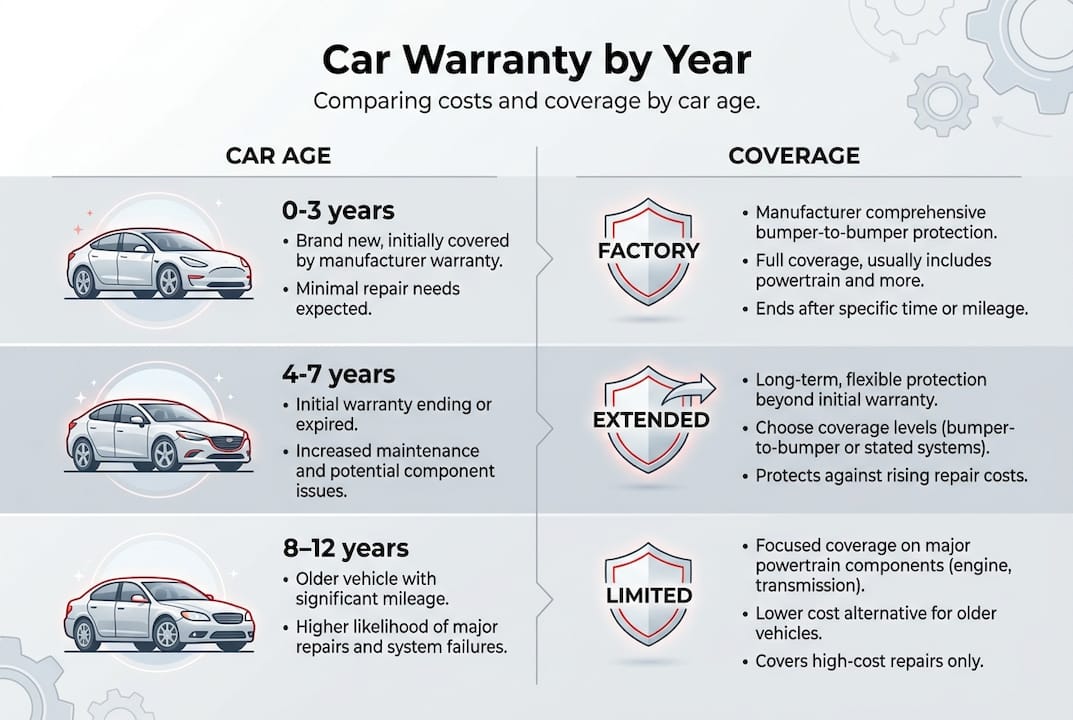
Extended warranty products fall into three primary categories, each offering different coverage depths that align with specific vehicle ages and owner priorities. Basic powertrain warranties cover only engine, transmission, and drivetrain components, making them suitable for newer vehicles where these major systems remain reliable but you want catastrophic failure protection. Mid-level plans add coverage for electrical, cooling, and fuel systems, addressing the broader range of failures that emerge in 5-8 year old vehicles. Comprehensive warranties extend protection to nearly every mechanical and electrical component, which benefits older cars facing multiple simultaneous system failures.

Vehicle age dramatically influences which warranty types providers offer and at what price point. Cars under five years old typically qualify for all coverage levels at reasonable premiums because failure rates remain low. Vehicles 6-10 years old face higher premiums and sometimes coverage exclusions for high-mileage components. Cars exceeding 10 years or 100,000 miles often find limited options, with many providers declining coverage entirely or imposing strict pre-inspection requirements and component exclusions that reduce the warranty's practical value.
Coverage tier characteristics:
- Basic powertrain: Lowest premiums, covers only major mechanical failures, best for reliable newer vehicles
- Mid-level comprehensive: Moderate cost, addresses common mid-life failures, ideal for 5-8 year old cars
- Full comprehensive: Highest premiums, broadest protection, most valuable for 8-12 year old vehicles with unknown histories
Pro Tip: Calculate your vehicle's current value before purchasing comprehensive coverage. If the warranty costs exceed 15-20% of your car's market value, you're likely better off setting aside that money in a dedicated repair fund rather than paying premiums to a provider.
The economics behind extended warranties reveal why providers design plans to remain profitable: customers pay more in premiums than they receive in repairs on average. This doesn't mean warranties lack value, but it does mean you must carefully assess whether your specific vehicle's risk profile justifies the cost. A Honda Accord with stellar reliability ratings might not warrant coverage, while a European luxury car with documented electrical issues could save you thousands. Understanding protection plan options helps you match coverage to your actual risk rather than buying based on sales pressure or fear.
Younger vehicles with active factory warranties rarely benefit from extended coverage since overlapping protection wastes money. The sweet spot for warranty purchases typically falls between months 30-36 of ownership, just before factory coverage expires but while the vehicle still qualifies for favorable premium rates. Waiting until after factory warranty expiration often means higher costs or coverage denials if problems have already surfaced. Timing your warranty purchase strategically maximizes value while minimizing premium expense.
Comparing warranty options: costs, coverage, and car year impact
Warranty premiums and coverage terms vary significantly based on vehicle age, creating distinct value propositions for different ownership scenarios. Understanding these relationships helps you identify when extended coverage makes financial sense versus when you're better off self-insuring against repairs.
| Vehicle age | Average annual repair cost | Typical warranty premium | Coverage availability | Value assessment |
|---|---|---|---|---|
| 1-3 years | $500-800 | $800-1,200 | All tiers available | Usually poor value, factory warranty still active |
| 4-7 years | $1,200-1,600 | $1,000-1,800 | All tiers available | Moderate value, depends on reliability |
| 8-12 years | $1,800-2,500 | $1,500-2,500 | Limited options | Best value window for unreliable models |
| 13+ years | $2,500+ | Often unavailable | Severely restricted | Rarely available or cost-prohibitive |
This comparison reveals several important patterns. First, warranty premiums don't perfectly track repair cost increases, creating windows where coverage offers genuine value. The 8-12 year bracket shows the tightest alignment between actual repair expenses and warranty costs, making this age range the most logical time to carry extended protection if your vehicle's reliability history supports it. Second, very new and very old vehicles present poor warranty value, either because repair costs remain minimal or because coverage becomes unavailable or prohibitively expensive.
Evaluating warranty value step by step:
- Calculate your vehicle's average annual repair costs using model-specific reliability data
- Compare this figure against quoted warranty premiums plus deductibles
- Factor in your personal risk tolerance and emergency fund availability
- Consider whether your vehicle has known expensive failure points that coverage would address
- Review provider reputation and claims payment history to ensure coverage delivers when needed
The profitability structure of extended warranty products means providers collect more in premiums than they pay in claims across their entire customer base. This mathematical reality doesn't eliminate warranty value for individual owners, but it does mean you need a specific reason to expect above-average repair costs. Vehicles with documented reliability issues, complex electronic systems, or expensive parts qualify as good warranty candidates. Conversely, cars with stellar track records and affordable repair costs rarely justify the premium expense.
Coverage limitations become increasingly restrictive as vehicles age. Many providers cap total claim payouts at $3,000-5,000 for vehicles over 10 years old, exclude wear items like brakes and suspension components, and require expensive pre-purchase inspections. These restrictions significantly reduce the warranty's practical value, potentially leaving you responsible for exactly the repairs you hoped to avoid. Reading the fine print before purchasing reveals whether the coverage terms actually protect against your vehicle's most likely failure points.
Some manufacturers and models demonstrate exceptional reliability that makes extended warranties financially illogical. Japanese brands like Toyota, Honda, and Mazda typically maintain low repair costs well past 100,000 miles, making warranty premiums a poor investment. European luxury brands and certain American models with complex electronics often develop expensive problems that warranty coverage can mitigate. Research your specific vehicle's warranty options using model-year reliability data rather than relying on general age-based assumptions.
Practical tips for choosing the right warranty by car year
Selecting the optimal extended warranty requires analyzing your specific vehicle's characteristics alongside your financial situation and risk tolerance. Start by researching your exact make, model, and year's reliability record using consumer reports and owner forums. This research reveals whether your vehicle typically develops expensive problems during the coverage period you're considering. A car with documented transmission failures at 80,000 miles makes a strong warranty candidate, while a model known for trouble-free operation past 150,000 miles probably doesn't justify the premium cost.
Key evaluation factors:
- Vehicle reliability history for your specific model year
- Current mileage relative to when common failures typically occur
- Your emergency fund size and ability to absorb unexpected repair costs
- Warranty deductible amounts and claim limits that affect out-of-pocket exposure
- Provider reputation for claims payment and customer service quality
Pro Tip: Request detailed coverage documents before purchasing any warranty. Generic sales materials often promise comprehensive protection while actual contracts exclude critical components or impose strict maintenance requirements that void coverage. Reviewing the actual policy language prevents expensive surprises when you file claims.
Gathering multiple quotes from different providers reveals significant price variations for identical coverage levels. Premiums can vary by 30-50% between companies for the same vehicle and protection tier, making comparison shopping essential. Focus on total cost including deductibles rather than just monthly payments, since providers structure plans differently to obscure true expense. Some warranties charge per-visit deductibles while others use per-repair or annual deductible structures that dramatically affect your actual costs.
Understanding coverage exclusions prevents disappointment when filing claims. Most warranties exclude maintenance items, wear components, and pre-existing conditions. Some contracts require you to follow manufacturer maintenance schedules exactly, voiding coverage if you miss a single oil change or use non-approved parts. Others exclude coverage for vehicles used commercially, for ride-sharing, or beyond certain annual mileage limits. These restrictions significantly impact whether the warranty actually protects you during real-world ownership.
Provider reputation matters as much as coverage terms. Research complaint histories through state insurance departments and consumer protection agencies to identify companies that routinely deny valid claims or create obstacles to service. The best warranty becomes worthless if the provider refuses payment or requires you to fight for every claim. Established companies with strong financial ratings and transparent claims processes deliver far more value than unknown providers offering suspiciously cheap premiums.
Your personal financial situation should guide the final decision. If you maintain a healthy emergency fund and can absorb a $2,000 repair without hardship, self-insuring often makes more financial sense than paying ongoing premiums. Conversely, if an unexpected $1,500 repair would create genuine financial stress, a warranty provides valuable peace of mind even if the math doesn't perfectly favor it. Balance the statistical likelihood of major repairs against your personal risk tolerance and budget flexibility when making the final call.
Consider how long you plan to keep the vehicle. Warranties make more sense for cars you'll own throughout the entire coverage period, while short-term ownership rarely justifies the expense. If you typically trade vehicles every 3-4 years, extended coverage beyond factory warranties probably wastes money. Owners planning to keep vehicles past 100,000 miles benefit most from strategic warranty purchases timed to cover the highest-risk mileage ranges.
Protect your vehicle with tailored extended warranties
Choosing the right extended warranty transforms from guesswork into strategy when you understand how vehicle age affects both repair costs and coverage value. Rather than accepting generic plans that might not address your car's specific vulnerabilities, explore options designed around your vehicle's year, make, and model.

RPM Warranty partners with nationwide dealers to deliver protection plans that align with your car's actual risk profile. Whether you drive a reliable Volkswagen needing basic powertrain coverage or a high-performance Porsche requiring comprehensive electronic system protection, tailored plans ensure you're not paying for unnecessary coverage while maintaining protection against your vehicle's most likely failure points. Explore warranty protection options that match your car's age and your budget, giving you confidence that unexpected repairs won't derail your finances.
Frequently asked questions
What factors determine extended warranty eligibility by car year?
Eligibility depends primarily on vehicle age, current mileage, and overall condition as defined by each provider's underwriting standards. Most companies offer full coverage options for vehicles under 7 years old with fewer than 100,000 miles, while older or higher-mileage cars face restrictions, exclusions, or coverage denials. Some providers require pre-purchase inspections for vehicles over certain age or mileage thresholds to identify existing problems that would be excluded from coverage. Your vehicle's maintenance history and absence of check engine lights or known issues also affect warranty eligibility and premium costs.
Are extended warranties worth it for older vehicles over 10 years?
Extended warranties for vehicles exceeding 10 years old rarely deliver strong value because coverage becomes limited, premiums increase substantially, and many providers exclude critical components or impose low claim caps. Older vehicles face higher repair costs, but warranty restrictions often leave you paying out of pocket for the exact failures you hoped to avoid. If you can find comprehensive coverage without excessive exclusions, warranties might make sense for specific models with expensive electronic systems or complex drivetrains. Otherwise, setting aside warranty premium money in a dedicated repair fund typically provides better financial flexibility.
How do repair cost trends by car year affect warranty decisions?
Repair cost patterns reveal when warranties deliver maximum value versus when they waste money. Vehicles in the 5-10 year range experience the steepest repair cost increases while still qualifying for reasonable warranty premiums, creating the optimal window for extended coverage. Newer cars under 4 years old typically cost less to repair than warranty premiums, making coverage financially illogical. Very old vehicles over 12 years face such high repair costs that warranty providers either refuse coverage or charge premiums that exceed potential savings, again making self-insurance the smarter choice for most owners.
Should I buy an extended warranty when purchasing a used car?
Buying extended coverage at used car purchase depends entirely on the vehicle's age, reliability history, and your financial buffer for unexpected repairs. Used cars in the 4-8 year range with average or below-average reliability ratings represent the best warranty candidates because they're entering their highest-failure-rate years while still qualifying for comprehensive coverage. Avoid warranties on very reliable used cars that rarely need expensive repairs or on older used cars where coverage restrictions eliminate most value. Always research your specific model's common problems and typical repair costs before deciding, rather than accepting dealer-offered warranties that often include high markups and limited actual protection.
Recommended
- Best Smart Extended Vehicle Auto Motorcyle Warranty | Trusted By All Dealers Nationwide
- Extended Vehicle Auto Motorcyle Warranty | Trusted By All Dealers Nationwide
- Extended Vehicle Auto Motorcyle Warranty | Trusted By All Dealers Nationwide
- Best Bugatti Extended Vehicle Auto Motorcyle Warranty | Trusted By All Dealers Nationwide