

Most factory diesel engine warranties cover defects in materials and workmanship for a limited period, commonly a few years or a specified mileage, whichever comes first. Emission-related components often carry separate, sometimes longer terms that can stretch to several years or a high mileage depending on the part. Coverage typically includes parts and labor for genuine defects but excludes wear items, misuse, wrong fuel, and unauthorized modifications. Claims almost always require repairs at an authorized dealer with proper documentation, which is exactly why many owners layer on extended diesel engine warranty coverage once the factory clock runs out.
TL;DR:
- Factory diesel engine warranties generally last 3 to 5 years or 36,000 to 100,000 miles, with emission parts often covered longer.
- Coverage usually includes critical components like the cylinder block, fuel injectors, turbocharger, and oil pump, but excludes wear items and misuse.
- Emission system warranties can extend up to 10 years or 110,000 miles, covering parts like DPFs, DEF pumps, and NOx sensors, but owner error can void these claims.
- Proper maintenance records, fuel and oil specifications, and servicing at authorized locations are essential to prevent warranty denials.
- Extended warranties from providers like Rpmwarranty can fill coverage gaps, especially for costly aftertreatment components, and offering plans based on risk exposure.
Table of Contents
- What Factory Diesel Engine Warranties Usually Cover
- How Long Does Diesel Engine Warranty Coverage Last?
- Emission and Aftertreatment Coverage: The Part Owners Miss
- What Voids Your Warranty (And What You Need to Prove You Didn't Cause It)
- How Diesel Warranty Claims and Towing Actually Work
- When an Extended Diesel Engine Warranty Actually Pays Off
- A Practical Checklist Before You Buy Extended Coverage
- Getting a Diesel Engine Warranty Quote From Rpmwarranty
- Where to Verify Your Own Diesel Engine's Warranty Terms
- Sources
What Factory Diesel Engine Warranties Usually Cover
Diesel engine warranty coverage centers on the parts that keep the engine running under heavy compression and load. Cummins, for one, lists specific engine parts in its diesel engine limited warranty, and that coverage can run up to five years or 100,000 miles depending on the application.
Typical covered components include:
- Cylinder block, cylinder heads, and internal rotating assemblies
- Fuel injectors and the high-pressure fuel injection pump
- Turbocharger housing and internal turbo components
- Oil pump and factory-installed gaskets and seals
Coverage shape varies by manufacturer. Some plans cover the complete engine assembly, others draw a line at the long block or short block, and some name individual components rather than the whole unit. Ford, for instance, structures its Power Stroke coverage around specific assemblies and durations rather than a single blanket term. When a covered part fails and gets replaced under warranty, the new part usually doesn't reset the clock. It typically inherits whatever remains of the original warranty period, not a fresh term of its own. Powertrain warranty pages, including Ford's own breakdown of which parts qualify, spell out that internal lubricated parts and major assemblies are the priority, while external brackets and trim generally aren't.
How Long Does Diesel Engine Warranty Coverage Last?
Duration is where diesel engine warranty options get confusing fast, mostly because manufacturers stack multiple overlapping terms on the same vehicle. A basic bumper-to-bumper warranty often runs 3 years or 36,000 miles. Powertrain coverage, which includes the engine, transmission, and drivetrain, commonly extends to 5 years or 60,000 miles.
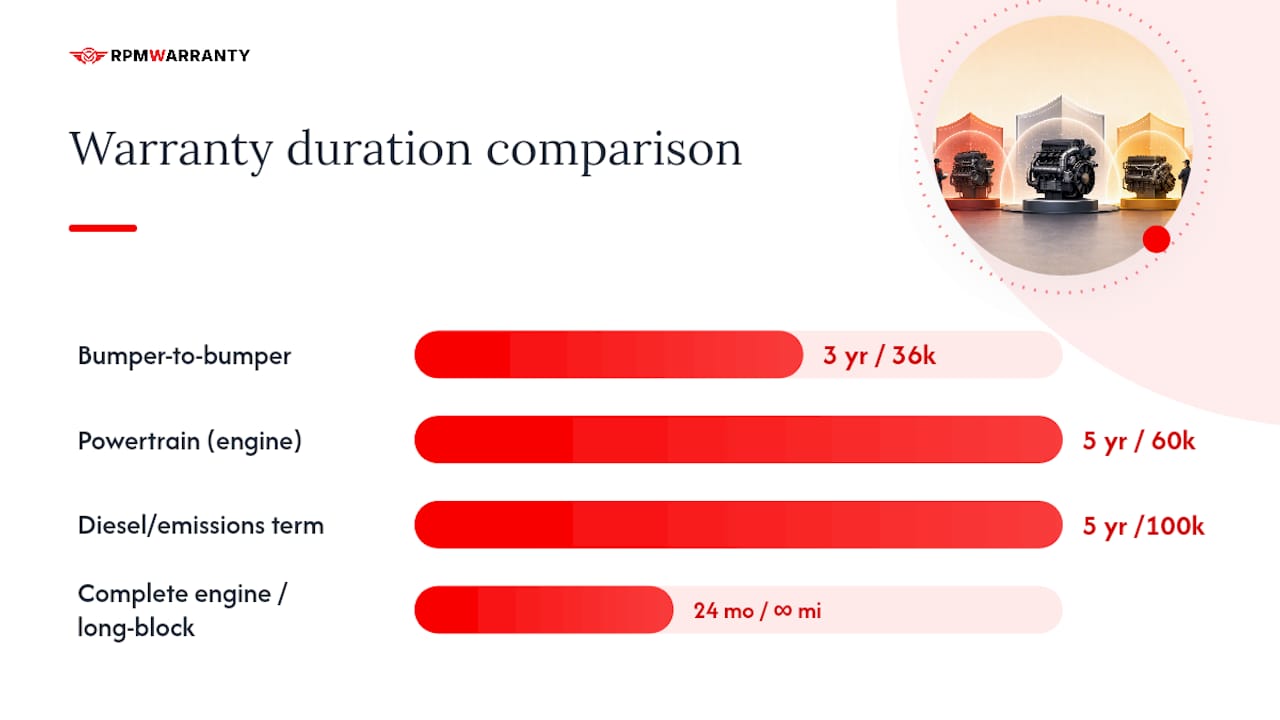
Diesel-specific terms often run longer than gasoline equivalents. Some diesel engine or emission-related warranties reach 5 years or 100,000 miles, and certain complete engine or long-block assemblies carry 24 months of unlimited-mile coverage, as Ford's own Power Stroke warranty page shows.
A few things worth checking on your own paperwork:
- Commercial and fleet diesel engines are often measured in operating hours rather than miles, which matters if your truck idles for long stretches on a job site
- The warranty clock usually starts at the original in-service date, not the manufacture date
- Transferability to a second owner isn't automatic. Some factory warranties transfer with proper registration; others don't, so read the fine print before buying used
Emission and Aftertreatment Coverage: The Part Owners Miss
Emission systems get their own warranty rules, separate from the general engine warranty, and the terms are often longer because federal regulation requires it. Ram's HD warranty documentation lays out a good example of how granular this gets, with some emission components covered for 5 years/50,000 miles, others for 8 years/80,000 miles, and select high-cost parts stretching to 10 years/110,000 miles.
Commonly covered aftertreatment parts include:
- Diesel particulate filter (DPF) and diesel oxidation catalyst (DOC)
- DEF pump, tank, and dosing module
- NOx sensors and particulate sensors
- Selective catalytic reduction (SCR) catalyst assembly
These parts are also the ones most vulnerable to owner error. Running the wrong DEF concentration, deleting emissions equipment, or installing aftermarket tuning that alters exhaust aftertreatment behavior is one of the fastest ways to get a claim denied outright, regardless of how many years are left on the warranty.
What Voids Your Warranty (And What You Need to Prove You Didn't Cause It)
Warranty denials rarely come from a mystery defect. They come from documented gaps in maintenance or fuel handling. Common exclusions include normal wear and tear, misuse or abuse, contamination from off-spec fuel, skipped service intervals, and unauthorized modifications, including emissions deletes.
Keep these habits in place to protect your coverage:
- Follow OEM service intervals exactly, not the shortened version some quick-lube shops recommend
- Use the fuel, oil, and DEF specifications listed in your owner's manual, not whatever's cheapest
- Save every service receipt, including oil changes done outside the dealer network
- Retain fuel receipts if fuel quality ever becomes a factor in a claim dispute
- Ask for a copy of any dealer diagnostic report tied to engine work
Pro Tip: Keep a dedicated folder, digital or physical, just for your diesel maintenance records. If a warranty dispute ever comes down to "prove you serviced it," a scanned receipt beats a memory every time.
How Diesel Warranty Claims and Towing Actually Work
Covered repairs almost always need to happen at an authorized dealer or an OEM-approved service location. Take your truck to an independent shop for a warranty-eligible repair, and you risk the claim getting denied outright, even if the diagnosis was correct.
The typical claims path looks like this:
- Initial diagnosis at the dealer, often followed by ECM data interrogation to confirm the failure mode
- Dealer submits the claim to the manufacturer, sometimes triggering a factory inspection on high-cost components like turbos or injection pumps
- Cummins' own warranty documentation confirms that manufacturers may pull ECM data as part of failure analysis before approving a claim
- Towing to the nearest authorized dealer is often covered, but conditions and distance caps vary by manufacturer and plan
If a technician finds metal debris in a high-pressure fuel system, OEM procedure typically calls for replacing the contaminated components rather than cleaning them, based on service guidance for 6.7L diesel fuel systems. Skipping that step to save money can void coverage on the repair and anything downstream of it.
When an Extended Diesel Engine Warranty Actually Pays Off
Modern diesel aftertreatment systems, NOx sensors, DPFs, DEF dosing units, are frequently among the most expensive and most claimed components once factory coverage runs out. That's exactly the gap extended diesel engine warranty coverage from Rpmwarranty is built to close, whether you're driving a heavy-duty Ram, a Ford Super Duty, or a diesel-powered SUV like a Range Rover or Mercedes.
Rpmwarranty structures coverage across three tiers so owners can match protection to actual risk exposure.
| Plan Tier | Focus | Typical Add-Ons |
|---|---|---|
| Elite | Broadest component coverage | Roadside assistance, high-tech electronics |
| Advanced | Engine, transmission, cooling systems | Turbo and fuel system add-ons |
| Essential | Core mechanical protection | Basic roadside assistance |
- Nationwide claims support through ASE-certified mechanics
- A four-step process: consultation, plan selection, customization, and agreement
A Practical Checklist Before You Buy Extended Coverage
If you're logging high annual mileage, running the truck commercially, or driving a model with known injector, turbo, or DPF failure patterns, extended coverage usually earns its cost back faster than owners expect. Confirm your factory warranty's actual end date first. Then tally what a turbo or SCR catalyst replacement would run out of pocket, compare plan exclusions line by line, and check that the claims network actually covers where you drive. None of it matters if your maintenance records aren't airtight when a claim comes up.
— Kenneth
Getting a Diesel Engine Warranty Quote From Rpmwarranty
Once you know where your factory coverage ends, getting a quote from Rpmwarranty takes a few minutes, not a dealership visit. You provide your VIN and basic vehicle details, choose a tier between Elite, Advanced, and Essential, and select add-ons like turbo or fuel system protection based on your engine's actual risk profile.
Every plan includes roadside assistance, and select tiers add rental reimbursement so a covered repair doesn't leave you stranded without a vehicle. Claims run through a nationwide network of ASE-certified mechanics, so you're not limited to a single dealership hours from home. If you're driving a diesel truck, an SUV like a Range Rover, or a heavy-duty Ford, Ram, or Mercedes platform, head to Rpmwarranty's free quote page to see what coverage fits your mileage and usage. You can also compare plan options for specific makes before deciding which tier makes sense for your engine.
Where to Verify Your Own Diesel Engine's Warranty Terms
- Check your OEM's diesel engine warranty PDF for exact durations and covered parts
- Review the emission warranty supplement in your owner's documentation for part-specific terms