

Most extended warranties do not cover brake pads and rotors — they are classified as wear items, the same category as tires and wiper blades. But that is not the whole story.
- Pads and rotors are almost always excluded as consumable, wear-and-tear parts under every plan tier.
- Non-wear brake components — ABS control modules, master cylinders, disc brake calipers, and hydraulic lines — are commonly covered on mid-tier and comprehensive plans when failure results from a mechanical or electrical breakdown, not normal use.
- Your immediate next step: pull out your contract, open the Definitions section, and find the Covered Components schedule. If you do not have a plan yet, contact Rpmwarranty for plan-specific confirmation before you buy.
Key Takeaways
Most extended warranties exclude brake pads and rotors as wear items, but mid-tier and comprehensive plans commonly cover non-wear brake components — and a single ABS module failure can cost as much as the plan itself.
| Point | Details |
|---|---|
| Pads and rotors are excluded | Friction surfaces are wear items and are excluded from every plan tier, including exclusionary plans. |
| Non-wear components may be covered | ABS modules, master cylinders, calipers, and hydraulic lines are commonly listed on mid-tier and comprehensive plans. |
| Read the Definitions section first | How your contract defines "breakdown" versus "wear" determines whether a brake claim is approved or denied. |
| Maintenance records are required | Missing service receipts or fluid flush records are a leading cause of legitimate brake claims being denied. |
| Rpmwarranty Elite and Advanced plans | These tiers cover hydraulic and electronic brake components through ASE-certified shops nationwide. |
Table of Contents
- Do extended warranties cover brakes, and why does the answer depend on the component?
- Which brake parts are typically covered and which are excluded?
- How contracts define coverage and what paperwork you need for a brake claim
- How to verify whether your specific plan covers brakes
- What brake repairs actually cost and when coverage pays off
- What to do when a brake-related claim is denied
- What vehicle owners commonly get wrong about brake warranty coverage
- Protect your brake system with the right plan from Rpmwarranty
- Sources
Do extended warranties cover brakes, and why does the answer depend on the component?
The phrase "extended warranty" is actually a marketing term. What you are buying is a vehicle service contract, a separate financial product that is not issued by the manufacturer. The FTC is clear on this distinction: service contracts vary widely in quality, coverage, and price, and the contract’s own Definitions section determines what counts as a covered failure.
Most plans fall into three tiers. A powertrain plan covers the engine, transmission, and drive axles — nothing else. A mid-tier plan adds steering, suspension, cooling, electrical, and often hydraulic brake components. An exclusionary plan (sometimes called bumper-to-bumper style) covers nearly every mechanical and electrical part except a short exclusion list, which almost always includes pads, rotors, tires, and wipers.
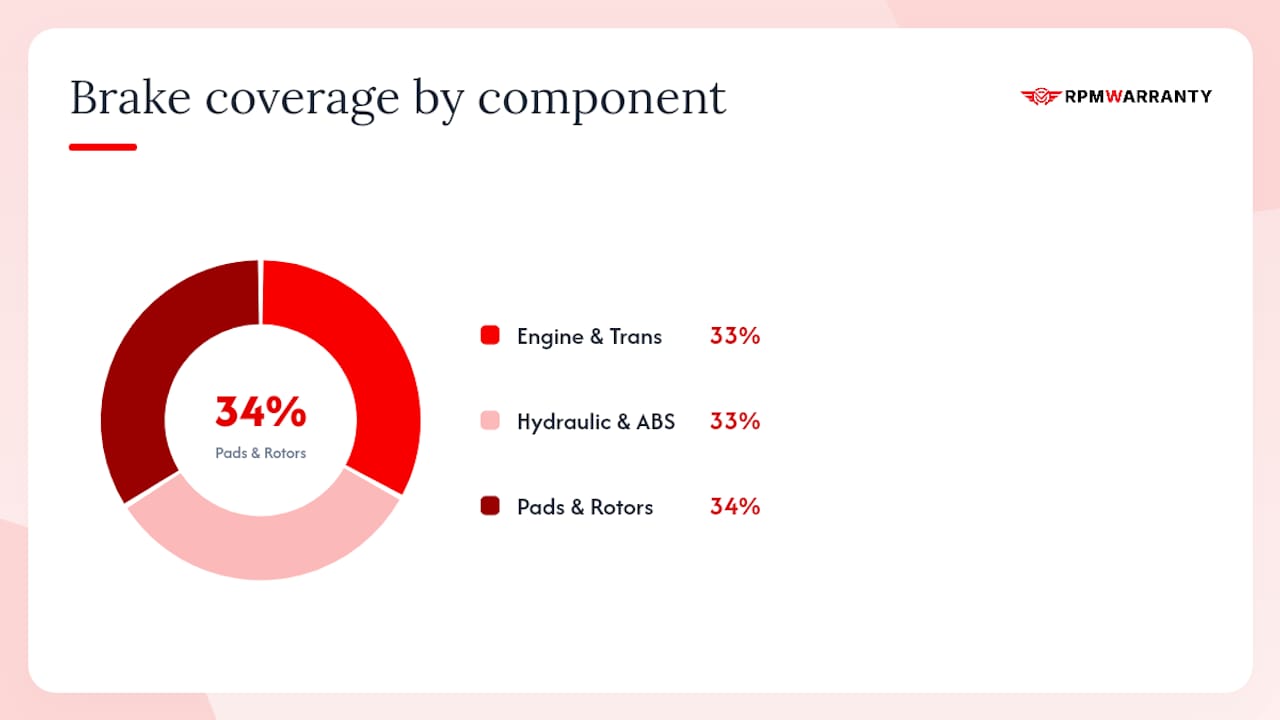
Brake pads and rotors sit in the exclusion list on every tier because they are friction surfaces designed to wear down through use. The CFPB notes that buyers should compare tiers carefully and avoid duplicating factory coverage — which means reading what each tier actually lists, not assuming "comprehensive" means everything.
Contract exclusion phrases to spot in the Definitions and Exclusions sections:
- "Normal wear and tear"
- "Consumable or maintenance items"
- "Friction surfaces"
- "Parts that require periodic replacement"
- "Pre-existing condition"
- "Improper or inadequate maintenance"
If any of those phrases appear next to "brakes" without a carve-out for hydraulic or electronic components, your brake system coverage is likely limited to nothing.
Which brake parts are typically covered and which are excluded?
LegalClarity's breakdown of extended warranty brake coverage puts it plainly: pads and rotors are wear items and are excluded from virtually every plan, while non-wear hydraulic and electronic components are commonly listed as covered parts on mid-tier and comprehensive contracts.
Three real-world scenarios show how this plays out:
Scenario 1 — Worn pads and rotors on a BMW 5 Series. After 40,000 miles, the pads are at minimum thickness and the rotors are scored. This is normal use. No extended warranty covers it, regardless of plan tier. The repair is your cost.
Scenario 2 — Failed ABS control module on a Range Rover Sport. The ABS warning light triggers and the module fails due to an internal electrical fault. On a mid-tier or exclusionary plan that lists the ABS module as a covered component, this repair is typically approved. The module on a Range Rover can run $800–$1,500 in parts alone, so the coverage matters.
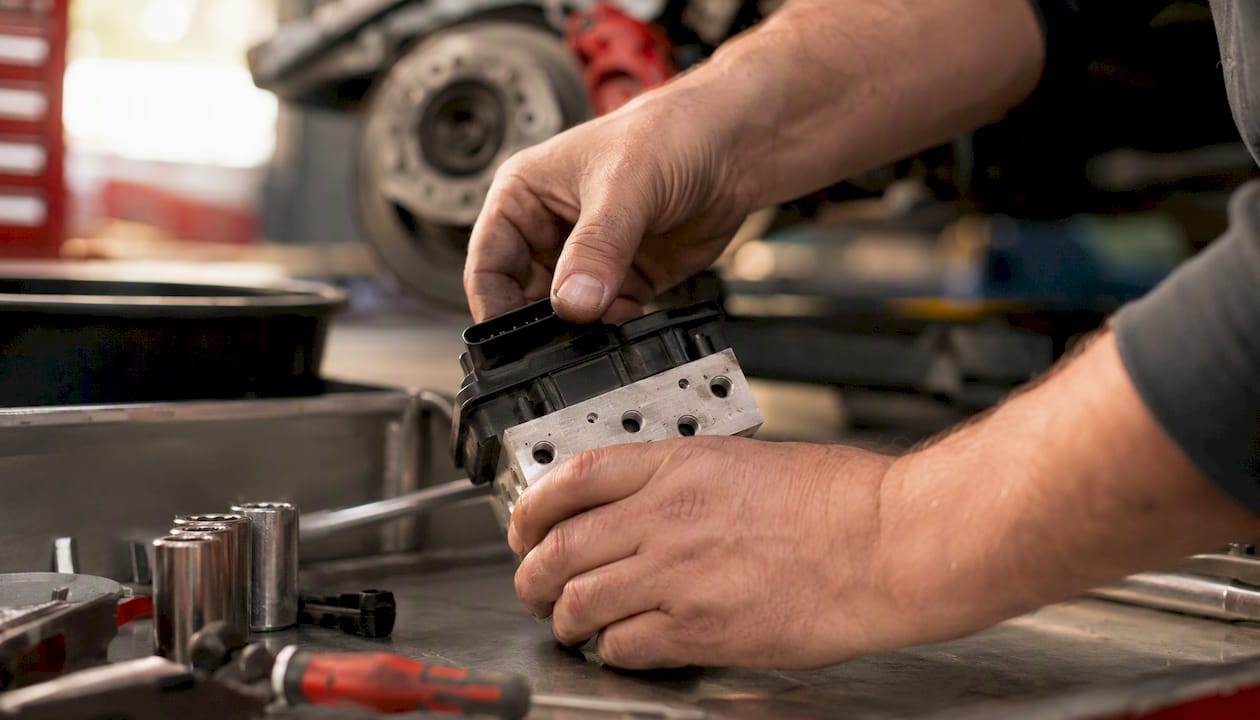
Scenario 3 — Master cylinder seal failure on a Honda Accord. The driver notices a spongy pedal and fluid loss. The master cylinder's internal seals have failed, causing loss of hydraulic pressure. This is a mechanical breakdown, not wear of a friction surface. Most mid-tier plans cover it.
One more clause worth knowing: consequential damage language. Some contracts state that if a covered component fails and causes damage to an otherwise-excluded part, the secondary damage may also be covered. If a seized caliper (covered) destroys a rotor (normally excluded), you may have a claim for both. Read your contract's consequential damage provision carefully.
How contracts define coverage and what paperwork you need for a brake claim
The single most important clause in any vehicle service contract is the definition of "mechanical breakdown." If your contract defines breakdown as "the failure of a covered part to perform its intended function due to a defect in materials or workmanship," then a worn pad does not qualify — it performed exactly as designed until it wore out. A failed ABS module, by contrast, stopped functioning due to an internal defect, which fits that definition.
Sections to read in your contract, in order:
- Definitions — how the contract defines "breakdown," "wear and tear," "covered component," and "pre-existing condition"
- Covered Components (or Schedule of Covered Parts) — the actual list of parts; if a component is not named here, it is not covered
- Exclusions — the list of what is never covered regardless of cause
- Maintenance Requirements — what service intervals you must follow and document
- Preauthorization — whether you must call the administrator before any repair begins
- Repair Facility Rules — whether you must use an approved or ASE-certified shop
Red-flag phrases that tend to sink brake claims:
- "Wear and tear, gradual deterioration, or rust" — covers the provider's refusal of pad and rotor claims
- "Parts that require periodic replacement" — another way to exclude consumables
- "Failure to perform required maintenance" — used when service records are missing
- "Pre-existing condition" — applied when a problem existed before the contract start date
Pro Tip: Keep a dedicated digital folder — a phone album, Google Drive folder, or Dropbox — with photos of every service receipt, inspection report, and brake fluid flush. Date each file. Warranty providers frequently require proof of proper maintenance to validate claims, and a missing brake fluid flush record has killed otherwise legitimate claims.
How to verify whether your specific plan covers brakes
Do not rely on a verbal summary from a salesperson. Here is the sequence to follow:
- Locate your physical or digital contract. The administrator's name and contract number appear on the first page.
- Open the Definitions section. Write down how the contract defines "breakdown" and "wear and tear."
- Find the Covered Components schedule. Search for: ABS module, master cylinder, caliper, hydraulic control unit, brake booster. If none appear, the plan likely covers nothing brake-related beyond the powertrain.
- Check the Exclusions list. Confirm whether "brake pads," "rotors," or "friction surfaces" appear there explicitly.
- Note the preauthorization requirement. Most contracts require you to call the administrator before authorizing any repair. Skipping this step is one of the most common reasons claims are denied outright.
- Confirm maintenance documentation requirements. Identify exactly which service records the contract requires you to keep.
- Get written confirmation. Call or email your provider and ask the following questions — then request the answers in writing (email is sufficient):
- "Does my plan list the ABS control module or hydraulic control unit as a covered component? If so, on which page of the contract does it appear?"
- "Is the master cylinder listed as a covered part under my current plan tier?"
- "If a covered brake component fails and damages a rotor, does my contract include consequential damage coverage?"
- "What maintenance records will you require if I file a brake-system claim?"
A claims authorization number or a written email from the provider counts as documentation. A verbal "yes" from a phone agent does not.
What brake repairs actually cost and when coverage pays off
Understanding the financial case for brake-system coverage starts with knowing what repairs cost without it.
| Repair | Typical U.S. Cost Range | Usually Covered by Extended Warranty? |
|---|---|---|
| Brake pad replacement (both axles) | $150 | No — wear item |
| Brake rotor replacement (pair) | $250 | No — wear item |
| Disc brake caliper replacement | $800 | Yes, on mid/comprehensive plans |
| Master cylinder replacement | $600 | Yes, on mid/comprehensive plans |
| ABS control module replacement | $800–$1,500+ | Yes, on mid/comprehensive plans |
RepairPal's brake pad cost estimator shows why pads are treated as low-cost consumables — the repair is predictable and relatively inexpensive. Rotor replacement costs more, but it is still in a range most owners can absorb. The ABS module is a different story, particularly on luxury vehicles.
Cost scenario: A mid-tier extended warranty plan might cost $1,200–$2,000 over three years. A single ABS module failure on certain luxury vehicles can run several thousand dollars in parts and labor. One covered ABS failure effectively pays for the plan. Add a master cylinder failure in the same period and the math is clear.
The break-even calculation also depends on your deductible. A $100 deductible per visit changes the net savings on a $900 caliper repair to $800. A $200 deductible on a $350 master cylinder job cuts the benefit to $150. For owners of vehicles where hydraulic and electronic brake components are expensive — Range Rover, Porsche Cayenne, Mercedes, BMW — a mid-tier or comprehensive plan with a low deductible tends to pay off faster than it does on a Honda Civic.
The FTC's guidance on vehicle service contracts is worth reading before any purchase: understand the cancellation and refund terms, because a plan you cancel early may refund only a prorated amount minus a cancellation fee.
What to do when a brake-related claim is denied
A denial is not necessarily final. Follow this sequence:
- Request the denial in writing. Ask for the specific reason code and the contract clause the administrator cited. "We don't cover that" is not an acceptable answer — you are entitled to the exact contractual basis.
- Get the repair shop's diagnostic report. An ASE-certified technician's written diagnosis stating the failure cause (electrical fault, internal seal failure, mechanical seizure) is your strongest piece of evidence. It establishes that the failure was a breakdown, not wear.
- Assemble your maintenance records. Pull every service receipt, inspection report, and fluid flush record. Submit them with a written request for re-review, citing the specific covered component by name and the contract page where it appears.
- Escalate to the provider's appeals unit. Most administrators have a formal appeals process. Submit everything in writing and request a decision within a stated timeframe (10–15 business days is reasonable to ask for).
- Contact your state insurance regulator or consumer protection agency. In most states, vehicle service contracts are regulated financial products. The California Department of Insurance publishes a consumer guide specifically for service contract disputes, and most states have an equivalent office. Filing a complaint often prompts a faster response from the administrator.
- File with the Better Business Bureau if the provider remains unresponsive after the appeals process.
Common denial reasons for brake claims and what tends to overturn them:
- Wear and tear — overturned when the shop's diagnostic report documents a sudden mechanical or electrical failure, not gradual deterioration
- Maintenance lapse — overturned when you produce complete service records showing all required intervals were met
- Pre-existing condition — harder to fight, but a pre-purchase inspection report or dealer service history showing no prior brake issues helps
- Excluded part — if the administrator misidentified the component, a corrected parts invoice from the shop can resolve it
What vehicle owners commonly get wrong about brake warranty coverage
Most people shopping for an extended warranty assume "brakes" means everything in the brake system. It does not. Pads and rotors are maintenance items — they wear out by design, and no service contract is built to replace them on a schedule. That is your job as the owner.
What the contract can protect you from is the expensive, unpredictable failure: the ABS module that shorts out on your BMW 3 Series at 80,000 miles, the master cylinder that loses pressure on a Porsche Macan, the caliper that seizes on a Ford F-150 in winter. Those failures are not maintenance failures — they are mechanical breakdowns, and that is exactly the category a well-structured service contract is designed to cover.
Two things matter more than most buyers realize. First, the covered-component list is everything. A plan that does not explicitly name the ABS module will not cover it, regardless of how "comprehensive" the marketing language sounds. Ask for the itemized list before you sign. Second, your maintenance records are as important as the contract itself. A provider can deny a legitimate claim if you cannot prove the vehicle was properly maintained. Keep every receipt, every inspection report, every fluid service record — digitally, with dates.
Rpmwarranty's Elite and Advanced plans include coverage for hydraulic and electronic brake components, backed by a nationwide network of ASE-certified repair facilities. The Essential plan covers powertrain fundamentals. The difference between tiers is exactly the kind of brake-system hardware discussed throughout this article.
Protect your brake system with the right plan from Rpmwarranty
Brake pad and rotor replacements are your responsibility as a vehicle owner — but a seized caliper, a failed ABS module, or a master cylinder that loses pressure on a Range Rover or BMW is a different problem entirely. Those repairs can run $800–$2,000 or more, and they happen without warning.
Rpmwarranty's Elite and Advanced plans cover hydraulic and electronic brake components, including calipers, master cylinders, ABS control modules, and hydraulic lines, through a nationwide network of ASE-certified mechanics. Every plan includes roadside assistance and a straightforward preauthorization process so you are not scrambling when a failure happens. Coverage is customized by your vehicle's year, make, and model — whether you drive a Honda Accord, a Mercedes GLE, or a Porsche Cayenne.
Get a free quote at Rpmwarranty, ask specifically which brake-system components appear on your plan's covered-component schedule, and request that confirmation in writing before you finalize your agreement.
Sources
- Does Extended Warranty Cover Brakes? Exclusions and Exceptions - LegalClarity
- Auto warranties and auto service contracts | Federal Trade Commission
- What is the difference between a manufacturer’s warranty and an extended vehicle warranty or service contract? | CFPB
- Brake pad replacement cost estimator | RepairPal