Standard car warranties almost never cover windshield repair or replacement unless the damage comes directly from a manufacturing defect. If a rock off the highway cracks your glass, your factory warranty will not pay for it. Here is what actually covers windshield damage, and what does not:
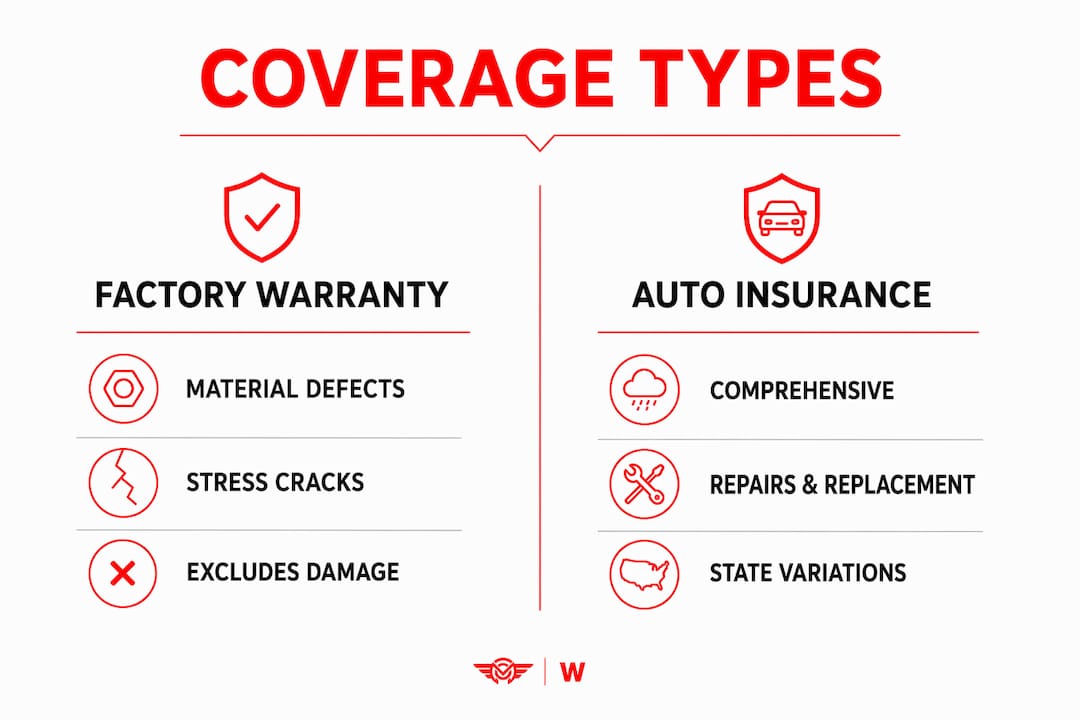
- Factory warranty: Covers defects like spontaneous stress cracks, faulty seals, or glass bubbles from the manufacturing process. Excludes all impact damage.
- Extended warranty / vehicle service contract: Glass is almost always excluded as a cosmetic or wear-and-tear item.
- Comprehensive auto insurance: Your primary tool for chips, cracks, and full replacements caused by road debris, hail, or vandalism.
- Windshield protection plans: Sold separately at dealerships, these cover cosmetic glass damage that falls outside both warranties and standard insurance.
- Brands covered below: Range Rover, BMW, Porsche, Mercedes, Ford, and Honda each handle windshield coverage differently, especially on models with advanced driver-assistance systems (ADAS).
Does a car warranty cover windshield damage from the factory?
Factory warranties cover defects in materials and workmanship, not damage from the outside world. A spontaneous stress crack with no impact point, a bubble in the glass, or a faulty factory seal can qualify. A rock chip cannot.
Ford is one of the few manufacturers that spells this out with a time limit: its warranty provides limited coverage for windshield stress cracks only during an initial period after purchase, even when caused by use or exposure to the elements. After that window closes, you are on your own. Most other manufacturers offer no such grace period at all.
What factory warranties typically cover for windshields:
- Spontaneous stress cracks with no identifiable impact point
- Manufacturing defects such as glass bubbles or distortions
- Faulty factory seals causing the windshield to leak or crack
What factory warranties always exclude:
- Chips or cracks from road debris, rocks, or gravel
- Hail damage, vandalism, or falling objects
- Any damage attributed to "external objects" or environmental exposure
Luxury brands follow the same basic rule. A BMW 5 Series, Mercedes GLE, Porsche Cayenne, or Range Rover Sport carries a factory warranty that covers manufacturing defects in the glass, but a chip from the freeway is excluded regardless of the vehicle's price tag. Honda and Ford owners face the same limitation on their Accord or F-150.
Extended warranties, also called vehicle service contracts, go even further. They are built to cover mechanical breakdowns, not body or cosmetic components. Glass is listed as an explicit exclusion in nearly every contract you will read.
How auto insurance actually pays for windshield repairs
Comprehensive auto insurance is the coverage that handles most windshield repairs and replacements. It applies when damage comes from a non-collision event: flying rocks, hail, falling branches, vandalism, or animal strikes. Comprehensive coverage pays for the repair or replacement minus your deductible, and many insurers waive the deductible entirely for repairs rather than full replacements.

Collision coverage takes over when windshield damage happens during a crash with another vehicle or a stationary object like a utility pole. Both coverages are optional add-ons, so if you only carry liability insurance, neither applies.
Coverage types and how they apply to windshield damage:
- Comprehensive: Rock chips, hail, vandalism, falling objects, animal strikes
- Collision: Damage during a crash with another vehicle or fixed object
- Full glass endorsement: An optional rider available in some states that covers glass with zero deductible
- Third-party liability: If the other driver caused the accident, you can file against their policy
State law creates real differences in what you pay out of pocket. Florida, Kentucky, and Arizona require insurers to waive deductibles for windshield replacement when the driver carries comprehensive coverage. South Carolina and Massachusetts have similar provisions. If you live in one of those states and carry comprehensive, a full replacement may cost you nothing.
ADAS-equipped vehicles add a wrinkle. A Range Rover Velar, BMW X5, or Porsche Macan with cameras and sensors mounted at the windshield requires sensor recalibration after glass replacement. That recalibration cost is often included in a covered insurance claim, but you should confirm with your insurer before the work begins.
Windshield protection plans: what they cover and how they work
Windshield protection plans are sold at dealerships as add-on products, separate from both the factory warranty and any extended service contract. They exist specifically to fill the gap that warranties and standard insurance leave open: cosmetic glass damage like chips and star cracks that are too small to file an insurance claim for but annoying enough to fix.
These plans typically offer low or zero deductible coverage for chip repairs and sometimes full replacements, depending on the contract terms. They are worth reading carefully because coverage limits, the number of claims allowed per year, and what counts as a "chip" versus a "crack" vary by provider.
What windshield protection plans generally cover:
- Chips, stars, and bullseye cracks from road debris
- Small crack repairs before they spread
- Some plans include full replacement up to a dollar limit
What they typically do not cover:
- Damage from collisions or accidents (that goes to collision insurance)
- Pre-existing damage at the time of purchase
- Side or rear glass on most basic plans
For owners of luxury vehicles like a Mercedes S-Class or a BMW 7 Series, these plans can make financial sense. The glass on high-end vehicles costs more to replace, and the ADAS recalibration adds to that bill. A protection plan with a low deductible keeps a minor chip from turning into a four-figure expense.
What does windshield repair or replacement actually cost?
Chip repair typically runs $50–$150. A full windshield replacement typically ranges from $200 to $1,000 or more depending on the vehicle make, glass type, and whether ADAS recalibration is required. On a Porsche Panamera or Range Rover Autobiography with multiple cameras embedded in the windshield, recalibration alone can push the total well past $1,000.

Honda Civic or Ford Escape owners sit at the lower end of that scale. A standard replacement without ADAS features usually lands between $200 and $400 at most shops. The cost jumps sharply once you add lane-keeping cameras, rain sensors, or heads-up display projectors to the glass.
Cost components to plan for:
- Chip or crack repair: $50–$150
- Standard windshield replacement: $200–$1,000 or more
- ADAS sensor recalibration: additional cost, varies by vehicle
- Dealership vs. independent shop: dealerships often charge more but may be required for warranty-related work
Pro Tip: Fix chips as soon as you notice them. Small chips spread quickly due to temperature changes and road vibration, turning a $100 repair into a $600 replacement. Most comprehensive policies cover chip repair with no deductible, so there is rarely a reason to wait.
How to choose the right windshield coverage for your vehicle
Start with what you already have. Pull your factory warranty documents and look for the glass exclusions section. Then check your auto insurance declarations page for comprehensive coverage and any glass-specific endorsements.
If you drive a vehicle with ADAS technology, like a BMW X3, Porsche Cayenne, or Range Rover Sport, confirm that your insurer covers recalibration as part of a glass claim. Not all policies include it automatically, and the cost is real enough to matter.
Decision checklist:
- Does your factory warranty include any windshield defect coverage? Check the exclusions list.
- Do you carry comprehensive auto insurance? If not, you have no coverage for road debris damage.
- What is your deductible? If it exceeds the repair cost, paying out of pocket may be smarter than filing a claim.
- Do you live in Florida, Kentucky, Arizona, South Carolina, or Massachusetts? State law may waive your deductible entirely.
- Does your vehicle have ADAS? Confirm recalibration is included in your insurance coverage before scheduling replacement.
- Is a dealership windshield protection plan worth adding? For luxury vehicles or high-mileage highway drivers, often yes.
For Honda Civic or Ford F-150 owners without ADAS, comprehensive insurance alone usually provides enough protection. For a Mercedes GLE or Range Rover with a full suite of driver-assistance cameras, layering comprehensive insurance with a windshield protection plan gives you the most complete coverage at the lowest out-of-pocket cost.
How major car manufacturers handle windshield coverage
Windshield policies vary by brand, though the core rule stays the same across all of them: manufacturing defects may be covered, impact damage is not.
Ford offers one of the more consumer-friendly factory positions, providing limited stress crack coverage for the first 12 months or 12,000 miles. That window is narrow, but it is more than most brands put in writing.
Honda follows the standard factory warranty approach: defects in materials and workmanship are covered, external damage is not. Honda's vehicles generally sit at the lower end of replacement costs, which makes comprehensive insurance the practical solution for most owners.
BMW factory coverage mirrors the industry standard, with no special glass provisions beyond manufacturing defects. The real consideration for BMW owners is ADAS recalibration. Models like the X5 or 5 Series with cameras integrated into the windshield require calibration after any replacement, and that cost should be confirmed with your insurer upfront.
Mercedes takes the same approach as BMW on factory coverage. On S-Class and GLE models, the windshield often houses multiple sensors, making recalibration a near-certain added expense after replacement.
Porsche factory warranties cover glass defects but exclude impact damage. Porsche models with the Driver Assistance Package carry cameras and radar systems tied to the windshield, so recalibration is standard after replacement and can be a significant line item.
Range Rover vehicles, particularly the Defender and Sport with full ADAS suites, sit at the top of the cost range for windshield work. The glass itself is expensive, recalibration is required, and the labor rates at Land Rover dealerships reflect the vehicle's price point. A standalone windshield protection plan is worth serious consideration for Range Rover owners.
Key Takeaways
Standard car warranties do not cover windshield damage from road hazards; comprehensive auto insurance and standalone protection plans are the primary coverage sources for most vehicle owners.
| Point | Details |
|---|---|
| Factory warranty limits | Covers only manufacturing defects like stress cracks or faulty seals, never impact damage. |
| Extended warranty exclusion | Glass is explicitly excluded from nearly all vehicle service contracts as a cosmetic item. |
| Insurance is the main tool | Comprehensive coverage pays for chips, cracks, and replacements from non-collision events. |
| State deductible waivers | Florida, Kentucky, and Arizona require zero-deductible windshield replacement under comprehensive coverage. |
| ADAS adds cost | Luxury vehicles from BMW, Porsche, Mercedes, and Range Rover require sensor recalibration after replacement, raising total costs. |
Knowing where your windshield coverage actually lives, whether in your insurance policy, a dealership protection plan, or a narrow factory defect clause, puts you in a much better position when damage happens. Rpmwarranty's vehicle protection plans are built to cover the mechanical failures that factory warranties leave behind once they expire. If you want to understand exactly what your extended coverage includes, the Rpmwarranty FAQ page breaks down coverage details clearly so there are no surprises at the shop.