
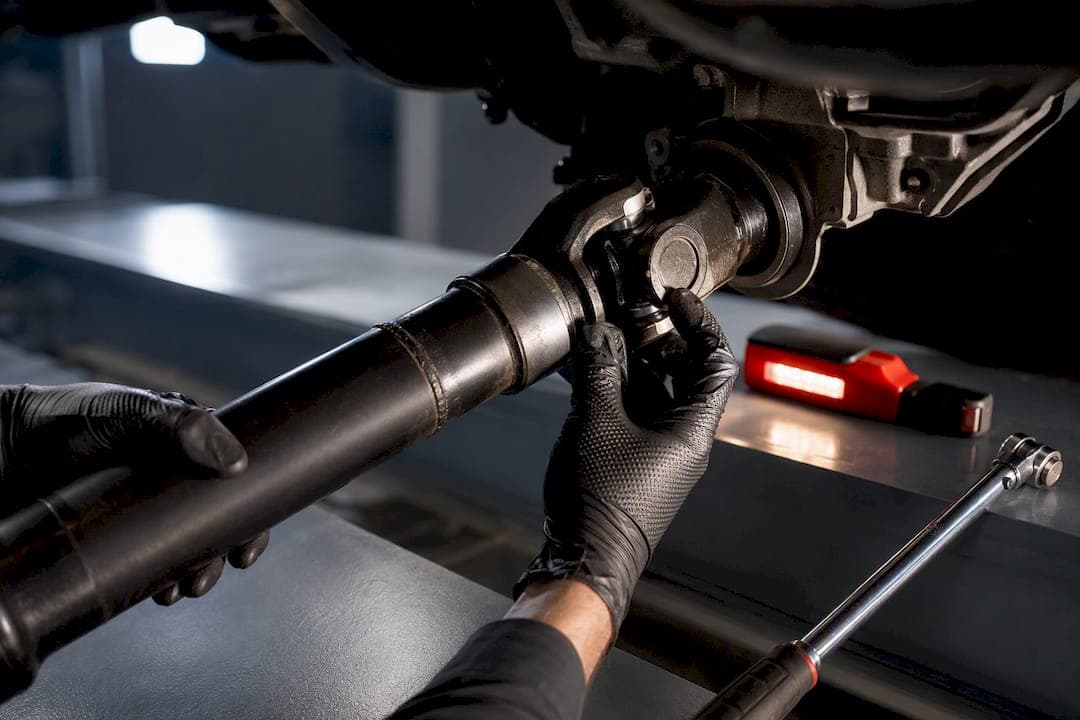
Driveshafts are covered under most standard powertrain warranties because they sit directly in the torque path from engine to wheels. Drivetrain warranties can be narrower and sometimes skip the engine entirely. Either way, coverage almost always excludes damage from wear, neglect, towing abuse, or aftermarket modifications, so your best move is pulling out your contract and checking your maintenance records before you assume anything.
TL;DR:
- Driveshafts are usually covered under powertrain warranties, but coverage excludes damage from neglect, wear, towing abuse, or aftermarket modifications.
- Claims require proof of sudden mechanical failure, with proper documentation, photos, maintenance records, and a detailed diagnostic report.
- Replacement costs range from $200 to $800 for standard driveshafts, with higher expenses for AWD or luxury vehicles that have more complex systems.
- Extended warranty plans from providers like RPM can offer additional coverage after factory warranties expire, with tiered options and varying costs.
Table of Contents
- What Powertrain and Drivetrain Warranties Actually Cover
- What Typically Voids a Driveshaft Claim
- How Driveshaft Claims Get Evaluated
- What Driveshaft Repairs Actually Cost
- Shop and Part Warranties vs. Factory Coverage
- Owning a Higher-End or AWD Vehicle Changes the Calculus
- Closing the Coverage Gap With RPM Warranty
- Sources
- FAQ
What Powertrain and Drivetrain Warranties Actually Cover
A powertrain warranty follows the full torque path: engine, transmission or transfer case, driveshaft, and differential or axles. That's the standard definition manufacturers use, and it's why driveshafts typically fall under powertrain protection rather than needing a separate policy. Coverage length varies a lot by brand, usually lasting several years or tens of thousands of miles.
Drivetrain warranties get murkier. Some manufacturers use the term interchangeably with powertrain. Others define it as everything from the transmission back, which quietly excludes the engine itself while still keeping driveshaft components covered.
Nissan's own warranty booklet spells this out in plain language, listing specific parts under coverage:
- Driveshaft assembly
- Universal joints
- Center support bearings
- Related seals and gaskets
That Nissan warranty booklet is a good template for what to look for in your own paperwork, whether you drive a Ford F-150 or a BMW X5.
What Typically Voids a Driveshaft Claim
Warranty administrators draw a hard line between mechanical failure and wear. A U-joint that seizes from a manufacturing defect is one thing. A U-joint that dries out because nobody greased it for three years is another entirely, and it's the second scenario that gets claims denied.
Common exclusions show up across nearly every brand:
- Routine wear on U-joints, CV joints, and CV boots
- Corrosion from road salt or lack of undercarriage protection
- Damage traced to towing beyond rated capacity
- Aftermarket lift kits, lowering kits, or modified driveline angles
- Neglected lubrication schedules
Small attached components like boots, clamps, and bearings often get treated as maintenance items rather than warrantable parts, even on a Mercedes G-Class or a Range Rover with heavy-duty axles.
Pro Tip: Keep every service receipt, grease log, and even phone photos from routine inspections. If a claim gets questioned, a time-stamped record showing you serviced the U-joints six months before failure does more for you than any argument.
How Driveshaft Claims Get Evaluated
Approval hinges on proving sudden mechanical failure rather than gradual neglect. Administrators and dealer service departments typically work through the same process:
- Diagnostic report from a certified shop documenting the failure mode
- Photos of the failed component, ideally before and after removal
- Mileage verification matching service records
- Maintenance history showing lubrication and inspection intervals were met
- Repair-shop notes explaining cause, not just symptoms
Shops usually run a visual inspection first, then check for vibration or imbalance at speed, followed by a hands-on check of U-joints and CV joints for play or looseness. Independent inspection notes that clearly separate sudden failure from progressive wear strengthen your case considerably.
Claims get denied most often for three reasons: missing documentation, visible signs of neglect or modification, and damage that looks pre-existing. If you get denied, ask for the specific reason in writing and request a second inspection if the cause is disputed.
What Driveshaft Repairs Actually Cost
Budgeting matters here because even a covered claim might leave you with a deductible or a partial denial. A standard driveshaft or CV axle replacement typically runs $200 to $800, while differential repairs land between $800 and $2,500. Engine or transmission rebuilds climb much higher, often $3,000 to $8,000.
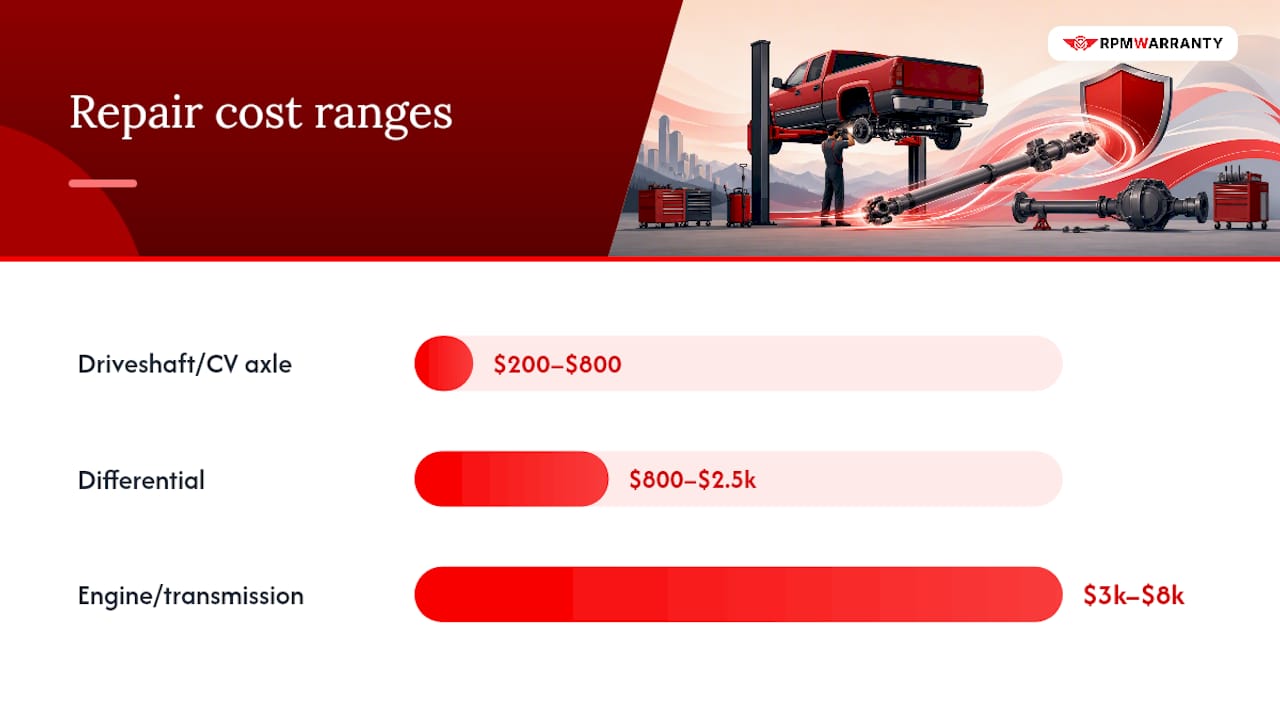
AWD and 4WD vehicles push costs toward the top of those ranges. A Porsche Cayenne or Range Rover with a multi-shaft AWD system has more parts to fail and higher labor rates at the dealership than a front-wheel-drive Honda Civic. Lifespan depends heavily on towing habits, off-road use, and how consistently U-joints get lubricated. The shaft tube itself can outlast the rest of the vehicle, but the joints and boots wear out much sooner under heavy load.
Shop and Part Warranties vs. Factory Coverage
Standalone driveshaft sellers and repair shops write their own limited warranties, separate from anything your vehicle manufacturer offers. Terms vary but tend to follow familiar patterns:
- Twelve months, sometimes stretching to a limited lifetime on the shaft tube
- Parts-only coverage unless you specifically pay for parts-and-labor
- Different terms for remanufactured versus new components
Read the fine print for prorated payouts, required maintenance intervals, and who covers shipping on a warranty return. If your factory powertrain warranty has expired but a shop warranty is still active, coordinate the two: file with the shop first for parts-only failures, and lean on any remaining factory coverage for anything tied to the original drivetrain assembly.
Owning a Higher-End or AWD Vehicle Changes the Calculus
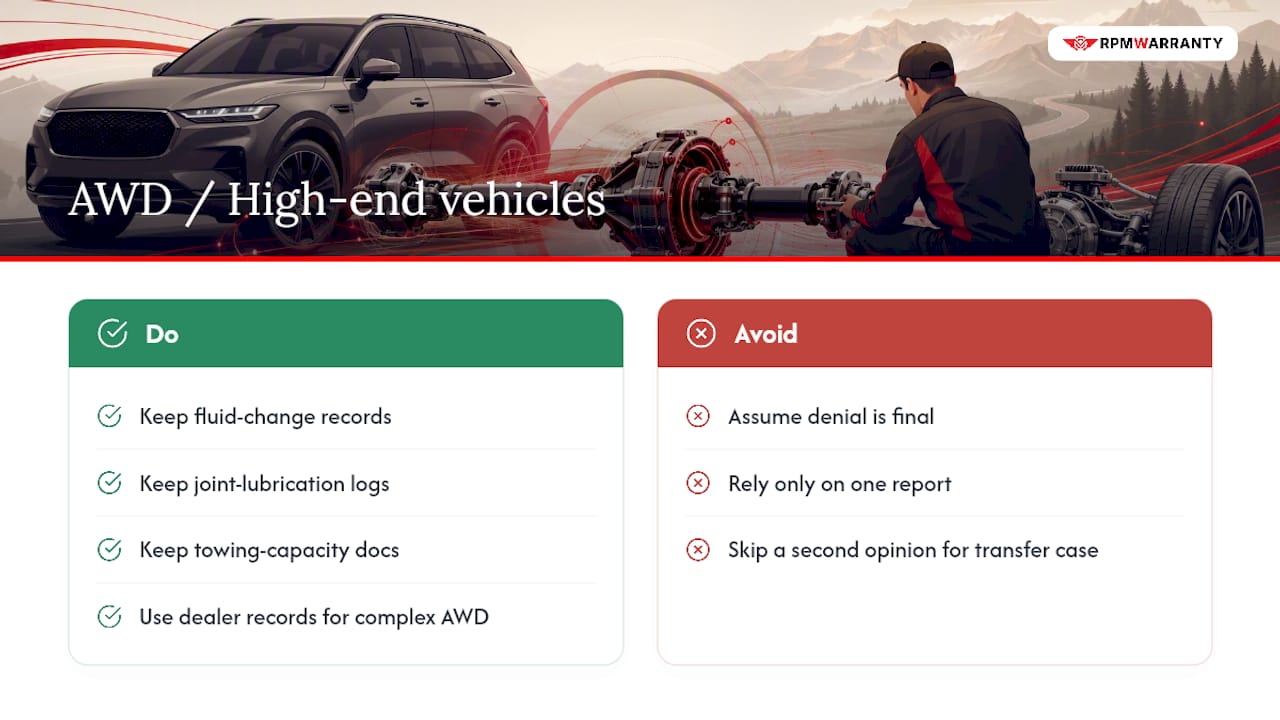
Complex AWD systems in a BMW xDrive or Range Rover often run multiple driveshafts feeding a transfer case, and that complexity cuts both ways on a claim. Dealer service records tend to carry more weight here because dealers have direct access to manufacturer diagnostic protocols for multi-shaft systems.
An ASE-certified independent shop report is usually sufficient for simpler failures, but for anything involving the transfer case interaction, get a second opinion before assuming denial is final. Keep fluid change records, joint lubrication logs, and towing capacity documentation on hand. Those three items settle more disputes than anything else.
— Kenneth
Closing the Coverage Gap With RPM Warranty
Factory powertrain coverage runs out eventually, and that's exactly when driveshaft and drivetrain repairs get expensive out of pocket. Extended vehicle warranty providers often offer tiered plans that extend protection for drivetrain components after original manufacturer coverage expires, sometimes including separate plans for motorcycle shaft-drive systems.
Coverage depth depends on the tier you pick, so it's worth comparing what each plan actually includes before your factory warranty runs out. Many extended warranty providers emphasize a streamlined claims process with fast turnaround, nationwide access to ASE-certified mechanics, and roadside assistance to support drivers in various situations. Check the protection plans page to compare Elite, Advanced, and Essential coverage, or grab a free quote to see what extending your driveshaft protection would actually cost.
Sources
- What Is a Powertrain Warranty? | Kelley Blue Book
- Powertrain vs drivetrain: what's the difference | AutoZone
- 2017 Nissan warranty information booklet (sample OEM warranty language)
- Driveshaft replacement cost guide for U.S. buyers | CostInsider
FAQ
Are Driveshafts Covered Under Warranty?
Yes, in most cases. Driveshafts are typically included under powertrain warranties since they carry torque from the transmission to the wheels, though coverage still excludes wear-related failures and neglect.
What Is the Average Lifespan of a Driveshaft?
The shaft tube itself can often last the life of the vehicle, but U-joints and CV joints wear out much sooner depending on towing load, off-road use, and how well they're lubricated.
Is a Drive Shaft Covered by a Powertrain Warranty?
Generally yes. Powertrain warranties are defined around the torque path, which includes the driveshaft, though a narrower drivetrain warranty may cover the same part while excluding the engine.
What Is the Average Cost to Replace a Driveshaft?
A standard driveshaft or CV axle replacement typically costs between $200 and $800, with AWD and luxury vehicles often landing at the higher end due to added parts and labor.
Does Rpmwarranty Cover Driveshaft Repairs?
Rpmwarranty's Elite, Advanced, and Essential plans can extend protection for drivetrain components, including driveshafts, depending on the tier selected. Current plan details and pricing are available on the protection plans page.