
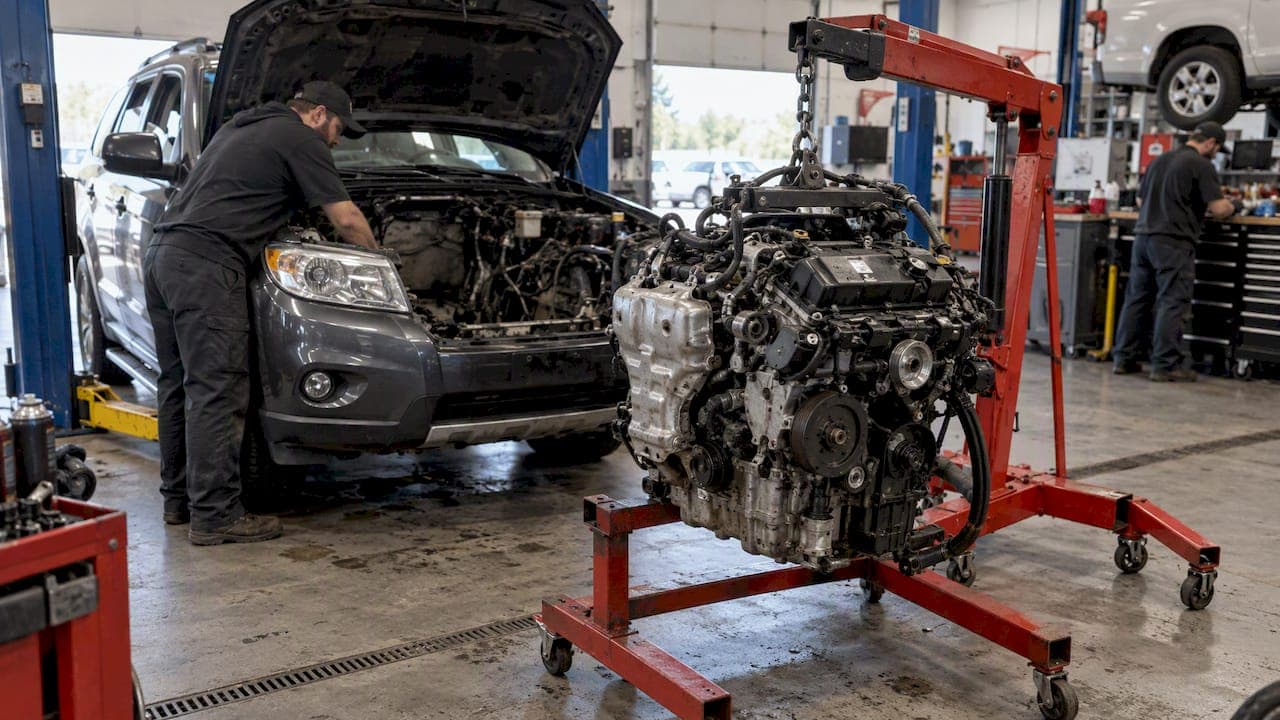
A typical engine replacement in the United States runs about $2,000 to $10,000, and luxury and high-output engines can cost far more. A factory warranty or a service contract can turn that bill into a deductible, but only if the failure is covered, the contract is in force and you followed its rules. This guide puts the two side by side: what the job costs, what coverage pays for, what it refuses, and how to decide before an engine fails.
TL;DR
- Replacing an engine commonly costs $2,000 to $10,000, and a luxury or performance engine can cost several times the high end of that range.
- A manufacturer's warranty covers defects for a set time or mileage. An extended warranty is really an optional service contract with its own terms, deductible and exclusions.
- Neither pays for wear, neglect, contaminated fluids or accident damage. Missing maintenance records are a common reason a claim stalls.
- The cost of coverage only makes sense against the cost of the engine on your specific vehicle, so price the risk by make, model and age.
- Read the contract in writing before you buy, and get repair authorization before any teardown.
Table of Contents
- What an engine replacement actually costs
- What a warranty pays when an engine fails
- What warranties exclude
- How the claim process affects what you collect
- Fix it, replace it, or replace the car
- Premium makes and the engine problems owners ask about
- Our perspective: price the engine, then price the risk
- Get a quote based on your vehicle
- How to compare coverage against your repair risk
- FAQ
- Sources
What an engine replacement actually costs
The headline range is wide because "engine replacement" covers very different jobs. According to a J.D. Power cost guide, price depends on the manufacturer, the engine's displacement and type, the make and model, the vehicle's age, parts availability and local labor rates. Luxury vehicles and high-end sports cars sit above the typical range.
The type of engine you install matters most:
| Option | Typical cost | What to know |
|---|---|---|
| Professional rebuild | $3,500 to $6,000 | Worn parts are replaced; lifespan can be shorter |
| Remanufactured engine | About $5,000 to $9,000 for a mainstream vehicle | Third-party installation adds roughly $1,200 to $1,500 or more |
| Dealership replacement | Close to $8,000 on average | High-output engines can cost three or four times as much |
| Used salvage engine | $600 to $6,000 | Cheapest up front, widest range of condition |
| New engine | $8,000 to $14,000+ | Highest price, longest expected life |
The rebuild, remanufactured and dealership figures come from Kelley Blue Book's rebuilt versus remanufactured guide. The new, remanufactured and salvage ranges come from an insurer's published cost breakdown. The ranges overlap because sources measure different vehicles and different labor markets. Treat them as a planning band, then get a written quote for your own car.
Why premium vehicles cost more
Engines in luxury cars are expensive for reasons beyond the badge. Twin-turbo V8s and V12s, tightly packaged engine bays, specialized tooling and long labor hours all add up. Parts for lower-volume models are also harder to source, and a remanufactured option may not exist at all. That is why a repair that costs a few thousand dollars on a commuter sedan can pass the value of an older performance car quickly.
What a warranty pays when an engine fails
The word "warranty" is used for two different products, and mixing them up is the most expensive mistake in this topic.
A manufacturer's warranty comes with a new vehicle and covers specified defects for a set time or mileage. An extended warranty is a different thing. As the FTC explains, auto service contracts are not warranties as federal law defines them. They are optional agreements to perform or pay for specified repairs, and they may carry deductibles and prior-approval requirements. The CFPB draws the same line: the factory warranty is included, the extended one is optional and separately purchased, with its own coverage and terms.
In practice that means:
- Factory warranty: pays for engine failures caused by defects in materials or workmanship while the vehicle is inside the time and mileage limit.
- Service contract: pays for the failures its contract lists, after the vehicle is out of factory coverage, subject to its deductible, authorization steps and exclusions.
If your engine fails inside factory coverage, the manufacturer handles it and you pay little or nothing. The question of cost against coverage really starts when the odometer or the calendar passes that line.
What warranties exclude
Coverage is defined as much by what it leaves out. A AAA overview of warranty limits notes that car warranties generally exclude routine maintenance, wear items, and damage from neglect, misuse or contaminated fluids, while accident and weather damage are matters for auto insurance.
Manufacturer documents say the same thing in their own words. BMW's 2026 U.S. limited warranty excludes engine damage caused by negligence, misuse, improper operation or repair, lack of maintenance, flood, accident, fire, and improper or contaminated fuel. It also excludes routine maintenance items such as fluids, filters and coolant. Heavy-duty engine maker Cummins lists similar carve-outs: running without adequate coolant or lubricant, inadequate maintenance, contaminants, unapproved parts and normal wear.

Does aftermarket service void the warranty?
Not automatically. The FTC has said a manufacturer generally may not void a warranty merely because you used an unauthorized part or an independent shop. It can deny the claim if it can show that the part or service caused the failure. The same causation logic appears in an FTC consent order involving a motorcycle maker. Keep receipts anyway, because proving what was done and when is your job in a dispute.
What insurance covers instead
Auto insurance is not a warranty substitute. Policies generally do not pay for engine failure from wear and tear, though collision or comprehensive coverage may pay for a replacement made necessary by an accident, flood, fire or vandalism. Check your own policy for the specifics.
How the claim process affects what you collect
The published cost numbers assume the bill gets paid. Whether it does depends on process. Contracts differ, so confirm each of these in your own paperwork, and ask for the answers in writing, as the FTC advises before you buy.
- Deductible. This is your share of each covered repair. Ask whether it applies per visit or per repair, and whether it changes if you use a particular type of shop.
- Authorization before repair. Many contracts require approval before work starts. If a shop tears the engine down and replaces it before the administrator signs off, payment can be refused. Tell the shop to call first.
- Maintenance records. Expect to prove oil changes and scheduled services were done on time. Keep dated invoices or a service log with mileage.
- Labor and parts. Confirm that labor is covered at the shop's rate, what happens if the rate is above the contract's limit, and whether the replacement engine can be used, remanufactured or new.
- Towing and rental. An engine failure usually means the car is not drivable. Check whether towing and rental reimbursement are included and to what limit.
- Cause of failure. A blown head gasket that damages the block may be treated differently depending on whether the contract counts the gasket as a covered part and whether the root cause is a wear item. Ask how consequential damage is handled.
- Wait period and eligibility. The CFPB notes that optional extended warranties may have eligibility restrictions and may not provide value in every circumstance. Ask about waiting periods and pre-existing conditions.
Fix it, replace it, or replace the car
Coverage changes this math, but if you pay cash, the decision comes down to the vehicle's value after repair. One rule of thumb from a vehicle-buying service says repair costs above 50% of the car's post-repair value are financially questionable and above 75% are clearly not worth it. Progressive gives an example of a $5,500 engine failure on a car worth about $5,000 in a private sale, where replacing the vehicle is the rational move.

A fleet lifecycle analysis from a Florida water agency adds a useful timing point: major components commonly begin failing between 150,000 and 200,000 miles, and a big repair is best justified when the vehicle will stay in service long enough to recover the investment.
A worked example, with made-up numbers for illustration only. Say a ten-year-old luxury SUV is worth $14,000 and needs an $11,000 engine. Cash repair is 79% of its value, so most people would walk away. With a contract that covers the failure and carries a modest deductible, the same repair costs you the deductible and the car stays worth keeping. The difference between those outcomes is the contract, which is why the timing of the decision matters: you cannot buy coverage for a failure that has already happened.
Premium makes and the engine problems owners ask about
We get the same question from owners of higher-end vehicles: is my engine one of the risky ones? No make is immune, and a model name is not a diagnosis. These are patterns owners and independent technicians commonly discuss, not guarantees about any single vehicle. Always check the specific engine code and your vehicle's service history.
BMW
BMW builds some of the most technically advanced engines on the road, and that complexity is the point of a service contract. Twin-turbo V8s in particular are known in owner communities for oil consumption and timing chain wear as mileage climbs, and cooling system plastics and gaskets age with heat cycles. BMW's own warranty treats fluids, filters and coolant as maintenance items, so a missed service history can complicate a claim on a car that was otherwise well built. Our Elite, Advanced and Essential plans are built around the components that tend to cost the most when they fail, including engine, cooling and electrical systems.
Mercedes-Benz
Mercedes engines are smooth and durable when maintained, but late-model turbo and mild-hybrid systems add sensors, belts and electronics to the engine bay. Oil leaks from aging seals, camshaft adjuster wear on some V6 and V8 generations, and cooling system failures are the typical repairs owners report. A coolant leak ignored for a week can become an overheated engine, and an overheated engine is usually a neglect question under any contract.
Range Rover and Land Rover
Range Rovers combine heavy vehicles, air suspension, advanced electronics and turbocharged or supercharged engines. Owners and independent specialists often discuss timing chain wear and cooling issues on some newer four- and six-cylinder engines, and the vehicles' weight stresses drivetrains. Repair labor is high and specialized, which is why a total bill on an out-of-warranty example can rival the vehicle's value. Reading the exclusion list on a contract matters here more than on a simple commuter car.
Porsche
Porsche engines are built to be driven hard, and that is exactly why maintenance records matter. Some earlier flat-six generations are well known for specific failure points such as intermediate shaft bearings and cylinder wall scoring, and cooling system leaks affect several water-cooled models. Because Porsche parts and labor are priced at the top of the market, a failure on an out-of-warranty car can run well above the typical $2,000 to $10,000 range. Track use, racing or competition is also a standard exclusion in many documents, so declare how you use the car.
Ford
Ford's trucks and SUVs get high mileage and heavy towing duty, and that is where claims show up. Turbocharged EcoBoost engines are widely discussed for timing components, carbon buildup and cooling system parts as they age. Because Ford owners often tow, ask whether commercial or heavy towing use is excluded. Many trucks cross the 100,000-mile line while still being worth far more than a major repair costs, which is a good case for coverage.
Honda
Honda has a strong reputation for durability, and that reputation is mostly earned. Even so, some small turbocharged engines have drawn owner reports of oil dilution, and some V6 designs that deactivate cylinders have drawn reports of oil consumption and vibration. High-mileage Hondas are worth repairing more often than most cars, since their resale value stays solid, so a covered engine repair on one is a clear win.
Other makes
If you drive something exotic or niche, we also publish dedicated pages for Tesla, McLaren, Lotus, Volkswagen and other makes. Motorcycles have their own engine economics, covered in our Full Throttle plan.
Our perspective: price the engine, then price the risk
Most people ask whether an extended warranty is worth it in general. We think the better question is narrower: how much would the worst-case engine bill hurt on this car, and how likely is it?
We built our plans around that framing. Elite, Advanced and Essential give you three levels of coverage so you can match protection to budget instead of buying the highest tier by default. Plans can include engine, transmission, cooling, electrical, steering, suspension, hybrid and high-tech components, plus roadside assistance and rental reimbursement. You enroll through a four-step process of consultation, plan selection, customization and final agreement.
A few things we tell owners directly:
- Buy before you need it. A contract cannot cover a failure that has already started. If your car is near the end of factory coverage, that is the time to compare.
- Match the plan to the car. A twin-turbo luxury SUV and a ten-year-old sedan carry very different engine risk, so they deserve different coverage.
- Read the exclusions first. Coverage lists are easy to like. Exclusions decide your claim. We keep our terms clear and we encourage you to ask for them in writing.
- Keep your records. Dated oil changes and service invoices are the most valuable thing you own when a claim is filed.
- Claims should be simple. We aim for rapid approvals, within 24 to 48 hours, and repairs through ASE-certified mechanics nationwide.
A contract is not for everyone. If your car is old, low in value and cheap to replace, saving the money may make more sense. If the car is worth keeping and a surprise $8,000 bill would hurt, coverage is a reasonable way to cap the risk.
— Kenneth
Get a quote based on your vehicle
If you are weighing a real engine risk against a real contract, the most useful step is a quote for your exact year, make and model. We will walk you through coverage, exclusions, deductible and the claims process before you agree to anything. Compare Elite, Advanced and Essential and request a free quote on the plan page, or start from our main site.
How to compare coverage against your repair risk
Use this short process before you spend money either way.
- Find your engine's replacement range. Start with the $2,000 to $10,000 band, then adjust up for luxury, turbo or high-output engines. Ask a shop for a written estimate for your car.
- Estimate the vehicle's value. Check what the car sells for in your area with a sound engine. If an engine would cost more than half of that, protection looks more valuable.
- Check what factory coverage remains. Look at the time and mileage limits in your warranty booklet.
- Collect your maintenance history. If it has gaps, fill them now with receipts or shop records.
- Read the contract. Look at deductible, authorization rules, labor limits, towing, rental, exclusions and cancellation terms. Get answers in writing.
- Compare the cost of coverage to the cost of the risk. If the contract price is small next to a single engine job, the case for coverage is strong. If it is not, consider setting the money aside yourself.
FAQ
Is engine replacement covered by warranty?
It depends on which warranty you mean. A manufacturer's warranty generally covers an engine that fails from a defect during its time and mileage limit. An extended service contract covers it only if the engine and the cause of failure are listed in your contract. Neither covers wear, neglect or accident damage.
Is it cheaper to fix an engine or replace it?
If the damage is limited, repair is usually cheaper. A professional rebuild commonly costs $3,500 to $6,000, compared with about $5,000 to $9,000 for a remanufactured engine before installation. If the repair approaches half the vehicle's value, replacing the car or the engine deserves a hard look.
How much should an engine replacement cost?
Plan for $2,000 to $10,000 on most vehicles, with luxury and high-performance engines costing more. The final price depends on the engine type you choose, your vehicle, parts availability and shop labor rates. Get at least one written estimate before deciding.
Will using an independent shop void my warranty?
Not by itself. The FTC says a manufacturer generally cannot void a warranty just because you used an independent shop or aftermarket part, though it can deny a claim if it shows that the part or service caused the damage. Keep records of every service either way.
Does car insurance pay for a failed engine?
Usually not for wear and tear. Collision or comprehensive coverage may pay when a specific event such as an accident, flood, fire or vandalism caused the damage. Check your policy and talk to your insurer.
Sources
- How Much Does It Cost to Replace an Engine? (J.D. Power)
- Should I Get a Rebuilt or Remanufactured Engine? (Kelley Blue Book)
- How Much Does it Cost to Replace a Car Engine? (Lemonade)
- Auto Warranties and Auto Service Contracts (FTC)
- Manufacturer's warranty vs. extended warranty or service contract (CFPB)
- What Does a Car Warranty Cover? (AAA)
- 2026 BMW New Vehicle Limited Warranty
- Cummins engine warranty document
- FTC advisory opinion on warranties and aftermarket parts
- FTC consent order on warranty claims
- Sell a Car With a Blown Engine (Clunqr)
- When Is It Not Worth Repairing a Car? (Progressive)
- Analysis of Fleet Replacement Lifecycle (South Florida Water Management District)