

A full out-of-warranty EV battery replacement can cost several thousand to over twenty thousand dollars installed — parts, labor, and tax combined — with most mainstream models falling within a broad mid-range according to AAA's automotive estimates. Before you panic at those numbers, your first move should be a VIN check for open recalls and a quick review of your OEM battery warranty. Many owners avoid out-of-pocket expenses because North American warranty coverage typically addresses most real-world battery issues.
Here is what the data actually shows:
- Most modern EVs rarely need a full pack replacement during the warranty window. Recurrent's large-sample research indicates warranties typically cover battery degradation triggers around 70% state of health (SoH), often over an 8-year or 100,000-mile span. Early catastrophic failures are uncommon.
- Labor is a bigger cost driver than most owners expect. AAA puts the labor contribution alone at $1,000–$3,000 of the installed total, and that number climbs sharply on vehicles with structurally integrated packs.
- Third-party remanufactured packs are a realistic option for many models, typically saving 30–50% versus OEM pricing, but not every vehicle supports them due to manufacturer parts-access restrictions.
- Recalls are free. If a safety defect triggers a recall, the manufacturer covers replacement at no cost. Check NHTSA's recall database with your VIN before getting any quote.
Pro Tip: Before calling a dealer, pull a battery management system (BMS) health readout from your vehicle's app or an OBD-II reader. A single SoH percentage can tell you whether you have a warranty claim, a mild degradation issue, or a genuine replacement need — and it costs nothing.
Key Takeaways
Out-of-warranty EV battery replacement costs range from roughly $3,500 to $25,000+ installed, with most mainstream models falling between $5,000 and $20,000 depending on pack size, architecture, and parts-access policy.
| Point | Details |
|---|---|
| Installed cost range | Most mainstream EVs run $5,000–$20,000 installed; large-pack flagships like Rivian R1T and Lucid Air can exceed $25,000. |
| Labor is a major variable | AAA estimates labor contributes $1,000–$3,000 to the installed total; structural packs push that figure higher. |
| Remanufactured packs save 30–50% | Independent reman packs typically cost 30–50% less than OEM new, but require vetting for test reports and BMS compatibility. |
| Check warranty and recalls first | Run a VIN check at NHTSA.gov and verify OEM coverage (commonly 8 yr / 100k mi, 70% SoH threshold) before paying for any repair. |
| Rpmwarranty extends your protection | Rpmwarranty's tiered plans cover high-voltage electrical systems through a nationwide ASE-certified network, converting a potential five-figure repair into a predictable claims cost. |
Table of Contents
- How EV Battery Replacement Cost Scales With Pack Size and Model
- Why Two EVs With Similar Range Can Differ Widely in Replacement Price
- How OEM Battery Warranties and Recall Coverage Actually Protect You
- Lower-Cost Options: Remanufactured Packs, Module Repair, and Extended Protection
- What a Real Replacement Looks Like: Timeline and Sample Quotes
- Should You Replace the Battery? A Decision Checklist
- How to Evaluate Extended Warranty Plans for High-Voltage Battery Coverage
- The Honest Outlook on EV Battery Longevity and Cost Trends
- Protect Your EV Investment With the Right Coverage Before the Bill Arrives
- Sources
How EV Battery Replacement Cost Scales With Pack Size and Model
The single biggest driver of your total bill is pack size, measured in kilowatt-hours (kWh). Larger packs cost more to manufacture, weigh more, take longer to remove, and require more calibration time after installation. MotorWatt's aggregated dealer quotes show pack-level material costs fell toward roughly $111/kWh by 2024 and continue declining, but installed totals remain high because labor and software work don't follow the same downward curve.
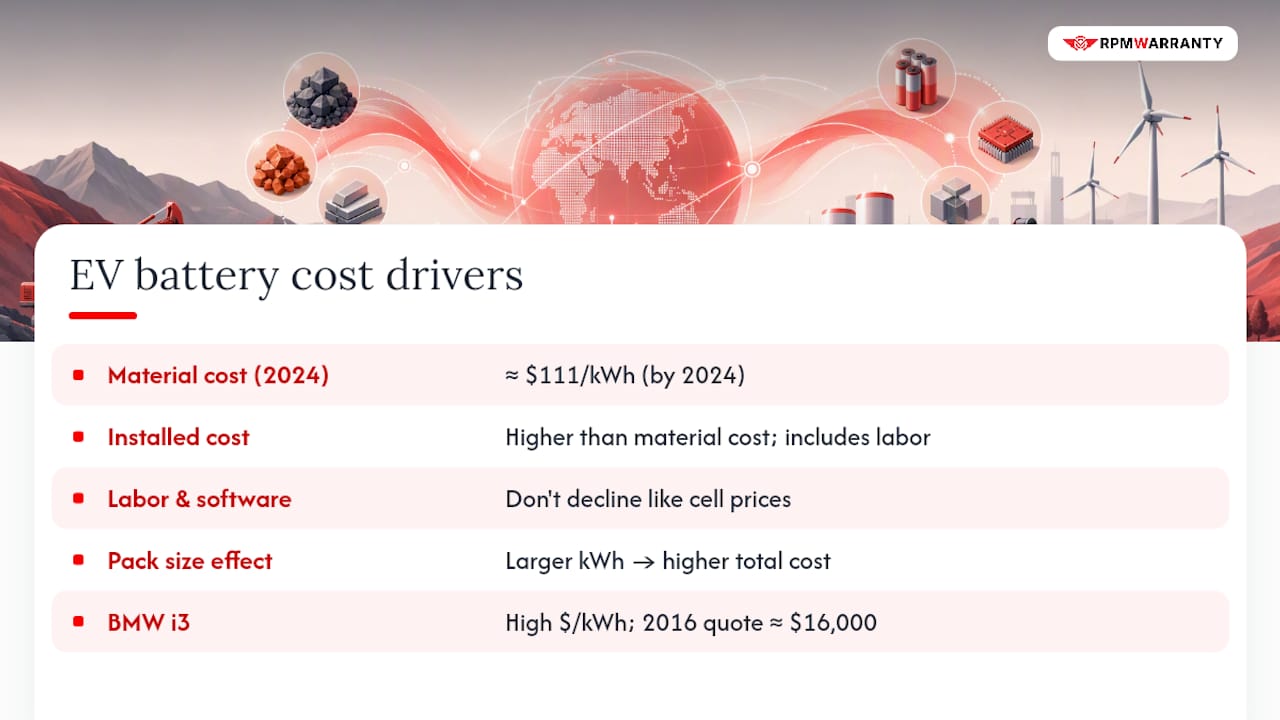
All figures below are installed estimates (battery + labor + tax) based on aggregated dealer quotes, community receipts, and published cost data. OEM pricing reflects new factory packs through authorized dealers; third-party reflects remanufactured or refurbished packs through independent shops.
The BMW i3 stands out for its high $/kWh figure despite a relatively small pack. A 2016 SAE report documented a replacement quote of approximately $16,000 for the i3 at a time when pack costs were far higher industry-wide. Prices have improved since, but the i3's proprietary architecture still limits third-party options and keeps per-kWh costs elevated compared to higher-volume models.
Cost trend note: Pack material costs have fallen sharply since 2010. The installed $/kWh figures above remain higher than raw pack costs because labor, software calibration, and shop overhead don't compress at the same rate as battery cell prices.
Why Two EVs With Similar Range Can Differ Widely in Replacement Price
Range is a poor proxy for replacement cost. A 250-mile Chevrolet Bolt and a 250-mile Tesla Model 3 can differ by $5,000–$10,000 at the shop, and the reasons are mostly invisible to the driver.
-
Pack size (kWh). Larger packs cost more in raw materials and take longer to handle physically. A 100 kWh pack is not just twice the work of a 50 kWh pack — it often requires specialized lifting equipment and more technician hours.
-
Cell chemistry. Lithium iron phosphate (LFP) cells, used in some Tesla Model 3 variants and Chevy Bolt packs, are generally cheaper per kWh to replace than nickel manganese cobalt (NMC) cells found in premium models. LFP also tends to degrade more slowly, reducing replacement frequency.
-
Pack architecture: modular vs. structural. Modular packs allow technicians to swap individual modules (sometimes $1,000–$3,000 per module) rather than the full pack. Structural packs, where the battery is load-bearing and integrated into the vehicle's chassis, require full-pack removal and often specialized tooling. Edmunds notes that module-level repairs can be a pragmatic halfway solution when faults are localized and the BMS supports recalibration. Tesla's structural pack design in newer Model Y and Model 3 variants is a well-documented example of the opposite: fewer repair options, higher labor bills.
-
Manufacturer parts-access policy. Some OEMs restrict pack sales to authorized dealers, effectively eliminating the third-party market for that model. DriveAuthority's 2026 analysis documents how this two-tier market works: open parts access creates a healthy remanufactured-pack ecosystem and lower owner costs, while restrictive policies push all repairs to dealer service centers.
-
Software and calibration work. Modern BMS software must recognize a new pack, recalibrate cell balancing, and sometimes update firmware. On some vehicles this is a 30-minute dealer procedure; on others it requires proprietary diagnostic tools that independent shops don't have access to. That gap shows up directly in your labor quote.
-
Regional labor rates. Shop rates in major metro areas can run $150–$200/hour versus $90–$120/hour in smaller markets. On a 10-hour job, that difference alone adds $600–$800 to the total.
Pro Tip: Ask your dealer or independent shop whether your vehicle uses a modular or structural pack before agreeing to any quote. Search "[your model] pack architecture" on owner forums like the Chevy Bolt EV Forum or Tesla Motors Club — members often post service manual excerpts that answer this in minutes.
How OEM Battery Warranties and Recall Coverage Actually Protect You
Hyundai and Kia go further, offering 10 years or 100,000 miles on the Ioniq 5 and EV6. Tesla extends its Model S and Model X coverage to 8 years or 150,000 miles. These terms apply to the high-voltage battery specifically, separate from the bumper-to-bumper powertrain warranty.
What the warranty actually covers matters as much as its length:
- Capacity degradation claims require documented SoH below the threshold. You'll typically need a dealer-run BMS diagnostic report showing the percentage, plus your service records. Some manufacturers also ask for charging history logs.
- Defect or failure claims (the pack stops working, not just degrades) are usually handled more straightforwardly, but still require a dealer inspection and written documentation.
- Recalls are categorically different. A recall is a safety or defect determination by the manufacturer or NHTSA, and replacement is free regardless of mileage or warranty status. The Chevy Bolt recall (related to fire risk in certain LG Energy Solution cells) resulted in free full-pack replacements for affected owners. Always run a VIN check at NHTSA.gov before paying for any battery service.
What dealers and warranty administrators typically ask for:
- Current BMS SoH readout (printed or screenshot from dealer diagnostic tool)
- Complete service and charging records
- Proof of original purchase and ownership transfer documentation (if applicable)
- Any prior battery-related service or software updates
One underappreciated wrinkle: OEM parts-access policy shapes what happens after your warranty expires. Manufacturers that restrict pack sales to authorized dealers effectively eliminate the independent repair market for your model. That means when your warranty ends, your only option may be a dealer quote at full OEM pricing. Knowing this before you buy a vehicle is genuinely useful information.
Lower-Cost Options: Remanufactured Packs, Module Repair, and Extended Protection
Full OEM replacement isn't your only path. The range of alternatives has expanded considerably, though each comes with real tradeoffs.
- OEM new pack (dealer). Highest cost, longest warranty (typically 3 years on the replacement pack), guaranteed software compatibility. The right choice when you need certainty and the vehicle is worth the investment.
- OEM remanufactured pack. Some manufacturers offer factory-reconditioned packs at a modest discount. Availability varies by model and region.
- Independent remanufactured/refurbished pack. Typically 30–50% cheaper than OEM new, according to aggregated shop data. Quality varies significantly by supplier. Ask for a written test report showing cell balance, capacity, and cycle count before agreeing to installation.
- Module-level repair. When only one or two modules have failed, a skilled independent shop can replace just those modules for $1,000–$3,000 rather than the full pack. This only works on modular architectures and requires BMS recalibration. It may not restore full original capacity, but it can recover meaningful range at a fraction of full-pack cost.
- Used/salvage pack. Pulled from a totaled vehicle, these are the cheapest option but carry the highest risk. You typically get no warranty, no test data, and no guarantee the BMS will pair cleanly with your vehicle's software. Suitable only for low-value vehicles where the economics of a better option don't work.
MotorWatt's cost trend data shows pack-level material prices have fallen steadily, which means the savings from remanufactured options are narrowing slightly as OEM prices drop. The labor cost gap, however, remains constant — a remanufactured pack installed by an independent shop still saves on both parts and hourly rate.
Savings callout: A remanufactured pack from a reputable independent supplier typically runs 30–50% less than an OEM new pack. On a $15,000 OEM quote, that's a potential $4,500–$7,500 in savings — before factoring in lower independent shop labor rates.
Questions to ask any remanufacturer or independent shop before committing:
- What is the warranty on the replacement pack, and is it transferable if I sell the vehicle?
- Can you provide a written test report showing capacity, cell balance, and cycle count?
- Does your shop have the OEM diagnostic software to complete BMS pairing and calibration?
- What is your return or remediation policy if the pack underperforms after installation?
- Will installation void any remaining OEM vehicle warranty on other components?
What a Real Replacement Looks Like: Timeline and Sample Quotes
The process from "my range dropped" to "car back in my driveway" typically takes 3–14 days, depending on parts availability and shop backlog. Here is what the stages look like in practice.
Typical replacement timeline:
- Day 1: Diagnosis. Dealer or independent shop runs a BMS diagnostic, pulls SoH data, and checks for fault codes. This usually takes 1–2 hours and may cost $100–$200 as a diagnostic fee (often waived if you proceed with repair).
- Days 2–5: Quoting and parts procurement. OEM packs may be in stock at larger dealers; independent shops ordering remanufactured packs can wait 3–7 business days for shipping.
- Days 5–10: Removal and installation. Physical removal of the old pack, installation of the new one, torque and safety checks. Ranges from 4 hours (small modular pack, experienced shop) to 20 hours (large structural pack, first time on that model).
- Day 10–14: Calibration, software update, and verification. BMS pairing, firmware update if required, test drive, and post-service range verification. Add 2–4 hours.
Sample installed quotes (aggregated from community receipts and dealer data):
All figures are installed estimates (parts + labor + tax where applicable). Labor rates reflect regional averages; your local market may vary.
When you get a quote, photograph or log:
- VIN and current odometer reading
- Itemized quote showing parts cost, labor hours, hourly rate, and tax separately
- Warranty terms on the replacement pack (years, miles, and what triggers a claim)
- Remanufacturer certificate or OEM part number for the replacement pack
- Shop's BMS calibration and software update procedure in writing
Should You Replace the Battery? A Decision Checklist
The math here is straightforward once you have two numbers: the replacement cost and the vehicle's current private-party market value. Everything else is context.
-
Get a firm installed quote first. Never make this decision on a ballpark. A written quote with parts, labor, and tax itemized is the starting point.
-
Look up your vehicle's current private-party value on a source like Kelley Blue Book or CarGurus. Use the "good condition" value, not the dealer trade-in figure.
-
Apply the 50–70% rule. If the replacement cost exceeds 50–70% of the vehicle's current market value, the financial case for replacement weakens considerably. Spending $12,000 to fix a car worth $15,000 leaves you with a repaired vehicle that may still sell for only $16,000–$17,000. The math rarely works in your favor at that ratio.
-
Apply the 30% rule in reverse. If replacement costs less than 30% of the vehicle's value and the rest of the car is in solid mechanical shape, replacing the pack is often the right call. A $9,000 replacement on a vehicle worth $35,000 is a reasonable investment.
-
Assess your actual range needs. If your daily commute is 40 miles and your degraded pack still delivers 90 miles of real-world range, you may not need a replacement at all. NPR's reporting on EV ownership documents owners who chose to live with reduced range rather than pay for a full replacement, particularly on older or lower-value vehicles.
-
Consider the alternatives before committing:
- Limited-use ownership: Keep the vehicle for short-range errands and local driving only.
- Sell as-is: A degraded EV still has value to buyers who understand the situation and want a project or a local commuter.
- Sell for parts/salvage: Motors, inverters, and other components retain value even when the pack is spent.
- Fleet or commercial conversion: Some businesses buy degraded EVs for low-speed or short-range fleet use where range is not critical.
-
Factor in remaining vehicle life. A battery replacement on a car with 180,000 miles on the suspension, brakes, and HVAC system may just shift the problem. Get a full mechanical inspection before committing to a five-figure battery repair.
How to Evaluate Extended Warranty Plans for High-Voltage Battery Coverage
Not all extended warranty contracts cover EV batteries the same way. The language in the contract is what matters, not the sales pitch. Before signing anything, work through this checklist.
What to verify in any protection plan:
- Does the contract explicitly name the high-voltage battery pack as a covered component? Vague language like "electrical components" often excludes the traction battery.
- What triggers a covered claim: outright failure, or capacity degradation below a defined threshold? Degradation coverage is rarer and more valuable.
- Are there per-claim or per-year dollar limits that could leave you exposed on a $15,000 replacement?
- Does the plan require repairs at OEM dealers only, or does it accept ASE-certified independent shops? A nationwide repair network matters when you're traveling.
- Does the plan allow remanufactured or refurbished packs, or does it require OEM new parts? This affects both claim approval speed and your out-of-pocket deductible.
- What is the deductible structure, and does it apply per visit or per repair event?
- Is the plan transferable if you sell the vehicle? Transferability adds resale value.
Questions to ask any provider directly:
- Is battery replacement covered outside the OEM warranty period, and what documentation triggers a claim?
- Are software diagnostic costs and BMS recalibration included in covered labor?
- How are labor rates handled — does the plan pay actual shop rates or a capped rate that leaves a gap?
- What are the specific exclusions? Ask for the battery-related exclusions in writing, not a verbal summary.
Red flags to watch for:
- Contract language that covers "battery" but defines it as the 12-volt auxiliary battery, not the high-voltage traction pack
- Coverage windows shorter than your expected ownership period
- No defined nationwide repair network or a network limited to a handful of dealers
- Claim approval processes that require pre-authorization with no emergency repair provision
Rpmwarranty's plans cover high-tech electrical systems and are customizable by vehicle make, model, and year, with claims processed through a nationwide network of ASE-certified mechanics. The Elite, Advanced, and Essential tiers let you match coverage depth to your vehicle's value and your risk tolerance, rather than paying for a one-size-fits-all contract. Tesla owners can review model-specific plan details before committing.
The Honest Outlook on EV Battery Longevity and Cost Trends
The conventional wisdom five years ago was that EV batteries were a ticking financial time bomb. The data has largely disproven that framing. Electrek's 2026 fleet analysis indicates that many EV batteries maintain over 90% state of health (SoH) even after substantial mileage, often outlasting the vehicles themselves. Modern BMS software and improved cell chemistry have made the early horror stories increasingly unrepresentative of what today's owners actually experience.

That said, the risk hasn't disappeared. It has concentrated. High-utilization owners and fleet operators face measurably faster degradation. Geotab's fleet analysis shows that higher vehicle utilization can accelerate battery degradation, increasing annual wear by around 0.8 percentage points compared to lower usage. Over eight years, that compounds into a meaningful SoH difference. And when a pack does fail out of warranty on a large-format vehicle like a Rivian R1T or Lucid Air, the bill can exceed $25,000.
The cost trend is genuinely encouraging. Pack material costs have fallen sharply since 2010, and that trajectory continues. But the savings don't flow evenly to owners. Structural pack designs shift costs into labor and proprietary service processes, as DriveAuthority's analysis documents clearly. The vehicles getting cheaper to repair are the ones with modular architectures and open parts access. The ones getting more expensive to repair are the ones with structurally integrated packs and manufacturer-controlled service ecosystems.
The practical takeaway: if your vehicle is within its OEM warranty window and you're not a high-utilization driver, your statistical risk of a costly out-of-warranty replacement is low. If you're approaching the end of that window on a large-pack vehicle with a structural design, an extended protection plan is a rational hedge, not a luxury purchase.
Protect Your EV Investment With the Right Coverage Before the Bill Arrives
A five-figure battery replacement is the kind of repair that turns a paid-off vehicle into a financial decision you weren't ready to make. The difference between a manageable situation and a stressful one often comes down to whether you have a plan in place before the diagnostic appointment.
Rpmwarranty converts that uncertainty into a predictable claims process with a known out-of-pocket cost. The Elite, Advanced, and Essential plan tiers cover high-tech electrical systems, engine, transmission, cooling, and more, with service through ASE-certified mechanics nationwide. There's no guessing about which shop will honor your coverage. The quote process takes minutes: submit your VIN, select your coverage tier, and get a plan customized to your vehicle's year, make, and model.
If you own a Tesla Model 3, Model S, or another high-value EV with a large pack and a structural design, the math on protection is straightforward. Get a free quote at Rpmwarranty and compare plan inclusions against your vehicle's remaining OEM warranty window before that window closes.

Sources
The following sources back the data and ranges in this guide. Each is worth bookmarking if you're actively shopping for a replacement or evaluating protection options.
- How Long Do Electric Car Batteries Last? | Recurrent Auto
- How Much Does an EV Battery Replacement Cost? | AAA Automotive
- EV battery replacement cost trends | MotorWatt
Methodology note: All "installed" figures in this guide represent the combined total of battery pack cost, labor, and applicable tax. Model rows were collated from aggregated dealer quotes, community service receipts, published cost databases, and manufacturer service documentation. Ranges reflect regional variation in labor rates and parts sourcing; your actual quote may fall outside these ranges depending on location, shop, and parts availability.