
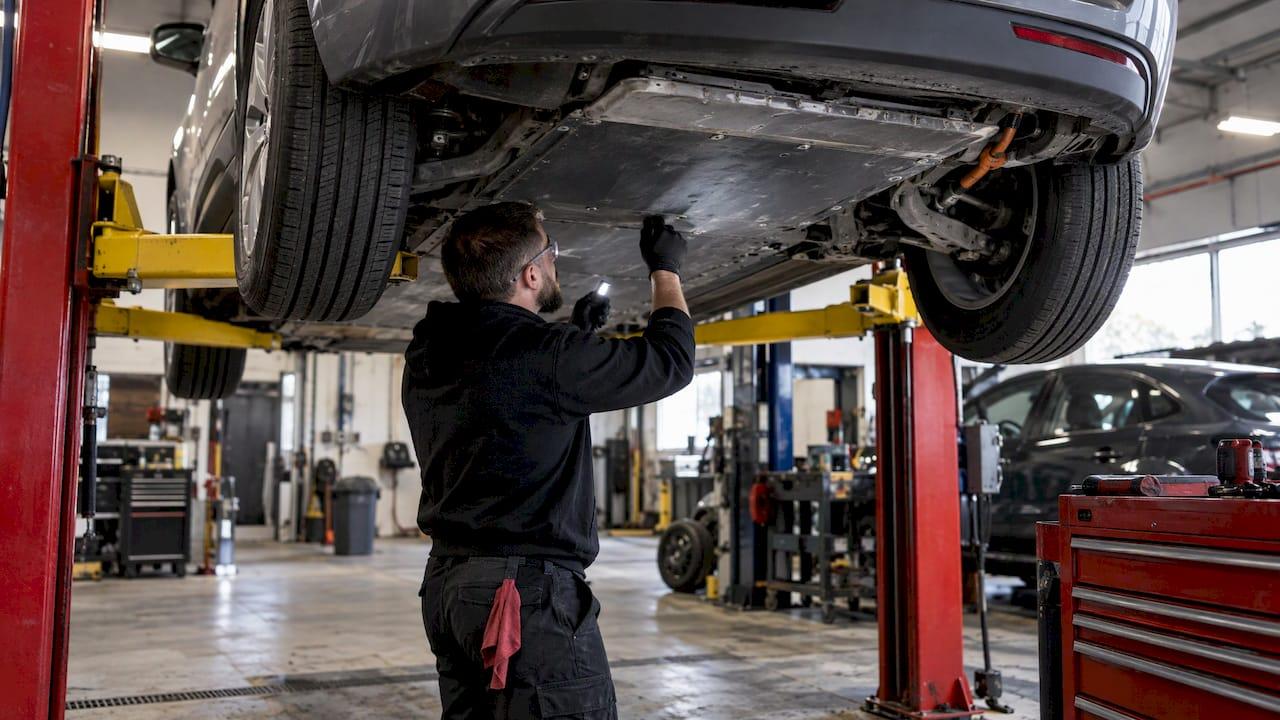
Electric vehicles cost less to maintain than gas cars, but repairs can cost more when something goes wrong. Routine upkeep is cheap because there are no oil changes or engine tune-ups. Collision repairs, high-voltage parts and out-of-warranty battery work are where the big bills show up. Below you will find the current numbers, what drives them, and how to plan for them, including on premium models from BMW, Mercedes-Benz, Porsche, Ford, Honda and Land Rover.
TL;DR
- Day-to-day EV maintenance costs less than gas-car maintenance, but a repairable collision claim still averages more for an EV than for a gas vehicle.
- A battery pack replacement outside warranty typically runs from about $4,000 on a small pack to $25,000 or more on the largest packs.
- Labor is a major driver: high-voltage work needs trained technicians, special equipment and more shop hours.
- Most EV battery warranties last 8 to 10 years or 100,000 miles, but they do not cover everything, and the rest of the vehicle is on you once factory coverage ends.
- An extended warranty plan can put a ceiling on the repair costs that fall outside factory coverage.
Table of Contents
- Do EVs cost more to repair than gas cars?
- What EV owners actually pay for
- EV battery replacement costs by pack size
- Why EV repairs cost what they do
- Premium makes: what to expect from the ownership side
- How warranties change what you pay
- Practical ways to keep EV repair costs down
- Our perspective
- Protect your vehicle before the big bill arrives
- FAQ
- Sources
Do EVs cost more to repair than gas cars?
It depends on what you count. For routine upkeep and ordinary wear, EVs come out ahead. For accident repairs and major component failures, they usually cost more.
Maintenance and wear. Consumer Reports found that EV and plug-in hybrid drivers paid about half as much for repair and maintenance as gasoline-car drivers, with an estimated $4,600 in lifetime savings against a comparable gas vehicle. The same report cited RepairPal estimates of about $900 a year for an EV by its fifth year, against about $1,200 for comparable gas cars.
Scheduled service. Kelley Blue Book reported that first-year scheduled maintenance averaged $7 for EVs and $30 for gasoline vehicles. The same study found that by 12 months, EV repair costs were about 1.6 times those of gas cars, and technicians spent 1.5 times as many hours on them.
Collision repairs. Using Mitchell data for the first quarter of 2024, Kelley Blue Book reported that the average repairable EV claim was $6,066, against $4,703 for an internal-combustion vehicle. That is a $1,363 gap, or roughly 29%.
The gap is shrinking. Mitchell's Q2 2026 report put average repairable battery-electric severity at $5,684 against $4,955 for ICE vehicles, a difference of $729. EVs were still more expensive per claim, but the trend points toward a narrower gap as more shops learn to work on them.

The practical reading: you will likely spend less on small things and more on the occasional big thing. That is exactly the pattern where planning ahead pays off.
What EV owners actually pay for
Routine items
Consumer Reports lists the usual EV maintenance items as cabin air filters, brake pads, tires, suspension parts, ball joints and steering tie-rod ends. Oil changes and engine tune-ups simply do not apply.
Tires deserve a note. EVs are heavy and deliver instant torque, so many owners find they wear tires on their own schedule. Rotating them on time and keeping pressure correct is the cheapest repair-cost strategy you have.
Major components
The expensive failures are rarely the ones people think about at purchase. Consumer Reports cited a RepairPal estimate of $6,000 to $9,000 for an electric-motor replacement and about $5,500 on average for a battery pack. Pack costs depend heavily on size, as the next section shows.
Other systems on a modern electric vehicle can add up too: onboard chargers, power electronics, thermal management and cooling loops, air or adaptive suspension, and the many sensors and modules behind driver-assistance features. Electrical and high-tech parts are a bigger share of the repair bill on an EV than on a simple gas car.
EV battery replacement costs by pack size
The battery is the number that scares buyers most. AAA's guidance on EV battery replacement gives installed ranges by capacity:
| Pack size | Typical installed cost |
|---|---|
| 20 to 30 kWh | $4,000 to $9,000 |
| 40 to 60 kWh | $7,000 to $14,000 |
| 75 to 100 kWh | $10,000 to $18,000 |
| Above 100 kWh | $15,000 to $25,000 or more |
AAA also gave model examples: $5,000 to $16,000 for a Nissan Leaf battery and $15,000 to $25,000 or more for a Rivian R1T pack. It says battery cost varies chiefly with make and model, pack size and chemistry, while labor varies with vehicle design, region and service provider.
This matters most for premium vehicles. Higher-end EVs tend to carry larger packs for more range and performance, which puts them toward the right-hand end of that table.
Repair, refurbish or replace
A full replacement is not always the only route. Grist reported that Cox Automotive estimated a refurbished battery generally costs about half as much as a new one, though availability and repairability depend on the automaker and pack design. The same article noted that an older Tesla Model S replacement could exceed $15,000, and that some battery repairs at an independent shop were estimated at more than $10,000.
It also made a safety point worth repeating: battery repair needs high-voltage training, protective equipment and specialized lifting equipment. It is not a driveway job. If a warning light or a range drop appears, take the vehicle to a qualified shop.
How long batteries last
The U.S. Department of Energy's Alternative Fuels Data Center says EV batteries eventually wear out, that comprehensive failure data is not available, and that many manufacturers provide eight-year, 100,000-mile battery warranties. Consumer Reports noted that battery packs generally last at least eight to 10 years. Most owners will never pay for a full pack, but a small share will, and the bill arrives all at once.
What the "80% rule" means for repairs
You will see "the 80% rule" mentioned in two ways. One is a charging habit: many owners stop daily charging around 80% to preserve the pack and save time at fast chargers. The other is the capacity threshold in battery warranties. AAA says battery warranties typically repair or replace a pack at no cost when capacity falls below 70%, not 80%, and the exact number is set by each manufacturer. Check your own warranty booklet for the figure that applies to your car.
Why EV repairs cost what they do
Four things push the totals up, and knowing them helps you decide where to save.
Labor hours. Mitchell data reported by Kelley Blue Book showed average mechanical labor of 3.04 hours for EVs against 1.66 hours for ICE vehicles. The reason is that the high-voltage system may need to be de-energized, and sometimes the pack has to come out.
Labor rates. Kelley Blue Book also reported that EV technician hourly rates were about 1.3 times those for gas-car technicians, reflecting extra certification and specialized work.
Where the work happens. In a German claims analysis, Allianz Zentrum für Technik found that authorized workshops handled 58% of battery-electric repairs against 48% of petrol-vehicle repairs, and charged about 50% more per hour than independent shops. That study is German, so treat it as an indicator of the pattern rather than a U.S. price. Still, many U.S. owners of newer EVs also end up at dealers because few independent shops have the training.
Parts mix. The same analysis reported that high-voltage components made up 7% of battery-electric replacement-parts costs, and up to 20% for some models. Comparable petrol-vehicle parts, such as the catalytic converter and fuel tank, made up 1%.
On a premium EV, add the technology layer: radar, cameras and ultrasonic sensors that often need calibration after even a minor repair, plus adaptive suspension and large wheels and tires.

Premium makes: what to expect from the ownership side
You asked about specific brands, so here is how the cost factors above play out across the vehicles our customers ask about. These are general patterns rather than quoted repair prices for any one model.
BMW and Mercedes-Benz
BMW's i-series and Mercedes-Benz's EQ lineup are packed with electronics: large central displays, driver-assistance sensors, adaptive lighting and software-controlled systems. The trade-off for that refinement is that a failed module or sensor is more costly to diagnose and replace than a mechanical part. Air or adaptive suspension, common on higher trims, adds another wear item. Repairs typically go through brand-trained technicians, which means higher labor rates.
Porsche
Porsche's electric Taycan pairs a large battery pack with performance hardware: powerful brakes, wide high-performance tires and sophisticated thermal management. Each of those parts is built for speed and priced accordingly. Under the AAA ranges above, a large premium pack sits at the top of the table.
Range Rover and other luxury SUVs
Large luxury SUVs, whether fully electric or plug-in hybrid, bring weight, air suspension and complex electrical architecture. Heavier vehicles are harder on tires and brakes, and hybrid systems add a second powertrain to keep healthy: engine, electric motor, battery and the electronics linking them.
Ford and Honda
Mainstream EVs such as the Ford Mustang Mach-E and the Honda Prologue tend to have lower parts costs than the luxury names, and wider dealer networks help with access to service. They still share the core EV exposure: a high-voltage battery, power electronics and sensor-heavy safety systems. A mainstream badge reduces the average bill, not the chance of a large one.
In short, the more advanced and larger the car, the more a single failure costs. That is the case for covering the vehicle before the factory warranty ends.
How warranties change what you pay
Your factory warranty is the first line of defense. AAA says most EV battery warranties last eight to 10 years or up to 100,000 miles, whichever comes first. They cover defects and excessive capacity loss. Accident damage and poor maintenance are not covered.
Two gaps are worth planning for:
- The rest of the car. Battery coverage is not the same as full-vehicle coverage. Basic factory coverage commonly ends sooner than the battery warranty, which leaves electronics, suspension, steering, charging hardware and cooling systems on you.
- The period after the battery warranty. Once you pass the mileage or age limit, a replacement is yours to pay for.
That is the gap an extended vehicle warranty is built to fill. Our plans are designed to protect against the cost of repairs after the manufacturer's coverage ends, across components such as the engine, transmission, cooling system, electrical system, steering, suspension, hybrid systems and high-tech electronics. Which components a plan includes depends on the tier and the vehicle, so confirm the covered-parts list for your exact year, make and model when you get a quote.
Practical ways to keep EV repair costs down
- Follow the maintenance schedule. AAA notes that poor maintenance can void battery warranty claims. Cabin filters, brake fluid, coolant for the battery loop and tire rotations are inexpensive.
- Keep service records. A clean paper trail makes claims smoother.
- Choose qualified technicians. High-voltage systems require training. Skilled, certified mechanics protect you and your car.
- Mind your charging habits. Avoiding constant 100% charges and relying less on fast charging are common ways owners try to preserve battery health.
- Cover collisions with the right insurance. EV claims average more than gas claims, so check your collision limits and deductible.
- Decide on coverage before you need it. Plans are priced on the vehicle's current condition and mileage, so the best time to look is while the car is healthy.
Our perspective
We talk with owners of everything from daily commuters to six-figure luxury vehicles, and the same pattern shows up with electric and hybrid models. The routine costs shrink, which feels great, and then one high-voltage or electronics repair eats the savings of several years.
That is why we built our plans around the parts that cost the most: engines, transmissions, cooling, electrical systems, steering, suspension, hybrid systems and high-tech electronics. Elite, Advanced and Essential let you match coverage to your vehicle and your budget, and the four-step process of consultation, plan selection, customization and final agreement keeps the terms clear from the start.
Our approach is designed around straightforward plans without hidden fees, nationwide service through ASE-certified mechanics, and a claims process built for fast decisions, with approvals targeted at 24 to 48 hours. Roadside assistance and rental reimbursement help when a repair keeps you off the road.
Our advice: do not wait for the factory coverage to run out. Look at your plan options while the car is in good shape, and pick the level that fits how you drive and what your vehicle's technology would cost to fix.
Kenneth
Protect your vehicle before the big bill arrives
If your vehicle is nearing the end of its factory coverage, or you bought it used, our Elite, Advanced and Essential plans give you tiered options for the repairs that hit hardest. Plans can be customized to your vehicle's year, make and model, and riders get their own options with Full Throttle motorcycle coverage.

Ready to see what fits your car? Get a free quote and compare coverage in minutes.
FAQ
Do EV cars cost more to repair?
Usually, per collision repair, yes. Mitchell's Q2 2026 data put the average repairable battery-electric claim at $5,684 against $4,955 for ICE vehicles. On routine maintenance and general repairs across ownership, EVs have tended to cost less, with Consumer Reports estimating $4,600 in lifetime savings.
What is the 80% rule for EV?
It most often refers to charging to about 80% for daily use, a habit many owners follow to ease wear on the pack and save time at fast chargers. Battery warranties use a separate capacity threshold. AAA says that threshold is typically 70%, set by the manufacturer.
Which part of an EV is most expensive to fix?
The high-voltage battery pack. AAA's installed ranges start around $4,000 for small packs and reach $15,000 to $25,000 or more for packs above 100 kWh. Electric motors are also costly, with a RepairPal estimate of $6,000 to $9,000 cited by Consumer Reports.
Does a factory EV warranty cover everything?
No. Battery warranties typically run eight to 10 years or 100,000 miles and cover defects and excessive capacity loss, not accident damage or poor maintenance. Other systems fall under separate, usually shorter coverage, which is where an extended warranty plan helps.
Sources
- Pay Less for Vehicle Maintenance With an EV, Consumer Reports
- Study: EVs Cost 30% More to Repair, Kelley Blue Book
- Study: EVs Cost More to Repair, Less to Maintain, Kelley Blue Book
- Plugged-In: EV Collision Insights Q2 2026, Mitchell
- How Much Does an EV Battery Replacement Cost? AAA
- Maintenance and Safety of Electric Vehicles, Alternative Fuels Data Center
- EV battery repair is dangerous, Grist
- Influence of electromobility and driver assistance systems, Allianz Zentrum für Technik