

Most drivers pay several hundred to several thousand dollars a year for an extended car warranty, or varyingly priced monthly premiums, depending on coverage level and vehicle type. Coverage tier, your vehicle's age and mileage, and the deductible you choose move that number more than anything else. Before signing anything, get at least two or three quotes and read the exclusions list line by line.
TL;DR:
- Extended car warranties typically cost between $1,068 and $3,588 annually, influenced heavily by coverage type, vehicle age, mileage, and risk factors.
- Powertrain plans cover key components like the engine and transmission at the lowest cost, while bumper-to-bumper plans offer the most comprehensive coverage at the highest price.
- Higher premiums usually reflect the vehicle's repair risk, with luxury brands and vehicles with advanced electronics commanding significantly higher prices.
- Deductible choices and contract length significantly impact yearly costs, with higher deductibles and longer terms generally reducing upfront payments.
- Buying a warranty makes more sense for high-repair-cost luxury vehicles or when ownership extends past typical failure windows, especially if factory coverage expires.
Table of Contents
- How Much Does an Extended Car Warranty Cost?
- What Does Coverage Type Do to the Price?
- What Factors Actually Move Your Quote?
- How Do Payment Plans Change What You Actually Pay?
- Is an Extended Warranty Worth the Cost?
- How Do You Estimate Your Own Extended Warranty Cost?
- What Does Rpmwarranty Offer, and How Does the Process Work?
- What's the Real Yardstick for Deciding?
- Get a Free Quote and See Your Real Number
- Where to Verify This Information Yourself
- Sources
How Much Does an Extended Car Warranty Cost?
The FTC is blunt about this: auto service contracts, which is the legal term for what most people call an "extended warranty," are optional products sold by dealers, manufacturers, or independent companies, and prices vary widely. That's not a hedge. It's the honest starting point for anyone shopping this category in 2026.
Pricing surveys back that up with real numbers. CoverageX's 2026 data puts annual costs anywhere from about $1,068 to $3,588 depending on coverage and how you pay, with a common cluster around $1,548 to $1,897 a year for mid-tier plans. Insurify reports a monthly average closer to $90, while USA TODAY's reporting lands between $70 and $180 a month. None of these figures contradict each other. They're measuring different slices of a market where a Honda Civic with 40,000 miles and a Range Rover Sport with 70,000 miles simply do not belong on the same price line.
Here's what that spread looks like over time:
- 1 year: roughly $1,068 to $3,588, depending on coverage tier and vehicle
- 3 years: roughly $3,200 to $10,800 at the low, median, and high ends
- 5 years: roughly $5,300 to $18,000, though most buyers choose shorter terms tied to their expected ownership window
Pro Tip: Deductibles typically run $0, $100, or $200 per visit, and choosing a $200 deductible over a $0 deductible can shave 10 to 20 percent off your premium. If you rarely file more than one or two claims a year, that trade almost always favors the higher deductible.
The gap between a $1,068 quote and a $3,588 quote usually comes down to one thing: how much of the car is actually covered, and how the provider prices risk on that specific make and model.
What Does Coverage Type Do to the Price?
Extended warranties come in three broad tiers, and the difference between them is the difference between "covered" and "sorry, that's not on the list" when your transmission starts slipping at 78,000 miles.
Powertrain plans cover the engine, transmission, and drivetrain, the parts most likely to cause a five-figure repair bill. They're the cheapest tier, often running $800 to $1,500 a year, because they exclude electrical systems, air conditioning, infotainment, and most sensors.
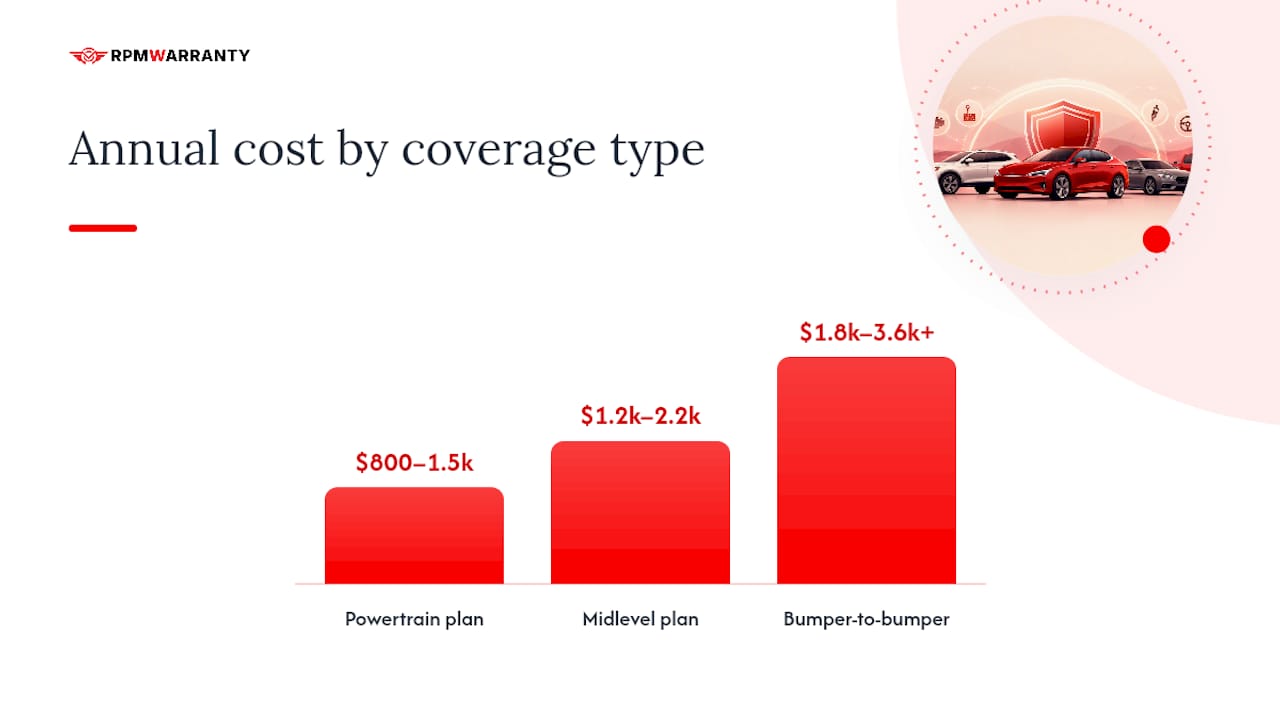
Midlevel plans add coverage for systems like air conditioning, fuel delivery, steering, and some electrical components. Expect to pay somewhere between $1,200 and $2,200 a year for this middle ground.
Bumper-to-bumper plans (sometimes called exclusionary coverage) cover nearly everything except a short, named list of exclusions, typically wear items like brake pads, tires, and wiper blades. These run $1,800 to $3,600 a year and up, especially on vehicles with complex electronics.
- Powertrain: engine, transmission, drive axle. Lowest cost, narrowest protection.
- Midlevel: powertrain plus AC, electrical, fuel system. Middle cost, middle protection.
- Bumper-to-bumper: nearly full coverage with named exclusions. Highest cost, broadest protection.
- Common add-ons: roadside assistance, rental car reimbursement, and trip interruption coverage, each typically adding $50 to $150 a year.
Consumer Reports flags a detail that catches a lot of buyers off guard: exclusionary language increasingly targets modern high-tech components. On a BMW X5 or a Mercedes GLE with advanced driver-assistance sensors, lane-keep cameras, and hybrid battery packs, check specifically how the contract treats those parts before you assume "bumper-to-bumper" means what it sounds like.
What Factors Actually Move Your Quote?
Some inputs are fixed the moment you buy the car. Others you still control. Knowing which is which keeps you from arguing with a quote that's actually just reflecting your vehicle's repair-cost profile.
Make and model set the floor. A Honda Accord and a Porsche Cayenne are not priced the same way, and they shouldn't be. Luxury brands with proprietary parts, dealer-only diagnostic tools, and complex air suspension or turbocharged systems, think Range Rover, Mercedes, BMW, and Porsche, tend to carry higher premiums because their average repair ticket is higher. A blown air suspension compressor on a Range Rover can run $1,500 or more in parts and labor; a comparable Ford Escape doesn't have that failure point at all. Warranty providers price around exactly this kind of risk.
Mileage and age move you between bands. Most providers use mileage brackets: under 36,000 miles, 36,000 to 75,000, 75,000 to 100,000, and beyond. Crossing from the second bracket into the third can add several hundred dollars a year to the same coverage tier, because the odds of a claim rise sharply once major components pass their typical failure window.
Deductible and term length trade against each other. A shorter term with a low deductible costs the most per year but the least in surprise expenses. A longer term with a $200 deductible spreads cost out but raises what you pay per visit.
Maintenance records matter more than most buyers realize. Providers can and do deny claims when a vehicle's service history has gaps, especially on timing belts, transmission fluid, and coolant flushes. Keep every receipt.
Regional labor rates shift the math too. A transmission rebuild in a major coastal metro costs more in labor than the same job in a smaller Midwest market, and providers factor that into regional pricing.
- Vehicle make and typical repair cost (luxury vs. economy)
- Current mileage and age bracket
- Deductible choice ($0, $100, $200)
- Contract term length (12, 24, 36, or more months)
- Documented maintenance history
- Regional labor rates
Pro Tip: Keep every service receipt in one folder, digital or physical, from day one. When a claim gets disputed, "we changed the oil at the dealership" doesn't help you. A dated invoice does.
How Do Payment Plans Change What You Actually Pay?
Warranty providers usually offer three ways to pay: monthly, annual, or a single upfront payment. They are not the same deal wearing different clothes.
- Monthly plans spread cost over the contract term but often carry an administrative fee or built-in markup, sometimes pushing the effective annual cost 5 to 10 percent higher than paying upfront.
- Annual payments avoid monthly fees and are the most common way providers quote their base price, the figures cited earlier from Insurify and USA TODAY reflect this.
- Financed or prepaid multi-year plans roll the full term into one payment, sometimes with interest if financed through a third party, so a $1,800 annual plan financed over 24 months at interest can end up costing $150 to $250 more than paying cash.
Before signing, scan the paperwork for cancellation fees, a "transfer fee" if you sell the car, and any administrative charge buried in the monthly breakdown. Those line items rarely show up in the headline price you were quoted over the phone.
Is an Extended Warranty Worth the Cost?
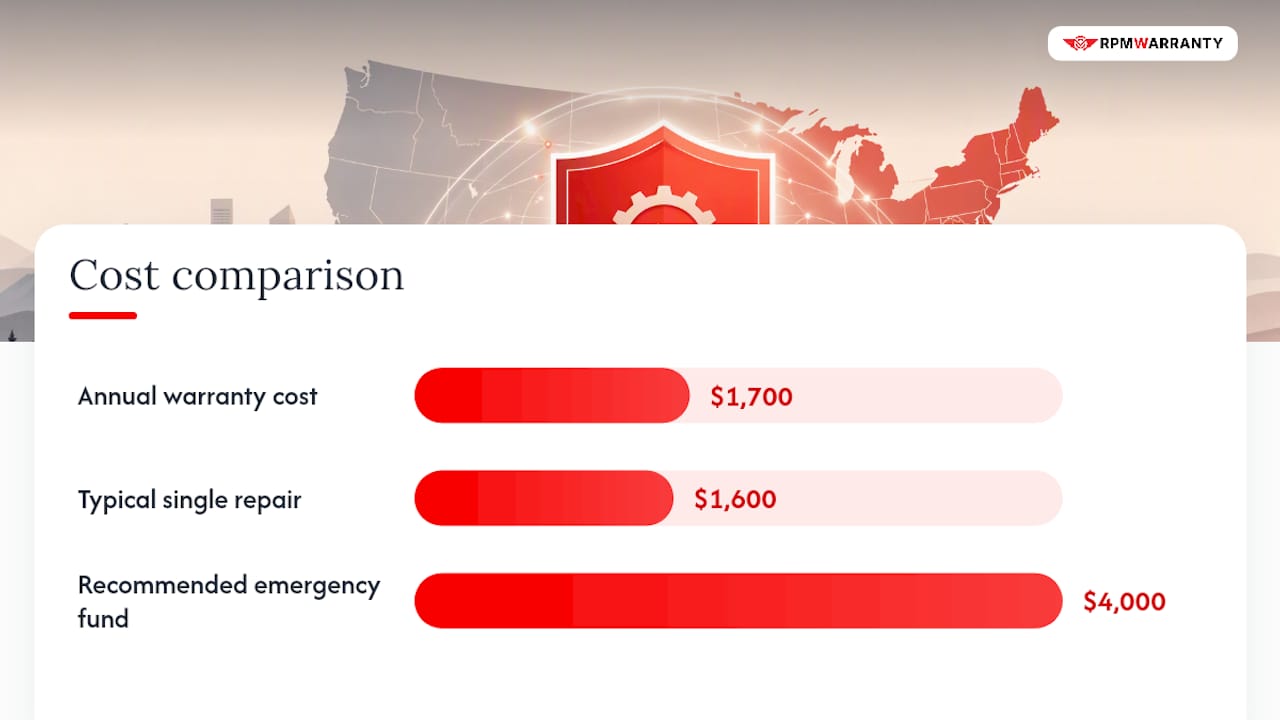
Consumer Reports found that extended warranties often cost more than the direct repair benefit a typical buyer receives, and recommends weighing an emergency fund as the alternative. That's a fair warning, not a blanket "never buy one." The math depends entirely on your specific vehicle and situation.
It tends to pay off when:
- You own a vehicle with historically expensive repairs, luxury brands with air suspension, turbocharged engines, or hybrid drivetrains fall here.
- You don't have $3,000 to $5,000 in accessible savings for a surprise repair.
- You plan to keep the car well past 75,000 miles, past the point where major components start failing more often.
It tends to be skippable when:
- Your vehicle has a strong reliability record and a low average repair cost, many Honda and Toyota models included.
- Substantial factory warranty coverage remains.
- You already carry a solid emergency fund and would rather self-insure.
Case one: A 2022 BMW 5 Series at 58,000 miles, out of factory warranty, with a midlevel plan at $1,700 a year. One electrical repair (a common BMW pain point involving iDrive modules or sensor faults) can run $1,200 to $2,000 alone. One claim nearly breaks even on the plan's annual cost.
Case two: A 2021 Honda CR-V at 45,000 miles, still under factory bumper-to-bumper coverage, with a strong reliability history. Buying a warranty now duplicates existing coverage and pays for protection against a repair risk that's statistically low. Consumer Reports notes the smarter move is buying protection while a newer vehicle is still under factory warranty, not stacking a redundant policy on top of one that's already active.
How Do You Estimate Your Own Extended Warranty Cost?
You can build a rough personal estimate before you ever request a quote, and it takes about ten minutes.
- Gather your vehicle details: VIN, model year, make, model, current mileage, and a summary of your maintenance history (regular oil changes, any prior major repairs).
- Start with a coverage-tier baseline: use roughly $900 for powertrain, $1,600 for midlevel, or $2,500 for bumper-to-bumper as your starting point.
- Apply a mileage multiplier: add 10 to 15 percent to your baseline if you're between 75,000 and 100,000 miles; add 20 percent or more above 100,000 miles.
- Apply a vehicle-class adjustment: add 15 to 30 percent for luxury or high-repair-cost brands (Range Rover, Mercedes, BMW, Porsche); economy brands like Honda and Ford typically stay closer to baseline.
- Adjust for deductible: subtract roughly 10 percent for a $200 deductible versus a $0 deductible.
- Multiply by your term: multiply your adjusted annual figure by 3 or 5 to get your total 3-year or 5-year cost estimate.
Example: A 2023 Ford Explorer at 68,000 miles, midlevel coverage, $100 deductible. Baseline $1,600, no mileage adjustment yet, no luxury adjustment, minor deductible reduction. Estimate lands near $1,500 a year, or about $7,500 over five years.
Pro Tip: Run this math before you call anyone. When a salesperson quotes you $2,400 for a plan you estimated at $1,500, that gap is your opening line for negotiation, not a number to accept at face value.
What Does Rpmwarranty Offer, and How Does the Process Work?
Rpmwarranty structures coverage into three tiers, Elite, Advanced, and Essential, so you can match protection depth to your vehicle's age, mileage, and your own budget rather than accepting one-size pricing. Each tier scales coverage across the systems that cause the most expensive repair bills: engine, transmission, cooling, electrical, steering, suspension, and, for newer vehicles, the high-tech electronics and hybrid systems that many contracts quietly exclude.
The process runs in four steps: a consultation to understand your vehicle and driving habits, plan selection across the three tiers, customization to add roadside assistance or rental reimbursement, and a final agreement you can review before committing.
Coverage is backed by a nationwide network of ASE-certified mechanics, meaning your car doesn't need to visit one specific shop to get warranty-eligible repairs. Rpmwarranty also provides free quotes upfront, so you can compare real numbers against the estimate math above before deciding anything.
What's the Real Yardstick for Deciding?
Most people overthink the "is it worth it" question by treating every vehicle the same. It isn't a math problem with one universal answer. It's a bet you're placing on your specific car's repair history against how long you plan to keep it. If you're driving a vehicle known for one or two catastrophically expensive failure points, and you plan to own it past the point those failures typically show up, the math tilts toward coverage almost every time.
The contract red flags I'd watch hardest for: vague pre-approval language that lets a provider deny a claim after the fact for "failure to get authorization," aggressive depreciation clauses that pay out less on parts the older your car gets, and repair-network restrictions that quietly funnel you to specific shops instead of letting you use a trusted local mechanic.
Before signing anything, check three things: does the contract name your exact deductible per visit, does it specify how claims get pre-approved, and does it list which repair centers you're allowed to use.
— Kenneth
Get a Free Quote and See Your Real Number
Rpmwarranty works best for two kinds of owners: people planning to keep a vehicle well past the 75,000-mile mark, and owners of higher-repair-cost vehicles where one major failure could otherwise wipe out a year of savings. If your Range Rover, BMW, Mercedes, or Porsche is aging out of factory coverage, or your Honda or Ford is approaching six figures on the odometer, that's exactly the window where a warranty quote is worth ten minutes of your time.
The next step is simple: request a free quote and compare it directly against the estimate math above. Ask for the deductible options in writing, request the claims process explained before you sign, and compare term lengths side by side rather than just the sticker price. If your vehicle is a Volkswagen or another make with specific known failure points, Rpmwarranty's model-specific coverage pages break down how plans get tailored by make and model. Start at Rpmwarranty to see current plan tiers and get your numbers in hand before your factory coverage runs out.
Where to Verify This Information Yourself
The FTC's consumer guide explains your legal rights and what sellers must disclose. The CFPB clarifies how service contracts differ from manufacturer warranties. Consumer Reports offers independent buying advice, while CoverageX, Insurify, and USA TODAY provide current pricing data. Before buying anywhere, check the provider's complaint record and ask for a sample contract in writing.