

An extended car warranty is worth it — sometimes. The honest answer depends on three things: how expensive your car is to repair, how much cash you have sitting in reserve for emergencies, and how long you plan to keep the vehicle.
- Repair-cost exposure: A BMW 5 Series or Range Rover with a failed air suspension or transfer case can cost several thousand dollars for repairs. A Honda Civic with a bad alternator might cost a few hundred dollars. The math is completely different.
- Emergency-fund capacity: If a $4,000 repair bill would genuinely derail your finances, a warranty functions as risk insurance. If you have $15,000 liquid, you may be better off self-insuring.
- Vehicle complexity and brand: High-tech European and luxury vehicles carry far higher parts and labor costs than mainstream Japanese models. Consumer Reports finds warranties are often overpriced for reliable, simple cars — but genuinely useful for owners of complex or unreliable vehicles.
Key Takeaways
An extended car warranty is worth buying when your vehicle's repair exposure exceeds your emergency-fund capacity — especially for luxury, European, or high-tech vehicles past 60,000 miles.
| Point | Details |
|---|---|
| Verdict: sometimes worth it | Worth buying for complex or luxury vehicles; less so for reliable, simple cars with strong savings. |
| Optimal timing | Buy before 60,000 miles or while the factory warranty is still active to lock lower rates. |
| Typical cost range | Many buyers pay several hundred to a few thousand dollars total |
| Top red flag | Vague component definitions and no named insurance obligor are the clearest signs of a poor contract. |
| Rpmwarranty option | Elite, Advanced, and Essential plans with direct pricing, ASE-certified shops, and a free online quote. |
Table of Contents
- Which drivers and vehicles actually benefit from extended coverage?
- What does a vehicle service contract actually cover?
- How much does an extended warranty cost?
- How to decide: a step-by-step process for your specific car
- Contract red flags that predict poor value
- How claims, cancellations, and transfers work
- Alternatives to buying an extended warranty
- The case for transparency over marketing
- Rpmwarranty offers coverage built around your specific vehicle
- Sources
Which drivers and vehicles actually benefit from extended coverage?
Not every car owner gets equal value from a vehicle service contract. Four profiles consistently come out ahead.
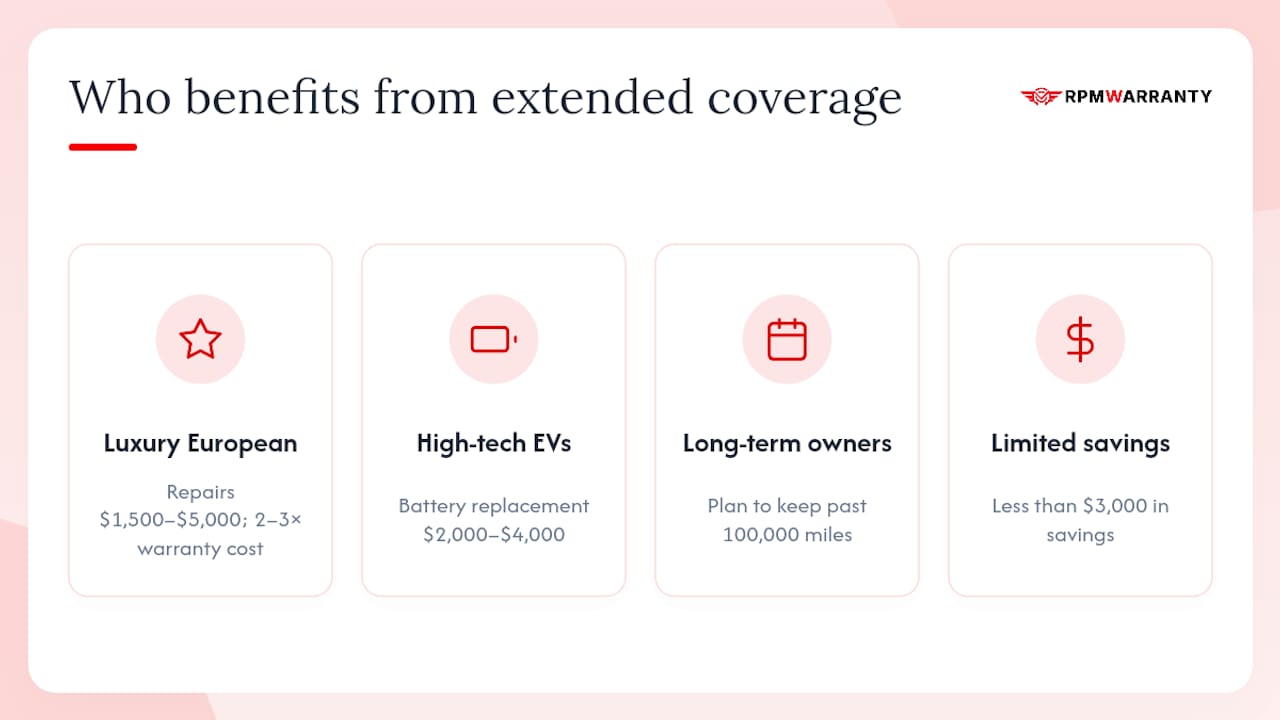
Luxury and European vehicle owners face a different cost reality than most. A Mercedes-Benz E-Class air suspension repair runs $1,500–$3,000. A Porsche Cayenne transfer case replacement can exceed $5,000. BMW's iDrive electronics and Range Rover's air ride systems are notorious for expensive failures once the factory warranty expires. CarSavr's analysis shows European luxury models often cost 2–3 times more to warranty than mainstream Japanese models — and that premium reflects real actuarial differences in parts cost, labor rates, and claim frequency.
Owners of high-tech hybrids and EVs face a similar exposure. A Toyota Prius hybrid battery replacement runs $2,000–$4,000 out of pocket. Ford's hybrid and plug-in systems carry complex power electronics that most independent shops won't touch. If your vehicle has advanced driver-assistance systems, a single radar or camera module can cost $1,500 to replace. Coverage that specifically includes hybrid battery modules and high-tech electronics changes the calculus significantly.
Long-term owners who plan to keep a vehicle past 100,000 miles are the clearest beneficiaries. Factory powertrain warranties typically expire at 60,000–100,000 miles, and that's precisely when repair frequency climbs. Owners who trade every three years rarely collect enough in claims to justify the premium.
Drivers with limited repair savings — say, less than $3,000 in accessible cash — benefit most from the financial certainty a warranty provides. You're not buying expected monetary gain; you're buying predictability. Many buyers pay $1,200–$1,800 more in premiums than they recover in claims, according to Dr. Vin's reporting, but for someone who can't absorb a surprise $4,000 bill, that premium buys real peace of mind.
Pro Tip: Lock in coverage while your factory warranty is still active — ideally between months 30–36 of ownership or before 60,000 miles. Waiting past these thresholds raises premiums materially and can eliminate your eligibility for the broadest plan tiers.
What does a vehicle service contract actually cover?
A vehicle service contract (VSC) — the industry term for what's commonly sold as an "extended warranty" — is a service agreement, not a manufacturer guarantee. The two terms are used interchangeably in the market, but VSC is the legally precise label.
Three main plan structures exist:
Powertrain plans cover the engine, transmission, and drive axles only. They're the cheapest option and the most limited. A failed air conditioning compressor or power steering rack won't be covered.
Stated-component plans list every covered part explicitly. If a component isn't named, it isn't covered. These plans vary enormously in scope — a thin stated-component plan might cover only 50 parts, while a generous one covers several hundred.
Exclusionary plans (sometimes called "bumper-to-bumper" or inclusionary plans) cover everything except a specific list of exclusions. This is the broadest coverage available and the closest equivalent to a factory warranty. Exclusionary plans typically cost 15–25% more than comparable stated-component plans, but they generate far fewer coverage disputes at claim time — a meaningful advantage for owners of complex vehicles.
Common exclusions to know
- Wear-and-tear items: brake pads, rotors, tires, wiper blades, filters, belts
- Pre-existing conditions (anything that failed before the contract start date)
- Maintenance requirements: missed oil changes can void claims
- Software updates and electronic calibrations
- Aftermarket parts or modifications
- Cosmetic damage and interior trim
Add-ons worth considering
- Roadside assistance: towing, lockout, flat tire service — often included in higher tiers
- Rental reimbursement: covers a loaner while your car is being repaired
- Hybrid/EV-specific modules: battery coverage, inverter, and power electronics
- Emissions coverage: useful in states with strict inspection requirements
Cars emphasizes that coverage terms — not provider brand — are the decisive variable. Read the actual contract, not the marketing summary.
How much does an extended warranty cost?
MarketWatch's secret-shopping and survey data found average extended warranty costs vary widely, with many buyers paying several hundred to a few thousand dollars total; some pay more for luxury or high-mileage vehicles.
The purchase channel deserves special attention. Dr. Vin's investigation found that dealer Finance and Insurance (F&I) offices commonly mark up third-party service contracts substantially compared to administrator wholesale prices. The coverage is often identical to what you'd buy direct — you're just paying for the dealer's margin.
Pro Tip: Always get a quote directly from the warranty administrator or a direct-to-consumer provider before walking into a dealer's F&I office. Bring that quote with you. Having a competing number often helps negotiate a better dealer price.
How to decide: a step-by-step process for your specific car
NerdWallet recommends a three-step framework: estimate repair exposure, check reliability and mileage, then compare multiple quotes. Here's that process in concrete steps.
-
Gather your vehicle data. Note the year, make, model, mileage, and remaining factory warranty. This determines your plan eligibility and baseline pricing.
-
Check reliability records. Look up your model's repair frequency and average repair cost on sources like Consumer Reports or owner forums. A 2019 Honda CR-V and a 2019 Land Rover Discovery are not the same risk profile.
-
Estimate your repair exposure. Think about what could realistically fail over the next 3–5 years. For a 2017 BMW 3 Series with 65,000 miles, common failure points include the water pump ($800–$1,200), iDrive control unit ($1,500–$2,500), and high-pressure fuel pump ($1,000–$1,800). A single electronics failure alone could exceed $2,500.
-
Run a break-even calculation. If a three-year exclusionary plan costs $2,400 total and your realistic repair exposure is $4,000+, the warranty pays. If your car is a 2018 Toyota Camry with a $1,500 total repair exposure over the same period, a $1,800 premium doesn't pencil out.
-
Compare your premium against your emergency fund. If you have $8,000 in savings and your likely repair exposure is $3,000, self-insuring is rational. If your savings are thin, the warranty's predictability has real value even if the expected-value math is neutral.
-
Get at least three quotes. Compare identical coverage definitions, deductible structures, and claim rules — not just the monthly payment. A $50/month plan with a $200 deductible and a narrow stated-component list may cost more at claim time than an $80/month exclusionary plan with a $100 deductible.
Contract red flags that predict poor value
Most warranty disappointments trace back to contract language, not the provider's reputation. Before signing, watch for these warning signs.
- Vague component definitions: phrases like "engine internals" without a specific parts list leave room for claim denial
- Long waiting periods: 30–60 days before coverage activates means you're exposed right after purchase
- High excluded-item frequency: a stated-component plan that excludes most of what actually fails on your model
- Non-transferability: a non-transferable contract reduces your car's resale value and eliminates a selling point
- Restrictive repair shop rules: plans that limit you to a single network or require pre-authorization from a specific call center add friction at the worst moment
- High cancellation penalties: some contracts charge a flat fee or forfeit a large portion of unused premium
- No financial backing disclosure: ask who the obligor is — the administrator, an insurance company, or the dealer. If the dealer is the obligor and they close, your contract may be worthless
- Persistent premium increases: some contracts allow rate escalation after year one
Before you sign, do this:
- Request the full sample contract in writing, not a brochure
- Ask whether the plan is backed by a licensed insurance company or an unregulated administrator
- Confirm the plan is accepted at ASE-certified shops nationwide, not just a proprietary network
- Get the cancellation and refund terms in writing — specifically the pro-rata refund formula
- Confirm transferability requirements and any transfer fees
How claims, cancellations, and transfers work
Understanding the claims process before you need it saves real frustration.
-
Diagnose the problem. Take your vehicle to an ASE-certified repair shop. The shop performs a diagnostic and identifies the failed component.
-
Get authorization. The shop contacts the warranty administrator — not you — to request repair authorization. This step can take anywhere from a few hours to one business day. Keep your maintenance records accessible; many contracts require proof of regular oil changes before approving engine-related claims.
-
Repair and payment. Once authorized, the shop completes the repair. The administrator pays the shop directly in most cases. You pay only your deductible.
-
Disputed claims. If a claim is denied, ask for the denial in writing with the specific contract clause cited. Many denials are overturned when the customer pushes back with documentation.
Cancellations: Most contracts allow cancellation within the first 30 days for a full refund. After that, refunds are typically pro-rata — you receive a portion of the unused premium minus a cancellation fee. MarketWatch's survey data found that 46% of buyers who cancel cite cost as the primary reason, and 61% of buyers originally purchased for coverage peace of mind. Read the escalation clause: some contracts allow the administrator to raise your rate at renewal, which is the most common trigger for cancellation.
Transfers: A transferable contract adds value to your car at resale. The new owner inherits the remaining coverage, which is a genuine selling point. Transfer typically requires notifying the administrator in writing within 30 days of the sale and paying a transfer fee ($50–$150 is common). Confirm these requirements before you buy — non-transferable contracts are a hidden cost.
Alternatives to buying an extended warranty
A warranty isn't the only way to manage repair risk. Three alternatives are worth considering seriously.
-
Self-insuring: Instead of paying a monthly premium, deposit that same amount into a dedicated repair savings account. If your premium would be $100/month, you'd accumulate $3,600 over three years. Dave Ramsey's position — and the Fox Business coverage that echoes it — is that warranties carry low loss ratios, meaning a significant share of premiums go to overhead and profit rather than claims. Self-insuring works well for owners of reliable vehicles with strong savings discipline.
-
Certified pre-owned (CPO) coverage: If you're buying a used vehicle, a manufacturer-certified pre-owned program often includes an extended factory-backed warranty at no additional cost. CPO coverage is backed by the manufacturer, uses OEM parts, and has no third-party administrator risk. The trade-off is a higher purchase price and limited vehicle selection.
-
Targeted single-component coverage: Some providers offer coverage for specific high-cost components — hybrid battery protection, for example, or a standalone powertrain plan for a vehicle you're keeping only two more years. This can be more cost-effective than a comprehensive plan when your risk is concentrated in one system.
-
Prepaid maintenance plans: These cover scheduled services (oil changes, tire rotations, brake inspections) rather than mechanical failures. They're not a substitute for breakdown coverage, but they reduce out-of-pocket maintenance costs and help maintain the service records that warranty claims often require.
Self-insuring makes the most sense for owners of reliable, low-complexity vehicles — a well-maintained 2020 Honda Accord or Toyota Camry with 40,000 miles and $10,000 in savings. It makes the least sense for a 2019 Range Rover Sport with 55,000 miles and a thin emergency fund.
The case for transparency over marketing
Most extended warranty articles focus on which provider has the best marketing. The more useful question is whether the contract language is honest and the claims process is fair.
The financial case for a warranty is rarely about expected monetary gain. Most buyers pay more in premiums than they recover in claims — that's how any insurance product sustains itself. What a warranty actually buys is financial certainty: the ability to absorb a $5,000 repair without disrupting your budget or going into debt.
That framing changes the evaluation entirely. The right question isn't "will I come out ahead?" It's "can I absorb the worst-case repair cost without this coverage?" For a Porsche Panamera owner with $5,000 in savings, the answer is almost certainly no. For a Toyota Prius owner with $20,000 in savings, the math usually favors self-insuring.
The signal I look for in any warranty product is contract transparency: clear component definitions, a named insurance obligor, straightforward cancellation terms, and no restrictive shop network. Those four things predict claims experience better than any marketing claim.
Rpmwarranty offers coverage built around your specific vehicle
When the decision math points toward buying coverage, the next question is where to buy it. Rpmwarranty offers three tiered plans — Elite, Advanced, and Essential — designed to match different vehicles, budgets, and risk profiles. Elite covers the broadest range of components, including high-tech electronics, hybrid battery systems, and advanced driver-assistance modules. Advanced hits the mid-range with strong powertrain and electrical coverage. Essential focuses on core mechanical systems for owners who want foundational protection at a lower monthly cost.
Every plan includes roadside assistance and rental reimbursement, and all repairs go through ASE-certified mechanics nationwide — no proprietary shop network that limits where you can take your car. Rpmwarranty sells direct, which means no dealer F&I markup on top of the administrator price. Coverage is customizable by vehicle year, make, and model, so a BMW 5 Series owner and a Ford F-150 owner get plans priced to their actual risk, not a one-size average.
Get a free quote at Rpmwarranty to see plan options and pricing for your specific vehicle. If you have questions about what each tier covers, the Rpmwarranty FAQ walks through plan details, the claims process, and cancellation terms in plain language.
Sources
The sources below are the primary references used for price benchmarks, reliability context, and buying guidance in this article. Each serves a distinct purpose.
- Should You Get an Extended Warranty for Your Car? - Consumer Reports
- Extended car warranty cost (MarketWatch)
- Best Extended Car Warranty Companies of 2026
- Do I Need an Extended Car Warranty? 3 Steps to Decide - NerdWallet
- Extended Warranty Cost by Car Brand — 2026 Real Quotes | CarSavr
- Used Car Extended Warranties: Worth It or a Waste? | Dr. Vin
- Are Extended Warranties Worth It? - Ramsey Solutions
- Dave Says Don’t Waste Money Buying Warranties | Fox Business