

Most factory warranties run about 3 years or 36,000 miles, with powertrain coverage stretching 5 to 10 years. Extended warranty length typically adds 2 to 7 years or extends protection to 100,000 to 150,000 miles, depending on the plan. Nearly every contract carries a waiting period and excludes pre-existing problems, so the clock you start matters as much as the length you buy.
TL;DR:
- Longer warranty plans beyond 3 years or 36,000 miles are more cost-effective if you plan to keep a high-maintenance vehicle or reach extensive mileage, but unnecessary for simple daily drivers.
- Factory bumper-to-bumper coverage typically expires at 3 years or 36,000 miles, while powertrain protection lasts 5 to 10 years, so choosing a plan aligned with your vehicle’s repair risk is crucial.
- High-cost vehicles like BMW, Mercedes, or Range Rover benefit from extended coverage that includes electrical and high-tech systems, especially if ownership exceeds 7 years or 100,000 miles.
- Buying warranty coverage before factory plans end reduces costs and avoids exclusions from pre-existing issues, which are not covered once the contract starts.
- Customization based on your vehicle’s make, age, mileage, and how long you intend to own it offers better value than defaulting to the longest available plan or buying late.
Table of Contents
- How Manufacturer Warranties Differ From Extended Service Contracts
- What Extended Warranty Terms Actually Look Like
- What Should Actually Decide Your Warranty Length
- When to Buy, Cancel, or Transfer Coverage
- How RPM Warranty Matches Coverage Length to Real Ownership Plans
- Pick Your Warranty Length in Five Minutes
- Get a Term Length Quote Built Around Your Vehicle
- Sources
- FAQ
How Manufacturer Warranties Differ From Extended Service Contracts
A factory warranty comes bundled with the car. It is not something you shop for. An extended warranty, sometimes called a vehicle service contract, is a separate agreement you purchase from a dealer, an automaker, or an independent administrator to cover repairs after that factory coverage runs out or narrows.
The legal distinction matters more than most buyers realize. A manufacturer's warranty is a promise from the company that built the car. An extended service contract is a commercial agreement, and its terms, exclusions, and claims process depend entirely on whoever wrote it. The Consumer Financial Protection Bureau notes that new car factory coverage commonly runs 3 years or 36,000 miles for bumper-to-bumper protection, while powertrain coverage often extends 5 to 10 years.
That gap between bumper-to-bumper and powertrain terms is exactly where extended plans do their work. Once you understand the layered structure, the rest of the decision gets easier:
- Bumper-to-bumper factory coverage protects nearly everything but wears out fastest, usually at 3 years/36,000 miles.
- Powertrain factory coverage protects the engine, transmission, and drivetrain far longer, often 5 to 10 years.
- Extended service contracts can start the moment you buy the car, kick in right when factory coverage ends, or overlap it for added protection.
- Transferability varies by provider. Some plans transfer to a new owner at resale, which can raise resale value; others do not.
A Range Rover owner facing air suspension or electrical gremlins at year four has already outlived the bumper-to-bumper window. A Honda Accord owner at the same mileage mark is usually still inside powertrain coverage. The length that makes sense for one is wasted money for the other.
What Extended Warranty Terms Actually Look Like
Shopping for coverage means choosing a combination of years and mileage, not just a single number. The two move together, and whichever limit hits first ends the contract.
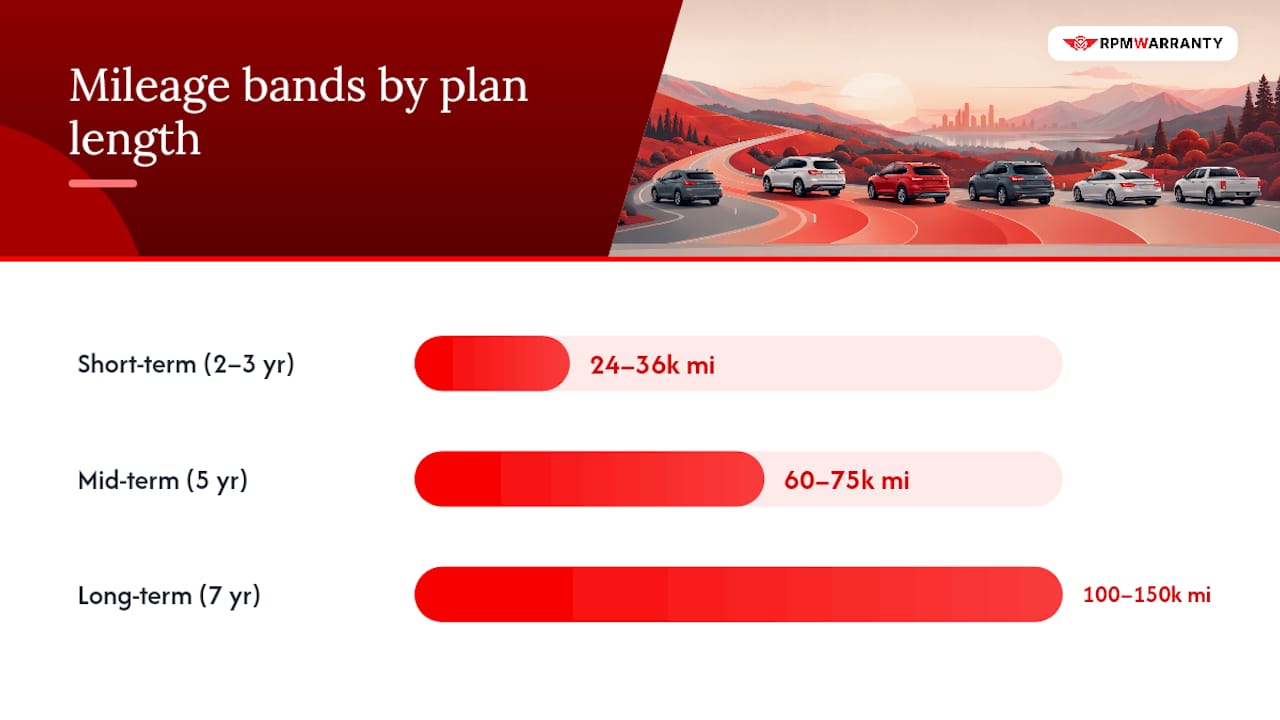
- Short-term plans (2 to 3 years / 24,000 to 36,000 miles): These usually bridge a small gap right after factory bumper-to-bumper coverage expires. They suit owners who plan to sell within a few years and just want continuity without overpaying.
- Mid-term plans (5 years / 60,000 to 75,000 miles): The most common sweet spot. This range typically overlaps with when major factory powertrain coverage tapers off on some brands and catches the early wave of expensive repairs.
- Long-term plans (7 years / 100,000 to 150,000 miles): Built for owners who intend to keep a vehicle well past the point where most manufacturer coverage has expired entirely. These cost more upfront but spread that cost over more years of ownership.
Mileage bands matter as much as the year count. A 5-year/100,000 mile plan and a 5-year/60,000 mile plan sound similar but cover very different driving patterns. A high-mileage commuter in a BMW 5 Series will hit 60,000 miles in under three years, effectively shortening that "5-year" plan to whichever limit arrives first.
Coverage format changes the math too. A full wrap plan mimics bumper-to-bumper protection across nearly every system, while a powertrain-only plan covers just the engine, transmission, and drivetrain. Wrap warranties exist specifically to fill the gap between a short bumper-to-bumper term and a longer powertrain term, which is common on vehicles where those two clocks run at different speeds. If your factory powertrain warranty outlasts your bumper-to-bumper coverage by several years, a wrap plan timed to that gap protects the electrical and comfort systems that powertrain-only plans ignore.
What Should Actually Decide Your Warranty Length
The right term length comes down to three variables: what you drive, how long you plan to keep it, and how much repair risk you can absorb without flinching.
Vehicle make matters enormously here. Certain makes with high average repair costs tend to justify longer coverage for owners planning to pass 100,000 miles. A BMW's electronically controlled air suspension, a Mercedes-Benz's air-mass sensors and adaptive suspension components, or a Range Rover's terrain-response electronics can each run well into four figures per repair. A Honda Civic or Ford F-150, by contrast, has a shallower repair-cost curve, which changes how much extended coverage is worth paying for.
Here is a simple way to think through the decision:
- Estimate your ownership horizon. If you plan to sell in 3 years, a short-term plan aligned to that window beats paying for years you won't use.
- Map your mileage pace. A driver who covers 20,000 miles a year needs a higher mileage ceiling, not just more calendar years.
- Weigh your vehicle's repair-cost profile. High-complexity luxury vehicles justify longer terms more easily than mechanically simpler daily drivers.
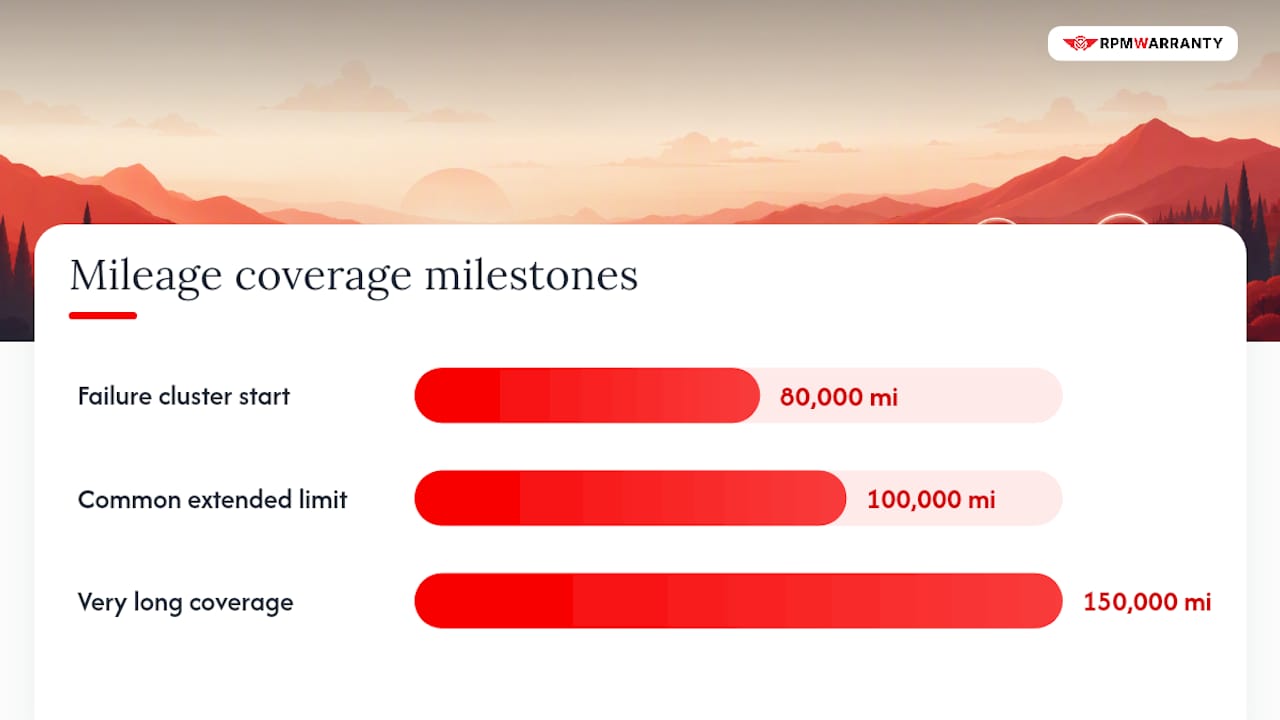
Repair frequency isn't evenly distributed across a vehicle's life. Expensive failures cluster heavily in the 80,000 to 100,000-mile range, once factory bumper-to-bumper coverage is long gone and components have logged real wear. A term that covers you through that window captures most of the financial benefit, even if it doesn't stretch to 150,000 miles.
Price scales with length, but not proportionally. A 7-year term costs more upfront than a 3-year term, yet its cost per year of coverage is often lower because administrative and underwriting costs get spread across more months. The tradeoff: very long contracts shift more risk onto the provider, which makes provider financial stability worth checking before you sign anything that runs 7 years or past 100,000 miles.
Pro Tip: A higher deductible lowers your monthly or upfront premium and can make a longer term affordable. Pick a deductible you could pay out of pocket tomorrow, not one that only looks good on paper.
When to Buy, Cancel, or Transfer Coverage
Timing changes both your price and your options more than most buyers expect.
Buying while your factory warranty is still active is almost always the better move. The FTC advises that purchasing before that original coverage lapses typically means lower pricing and continuous protection, since the vehicle hasn't accumulated the wear that makes insurers nervous.
A few operational rules to know before you sign anything:
- Cancellation and refunds: Most contracts allow cancellation with a prorated refund based on time or mileage used, minus a cancellation fee. Read the fine print before you assume you'll get most of your money back.
- Transfer at resale: Many plans transfer to a new owner for a small fee, which can be a genuine selling point when you list the car. Confirm this in writing, not from a sales pitch.
- High-mileage eligibility: Buying coverage after 100,000 to 150,000 miles is possible with some providers, but expect a required inspection and often a waiting period, sometimes 30 days or 1,000 miles, before claims are accepted.
- Pre-existing exclusions: Any problem that existed or was diagnosable before the contract started is excluded from coverage, which is exactly why the inspection step exists on higher-mileage vehicles.
Buying under pressure at the dealership finance desk rarely gets you the best term or price. Shopping while your factory warranty still has time left gives you leverage you lose the moment that coverage runs out.
How RPM Warranty Matches Coverage Length to Real Ownership Plans
Extended warranty providers often structure their tiers around tradeoffs like ownership length, repair risk, and budget.
- Elite targets owners who want the broadest component coverage paired with longer terms, suited to higher-complexity vehicles like a Porsche Cayenne or Mercedes-Benz GLE where electrical and high-tech systems carry real repair exposure.
- Advanced sits in the mid-term range, balancing meaningful coverage breadth with a more moderate price, a fit for owners planning to keep a vehicle 5 to 7 years past factory coverage.
- Essential covers core mechanical systems for owners who want a shorter, lower-cost bridge past their factory warranty's expiration.
- Full Throttle applies the same tiered logic to motorcycle owners who need coverage matched to their own riding and ownership timeline.
Plans can be customized based on vehicle specifics, and a typical process includes consultation, plan selection, customization, and final agreement to help match term length to an individual's driving pattern instead of a default dealer recommendation.
Roughly 8 in 10 extended warranty buyers never end up calling a claims line before the contract lapses, based on industry claims-frequency patterns, which is exactly why matching term length to real ownership plans, rather than buying the longest available option out of anxiety, tends to produce better value.
Pick Your Warranty Length in Five Minutes
Most owners overthink this decision.
First, how long will you actually keep this car? Second, how much financial risk can you absorb from a single failed transmission or air suspension unit? Third, what does your specific vehicle's repair-cost profile actually look like?
Here's how that plays out for three different drivers. A BMW X5 owner planning to keep the vehicle 8 or more years should lean toward a long-term plan, 7 years or 100,000+ miles, because electronic air suspension and turbocharger repairs on that platform get expensive right when factory coverage runs dry. A Honda CR-V owner planning to sell in 3 years is better served by a short-term plan that simply bridges the gap after bumper-to-bumper coverage ends. A used car buyer whose factory warranty has already expired needs a plan that starts protecting immediately, no gap, no overlap, since there's no factory coverage left to wait out.
The mistake I see most often isn't choosing the wrong length. It's buying too late. Pro Tip: Buy before you need it, because every provider excludes pre-existing conditions, and a "known issue" you've already noticed will never be covered no matter how long the term is.
— Kenneth
Get a Term Length Quote Built Around Your Vehicle
RPM Warranty prices coverage around your actual vehicle and ownership plan, not a one-size-fits-all term. A Porsche 911 owner keeping the car a decade needs a different length and coverage mix than a Ford F-150 owner selling in three years, and pretending otherwise is how people overpay or come up short on coverage.
Getting a quote takes a few basic details: your vehicle's year, make, model, and current mileage. From there, RPM Warranty matches you to a tier, Elite, Advanced, or Essential, or Full Throttle if you're covering a motorcycle, based on how long you plan to own the vehicle and what kind of repair exposure it carries. Before you sign anything with any provider, confirm three things in writing: the waiting period before coverage activates, the deductible per claim, and the exact list of excluded components. RPM Warranty's process walks through consultation, plan selection, customization, and final agreement so those terms are clear before you commit. Request a free quote and see what term length actually fits your car and your plans for it.
Sources
- What are the differences between a manufacturer’s warranty and an extended vehicle warranty or service contract? - Consumer Financial Protection Bureau
- Auto warranties and auto service contracts - Federal Trade Commission
- Cars
- Extended warranties for cars are an expensive game - Consumer Reports
FAQ
How Much Does a 100,000-Mile Extended Warranty Cost?
Pricing varies by vehicle make, model, and coverage tier, so there's no single flat rate; RPM Warranty provides an exact figure once you submit your vehicle's year, make, model, and mileage through a free quote.
Is a 2-Year Extended Warranty Worth It?
A 2-year term makes sense mainly as a short bridge right after factory bumper-to-bumper coverage expires, especially if you plan to sell the car soon; owners keeping a vehicle longer usually get better value from a 5 to 7 year term.
Can I Cancel My Extended Warranty After 2 Years?
Most contracts allow cancellation at any time with a prorated refund based on unused time or mileage, minus a cancellation fee, so check your specific contract's refund formula before assuming a full refund.
Can You Buy an Extended Warranty After 150,000 Miles?
Some providers still offer coverage past 150,000 miles, but expect a required vehicle inspection, a waiting period before claims are accepted, and exclusions for any pre-existing issues found during that inspection.