

TL;DR:
- Buying Porsche Vehicle Service Protection during the factory warranty preserves OEM parts and dealer service, especially for resale. Third-party plans like Rpmwarranty offer flexible, nationwide coverage through ASE-certified mechanics, often at a lower cost. Owners should compare coverage details, network limitations, and costs to determine the best protection option for their driving needs.
For most Porsche owners in North America, the smartest move is to layer your options: buy Porsche Vehicle Service Protection (VSP) while your factory warranty is still active if you want OEM parts and dealer-network continuity, or go with Rpmwarranty if you need flexible nationwide coverage through ASE-certified shops without being locked into a Porsche Center. Both paths are legitimate. The right one depends on how you drive, where you live, and what you plan to do with the car.
Quick scenarios:
- Low-mileage new owner prioritizing resale: Porsche VSP or Porsche Approved Warranty keeps your service history clean and maintains OEM parts documentation.
- High-mileage daily driver who wants cost control: A tiered third-party plan like Rpmwarranty's Elite or Advanced tier covers costly electronics and driveline systems without dealer-only restrictions.
- Owner far from a Porsche Center: Rpmwarranty's nationwide ASE-certified network means you're not driving 90 minutes for every warranty repair.
Before you call anyone, have your VIN, current odometer reading, and factory warranty end date ready. That's all you need to get an accurate quote from either a dealer or Rpmwarranty's quote page.
Table of Contents
- What Porsche's official extended plans actually cover
- How third-party plans differ from manufacturer coverage
- What drives the price of a Porsche extended warranty
- Is an extended warranty worth it for your Porsche?
- How to buy, extend, or transfer coverage for your Porsche
- How claims and repairs work: dealer vs. independent shop
- How Rpmwarranty's plans work for Porsche owners
- Key Takeaways
- The part most Porsche owners get wrong about extended warranties
- Rpmwarranty: flexible Porsche coverage with nationwide reach
- Useful sources for verifying coverage terms
What Porsche's official extended plans actually cover
Porsche offers two main dealer-backed protection paths: Vehicle Service Protection (VSP) and the Porsche Approved Warranty tied to its Certified Pre-Owned program.
VSP is the more flexible of the two. Coverage runs concurrently with your factory warranty and can extend protection up to 10 years or 100,000 miles, using genuine OEM Porsche parts or like-kind-and-quality replacements for covered repairs. You can buy it at vehicle purchase or while still under the factory warranty, though eligibility conditions vary by state. The plan typically comes in Powertrain and Platinum tiers. Powertrain covers the engine, transmission, and driveline. Platinum adds suspension, brakes, select electronics, and in applicable models, hybrid battery systems.

Deductibles commonly run $100 or $250 per visit. One detail worth knowing: some manufacturer-backed plans waive the deductible entirely if the repair is completed at the selling dealer, which can add up to real savings over a multi-year term.
The Porsche Approved Warranty applies specifically to CPO vehicles and typically extends coverage for up to two years with unlimited miles in many dealer descriptions, though exact terms vary by model year and eligibility. The 111-point inspection required for Porsche Approved certification is part of what makes this path attractive for used-car buyers: you're getting a documented mechanical baseline alongside the warranty.
Key coverage points for both official plans:
- Engine, transmission, and driveline components
- Suspension and steering systems
- Brakes and brake-assist electronics
- Select infotainment and sensor systems (Platinum tier)
- Hybrid battery coverage where applicable
- Repairs performed by Porsche-trained technicians at authorized Porsche Centers
- OEM or like-kind-and-quality parts guaranteed
Always read the actual Vehicle Service Contract for your state. Exclusions, aggregate claim caps, and electronics coverage definitions differ, and a brochure summary is not the same as the binding contract language.
Statistic: Porsche VSP extends protection for many years or miles, covering components from the engine to complex electronics depending on the plan tier selected.
How third-party plans differ from manufacturer coverage
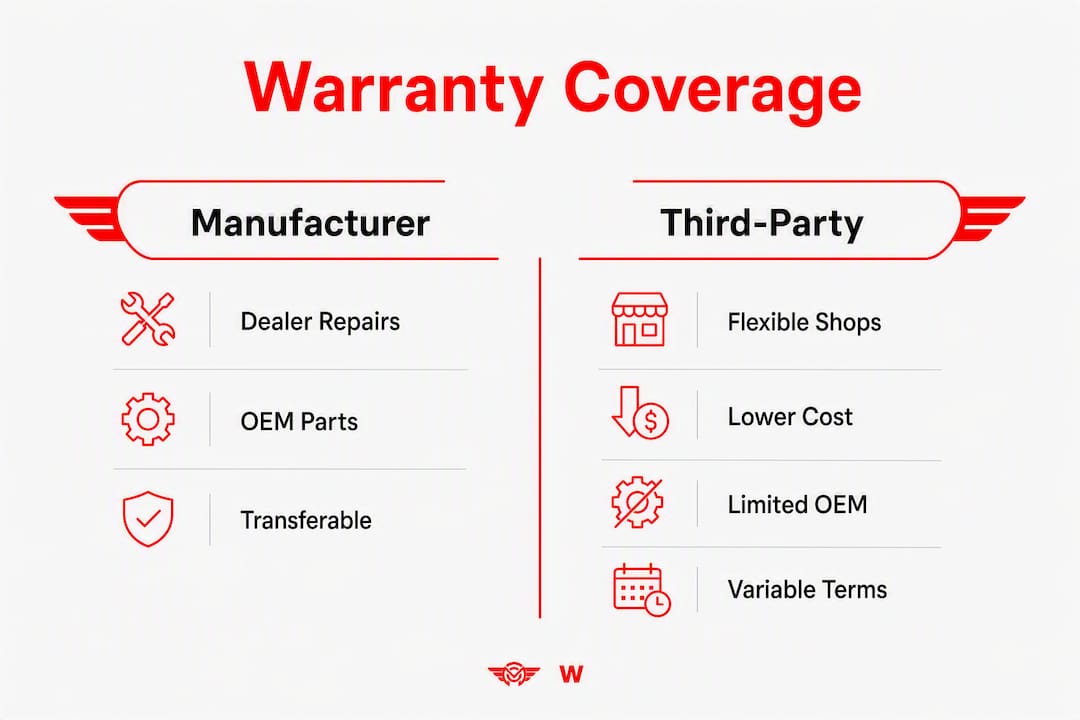
Third-party extended warranties trade the certainty of dealer-only repairs and guaranteed OEM parts for two things: lower price and shop flexibility. Whether that trade is worth it depends entirely on your situation.

Third-party plans typically allow you to use independent shops, not just Porsche Centers. This matters enormously if you live outside a major metro area or simply prefer a trusted independent mechanic. The catch is that most third-party contracts require pre-authorization before a repair begins, and some operate on a reimbursement model rather than paying the shop directly. That distinction is not minor. If you're facing a $4,000 transmission repair, fronting that cost and waiting for reimbursement is a very different experience than the shop billing the warranty company directly.
Pros of third-party coverage:
- Repair-shop flexibility, including independent ASE-certified mechanics
- Often lower upfront cost than dealer-backed plans
- Can sometimes cover older or higher-mileage vehicles that no longer qualify for VSP
- Enrollment possible after factory warranty expires (subject to inspection)
Cons and risks:
- Aftermarket or non-OEM parts may be used unless the contract specifies otherwise
- Pre-authorization requirements can delay repairs
- Reimbursement-only models require out-of-pocket payment upfront
- Electronics and sensor coverage varies widely; some plans exclude it entirely
- Claims processes differ significantly between providers
Pro Tip: Before signing any third-party contract, find the exact definition of "authorized repair facility" in the agreement. Also confirm whether the provider pays the shop directly or reimburses you, and check whether ECUs, infotainment systems, and advanced driver-assist sensors are explicitly listed as covered components. These three clauses determine most of the real-world value of the plan.
For Porsche owners who prioritize resale value and a clean OEM service history, the dealer route has a clear edge. For owners who drive long distances, live far from a Porsche Center, or want cost flexibility, a well-structured third-party plan from a provider like Rpmwarranty can cover the same critical systems without the geographic restriction.
What drives the price of a Porsche extended warranty
Price is the variable that surprises most owners. Automoblog reports an average annual cost around $1,348 for Porsche extended warranty coverage, but that figure is a midpoint in a wide range. Dealer-backed Platinum plan quotes on certain models can reach several thousand dollars depending on term length and vehicle configuration. Owner forum reports consistently show multi-thousand-dollar quotes for extended coverage on turbocharged models like the 911 Turbo or Cayenne Turbo S E-Hybrid.
The variables that move the price most:
| Cost Driver | Effect on Price |
|---|---|
| Vehicle model and engine type | Turbocharged and hybrid models cost significantly more to cover |
| Vehicle age | Older vehicles carry higher risk; premiums rise accordingly |
| Current mileage | Higher mileage at enrollment increases cost and may limit eligibility |
| Coverage tier (Powertrain vs. Platinum/Elite) | Comprehensive tiers cost significantly more than basic powertrain-only plans |
| Deductible amount | A $250 deductible lowers the plan premium vs. a $100 option |
| Electronics and hybrid system inclusion | Adding ECU, sensor, and hybrid battery coverage raises cost noticeably |
| Repair network (dealer-only vs. independent) | Dealer-only plans often carry higher premiums |
| Optional perks (roadside, rental reimbursement) | Each add-on increases the total plan cost |
The practical way to evaluate any quote: divide the total plan cost by the number of years covered, then compare that annual figure against what a single major repair would cost out of pocket. A Porsche ECU replacement or hybrid battery service can run well into four figures. If your plan costs $1,500 per year and covers those systems, one avoided repair often justifies the entire term.
Is an extended warranty worth it for your Porsche?
It depends on the car and how you use it. Here's a decision checklist to work through before you commit.
Decision checklist:
- How long do you plan to own the car? Plans pay off most for owners keeping a vehicle 4+ years beyond the factory warranty.
- What's your annual mileage? High-mileage drivers accumulate wear on turbos, suspension, and electronics faster.
- Which model do you own? A 911 GT3 with a naturally aspirated engine has a different risk profile than a Cayenne Turbo S E-Hybrid with a complex hybrid system and twin turbos.
- How close are you to a Porsche Center? If the nearest dealer is 60+ miles away, a plan requiring dealer-only repairs has a practical cost beyond the deductible.
- What are your resale goals? OEM-backed coverage with documented dealer service history supports resale value more than a third-party plan.
- Are you comfortable with the electronics exposure? Modern Porsches carry advanced driver-assist sensors, multi-zone infotainment, and multiple ECUs. These systems cause repairs that can quickly exceed the cost of a warranty plan, and not all plans cover them.
Pros of buying coverage:
- Predictable repair budget, especially for turbocharged and hybrid models
- OEM parts and dealer service history preserved (manufacturer plans)
- Transferable to new owner, which can support asking price at resale
- Roadside assistance and rental reimbursement included in most plans
Cons:
- Upfront cost is real, and not every owner will use the coverage fully
- Dealer-only repair requirements limit flexibility
- Some plans have aggregate caps that limit total payout over the term
Two quick owner archetypes: a low-mileage 911 collector who drives 4,000 miles per year and stores the car seasonally has limited exposure to high-frequency wear items. A Macan owner commuting 18,000 miles annually in a northern climate faces suspension, turbo, and electronics wear at a much faster rate. The math looks very different for each.
How to buy, extend, or transfer coverage for your Porsche
The simplest time to buy is during the factory warranty or at CPO purchase. After that, options still exist, but third-party providers may require an inspection or impose mileage caps before they'll enroll an older vehicle.
Step-by-step purchase process:
- Gather your documents: VIN, current odometer reading, factory warranty end date, maintenance records, and any existing inspection reports.
- Request quotes from at least two sources: Your Porsche dealer for VSP pricing, and Rpmwarranty for a third-party comparison.
- Compare coverage scope, not just price: Check which components are listed, whether electronics are included, and what the deductible structure looks like.
- Confirm the repair network: Ask explicitly whether repairs can be done at independent shops or only at Porsche Centers.
- Ask about OEM parts: Get written confirmation of the parts standard used for covered repairs.
- Negotiate VSP pricing at the dealer: Dealer-backed plans often have pricing flexibility, especially when bundled at purchase.
- Review the full Vehicle Service Contract: Not the brochure. The actual contract, including exclusions, aggregate caps, and claims procedures.
Documents to have ready:
- Vehicle VIN
- Proof of ownership (title or registration)
- Current factory warranty documents
- Maintenance records (especially for older vehicles)
- Recent inspection report if required by the provider
- Current odometer reading
On transferability: Most manufacturer-backed VSP plans are transferable to a subsequent owner, which adds real value at resale. Third-party plans vary. Ask for the transfer fee and process in writing before you buy. On cancellation, most plans offer a prorated refund if you cancel mid-term, though administrative fees typically apply.
How claims and repairs work: dealer vs. independent shop
Manufacturer plans pay the Porsche Center directly and require OEM or like-kind-and-quality parts. Third-party plans may pay the shop directly or reimburse you after the fact, depending on the contract.
Typical claims workflow:
- File the claim: Contact the warranty provider before authorizing any repair. Most plans require pre-authorization.
- Diagnostic authorization: The shop submits a diagnostic report; the provider approves or denies coverage for the specific failure.
- Repair approval: Once approved, the shop proceeds. Approval timelines vary from same-day to 48 hours depending on the provider.
- Documentation: Keep all repair orders, diagnostic reports, and parts invoices. These are required if a claim is disputed.
- Payment: Manufacturer plans typically pay the dealer directly. Third-party plans either pay the shop or issue reimbursement to you.
Deductible behavior: Under some manufacturer-backed plans, the deductible is waived if the repair is done at the selling dealer. At any other Porsche Center, the standard deductible applies. Third-party plans typically charge the deductible per visit regardless of shop.
Pro Tip: Document every oil change, tire rotation, and service visit. A denied claim often traces back to a gap in maintenance records rather than a coverage exclusion. Providers can and do deny claims when they can't confirm the vehicle was properly maintained. Keep a folder, physical or digital, with every receipt.
If a claim is delayed, ask for the specific reason in writing and request the contract clause the provider is citing. Vague denials are a red flag. A reputable provider will point you to the exact exclusion language.
How Rpmwarranty's plans work for Porsche owners
Rpmwarranty offers three coverage tiers designed to protect the systems Porsche owners worry about most, with repairs available through a nationwide network of ASE-certified mechanics.
Plan tiers:
- Elite: The most comprehensive tier, covering engine, transmission, driveline, suspension, steering, cooling, electrical systems, and high-tech electronics including infotainment and ECUs. Built for owners of turbocharged and hybrid Porsches who want broad protection.
- Advanced: Covers the major mechanical systems with expanded electrical coverage. A strong fit for owners who want meaningful protection beyond basic powertrain without the full Elite premium.
- Essential: Powertrain-focused coverage for owners who want a cost-effective floor of protection on engine and transmission components.
Rpmwarranty's four-step process:
- Consultation: Discuss your vehicle, mileage, and coverage needs with an Rpmwarranty advisor.
- Plan selection: Choose the tier that fits your Porsche's risk profile and your budget.
- Customization: Adjust deductible, term length, and optional perks like roadside assistance and rental reimbursement.
- Final agreement: Review and sign the contract with full transparency on what's covered and what's excluded.
Rpmwarranty's network covers all 50 states, so whether you're in a major metro or a smaller market, you're not limited to a single authorized dealer. Repairs go through ASE-certified mechanics, and the claims process is designed to pay the shop directly rather than requiring you to front the cost.
To get a Porsche-specific quote, have your VIN, current mileage, and model year ready. Rpmwarranty uses those details to price the plan accurately for your specific vehicle configuration, including turbo and hybrid variants.
Key Takeaways
Porsche owners who buy VSP during the factory warranty period or choose Rpmwarranty for flexible nationwide coverage get the most value from their extended protection investment.
| Point | Details |
|---|---|
| OEM plans suit resale-focused owners | Porsche VSP covers up to 10 years/100,000 miles with OEM parts and dealer service history. |
| Electronics coverage is critical | ECUs, sensors, and infotainment failures can exceed plan costs; confirm explicit coverage before buying. |
| Price varies widely | Reported annual costs average around $1,348 but can reach several thousand for turbocharged or hybrid models. |
| Buy during the factory warranty | Enrollment windows close after the factory warranty expires for most manufacturer-backed plans. |
| Rpmwarranty offers a flexible alternative | Elite, Advanced, and Essential tiers cover Porsche systems nationwide through ASE-certified mechanics. |
The part most Porsche owners get wrong about extended warranties
The conventional wisdom says extended warranties are mostly for people who can't afford surprise repairs. That framing misses the real reason Porsche owners should think carefully about coverage: it's not the engine that breaks first. It's the electronics.
Modern Porsches, from the Taycan's 800-volt architecture to the Cayenne's adaptive air suspension control modules, carry sensor and software complexity that rivals aerospace equipment. A single PASM (Porsche Active Suspension Management) control unit or a PCM (Porsche Communication Management) failure can generate a repair bill that dwarfs what a basic powertrain plan costs per year. Owners who buy Powertrain-only coverage and assume they're protected often discover the hard way that their most expensive failure isn't covered.
The other mistake is treating the deductible as the only financial variable. The repair network matters just as much. If your plan requires a Porsche Center and the nearest one is an hour away, you're paying in time and inconvenience on every claim, not just money. For owners in smaller markets, a plan with a nationwide independent-shop network is often the more practical choice, even if the OEM parts guarantee is slightly softer.
My recommendation: if you're buying a new Porsche or a CPO vehicle, get the VSP quote at the dealer and compare it against an Rpmwarranty Elite quote for the same term. The difference in price and coverage scope will tell you everything you need to know about which path fits your situation.
Rpmwarranty: flexible Porsche coverage with nationwide reach
Porsche owners who want dealer-quality protection without the dealer-only repair restriction have a clear option in Rpmwarranty. The tiered plan structure covers the systems that actually fail on modern Porsches: turbos, electronics, hybrid components, suspension, and driveline, not just the basic powertrain.
Why Porsche owners choose Rpmwarranty:
- Elite, Advanced, and Essential tiers let you match coverage depth to your vehicle's risk profile and your budget
- Nationwide ASE-certified repair network means you're not limited to a single Porsche Center
- Four-step process (consultation, selection, customization, agreement) is transparent from the start
- Roadside assistance and rental reimbursement available as plan perks
- Transferability options support resale value
To get a quote, have your VIN, current mileage, and model year ready. Visit Rpmwarranty's free quote page or call directly to speak with an advisor about your specific Porsche configuration.
Before purchasing any extended warranty, compare the full Vehicle Service Contract terms against Porsche's official VSP documentation to confirm the plan matches your ownership goals.
Useful sources for verifying coverage terms
Before you sign anything, read the actual contract documents, not just the brochure summaries. These are the authoritative sources to check:
- Porsche VSP official plan page: Confirms covered components, OEM parts policy, and plan structure directly from Porsche.
- Porsche VSP brochure PDF: The binding document language for VSP, including exclusions, aggregate caps, and claims procedures.
- Porsche dealer finance page (VSP): Explains enrollment windows, concurrency with factory warranty, and deductible-waiver provisions.
- Automoblog Porsche extended warranty review: Independent analysis of plan options, cost averages, and third-party comparisons.
- AnUsedCar Porsche protection plan overview: Covers enrollment timing, inspection requirements, and what to check in contract exclusions.
- Rpmwarranty plan pages: Details on Elite, Advanced, and Essential tiers, the claims process, and how to request a Porsche-specific quote.
What to look for in any contract before signing:
- Definition of "authorized repair facility" and whether independent shops qualify
- Whether the provider pays the shop directly or reimburses you
- Explicit list of covered electronics, sensors, and ECUs
- Aggregate claim caps and per-incident limits
- Transferability terms and associated fees
- Cancellation and prorated refund policy
Ask the provider for a written exclusions list before you commit. Any reputable warranty company will provide one without hesitation. If they won't, that tells you something.
This article is general information, not legal or financial advice. Verify current plan terms, eligibility rules, and contract language directly with Porsche Financial Services or your chosen warranty provider before purchasing.