

TL;DR:
- A factory warranty covers manufacturer repairs for a set time and mileage after vehicle purchase, preventing unnecessary expenses. Understanding coverage types and timing helps owners avoid duplicate or gaps in protection, especially when considering extended warranties. Properly reviewing warranty details ensures maximum benefit and cost savings over the vehicle's lifespan.
A factory warranty is the manufacturer's promise to repair or replace defective parts at no cost, automatically included with every new vehicle purchase for a defined term and mileage. Understanding your factory warranty list, the industry term for the full schedule of covered components and exclusions, is the single most important step before spending a dollar on any additional protection. Most car owners skip this step and either pay for repairs already covered or buy duplicate coverage they don't need. This guide gives you the complete picture: what's covered, how long it lasts, and when extended protection actually makes sense.
What types of coverage are included in a standard factory warranty list?
Factory warranties cover manufacturing defects at no cost, while extended protections require careful review and often have deductibles and terms. That distinction matters because the two products are built differently and serve different purposes. Knowing what your factory warranty already covers prevents you from paying twice.
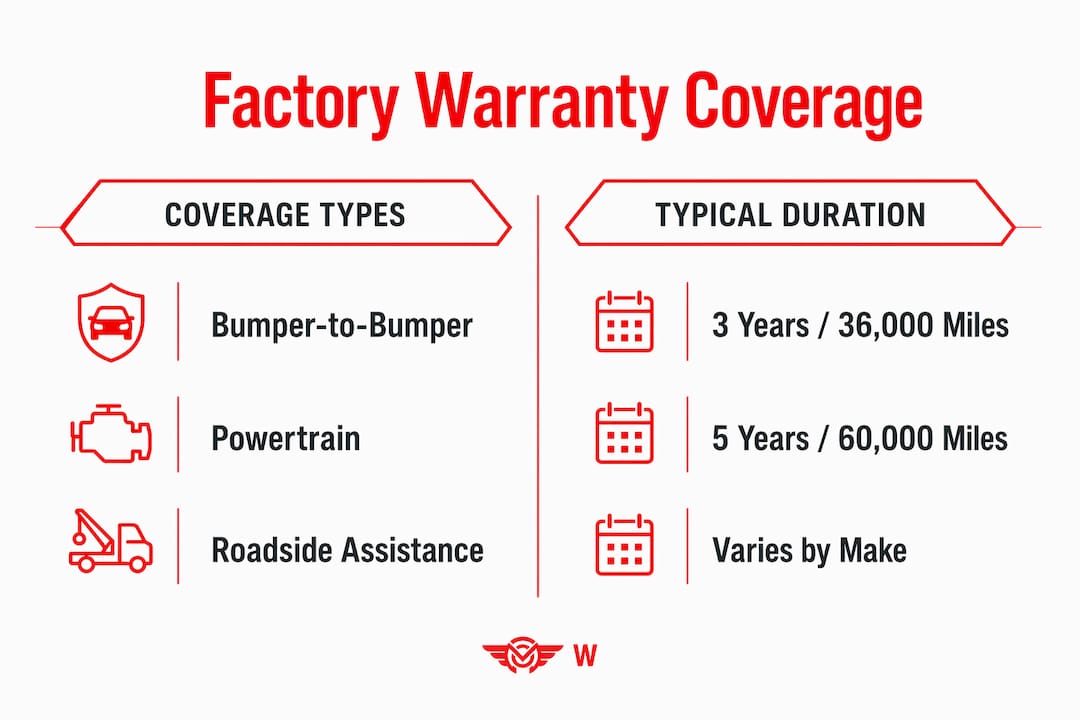
A complete manufacturer warranty details package typically includes six distinct coverage types:
- Bumper-to-bumper warranty. This is the broadest coverage. It protects most vehicle components from the front bumper to the rear, including electrical systems, air conditioning, infotainment, and interior parts. It does not cover wear items.
- Powertrain warranty. This covers the engine, transmission, and drivetrain. It runs longer than bumper-to-bumper coverage because powertrain failures are expensive and less frequent.
- Corrosion warranty. This protects against rust perforation on body panels. Most manufacturers offer 5–7 years on this coverage.
- Emissions warranty. Federal law requires manufacturers to cover emissions-related components. The basic emissions warranty typically runs 2 years or 24,000 miles; the longer defect warranty covers major components for 8 years or 80,000 miles.
- Safety restraint system (SRS) warranty. Airbags, seatbelts, and related components receive separate coverage, often matching or exceeding bumper-to-bumper terms.
- Roadside assistance. Most manufacturers include towing, flat tire service, and lockout help for the duration of the bumper-to-bumper period.
Common warranty exclusions include normal wear and tear, routine maintenance, environmental damage, aftermarket parts, and misuse. That means oil changes, brake pads, wiper blades, and tires are never covered. Damage from accidents, floods, or improper modifications also falls outside the factory warranty list.
Pro Tip: Read the warranty booklet in your owner's manual before your first service appointment. Dealers sometimes charge for repairs that are still covered under factory terms. Knowing your coverage in advance prevents that.
How long do factory warranties typically last?
A standard bumper-to-bumper warranty lasts 3 years or 36,000 miles, whichever comes first. Powertrain warranties extend significantly longer, often from 5 to 10 years depending on the manufacturer. The gap between those two terms is where most unexpected repair costs hit car owners hardest.

Vehicle type and brand segment also affect term length. Electric vehicles carry separate battery and electric motor warranties, often 8 years or 100,000 miles, mandated by federal regulation. Luxury brands like BMW and Mercedes-Benz sometimes bundle roadside assistance and complimentary maintenance into their warranty packages, which changes the value calculation considerably. Porsche, for example, includes a 4-year bumper-to-bumper warranty with no mileage cap on some models, which is notably generous compared to mainstream brands.
Certified pre-owned (CPO) vehicles add another layer. CPO vehicles usually retain the original factory warranty remainder plus additional limited warranties after a manufacturer-certified inspection. A CPO BMW or Honda with 18 months left on its factory bumper-to-bumper coverage, for instance, may also receive an additional 1-year CPO limited warranty on top of that remainder.
The table below summarizes typical warranty terms across popular vehicle makes. These reflect standard new-vehicle coverage and may vary by model year or trim.
| Make | Bumper-to-Bumper | Powertrain | Roadside Assistance |
|---|---|---|---|
| Ford | 3 years / 36,000 miles | 5 years / 60,000 miles | 5 years / 60,000 miles |
| Honda | 3 years / 36,000 miles | 5 years / 60,000 miles | 3 years / 36,000 miles |
| BMW | 4 years / 50,000 miles | 4 years / 50,000 miles | 4 years / unlimited miles |
| Mercedes-Benz | 4 years / 50,000 miles | 4 years / 50,000 miles | 4 years / unlimited miles |
| Porsche | 4 years / no mileage cap | 4 years / no mileage cap | 4 years / no mileage cap |
| Range Rover | 4 years / 50,000 miles | 4 years / 50,000 miles | 4 years / 50,000 miles |
Most manufacturers offer 3 years/36,000 miles bumper-to-bumper and 5 years/60,000 miles powertrain warranties, with luxury brands extending coverage further in both time and mileage. High-mileage drivers hit the mileage cap well before the time limit expires, which is why understanding both thresholds matters.
Routine maintenance like oil changes and tire rotations is excluded from every factory warranty and every extended warranty. Some dealers sell prepaid maintenance plans separately, which are worth comparing against independent shop pricing before you commit.
What is the difference between a factory warranty and an extended warranty?
Extended warranties are legally classified as vehicle service contracts, not warranties in the legal sense. That distinction matters because service contracts are regulated differently than manufacturer warranties and carry different consumer protections depending on your state. Calling them "extended warranties" is common in everyday speech, but the legal and regulatory difference is real.
The practical differences break down clearly:
- Cost. Factory warranties are included in the vehicle purchase price. Extended service contracts are optional, paid products with their own pricing, deductibles, and terms.
- Coverage. Factory warranties cover manufacturing defects. Service contracts vary widely. Some mirror bumper-to-bumper coverage; others cover only the powertrain. Reading the contract carefully is non-negotiable.
- Who backs it. Factory warranties are backed by the manufacturer. Service contracts are backed by the issuing company, which may be a dealer, a third-party administrator, or an insurance carrier.
- Transferability. Many factory warranties transfer to subsequent owners automatically. Service contracts may or may not transfer, and some charge a transfer fee.
- Deductibles. Factory warranties have no deductible. Service contracts typically charge $0–$200 per repair visit depending on the plan tier.
Consumers often confuse factory warranties with extended warranties, and that confusion leads to duplicate coverage purchases. If your bumper-to-bumper coverage still has two years remaining, buying a service contract that starts immediately means you're paying for protection you already have.
Avoid purchasing extended coverage under pressure at the dealership finance office. That environment is designed to produce quick decisions, and the contracts offered there are rarely the most competitive options available.
Pro Tip: The best time to evaluate an extended service contract is 60–90 days before your factory warranty expires. At that point, you know your vehicle's reliability history, you're not paying for duplicate coverage, and you have time to compare plans without pressure.
How to read and use your vehicle warranty coverage details
Reading your factory warranty list correctly takes about 20 minutes and can save you hundreds of dollars. The process is straightforward when you know where to look and what to confirm.
-
Locate your warranty documentation. Your owner's manual contains a dedicated warranty section. New vehicle purchases also include a separate warranty booklet in the glove compartment. For used vehicles, request the warranty transfer documents from the seller or confirm remaining coverage directly with the manufacturer's customer service line.
-
Identify your coverage start date and mileage. Factory warranty terms begin on the original purchase date and the odometer reading at delivery. If you bought a used vehicle, the clock started when the first owner drove it off the lot, not when you bought it.
-
Map each coverage type to its term. Your bumper-to-bumper, powertrain, corrosion, and emissions coverages each have different expiration points. Write them down in one place. Many car owners only know their bumper-to-bumper term and are blindsided when they realize their powertrain coverage is still active years later.
-
Confirm what is explicitly excluded. The exclusions section of your warranty booklet lists every category of repair the manufacturer will not cover. Read it as carefully as the coverage section. Exclusions for "misuse" and "improper maintenance" are broad and can be used to deny claims if your service records are incomplete.
-
File a warranty claim correctly. Take your vehicle to an authorized dealership for any repair you believe is covered. Bring your warranty documentation and service records. The dealer submits the claim to the manufacturer on your behalf. Keep copies of every repair order, whether covered or not, because a documented service history protects you if a claim is disputed.
-
Check transferability before selling. If you sell your vehicle while the factory warranty is still active, confirm whether coverage transfers automatically or requires a formal request. BMW and Mercedes-Benz factory warranties transfer to subsequent owners without a fee. Some brands require written notification within a set number of days after the sale.
Pro Tip: Create a simple document with your vehicle's warranty expiration dates by coverage type. Set a calendar reminder 90 days before each expiration. That window gives you time to plan for potential out-of-pocket repairs or evaluate extended coverage options without rushing.
Key Takeaways
A factory warranty is your baseline vehicle protection, and understanding every coverage type, term, and exclusion before it expires is the most cost-effective decision you can make as a car owner.
| Point | Details |
|---|---|
| Factory warranty is automatic | Every new vehicle includes manufacturer coverage at no extra cost, starting at delivery. |
| Coverage has six distinct types | Bumper-to-bumper, powertrain, corrosion, emissions, SRS, and roadside assistance each carry different terms. |
| Standard terms vary by brand | Most brands offer 3 years/36,000 miles bumper-to-bumper; luxury brands like BMW and Porsche extend further. |
| Extended warranties are service contracts | Legally distinct from factory warranties, they require careful review of deductibles, coverage, and who backs them. |
| Timing your extended coverage matters | Evaluate service contracts 60–90 days before factory warranty expiration to avoid duplicate coverage costs. |
What I've learned after years of watching car owners misread their coverage
The most expensive mistake I see car owners make is not reading their warranty documentation until something breaks. By then, the coverage window has often closed, or the repair falls into an exclusion they never knew existed. Factory warranties are not complicated documents, but they reward the owners who actually read them.
The second mistake is buying an extended service contract at the dealership on the day of purchase. I understand the appeal. You're already signing documents, the finance manager presents it as a natural next step, and the monthly payment looks small when it's rolled into your loan. But that is exactly the wrong time to make that decision. You have no idea yet how reliable your specific vehicle will be. A Ford F-150 with a strong reliability record needs a different coverage calculation than a Range Rover with complex air suspension and advanced electronics.
My honest recommendation: treat your factory warranty like a financial asset. Know its exact expiration dates. Keep your service records current and complete, because incomplete maintenance history is the most common reason manufacturers deny warranty claims. And when your bumper-to-bumper coverage is 90 days from expiring, sit down and evaluate whether your vehicle's repair profile justifies extended coverage. A BMW 5 Series or a Mercedes-Benz GLE with 60,000 miles and expensive electronic components is a very different risk calculation than a Honda Civic at the same mileage.
Extended coverage is not a bad product. It's a bad product when bought impulsively, without comparing terms, or when it duplicates coverage you already have. The car owners who get the most value from extended plans are the ones who buy them deliberately, near the end of their factory term, with a clear understanding of what the contract actually covers.
— Kenneth
Vehicle protection plans for when your factory coverage ends
Factory warranties provide strong baseline protection, but they all expire. When that day comes, the repair costs for vehicles like a BMW, Ford, or Volkswagen can be significant, especially for engines, transmissions, and electrical systems.
Rpmwarranty offers extended protection plans designed specifically for the period after your factory coverage ends. The Elite, Advanced, and Essential plan tiers cover components including engines, transmissions, cooling systems, and high-tech electronics, with nationwide coverage and straightforward claims processing. Whether you drive a Volkswagen and want a Volkswagen-specific plan or need coverage for another make, Rpmwarranty matches protection to your vehicle's year, make, and model. Get a free quote and compare plan options before your factory warranty expires.
FAQ
What does a factory warranty list include?
A factory warranty list covers bumper-to-bumper components, the powertrain, corrosion protection, emissions systems, safety restraints, and roadside assistance. Each coverage type carries its own term and mileage limit.
How do I check if my factory warranty is still active?
Contact the manufacturer's customer service line with your Vehicle Identification Number (VIN), or visit an authorized dealership. Your original purchase date and current mileage determine which coverages remain active.
Is an extended warranty the same as a factory warranty?
No. Extended warranties are legally classified as vehicle service contracts and are regulated differently than factory warranties. Factory warranties are included with the vehicle at no cost; service contracts are optional, paid products with their own deductibles and terms.
When should I buy an extended warranty?
The best time to evaluate an extended service contract is 60–90 days before your factory warranty expires. Buying earlier creates duplicate coverage; buying later leaves a gap in protection.
Does a factory warranty transfer to a new owner?
Many factory warranties transfer automatically to subsequent owners, but the rules vary by manufacturer. BMW and Mercedes-Benz transfer coverage without a fee; other brands may require written notification or charge a transfer fee.