

TL;DR:
- GWC Warranty offers legitimate vehicle protection especially for high-mileage or used cars, but contract details greatly influence claim outcomes.
- Its coverage varies from broad exclusionary plans to narrower stated-component policies, impacting repair payouts and acceptance of claims.
GWC Warranty is a legitimate extended auto warranty provider sold primarily through used-car dealers, and it can be a reasonable fit for higher-mileage buyers who want protection beyond the factory window — but the contract details matter enormously. The coverage style, exclusions, and labor-rate policies vary enough between plan tiers that two buyers with identical vehicles can have completely different claims experiences.
Quick orientation:
- Pro: Day One, Mile One coverage activation, nationwide shop access, and an A+ BBB rating signal a real, established operation
- Pro: Exclusionary-tier plans cover a broad range of components, including hybrid systems and high-tech electronics
- Con: Stated-component plans cover only the parts explicitly named in the contract, which catches many buyers off guard on expensive repairs to vehicles like a BMW 5 Series or Range Rover Sport
- Con: BBB complaint data shows 177 total complaints over three years, with recurring themes around claim denials and labor-rate shortfalls
If you drive a high-mileage Honda Accord or a used Ford F-150 and you bought the warranty at the dealership, GWC may cover exactly what you need. If you own a Mercedes-Benz GLE or a Porsche Cayenne and you're counting on full dealer-rate reimbursement, read every line of the contract before you sign.
Table of Contents
- What is GWC Warranty and who stands behind it?
- How do GWC Warranty plan tiers compare?
- What does GWC cover and what gets excluded?
- How does the claims process work and where can you use it?
- How much does a GWC warranty cost and who qualifies?
- What do real customers say about GWC Warranty?
- Is GWC Warranty a good fit for your vehicle?
- Questions to ask before you buy any extended warranty
- How Rpmwarranty structures its plans and helps buyers
- Key Takeaways
- Why contract clarity matters more than brand reputation
- Rpmwarranty is a direct path to a clearer warranty purchase
- Useful sources
What is GWC Warranty and who stands behind it?
GWC Warranty, operating as Guardian Warranty Corporation, is a Georgia-based extended vehicle service contract provider with a distribution model built around franchised and independent used-car dealers. The company markets itself as serving more than 1.5 million drivers nationwide, which puts it firmly in the mid-to-large tier of the aftermarket warranty space. Coverage activates at the moment of purchase rather than after a waiting period, which is the "Day One, Mile One" claim you'll see in their marketing.

On the trust-signal front, GWC holds BBB accreditation with an A+ rating, and the company appears on major third-party review platforms including Trustpilot and ConsumerAffairs. The A+ rating reflects responsiveness to complaints more than complaint volume, so it's a useful data point but not the whole picture.
The primary product categories that GWC markets include:
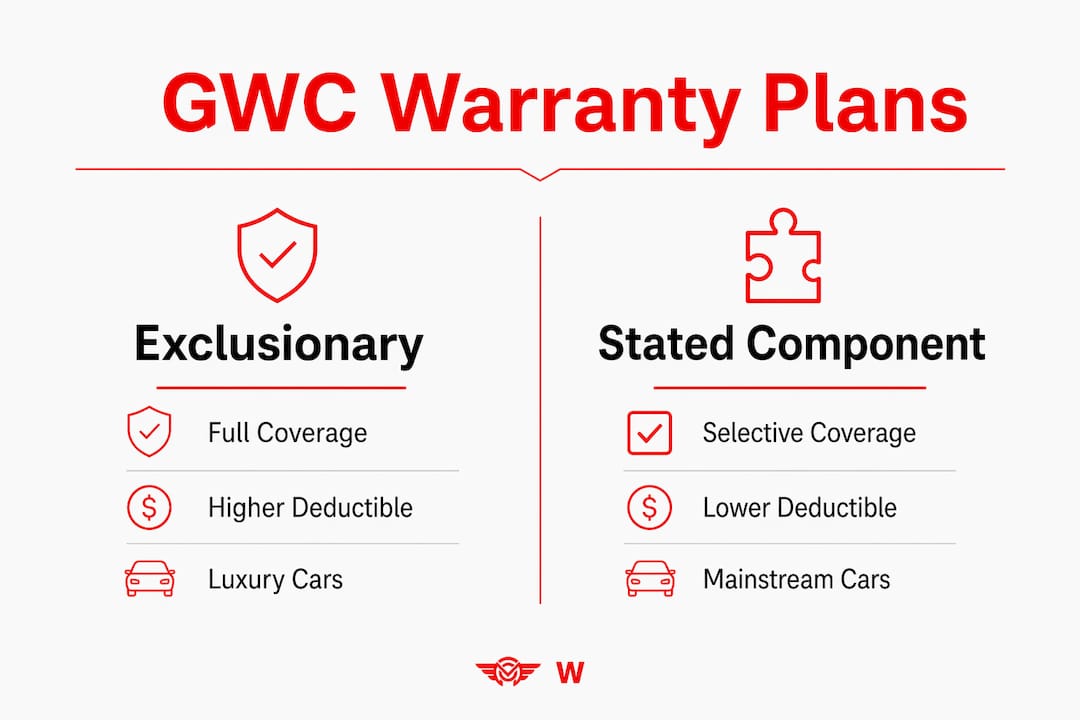
- Exclusionary coverage: Covers everything except what is specifically listed as excluded. Closest to a factory warranty in scope.
- Stated-component coverage: Covers only the parts and assemblies explicitly named in the contract. Narrower and typically less expensive.
- Add-ons: Roadside assistance, rental reimbursement, and trip interruption benefits are commonly available as riders.
GWC contracts are sold through dealers, which means the dealer's finance office is usually your first point of contact, not GWC directly. That distribution model has implications for how you negotiate terms and what questions you ask at the point of sale.
How do GWC Warranty plan tiers compare?
GWC markets several plan tiers, with the core distinction being whether the contract uses exclusionary or stated-component language. Here's how the tiers stack up in practical terms:
| Plan Type | Coverage Style | Best For | Typical Deductible | Mileage/Age Limits |
|---|---|---|---|---|
| Exclusionary (top tier) | Covers all systems except listed exclusions | Lower-mileage vehicles, luxury makes | — | Stricter upper limits |
| Mid-tier stated component | Named systems only (engine, transmission, etc.) | Mid-mileage, mainstream makes | — | More flexible |
| Entry stated component | Core powertrain only | High-mileage, budget buyers | $50–$200 per visit | Highest mileage tolerance |
For a BMW 3 Series or Mercedes-Benz C-Class, the exclusionary tier is the only one that realistically covers the full range of electronics, adaptive suspension components, and turbocharged engine systems those vehicles carry. A stated-component plan on a Range Rover Sport, for example, might cover the engine and transmission but leave the air suspension, transfer case electronics, and infotainment system entirely exposed. Those are exactly the systems that fail on high-mileage Range Rovers, and they're expensive.
Deductibles typically apply per repair visit, not per component, which is favorable when multiple systems fail simultaneously. Confirm whether your contract uses a "per visit" or "per component" deductible structure before signing.
How to pick a tier: If your vehicle still has some factory coverage remaining, a mid-tier stated-component plan may bridge the gap affordably. If the factory warranty has expired and you're driving a Porsche Macan or a Mercedes-Benz E-Class, the exclusionary tier is worth the premium because one electronics repair at a dealer can run $2,000 or more. High-mileage buyers on mainstream vehicles like a Honda CR-V or Ford Escape often find the entry powertrain plan covers their most realistic risk.
Pro Tip: Before you sign, flip directly to the "What Is Not Covered" section of the contract and read it in full. On a stated-component plan, if a part isn't named there, it isn't covered — regardless of what the dealer's sales pitch implied.
What does GWC cover and what gets excluded?
GWC's exclusionary-tier contracts typically cover a wide range of systems. Commonly included components span:
- Engine internals (pistons, crankshaft, camshaft, seals)
- Transmission and transfer case
- Cooling system (water pump, thermostat, radiator)
- Electrical systems (alternator, starter, wiring harnesses)
- Steering and suspension components
- Hybrid and EV drivetrain components (on eligible plans)
- High-tech electronics (navigation, sensors, driver-assist modules on qualifying contracts)
Stated-component plans cover a subset of the above, limited to exactly what the contract names. A repair that costs $3,500 on a BMW X5 might be fully covered under an exclusionary plan and completely uncovered under a stated-component plan if the failed part isn't on the list.
The exclusions that cause the most friction:
- Pre-existing conditions: Any failure the inspector determines existed before the contract start date. This is the single most common denial reason.
- Maintenance-related wear: Failures attributed to lack of oil changes, coolant flushes, or other scheduled maintenance. Keep every receipt.
- Wear-and-tear items: Brake pads, rotors, belts, hoses, and filters are almost universally excluded.
- "New" vs. "Used" contract tick-box: Some BBB complaints reference situations where the contract's vehicle-condition designation affected coverage eligibility. Confirm the correct box is checked at purchase.
- Parts quality clauses: Many contracts allow the provider to authorize "like kind and quality" replacement parts rather than OEM. On a Porsche or Mercedes-Benz, that can mean aftermarket parts at a fraction of dealer cost, with the owner responsible for the difference.
On luxury vehicles, the parts-quality clause is where the real money hides. A Mercedes-Benz dealer charges OEM prices. If the contract authorizes a remanufactured or aftermarket equivalent, the reimbursement gap can reach hundreds of dollars on a single repair. Exclusionary coverage doesn't automatically mean full-cost coverage — it means the repair is eligible, not that every dollar is paid.
For a Honda Civic or Ford Fusion, the gap between OEM and aftermarket parts is manageable. For a Range Rover Velar or Porsche Panamera, it can be significant enough to change the math on whether the warranty paid for itself.
How does the claims process work and where can you use it?
GWC's official FAQ states that covered repairs can be completed at any ASE-licensed, reputable service facility. That's a meaningful benefit: you're not locked into a dealer network, and most independent shops qualify.
Step-by-step claim flow:
- Notice a problem. Stop driving if the failure is active. Document the warning lights, symptoms, and mileage at the time of failure.
- Call GWC's claims line before authorizing repairs. This is non-negotiable. Repairs authorized without prior approval are almost always denied.
- Take the vehicle to an ASE-licensed shop. The shop diagnoses the failure and contacts GWC directly to open the claim.
- GWC reviews the claim. An adjuster may request a teardown inspection or additional documentation. This step is where delays occur.
- Authorization issued. GWC approves covered components and a labor amount. The shop proceeds with the repair.
- Payment. GWC pays the shop directly for the approved amount. You pay your deductible plus any balance not covered (labor-rate gaps, non-covered parts).
Timeline expectations vary. Straightforward claims on clear mechanical failures often get approved within a business day. Claims involving ambiguous failure causes, high-dollar repairs, or luxury vehicles with specialized components can take several days if an independent inspection is ordered.
The most common source of delays is the labor-rate gap: GWC's approved labor schedule may be lower than the shop's posted rate, which requires negotiation between the shop and the adjuster. Dealer service departments at BMW, Mercedes-Benz, or Land Rover typically charge premium labor rates that exceed what many warranty providers will authorize without pushback.

Pro Tip: The moment you notice a potential failure, photograph the dashboard warning lights and write down the exact mileage. If the shop later disputes the failure timeline with GWC, your timestamped documentation is the clearest evidence that the problem appeared before the repair was attempted.
How much does a GWC warranty cost and who qualifies?
GWC doesn't publish retail pricing directly, because contracts are sold through dealers who set their own margins. That said, several factors drive the final cost:
Primary cost drivers:
- Plan tier: Exclusionary coverage costs more than stated-component coverage, sometimes significantly.
- Mileage at purchase: A vehicle with 85,000 miles costs more to cover than one with 35,000 miles.
- Vehicle make and model: A Porsche Cayenne or Range Rover carries a higher premium than a Honda Pilot or Ford Explorer, reflecting higher parts and labor costs.
- Deductible choice: A $50 deductible raises the plan cost; a $200 deductible lowers it.
- Add-ons: Roadside assistance and rental reimbursement riders add to the base price.
For a mainstream vehicle like a Honda Accord at moderate mileage, a mid-tier stated-component plan might run in the range of a few hundred to several thousand dollars over the contract term. A luxury vehicle like a BMW 7 Series or Mercedes-Benz S-Class on an exclusionary plan can run considerably higher. These are ranges, not quotes — the only way to get an accurate number is to request one based on your specific vehicle.
Eligibility: Upper mileage limits vary by plan tier. Entry-level stated-component plans typically accept vehicles with higher odometer readings than exclusionary plans. Vehicle age limits also apply. Confirm both at the point of sale.
Transferability: GWC contracts are generally transferable to a subsequent owner, which can add resale value. Confirm the transfer fee and process in writing before purchase.
Cancellation and refunds: Most GWC contracts allow cancellation within a specified window for a full or prorated refund. After that window, a prorated refund minus a cancellation fee is typical. State-specific disclosure rules may apply, so ask for the cancellation terms in writing before you sign.
What do real customers say about GWC Warranty?
Customer reviews split into two fairly distinct camps. Positive reviewers describe fast approvals on major mechanical repairs, relief at not paying out of pocket for transmission or engine work, and responsive customer service on straightforward claims. Negative reviewers describe a different experience: denied claims tied to contract language they didn't fully understand at purchase, short payments where the approved labor amount didn't match the shop's invoice, and difficulty getting documentation from GWC.
Common praise themes:
- Quick authorization on clear powertrain failures
- Covered repairs that saved owners $1,000 or more
- Accessible claims phone line
Common complaint themes:
- Claim denials based on pre-existing condition determinations
- Labor-rate shortfalls leaving owners responsible for the balance
- Requests for vendor part-warranty documentation that went unanswered
- Contract language disputes, particularly around the "New" vs. "Used" vehicle designation
The BBB complaint record shows 177 total complaints over the past three years, with 68 closed in the last 12 months. For a company serving a large nationwide customer base, that volume is relatively contained, but the complaint patterns are consistent enough to be instructive. The most repeated issues involve contract interpretation disputes and labor/parts payment gaps.
How to read the reviews: Weight recent complaints more heavily than older ones, and look for complaint-resolution notes. A company that responds to and resolves BBB complaints is meaningfully different from one that ignores them. GWC's A+ rating reflects engagement with the complaint process, which is a real signal even if it doesn't eliminate the underlying friction.
Pro tip for luxury-vehicle owners: BBB complaint patterns show that labor-rate disputes are more frequent on vehicles with high dealer labor rates. If you drive a Land Rover, BMW, or Porsche and your nearest qualified shop is a franchised dealer, confirm the labor-rate reimbursement ceiling in the contract before purchase.
Is GWC Warranty a good fit for your vehicle?
Pros:
- Day One, Mile One activation with no waiting period
- Nationwide ASE-licensed shop access
- BBB A+ accreditation and established track record
- Exclusionary-tier plans cover a genuinely broad range of systems
- Transferable contracts can support resale value
Cons:
- Stated-component plans leave significant gaps on complex vehicles
- Labor-rate reimbursement caps can leave owners short-paid at dealer service centers
- Pre-existing condition denials are a recurring complaint
- Pricing is dealer-set and not transparent before you're in the finance office
Who should consider GWC: Buyers of used mainstream vehicles (Honda, Ford, Toyota) at moderate mileage who purchased through a dealer and want powertrain protection. Buyers who want exclusionary coverage and are willing to read the full contract carefully.
Who should think twice: Owners of Range Rover, BMW, Mercedes-Benz, or Porsche vehicles who plan to service at franchised dealers. The labor-rate gap between what those dealers charge and what many warranty providers authorize can be substantial. Also, buyers who can't verify the contract terms in writing before signing should pause.
Bottom line: GWC is a real product with real coverage, but the plan tier and contract language determine almost everything. Request the sample contract before you commit, and if the dealer won't provide one, that's your answer.
Questions to ask before you buy any extended warranty
Walk into any dealer finance office or warranty sales call with this checklist. The answers will tell you more than the brochure.
- What is the deductible structure? Ask specifically: is it per repair visit or per component? A per-component deductible on a multi-system failure can multiply your out-of-pocket cost.
- What is the labor-rate reimbursement ceiling? Get the exact dollar amount per hour the contract will pay. Compare it to your preferred shop's posted rate.
- How are parts sourced and priced? Ask whether the contract requires OEM parts or allows "like kind and quality" substitutes. For a Porsche or Mercedes-Benz, this is a significant cost variable.
- What is the pre-existing condition definition? Ask how the company determines a condition is pre-existing and what documentation they use.
- Is the contract transferable? Get the transfer fee and process in writing.
- What are the cancellation terms? Ask for the full refund window, the prorated refund formula, and any cancellation fees.
- Can I see the sample contract now? A legitimate provider will hand it over. Hesitation is a red flag.
- Who is the obligor/administrator? The selling dealer, the warranty company, and the obligor (the entity legally responsible for paying claims) may be three different parties. Know who you're actually contracting with.
- What happens if the repair shop and the adjuster disagree on the failure cause? Ask how disputes are resolved and what your rights are.
- Will you provide the vendor's part warranty documentation if I request it? BBB complaints cite cases where this was refused. A yes answer is the right answer.
Red flags to watch: No written sample contract available before signing. Vague answers on labor-rate caps. A sales rep who says "everything is covered" without pointing to specific contract language. Pressure to sign before you've read the exclusions section.
How Rpmwarranty structures its plans and helps buyers
Rpmwarranty offers three tiered extended warranty plans — Elite, Advanced, and Essential — covering engine, transmission, cooling, electrical, steering, suspension, hybrid systems, and high-tech electronics. Coverage is customizable by vehicle make, model, and year, which matters when you're protecting a BMW X5 differently than a Honda Pilot.
The purchase process follows four steps: consultation, plan selection, customization, and final agreement. At the consultation stage, a representative walks through your vehicle's specifics and risk profile before recommending a tier. Plan selection is based on that conversation, not a one-size-fits-all default. Customization lets you adjust deductible levels and add roadside assistance or rental reimbursement. The agreement step is where you review the full contract terms before committing.
Rpmwarranty's approach directly addresses the friction points that appear most often in GWC warranty reviews: clear contract language reviewed before purchase, transparent parts and labor policies, and nationwide access to ASE-certified mechanics. If you've been quoted a GWC plan at a dealership and want a side-by-side comparison, Rpmwarranty's free quote process gives you a benchmark with no obligation. You can also review plan details and FAQs before speaking with anyone.
Key Takeaways
GWC Warranty can deliver real value for the right buyer, but the plan type and contract language determine almost everything about the actual claims experience.
| Point | Details |
|---|---|
| Coverage type is the critical variable | Exclusionary plans cover far more than stated-component plans; luxury vehicle owners need exclusionary coverage. |
| Read the exclusions section first | Pre-existing conditions, wear-and-tear items, and parts-quality clauses are the most common denial triggers. |
| Labor-rate caps affect out-of-pocket costs | GWC's approved labor rate may fall below dealer rates at BMW, Mercedes-Benz, or Land Rover service centers. |
| BBB data provides context | 177 complaints over three years against a large nationwide driver base is contained, but complaint patterns reveal consistent friction points. |
| Rpmwarranty offers a transparent alternative | Rpmwarranty's Elite, Advanced, and Essential plans include a four-step consultative process and clear contract review before purchase. |
Why contract clarity matters more than brand reputation
Extended warranty shopping tends to focus on brand names and star ratings, which is understandable but misses the actual risk. The contract is the product. A warranty from a well-known company with an A+ rating can still leave you with a $900 out-of-pocket bill if the labor-rate ceiling is $85/hour and your BMW dealer charges $175. The rating doesn't change that math.
What actually protects buyers is reading the "What Is Not Covered" section before signing, confirming the labor-rate reimbursement ceiling in writing, and understanding whether the plan is exclusionary or stated-component. Those three things predict claims outcomes better than any review aggregate.
The review patterns for GWC and most extended warranty providers follow the same shape: satisfied customers had clear, high-dollar mechanical failures that fell squarely within covered components. Dissatisfied customers ran into the edges of the contract, usually in ways the dealer's sales pitch didn't prepare them for. That gap isn't unique to GWC. It's the nature of the product category, and the only defense is contract literacy before purchase.
Rpmwarranty is a direct path to a clearer warranty purchase
If the GWC claims experience you've read about gives you pause, Rpmwarranty offers a different route to the same goal: protecting your vehicle from costly repairs with coverage you actually understand before you sign.
Why buyers choose Rpmwarranty:
- Three plan tiers (Elite, Advanced, Essential) with coverage explained before purchase, not after a claim
- Nationwide ASE-certified mechanic access, including dealer service centers
- Transparent parts and labor policies reviewed at the agreement stage
- Roadside assistance and rental reimbursement available on qualifying plans
- Coverage for engine, transmission, electrical, cooling, hybrid systems, and high-tech electronics
Get a personalized warranty quote based on your vehicle's year, make, model, and mileage. No pressure, no finance-office urgency. Just a clear look at what coverage costs for your specific car, whether that's a Ford Explorer, a Mercedes-Benz GLE, or a Porsche Cayenne.
Useful sources
These are the primary sources referenced throughout this article. Use them to verify policy language, review complaint data, and compare your options directly.
- GWC Warranty Driver FAQs: Official guidance on where to take your vehicle for repairs and how to file a claim. Start here for the claims process.
- GWC Warranty BBB Business Profile: Accreditation status, A+ rating, and business profile details.
- GWC Warranty BBB Complaints: 177 total complaints over three years with complaint narratives and resolution notes. Useful for understanding recurring denial patterns.
- GWC Warranty Trustpilot Reviews: Aggregated customer reviews with both positive and negative claim experiences.
- ConsumerAffairs GWC Reviews: Additional customer review data with detailed complaint narratives.
- CarTalk GWC Extended Warranty Review: Third-party editorial review covering plan structure and coverage analysis.
- Rpmwarranty Plans and Quote: Publisher's plan overview, coverage categories, and the four-step purchase process.
- Rpmwarranty Free Quote: Get a no-obligation quote based on your vehicle's specifics.
This article is general information about extended vehicle warranty options and is not legal or financial advice. Confirm current contract terms, eligibility rules, and cancellation policies directly with the warranty provider or a qualified professional before purchasing.