

TL;DR:
- Luxury and high-performance vehicles have the highest 10-year maintenance costs, primarily due to proprietary parts and complex electronics. Land Rover and Porsche lead with expenses exceeding $16,000, while extended warranties help owners manage these high costs. Proper maintenance, early warranty coverage, and independent repairs can significantly lower ownership expenses.
The highest maintenance cost cars are overwhelmingly luxury and high-performance vehicles. Land Rover tops the list with 10-year maintenance costs approaching $17,450, followed by Porsche at around $16,000, Mercedes-Benz at $13,100, and Audi at $11,050. BMW clears $9,800 over a decade. These figures aren't outliers — they reflect the real cost of owning vehicles built around proprietary parts, advanced electronics, and labor-intensive service protocols.
Key brands and what their upkeep actually costs over 10 years:
- Land Rover: ~$17,450 — air suspension failures and electronic module replacements are the biggest culprits
- Porsche: ~$16,000 — PDK transmission service and carbon-ceramic brake replacements drive the bill
- Mercedes-Benz: ~$13,100 — AIRMATIC suspension repairs and 48V mild-hybrid battery work
- Audi: ~$11,050 — proprietary electronics and complex all-wheel-drive systems
- BMW: ~$9,800 — oil leaks, transfer case failures, and high dealer labor rates
- Volvo: ~$9,825 — increasingly complex electronics as the brand pushes into electrification
- Ford and Honda: typically mid-range, but high-end trims with advanced driver assistance tech push costs noticeably higher
European luxury brands cost roughly 50% more to maintain than mass-market vehicles, and that gap widens the older the car gets.
Table of Contents
- What actually drives high maintenance costs in luxury vehicles?
- 1. Range Rover — the most expensive vehicle to maintain
- 2. Porsche — performance comes with a repair bill
- 3. Mercedes-Benz — luxury systems with luxury repair costs
- 4. BMW — oil leaks, transfer cases, and high labor
- 5. Audi — complex all-wheel drive and electronics
- 6. Ford and Honda — when technology changes the math
- How maintenance costs change as your vehicle ages
- How extended warranties help you control expensive repair costs
- Luxury vs. sports vs. mainstream: how the costs actually compare
- What ownership actually costs: parts, labor, and service frequency
- How to keep maintenance costs down on a high-maintenance vehicle
- Key Takeaways
What actually drives high maintenance costs in luxury vehicles?
The price gap between maintaining a BMW and a Toyota isn't random. Several structural factors push luxury vehicle upkeep into a different cost category entirely.
- Proprietary parts: European luxury brands rely on components that have little to no aftermarket supply. When a part fails, you're buying from the manufacturer at manufacturer pricing.
- ADAS recalibration: Advanced Driver Assistance Systems require expensive electronic recalibration after even minor repairs. A fender-bender that costs $800 to fix on a mainstream sedan can trigger $1,500 in sensor recalibration on a luxury vehicle.
- Labor complexity: Diagnosing faults in modern luxury vehicles takes longer. Technicians need specialized training and equipment, and dealers charge accordingly.
- Premium service protocols: Manufacturers mandate specific fluids, filters, and service intervals that cost more than generic equivalents.
- High-failure systems: Air suspensions, dual-clutch transmissions, and hybrid battery modules fail more often and cost more to fix than conventional alternatives.
The proprietary parts problem is especially acute for European brands. Asian luxury brands share more components with their mass-market siblings, which keeps parts costs lower.
1. Range Rover — the most expensive vehicle to maintain
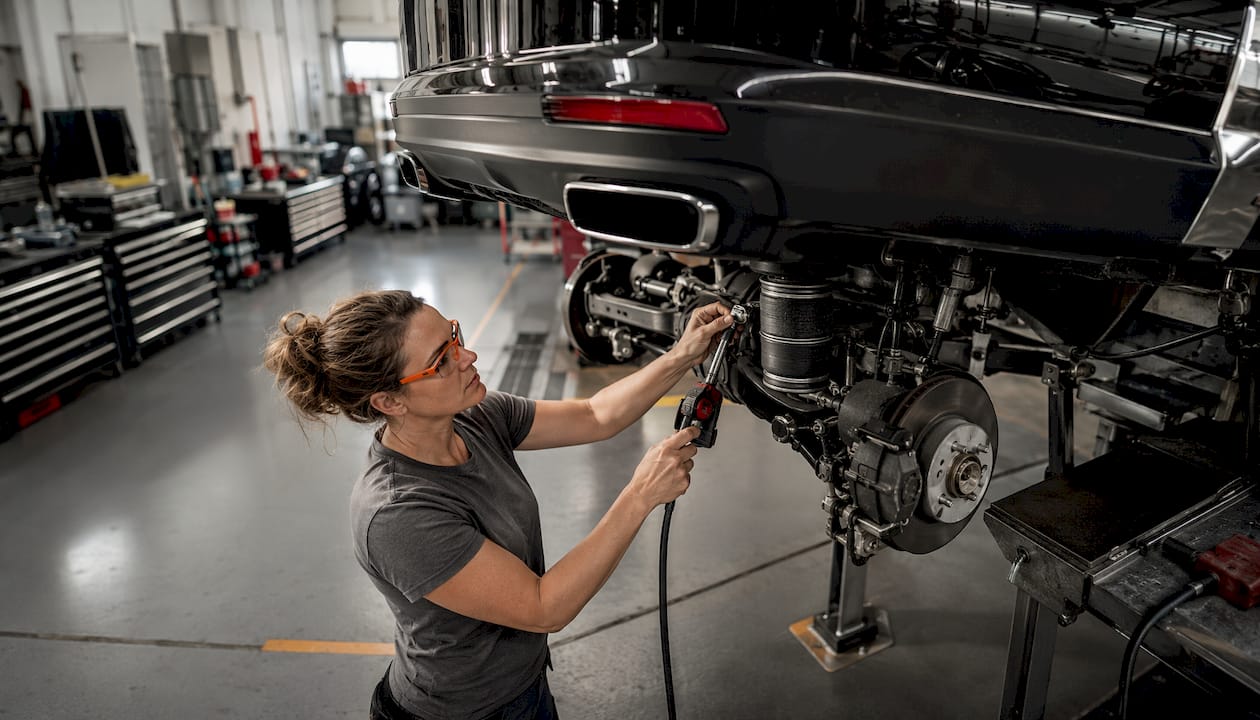
Land Rover's Range Rover consistently tops cost charts in North America. The air suspension system is the primary offender: a full replacement can run several thousand dollars, and these systems are known to fail well before the 100,000-mile mark. Electronic module failures compound the problem, often requiring dealer-only diagnostics that aren't cheap. The 10-year cost figure of $17,450 reflects a vehicle that demands serious financial commitment beyond the purchase price.
2. Porsche — performance comes with a repair bill
Porsche's 10-year average of $16,000 is driven by two specific cost centers: the PDK dual-clutch transmission and carbon-ceramic brakes. PDK service intervals are expensive, and the transmission itself is a major repair when it fails. Carbon-ceramic brakes, standard on many performance trims, cost multiples of conventional brake systems to replace. Porsche ownership rewards drivers who budget aggressively for maintenance from day one.
3. Mercedes-Benz — luxury systems with luxury repair costs
Mercedes-Benz vehicles carry annual repair averages that exceed $900 in industry data, and the decade total reaches $13,100. The AIRMATIC air suspension system is a known cost driver, particularly on E-Class, S-Class, and GLE models. The brand's push into 48V mild-hybrid architecture has added battery replacement costs that didn't exist in earlier generations. Dealer labor rates for Mercedes work are among the highest in the industry.
4. BMW — oil leaks, transfer cases, and high labor
BMW's 10-year cost of $9,800 understates the ownership experience for many drivers. Oil leaks from valve cover gaskets and oil pan seals are a recurring issue across multiple model lines. Transfer case failures on xDrive models add another expensive repair category. The real multiplier is labor: BMW dealer rates are high, and the brand's engineering makes DIY repairs impractical for most owners.
5. Audi — complex all-wheel drive and electronics
Audi's $11,050 decade cost reflects the brand's reliance on Quattro all-wheel-drive systems that require specialized service, combined with electronics that are expensive to diagnose and repair. DSG transmission service is another recurring expense. Audi shares some components with Volkswagen, which helps at the margins, but the brand's premium positioning means parts and labor costs stay elevated.
6. Ford and Honda — when technology changes the math
Ford and Honda are typically mid-range on maintenance cost charts, with Honda at $6,130 and Ford at $5,950 over 10 years. But that changes with premium trims. Ford's high-end F-150 configurations with Pro Power Onboard, advanced towing tech, and ADAS packages introduce repair complexity that mainstream trims don't carry. Honda's Pilot Elite and Odyssey Elite trims with full sensing suites follow the same pattern. The vehicles themselves are reliable; the technology layered on top is what drives costs up.
How maintenance costs change as your vehicle ages
The cost trajectory follows a predictable wear curve that every owner should understand before buying.
- Years 0–3: Costs are low and predictable. Factory warranty covers most failures, and components are new.
- Years 4–7: Brake pads, rotors, tires, and suspension bushings start wearing. Costs rise moderately but remain manageable with routine service.
- Years 8+: Major system failures begin. Engines, transmissions, and electronics are the expensive categories. Repair unpredictability increases sharply as corroded fasteners and scarce parts complicate every job.
- ADAS recalibration: Can be triggered at any age by minor collisions or even routine component swaps, adding costs that don't follow a predictable schedule.
- Geography matters: Labor rates in New York, Los Angeles, and San Francisco run significantly higher than rural Midwest or Southern markets, affecting the total cost of any repair.
Once the factory warranty expires, costs become substantially harder to predict. That's the window where extended coverage pays for itself.
How extended warranties help you control expensive repair costs
An extended warranty converts unpredictable repair bills into a manageable fixed cost. For owners of high-maintenance vehicles, that's not a minor convenience — it's a financial strategy.
- Major system coverage: Engine, transmission, suspension, and electronics are the most expensive repair categories. Quality extended warranty plans cover all of them.
- Labor protection: Proprietary parts require specialized labor. Extended warranties absorb those costs rather than passing them to the owner.
- Roadside assistance: Most plans include roadside coverage, which matters when an air suspension failure leaves you stranded.
- Flexible terms: Plans can be tailored to vehicle age, mileage, and condition, so coverage fits where you actually are in the ownership cycle.
- Claims support: Access to an authorized repair network with streamlined claims processing removes the friction from an already stressful situation.
Pro Tip: Choose a plan that explicitly covers electronic systems and ADAS components. Many basic plans exclude these, which is exactly where luxury vehicle repair costs concentrate.
Extended warranties reduce financial exposure by covering the repairs that hurt most — the ones you didn't see coming on a vehicle you couldn't afford to leave at the dealer for two weeks.
Luxury vs. sports vs. mainstream: how the costs actually compare
| Category | 10-Year Maintenance Cost | Key Cost Drivers |
|---|---|---|
| Mainstream (Toyota, Honda, Ford) | $5,950–$6,130 | Routine wear items, widely available parts |
| Luxury (BMW, Mercedes-Benz, Audi) | $9,800–$13,100 | Proprietary parts, high labor, advanced electronics |
| Ultra-luxury/performance (Porsche, Land Rover) | $16,000–$17,450 | Specialized transmissions, air suspension, carbon brakes |
Luxury brands cost more than double what mainstream brands cost over a decade. The gap between a Toyota at $5,950 and a Land Rover at $17,450 is real money — over $11,500 across 10 years, before accounting for the higher labor rates in urban markets.
What ownership actually costs: parts, labor, and service frequency
A Mercedes-Benz S-Class oil change runs $200–$300 at a dealer, compared to $60–$80 for a Honda Accord. Brake pad replacement on a Porsche 911 with carbon-ceramic rotors can exceed $5,000 for a full axle set. A Range Rover air suspension compressor replacement typically runs $1,500–$2,500 in parts and labor combined.
Independent repair shops can offer 35%–45% lower costs than dealerships for many luxury repairs. The catch: certain transmissions and electronics require dealer-level diagnostic tools, so the savings option isn't always available. Service frequency also matters — BMW and Mercedes mandate annual inspections with fluid services that add up faster than the every-other-year schedules common on mainstream vehicles.
How to keep maintenance costs down on a high-maintenance vehicle
- Find a qualified independent specialist. For brands like BMW and Mercedes, independent shops with factory-trained technicians can cut your bill by a third or more on routine work.
- Stay ahead of known failure points. Range Rover air suspension, BMW valve cover gaskets, and Mercedes AIRMATIC components have predictable failure windows. Addressing them proactively costs less than emergency repairs.
- Use OEM-spec fluids and filters. Cutting corners on consumables accelerates wear on expensive components. The $30 you save on oil is not worth a $4,000 transmission repair.
- Secure extended warranty coverage before the factory warranty expires. Once a vehicle crosses into year four or five, coverage becomes harder to obtain and more expensive. Locking in protection early is the smarter move.
- Track your service history meticulously. A complete record supports warranty claims and helps technicians diagnose problems faster, reducing diagnostic labor costs.
Key Takeaways
Land Rover and Porsche carry the highest 10-year maintenance costs in North America, exceeding $16,000, while extended warranty coverage is the most effective tool for managing those expenses.
| Point | Details |
|---|---|
| Land Rover tops the list | 10-year maintenance costs reach $17,450, driven by air suspension and electronic failures. |
| Luxury costs 50% more | European luxury brands cost roughly 50% more to maintain than mass-market vehicles. |
| Costs spike after year 8 | Major engine, transmission, and electronics failures cluster in the later ownership years. |
| Extended warranties absorb the biggest hits | Coverage for engine, transmission, suspension, and electronics converts surprise bills into fixed costs. |
| Independent shops save 35%–45% | On eligible repairs, qualified independents cut costs significantly versus dealer rates. |