
TL;DR:
- Warranty-worthy repairs are caused by manufacturing defects that meet your warranty's time and mileage limits. Knowing how to identify these repairs, documenting symptoms, and understanding coverage rules help you avoid unnecessary costs. Proper preparation and record keeping increase your chances of a successful warranty claim.
A warranty-worthy repair is any vehicle issue caused by a defect in materials or workmanship that falls within your warranty's active time and mileage limits. Knowing how to identify warranty-worthy repairs before you walk into a dealership saves you money, prevents unnecessary out-of-pocket costs, and puts you in control of the conversation. Factory warranties and extended warranties each define covered repairs differently, and the gap between what you assume is covered and what actually qualifies can cost hundreds of dollars. The Magnuson-Moss Warranty Act, a federal consumer protection law, governs how manufacturers must honor warranty obligations in the United States. Understanding your rights under that law, combined with a clear warranty coverage checklist, is the foundation of every successful claim.
How to identify warranty-worthy repairs: coverage basics
The standard bumper-to-bumper warranty covers mechanical and electrical components for 3 years or 36,000 miles. That means if your BMW 3 Series develops an electrical fault or your Mercedes-Benz C-Class has a sensor failure within that window, the repair qualifies. Powertrain warranties extend further, often reaching 5–10 years, and cover the engine, transmission, and drivetrain components specifically.
Two categories define every warranty claim: defects in materials or workmanship, and damage or wear. Only the first category qualifies. A cracked engine block caused by a manufacturing flaw is a defect. A worn clutch plate on a Honda Accord with 80,000 miles is wear. The distinction sounds simple, but manufacturers and dealers sometimes blur the line, which is why knowing the difference matters.
What factory warranties typically cover
Factory warranties generally include the following component groups:
- Engine internals: pistons, crankshaft, camshaft, cylinder heads
- Transmission: gears, torque converter, valve body
- Electrical systems: wiring harnesses, control modules, sensors
- HVAC systems: compressor, evaporator, blower motor
- Steering and suspension: power steering pump, tie rods, control arms (when defective, not worn)
- High-tech components: infotainment modules, driver-assistance sensors, hybrid battery systems on vehicles like the Ford Escape Hybrid or BMW 5 Series plug-in
What factory warranties exclude
Wear-and-tear items like brake pads, rotors, tires, and windshield wipers are consistently excluded from coverage. That exclusion is non-negotiable across virtually every manufacturer. External damage from accidents, road debris, or weather events also falls outside warranty scope, as do cosmetic issues like paint fading from sun exposure.
| Covered Repairs | Excluded Repairs |
|---|---|
| Engine control module failure | Brake pad replacement |
| Transmission valve body defect | Tire wear or puncture |
| HVAC compressor failure | Windshield wiper blades |
| Wiring harness short circuit | Paint fading or scratches |
| Suspension component defect (manufacturing) | Shock absorber wear |
| Sensor malfunction (factory defect) | Battery replacement (routine) |
The table above reflects the standard split. When a repair sits in a gray area, the diagnostic report from the dealership technician determines which side it lands on.
How do you recognize whether a vehicle issue qualifies?
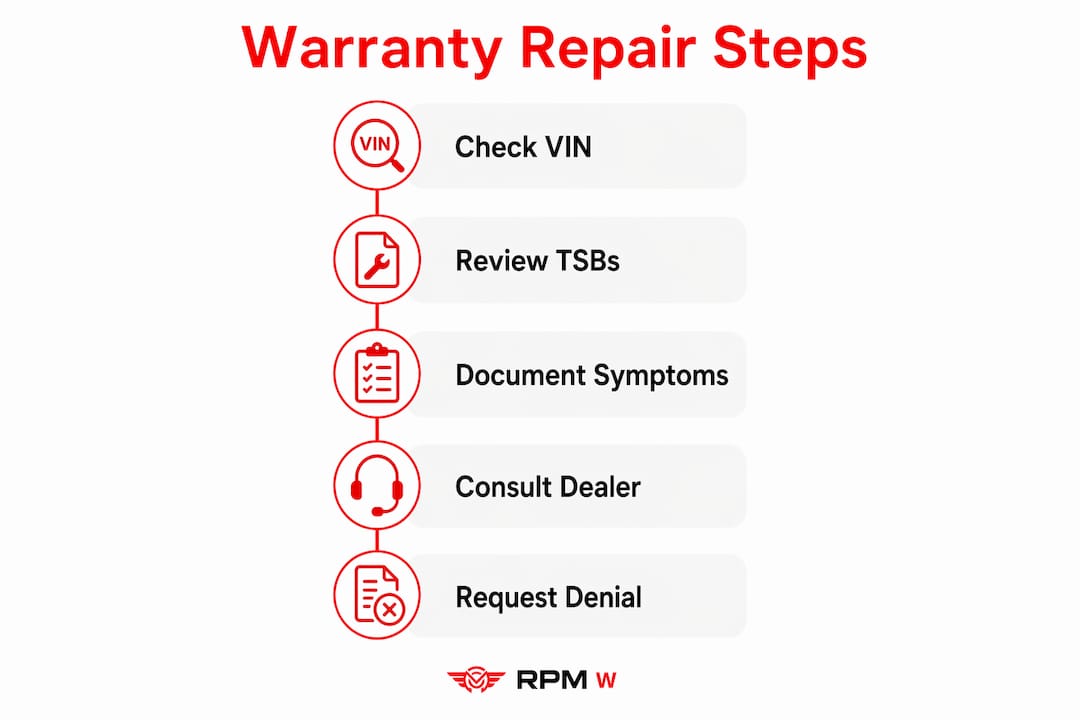
Recognizing repair issues that qualify for warranty coverage starts with documenting symptoms before you contact the dealer. Write down exactly when the problem started, what conditions trigger it (cold starts, highway speeds, specific gear changes), and whether any warning lights appeared. A Range Rover Sport owner reporting "a clunking noise from the front suspension when turning at low speed" gives the technician a specific, reproducible complaint. Vague descriptions lead to inconclusive diagnostics and denied claims.
Step 1: Check your VIN and warranty status
Your Vehicle Identification Number (VIN) is the fastest way to confirm active coverage. Every manufacturer maintains an online portal where you can enter your VIN and see the exact warranty expiration date and mileage. Ford, Honda, BMW, Mercedes-Benz, and Porsche all offer this lookup on their official websites. Dealers can also run a VIN check during scheduling.

Step 2: Research Technical Service Bulletins
Technical Service Bulletins (TSBs) document known manufacturing defects and can convert denied claims into approved repairs when presented to the dealer. The National Highway Traffic Safety Administration (NHTSA) maintains a public TSB database at nhtsa.gov. If your Porsche Cayenne has a recurring oil consumption issue and a TSB exists for that engine, you have documented evidence that the problem is a known defect, not driver error or neglect.
Step 3: Identify red flags that disqualify a claim
Certain conditions signal that a repair will not qualify, regardless of the component involved:
- Accident damage or collision-related deformation
- Unauthorized modifications, including aftermarket engine tunes or suspension lifts not approved by the manufacturer
- Evidence of neglect, such as severely degraded oil or a clogged cooling system from skipped services
- Repairs already attempted by an uncertified shop using non-specification parts
Pro Tip: Consumers often assume dealership-only service is required to keep a warranty valid. The Magnuson-Moss Warranty Act protects independent repairs as long as the service meets manufacturer specifications. Keep every receipt from every oil change, regardless of where you had it done.
What does the warranty claim process actually involve?
Filing a warranty claim effectively requires preparation before you arrive at the dealership. The warranty claim process has five distinct stages, and skipping any one of them increases the chance of a denial.
-
Confirm active coverage. Check your owner's manual, your VIN lookup result, and your current mileage. If your vehicle is at 35,800 miles and the bumper-to-bumper limit is 36,000, schedule the appointment immediately. Do not wait.
-
Schedule a diagnostic appointment. Call the service department and describe the symptom precisely. Request that the technician reproduce the issue during the diagnostic drive. Ask upfront whether a diagnostic fee applies if the issue is deemed non-warranty related. Diagnostic fees may apply when the dealer finds the issue falls outside coverage, so clarifying this in advance protects you.
-
Bring complete documentation. Arrive with your maintenance records organized by date and mileage, your warranty booklet or digital copy, and any photos or videos of the symptom. A Mercedes-Benz GLE owner who shows up with two years of oil change receipts and a video of the engine warning light is far harder to deny than one who arrives empty-handed.
-
Understand the authorization process. After the technician diagnoses the issue, the dealer submits a repair authorization request to the manufacturer. The manufacturer reviews the diagnostic report and approves or denies coverage. This process can take hours or several days for complex repairs on vehicles like the BMW 7 Series or Range Rover Autobiography.
-
Handle a denial in writing. If the claim is denied, request a written explanation with specific technical reasons. Vague denials lack legal weight and can be challenged through the manufacturer's customer relations department or through arbitration. A written denial gives you the foundation to escalate.
Pro Tip: If your issue appeared just before warranty expiration but the repair happens after, document the original symptom date with a timestamped photo or a service appointment record. TSB documentation and repair logs can persuade manufacturers to approve goodwill repairs even after the official warranty period ends.
What pitfalls and exclusions can void or complicate your claim?
The most frequent cause of a valid warranty claim denial is the absence of documented scheduled maintenance. Manufacturers may refuse claims by assuming vehicle neglect if you cannot produce maintenance records. That means a legitimate engine defect on a Ford F-150 can go uncovered simply because the owner discarded oil change receipts.
Several other pitfalls consistently trip up vehicle owners:
- Aftermarket parts misunderstood as voids. Many owners believe adding aftermarket wheels or an aftermarket air filter automatically voids their warranty. The Magnuson-Moss Warranty Act requires the manufacturer to prove the aftermarket part caused the specific defect before denying coverage. An aftermarket stereo does not void your transmission warranty.
- Assuming all exclusions are legitimate. Dealers sometimes deny claims for components that are actually covered. If a denial feels wrong, cross-reference the warranty booklet language against the denial reason.
- Failing to escalate. A dealer-level denial is not the final word. Manufacturers have customer relations departments specifically for escalated claims. Porsche, BMW, and Mercedes-Benz each maintain dedicated owner assistance lines.
- Ignoring TSBs. Savvy owners leverage TSBs to appeal denials. If a TSB exists for your exact symptom, present it during escalation.
"Organize all maintenance records digitally or physically by date and mileage. This single habit prevents the most common reason warranty claims are denied: the manufacturer's assumption of owner neglect. A well-organized file turns a disputed claim into an approved one."
Always demand a written denial with specific technical reasoning. A service advisor saying "it's not covered" verbally carries no legal weight. The written document is what you bring to the manufacturer's regional representative or, if necessary, to arbitration under the Magnuson-Moss Warranty Act.
Key Takeaways
Identifying covered repairs requires knowing your warranty type, documenting symptoms early, and presenting maintenance records at every claim appointment.
| Point | Details |
|---|---|
| Know your warranty type | Bumper-to-bumper covers 3 years or 36,000 miles; powertrain extends to 5–10 years. |
| Document symptoms immediately | Record when, how, and under what conditions the issue occurs before contacting the dealer. |
| Use TSBs as claim tools | NHTSA's public TSB database can turn a denied claim into an approved repair. |
| Keep all maintenance records | Missing oil change receipts are the leading cause of valid claim denials. |
| Demand written denials | Vague verbal denials have no legal weight; written reasons can be challenged and escalated. |
What I've learned after years of watching warranty claims go wrong
Most vehicle owners treat their warranty like a vague safety net rather than a specific legal contract. That misunderstanding costs them money every year. The owners who get the most out of their coverage are the ones who read the warranty booklet when the vehicle is new, not when something breaks.
The single most underused tool in warranty disputes is the TSB. I have seen Range Rover owners pay out of pocket for suspension repairs that were covered under a known-defect bulletin simply because they did not know to look it up. The NHTSA database is free and public. Spending ten minutes there before your dealer appointment can change the outcome of a claim entirely.
Extended warranties make the most sense for vehicles with complex electronics and expensive components. A BMW 5 Series or Mercedes-Benz E-Class outside its factory coverage window carries real financial risk. An extended plan with clear contract terms from a reputable provider is worth the cost when the alternative is a $4,000 transmission repair with no coverage. The key word is "reputable." Read the contract, confirm what is excluded, and verify the provider works with dealers nationwide before signing anything.
My strongest advice: treat your vehicle's maintenance records the way you treat tax documents. Keep them organized, keep them complete, and never throw them away. That file is your best defense against any denial, legitimate or not.
— Kenneth
Rpmwarranty: extended protection when your factory coverage ends
Factory warranties expire. When they do, the cost of repairs on vehicles like the BMW X5, Mercedes-Benz GLE, or Ford Explorer falls entirely on you. Rpmwarranty offers extended vehicle protection plans designed to cover exactly the components your factory warranty covered, with nationwide dealer acceptance so you are never stuck finding an approved shop.
Rpmwarranty's Elite, Advanced, and Essential plans cover engines, transmissions, electrical systems, cooling systems, and high-tech components. The process is straightforward: get a consultation, select a plan, customize coverage to your vehicle, and finalize the agreement. You can get a free quote in minutes based on your vehicle's year, make, and model. Volkswagen owners can review Volkswagen-specific coverage options tailored to that brand's common repair needs. Rpmwarranty also includes roadside assistance with every plan.
FAQ
What repairs does a bumper-to-bumper warranty cover?
A bumper-to-bumper warranty covers mechanical and electrical components including the engine, transmission, HVAC, sensors, and wiring for 3 years or 36,000 miles in most cases. Wear-and-tear items like brake pads, tires, and windshield wipers are excluded.
How do I file a warranty claim for my vehicle?
Confirm your warranty is active via VIN lookup, schedule a diagnostic appointment at an authorized dealership, bring complete maintenance records, and request written authorization before any repair begins. If denied, ask for a written explanation with specific technical reasons.
Can aftermarket parts void my vehicle warranty?
Under the Magnuson-Moss Warranty Act, a manufacturer must prove the aftermarket part directly caused the defect before denying coverage. Adding aftermarket wheels or a stereo does not automatically void your powertrain or electrical warranty.
What is a Technical Service Bulletin and why does it matter?
A Technical Service Bulletin (TSB) is an official document from a manufacturer identifying a known defect in a specific vehicle model. Presenting a relevant TSB at your dealer appointment can convert a denied warranty claim into an approved repair.
What happens if my warranty claim is denied?
Request a written denial with specific technical reasons, then escalate to the manufacturer's customer relations department. You can also reference applicable TSBs, submit a goodwill repair request, or pursue arbitration under the Magnuson-Moss Warranty Act if the denial is improper.