

TL;DR:
- Keeping organized warranty records ensures vehicle owners can successfully file claims by providing essential documentation. Regular review and accurate record-keeping during repairs protect against claim disputes and maximize warranty benefits. Using both physical and digital systems offers a reliable way to maintain proof of coverage and repair history.
Managing warranty paperwork means keeping a complete, organized, and accessible record of every document, receipt, and communication tied to your vehicle's coverage. Whether you drive a BMW 5 Series, a Range Rover Sport, or a Honda Pilot, your ability to file a successful warranty claim depends almost entirely on the quality of your paper trail. Federal law shifts the burden of proof to the manufacturer, but documentation is the single most important tool for getting a claim approved. Without organized records, even a legitimate claim can be denied. This guide walks you through exactly what to collect, how to store it, and how to keep it current.
How to manage warranty paperwork: the documents you need
Vehicle owners should maintain a centralized warranty file containing at least 12 critical document types to support claims and protect their rights. That number covers everything from your original purchase agreement to photos of a dashboard warning light. Missing even one category can give a manufacturer grounds to dispute or delay a payout.
Here is the full list of documents every vehicle owner needs to collect and keep:
- Original purchase or lease agreement. This establishes ownership, purchase date, and vehicle identification number (VIN). For financed vehicles, include the financing contract as well.
- Manufacturer warranty booklet. This document defines what is covered, for how long, and under what conditions. For premium vehicles like a Porsche Cayenne or Mercedes GLE, the booklet may include separate powertrain, corrosion, and emissions warranty terms.
- Extended warranty contract. If you purchased a vehicle service contract beyond the factory warranty, keep this document in the same file. It defines your coverage limits and the warranty claim process.
- All repair orders and invoices. Every service visit generates a repair order. Keep every single one, even visits where the technician found nothing wrong. A "no defect found" record still proves you reported the problem.
- Receipts for towing, roadside assistance, and rental vehicles. These costs are often reimbursable under warranty. Without receipts, you cannot recover them.
- Photos and videos of defects. Date-stamped photos of dashboard warning lights serve as strong, incontestable evidence when dealing with dealerships. Take photos before and after every service visit.
- Communication logs. Record every phone call, email, and chat with the manufacturer or dealer. Log the date, the name of the representative, and a summary of what was discussed. Save case numbers.
- Out-of-service days tally. Tracking the total days your vehicle is in the shop is required for Lemon Law claims in most states. Keep a running count in a notebook or spreadsheet.
- DIY maintenance receipts and logs. If you change your own oil or replace filters, keep the parts receipts and a written log with the date, mileage, and service performed.
- Loaner and rental car receipts. These document the inconvenience caused by extended repairs and may support claims for reimbursement.
- Recall notices and manufacturer correspondence. Any letter or email from the manufacturer about your vehicle belongs in this file.
- Photos of your odometer at drop-off and pick-up. Mileage discrepancies between visits can become a dispute point. A photo removes all ambiguity.
For owners of high-end vehicles like a Range Rover Defender or a BMW X5, this file is especially critical. Repairs on these vehicles often cost thousands of dollars, and manufacturers scrutinize claims more carefully at that price level.
What are the best methods to organize warranty documents?
The best warranty tracking methods combine a physical folder for originals and a digital system for backups and quick access. Relying on one format alone creates risk. Paper folders get lost in floods, fires, or moves. Digital files disappear when a hard drive fails or a cloud account lapses.

Physical organization
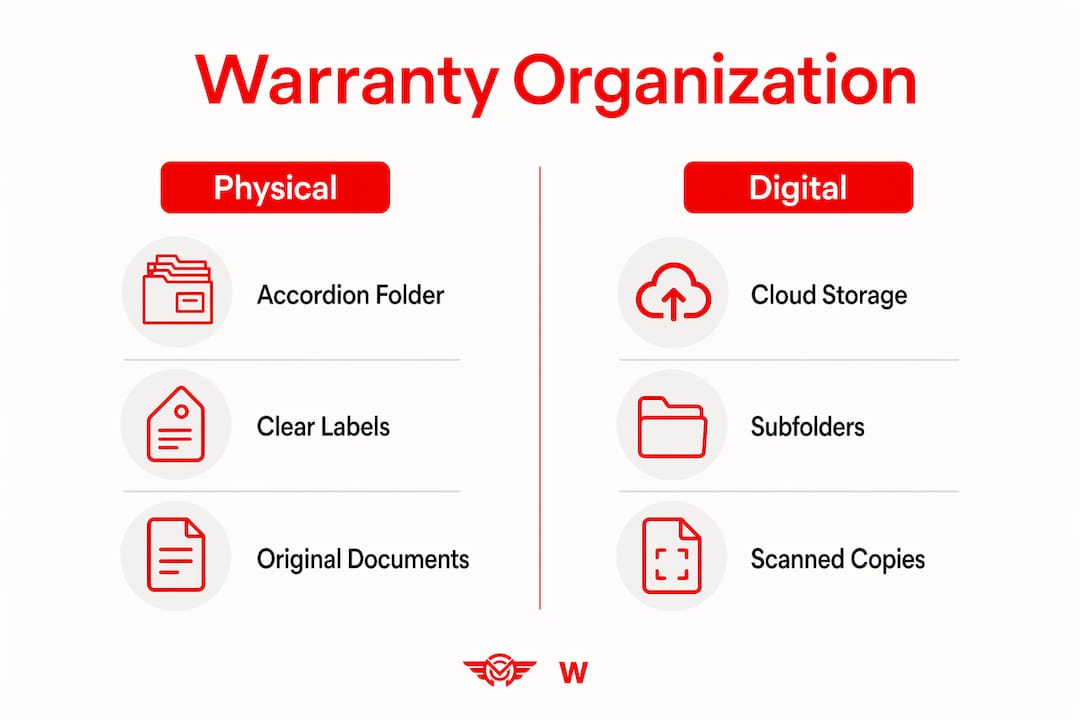
Set up a dedicated accordion folder or binder labeled clearly with your vehicle's year, make, model, and VIN. Divide it into labeled sections: purchase documents, warranty contracts, repair orders, receipts, and communications. Store it in a consistent location, such as a fireproof box or a filing cabinet. Never keep it in the glove compartment, where it can be stolen or damaged.
Digital organization
Create a folder in a cloud storage service such as Google Drive, iCloud, or Microsoft OneDrive. Use subfolders that mirror your physical system: one for contracts, one for repair orders, one for photos, and one for communication logs. Name every file with the date and a short description, for example "2024-11-03 BMW X5 oil change invoice." That naming convention makes searching fast and reliable.
| Organization method | Pros | Cons |
|---|---|---|
| Physical folder | No technology required; easy to hand to a dealer | Can be lost, damaged, or stolen |
| Cloud storage | Accessible anywhere; easy to share with attorneys | Requires internet access; account security matters |
| Mobile maintenance app | Logs mileage and service automatically | Data portability varies by app |
| Combination system | Redundant and resilient | Requires consistent upkeep |
Digital storage and photo documentation provide convenience and incontestable proof compared to paper receipts alone. The combination system wins every time because it covers every failure scenario.
Pro Tip: Scan every paper receipt within 48 hours of receiving it. Thermal paper receipts fade within months, and a faded receipt is as useless as no receipt at all.
How do you maintain accurate records at every service visit?
Accurate record-keeping during service visits is the foundation of a strong warranty claim. The quality of your repair orders directly determines whether a claim succeeds or fails. A vague description like "car makes noise" gives a manufacturer room to dispute the claim. A specific description like "grinding sound from front left wheel at speeds above 40 mph" does not.
Follow these steps at every service visit:
- Describe the problem in writing before you arrive. Write down the exact symptom, when it occurs, and how often. Hand this written description to the service advisor and ask them to copy it word for word onto the repair order.
- Photograph your odometer at drop-off. Take a clear photo with your phone before you hand over the keys. This creates a timestamped record of the mileage at the start of the visit.
- Verify the repair order before you leave. Confirm that it includes the date, your mileage, your exact complaint, the diagnostic work performed, and any parts replaced. Before leaving the dealership, verify every field on the repair order is complete and accurate.
- Request a copy of every repair order. Ask for a copy even if the technician found nothing wrong. A "no defect found" record proves you reported the issue on a specific date.
- Photograph your odometer at pick-up. Compare it to your drop-off photo. If the mileage is significantly higher than expected, ask for an explanation and document the response.
- Log the visit in your communication record. Write down the service advisor's name, the date, what was discussed, and any promises made about follow-up repairs.
- Track the days your vehicle was out of service. Add the number of days to your running tally. This number matters for Lemon Law eligibility in most states.
For owners of vehicles like a Ford F-150 or a Mercedes C-Class, technicians handle dozens of vehicles per day. A detailed written complaint from you is the clearest signal that this repair order needs to be thorough.
Pro Tip: Ask the service advisor to read your complaint back to you before you leave the counter. If their summary is vague, correct it on the spot. You have every right to request accurate documentation.
How often should you review and update your warranty file?
Updating warranty records every six months prevents data loss and keeps your file ready for claim scrutiny at any time. A biannual review takes less than an hour and can save you thousands of dollars if a dispute arises. Schedule it on your calendar for january and july, so it becomes a habit tied to the change of seasons.
Use this checklist for each review session:
- Scan any paper receipts or repair orders received since the last review and upload them to your digital folder.
- Confirm that your maintenance schedule aligns with the requirements in your warranty contract. Missing a required service can void coverage.
- Cross-check your repair orders against your communication log. If a dealer promised a follow-up repair, verify it happened and was documented.
- Update your out-of-service days tally with any new repair visits.
- Delete or archive documents for vehicles you no longer own.
- Confirm your cloud storage account is active and your files are backed up.
- Review your extended warranty contract terms to confirm coverage has not lapsed.
Biannual reminders for organizing paperwork and updating digital files are the single most effective habit for maintaining a complete record. For owners of vehicles with extended warranties through providers like Rpmwarranty, this review also confirms that your coverage terms are current and that you understand what your plan covers.
Pro Tip: Set a recurring calendar reminder titled "Warranty File Review" every six months. Attach a link to your cloud folder in the reminder so you can open it immediately and get started.
What mistakes most often kill a warranty claim?
The most common warranty claim failures come from avoidable paperwork errors, not from coverage gaps. Knowing where vehicle owners go wrong gives you a clear advantage.
- Delaying repairs. Waiting weeks to bring a vehicle in after a warning light appears gives manufacturers grounds to argue the damage worsened due to neglect. Report problems promptly.
- Using vague symptom descriptions. "Something feels off" is not a warranty-ready complaint. "Transmission hesitates for two to three seconds when shifting from first to second gear at low speeds" is.
- Losing repair orders. A repair order is legal evidence. Treat it like a receipt for a major purchase. Federal consumer protections require manufacturers to prove neglect, but they routinely deny claims when maintenance records are incomplete.
- Failing to track out-of-service days. Many vehicle owners do not realize that cumulative repair time is a legal threshold in Lemon Law cases. A missing tally can disqualify an otherwise valid claim.
- Skipping DIY maintenance documentation. DIY maintenance requires pairing parts receipts with a detailed log of dates, mileage, and services performed. Without this, a manufacturer can claim you failed to maintain the vehicle.
- Not keeping records confidential. Store your warranty file securely. Do not share it with parties outside the claim process. Sensitive documents like financing agreements contain personal information.
If a claim is denied, gather every document in your file, request a written explanation from the manufacturer, and escalate through the manufacturer's customer relations department. If the denial appears unjustified, a consumer attorney specializing in Lemon Law can review your file.
"Warranty claim success is closely tied to the quality and completeness of the consumer's paper trail. A well-organized file is not just helpful. It is often the deciding factor between a paid claim and a denied one."
Key Takeaways
Effective warranty paperwork management requires collecting the right documents, organizing them in both physical and digital formats, and reviewing them every six months to stay claim-ready.
| Point | Details |
|---|---|
| Collect 12 document types | Include purchase agreements, repair orders, photos, receipts, and communication logs. |
| Use a combination system | Pair a physical folder with cloud storage to protect against loss or damage. |
| Document every service visit | Verify repair orders include exact symptoms, mileage, and parts replaced before leaving. |
| Review records biannually | Schedule checks every six months to scan new receipts and update your out-of-service tally. |
| Avoid vague descriptions | Specific symptom language on repair orders prevents manufacturers from disputing claims. |
What I've learned from watching warranty claims succeed and fail
I have reviewed enough warranty situations to say with confidence that the outcome almost never comes down to the coverage terms. It comes down to the paperwork. Vehicle owners with complete, organized files get paid. Owners with scattered receipts and vague repair orders get denied, even when their claim is legitimate.
The mistake I see most often is treating warranty documents like grocery receipts. People stuff them in a glove compartment or a kitchen drawer and forget about them until something goes wrong. By then, half the records are missing or unreadable. For owners of vehicles like a Porsche Macan or a Range Rover Velar, where a single repair can exceed $5,000, that disorganization is an expensive habit.
The owners who fare best are the ones who build a simple routine. They scan a receipt the same day they receive it. They photograph their odometer every time they drop off the vehicle. They keep a running note on their phone for out-of-service days. None of these habits take more than five minutes. Together, they create a file that is nearly impossible to dispute.
My practical advice for busy vehicle owners: start with one folder, physical or digital, and commit to adding every document the day you receive it. Do not wait for a "better system." A simple, consistent habit beats a perfect system you never maintain. And if you own a luxury vehicle with an extended warranty, treat that warranty contract like the financial asset it is. Know what it covers, keep it current, and review it every six months alongside your service records.
— Kenneth
Rpmwarranty: extended coverage that's worth protecting
Good paperwork habits matter most when you have strong coverage behind them. Rpmwarranty offers extended vehicle protection plans trusted by dealers nationwide, covering engines, transmissions, cooling systems, electrical systems, and high-tech components well beyond the factory warranty period.
Rpmwarranty's plans come in three tiers: Elite, Advanced, and Essential, so you can match coverage to your vehicle's age, mileage, and your budget. Every plan includes roadside assistance and a straightforward claims process. If you want to know exactly what your vehicle qualifies for, you can get a free quote based on your year, make, and model. Protecting your vehicle is only half the equation. Keeping the paperwork to back it up is the other half.
FAQ
What documents are most critical for a warranty claim?
The most critical documents are your repair orders, original purchase agreement, warranty contract, and communication logs. Together, these form the core of any successful warranty claim process.
How should I store warranty paperwork digitally?
Use a cloud storage service like Google Drive or iCloud with clearly labeled subfolders for contracts, repair orders, photos, and communications. Name every file with the date and a short description for fast retrieval.
What happens if I do my own oil changes?
DIY maintenance is acceptable under most warranties as long as you keep parts receipts and a written log that includes the date, mileage, and service performed. Without this documentation, a manufacturer can argue the vehicle was not properly maintained.
How do out-of-service days affect my warranty claim?
Out-of-service days are the total number of days your vehicle spends in a repair shop. In most states, Lemon Law eligibility depends on reaching a minimum threshold of repair days, making an accurate tally a legal requirement for those claims.
How often should I review my warranty file?
Review and update your warranty file every six months. This schedule keeps your records current, prevents document loss, and confirms your coverage terms are still active and understood.