
TL;DR:
- Preparing your vehicle with complete documentation and performing pre-inspection checks ensures a smoother warranty claim process. Properly organizing records, avoiding fault code clearing, and transparently disclosing repairs are crucial to passing inspections for luxury vehicles. Thoroughly preparing the vehicle’s condition and documentation increases the likelihood of a successful warranty claim approval.
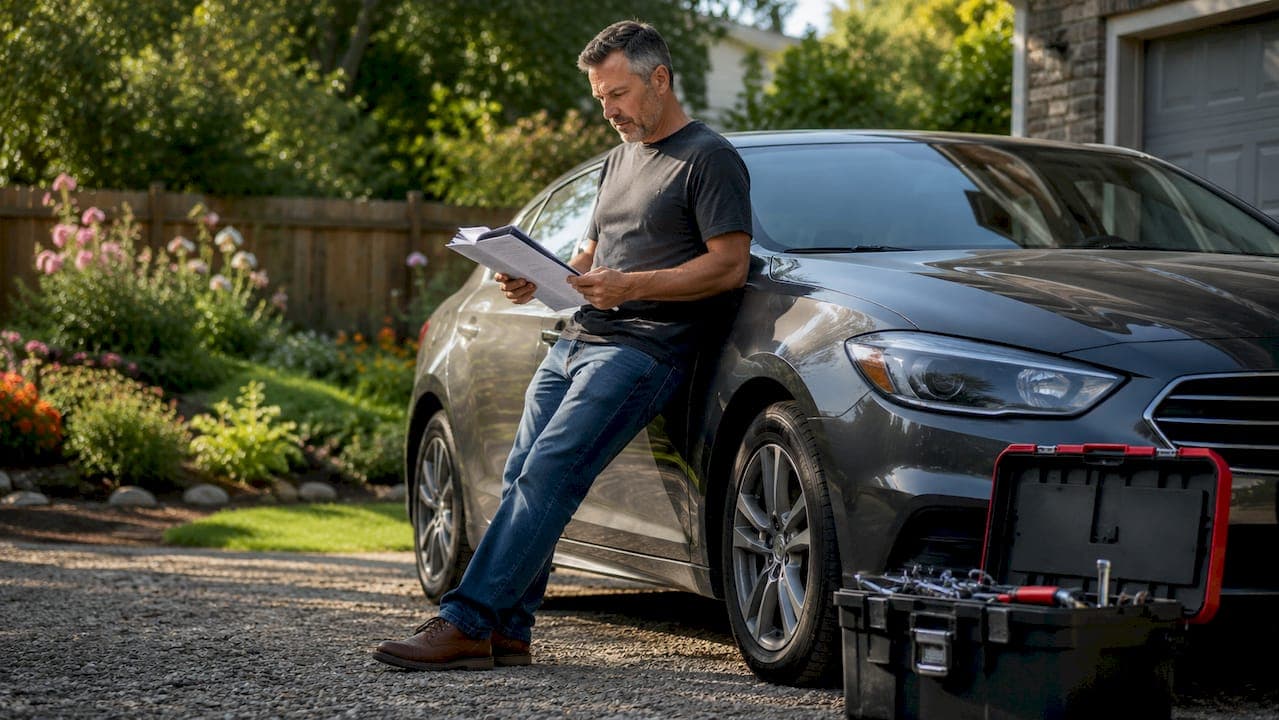
Preparing your car for a warranty inspection means verifying vehicle condition, organizing essential documentation, and meeting every service requirement your warranty plan demands. A warranty inspection, sometimes called a pre-warranty vehicle assessment, is a formal review conducted by an independent, VAT-registered garage to establish a baseline condition of your vehicle before coverage activates or a claim is approved. For owners of premium vehicles like BMW, Mercedes-Benz, Range Rover, and Porsche, the stakes are higher. These vehicles carry complex electronics, expensive components, and strict manufacturer service schedules. Knowing how to prepare your car for warranty inspection before the appointment puts you in control of the outcome.
How to prepare your car for warranty inspection: start with documents
The most common reason warranty claims get denied is not a mechanical fault. It is missing or incomplete paperwork. Before your inspection appointment, gather every document that proves your vehicle has been maintained correctly.
The documents you need to bring:
- Your warranty plan details, including coverage terms and any exclusions
- Current vehicle registration and proof of insurance
- Driver's license
- A valid payment method for any diagnostic fees
- All service records from the past two to three years
- Receipts for recent repairs, including brake work, tire replacements, and fluid changes
- Invoices from any work done outside an authorized service center
Organizing these documents before the appointment reduces delays and removes one of the most common failure points in the claims process. Inspectors and warranty providers need to see that your vehicle received maintenance on schedule, not just that it runs today.
For BMW, Mercedes-Benz, and Porsche owners specifically, manufacturer service intervals are strict. A 2019 BMW 5 Series, for example, requires oil changes every 10,000 miles using BMW-approved synthetic oil. If your records show a gap or a non-approved product, that gap becomes a liability during inspection.

Maintaining service records according to the manufacturer's schedule is mandatory for warranty compliance, even if the work was done outside an authorized center, provided you kept detailed invoices. That last part matters. Many owners use independent shops to save money on Range Rover or Mercedes servicing. That is perfectly acceptable, but only if you have the original invoice showing the work performed, the parts used, and the mileage at the time of service.
Pro Tip: Scan all paper receipts and store them in a cloud folder labeled by date and mileage. If a physical receipt is lost, a digital backup can still satisfy an inspector's documentation requirement.
Service records are the backbone of warranty compliance. Original invoices matter especially when service is performed outside manufacturer centers. Treat your service history as financial documentation, because during a warranty inspection, it functions exactly like that.
What vehicle checks should you do before the appointment?
A structured pre-inspection walkthrough takes about 15 minutes to complete and covers the most common inspection failure points. Do this the day before your appointment, not the morning of.
Here is the order that works best:
-
Check all exterior lights. Walk around the vehicle and test headlights, brake lights, reverse lights, and turn signals. On a Range Rover Sport or Mercedes GLE, a single burned-out bulb can trigger a warning light and flag an inspection failure. Replace any faulty bulbs before the appointment.
-
Check fluid levels. Open the hood and verify engine oil, coolant, brake fluid, power steering fluid, and windshield washer fluid. Top off anything that is low. A BMW with low coolant will often display a dashboard warning, which creates a problem you do not want the inspector to see first.
-
Test tire tread depth. Use the penny test: insert a penny into the tread groove with Lincoln's head pointing down. If you can see the top of Lincoln's head, the tread is below the 2/32 inch minimum and the tire fails inspection. Porsche and BMW owners should also check for sidewall cracks or bulges, which are common on performance tires that have aged.
-
Inspect the windshield. Any crack in the driver's direct line of sight is an automatic failure point. Check wiper blade condition too. Worn wipers on a Porsche Cayenne or Honda Pilot are a minor fix that prevents an unnecessary flag.
-
Note every dashboard warning light. Do not clear fault codes before the inspection. Clearing codes before diagnosis can jeopardize warranty claims because it removes the diagnostic evidence the inspector needs to validate your claim. Write down every warning light that is active and be ready to describe when each one appeared.
-
Test the horn and seatbelts. These are basic safety checks that inspectors verify. Both take under two minutes to confirm.
-
Look under the vehicle. Check for active fluid leaks. Oil, coolant, or brake fluid pooling under a parked vehicle is a red flag. Poor lighting, insufficient tire tread, dashboard warnings, and leaks are the four most common inspection failure points. Address any leaks before the appointment if possible, or at minimum, disclose them clearly to the inspector.
Pro Tip: Print a physical pre-inspection checklist and check off each item as you complete it. A written record of your own checks shows the inspector you are organized and transparent, which builds credibility for your claim.
The goal of this walkthrough is not to hide problems. It is to know exactly what condition your vehicle is in before someone else tells you. Surprises during inspection almost always work against you.
How do you coordinate with your inspection provider?
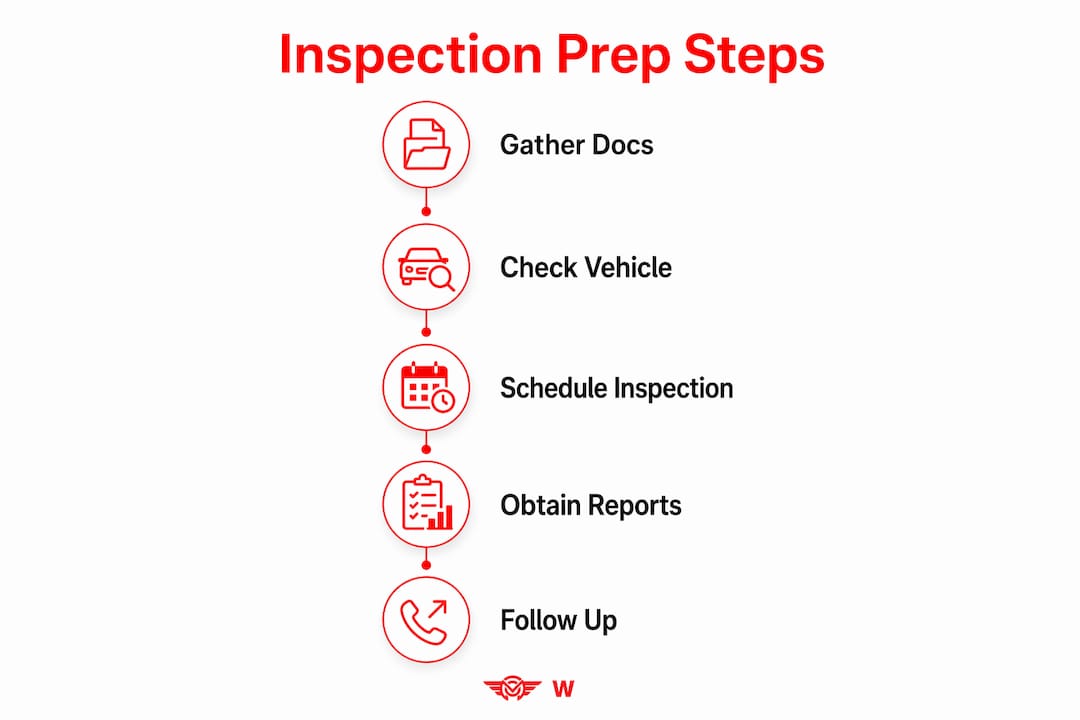
A warranty inspection follows a defined workflow. The five-step process covers issue reporting, warranty declaration, diagnostic approval, evidence compilation, and claim submission. Understanding each step helps you communicate clearly and avoid costly delays.
Before the appointment:
- Call the workshop in advance and tell them your vehicle is under warranty. Give them the warranty plan details so they can prepare the right diagnostic approach.
- Confirm whether diagnostic fees require your pre-authorization. Most warranty providers require written approval before any diagnostic work begins. Skipping this step can result in costs you cannot claim back.
- Describe your vehicle's symptoms clearly and consistently. If your Mercedes E-Class has been making a grinding noise during cold starts, say exactly that. Vague descriptions like "it sounds weird sometimes" give the technician nothing to work with.
During the inspection:
The workshop will typically perform an OBD diagnostic scan, a visual examination of the vehicle's exterior and undercarriage, and a road test. For premium vehicles like a BMW M5 or Porsche Panamera, the OBD scan pulls fault codes from multiple control modules, not just the engine. This is where pre-existing issues that were never repaired will surface.
The inspector also collects evidence. This includes photographs of any damage or wear, fault codes from the diagnostic scan, and written technician notes. This evidence package is what gets submitted with your warranty claim.
Pro Tip: Ask the workshop to provide you with a copy of the diagnostic report and all photographs taken during the inspection. You have a right to this documentation, and it protects you if a claim is later disputed.
Independent inspections are the standard for objective warranty assessments. Independent garages document existing faults rather than predict future reliability. That distinction matters. The inspection is not a judgment on whether your car will break down. It is a snapshot of its current condition. Your job is to make sure that snapshot is accurate and well-documented.
What mistakes cause warranty inspection failures?
Most warranty inspection failures are preventable. They come from predictable oversights, not catastrophic mechanical problems.
The most common mistakes to avoid:
-
Missing or incomplete service records. If you cannot prove your Range Rover received its scheduled transmission service, the warranty provider can deny a transmission-related claim. No records means no coverage.
-
Failing to disclose symptoms or previous repairs. If you had a coolant leak repaired six months ago and do not mention it, the inspector may find evidence of it anyway. Undisclosed prior repairs raise fraud concerns and can void coverage entirely.
-
Clearing fault codes before the diagnostic scan. This is one of the most damaging mistakes an owner can make. Fault codes are the primary evidence for many warranty claims. Clearing them removes that evidence and signals to the inspector that something may have been hidden.
-
Ignoring fluid leaks or active warning lights. Arriving at an inspection with a known oil leak and no disclosure puts you in a difficult position. Inspectors document what they find. Undisclosed leaks suggest neglect.
-
Using unapproved parts without proper invoices. A BMW 3 Series repaired with non-OEM brake components is not automatically disqualified from warranty coverage, but only if you have an invoice showing what was used and why. Without documentation, the inspector cannot confirm compliance.
-
Tires below legal tread limits or cracked windshields. These are straightforward failures that cost very little to fix in advance. A new set of tires for a Porsche Macan costs far less than a denied warranty claim on a suspension component.
-
Delaying authorization for diagnostic work. Warranty providers require pre-authorization for diagnostic costs. Delays in approving this work slow the entire process and can result in the claim window closing before evidence is compiled.
Owners should require physical telemetry data and inspection logs rather than accepting generic digital checkmarks. Digital fraud in vehicle inspections is a documented problem. Insisting on physical proof, including printed fluid level readings and signed technician notes, protects your claim from being challenged later.
Key takeaways
Passing a warranty inspection comes down to three things: complete documentation, a vehicle in known condition, and clear communication with your inspection provider before the appointment.
| Point | Details |
|---|---|
| Documentation is non-negotiable | Bring service records, receipts, registration, insurance, and warranty plan details to every inspection. |
| DIY checks prevent surprises | A 15-minute pre-inspection walkthrough covering lights, fluids, tires, and leaks removes the most common failure points. |
| Never clear fault codes | Fault codes are primary evidence for warranty claims; clearing them before diagnosis can void your coverage. |
| Disclose everything | Undisclosed prior repairs or known issues raise fraud concerns and can result in full claim denial. |
| Demand physical proof | Require printed diagnostic reports and photographs, not just digital checkmarks, to protect your claim. |
What i've learned preparing luxury cars for warranty inspections
After years of working with premium vehicle owners, the pattern I see most often is this: the car is in fine mechanical shape, but the paperwork is a disaster. A Range Rover Defender with a spotless engine and a missing oil change receipt from 18 months ago is a warranty claim waiting to be denied.
BMW and Porsche owners tend to be the most prepared, partly because their dealerships train them well on service documentation from day one. Mercedes-Benz owners are often the opposite. They trust the dealer to keep records and never request copies for themselves. That trust is misplaced. Always keep your own set.
The DIY checks I described above are not just about passing inspection. They are about knowing your vehicle. When you walk into an inspection having already identified every warning light, checked every fluid, and confirmed your tire tread depth, you communicate something important to the inspector: you are an attentive owner. That credibility matters when a borderline claim goes to review.
One thing I push hard on is the diagnostic authorization step. Owners of complex vehicles like the Porsche Cayenne Turbo or BMW X5 M often balk at paying $150 for a diagnostic scan. That scan is the foundation of your entire claim. Refusing it or delaying it to save money is the most expensive decision you can make.
The inspection process is not adversarial. It is a documentation exercise. Treat it like one, prepare accordingly, and the outcome almost always works in your favor.
— Kenneth
Protect your premium vehicle with the right warranty plan
Preparing your vehicle for inspection is only half the equation. The other half is making sure your coverage is strong enough to matter when a claim is approved.
Rpmwarranty offers extended warranty plans trusted by dealers nationwide, covering engines, transmissions, cooling systems, electrical systems, and high-tech components on premium vehicles including BMW, Mercedes-Benz, Range Rover, and Porsche. The Elite, Advanced, and Essential plan tiers give you coverage options that match your vehicle's complexity and your budget. Rpmwarranty's four-step process, from consultation through final agreement, makes selecting the right plan straightforward. Explore your vehicle protection options and get a free quote based on your vehicle's year, make, and model today.
FAQ
What is a warranty inspection?
A warranty inspection is a formal vehicle assessment conducted by an independent garage to document the current condition of a vehicle before warranty coverage activates or a claim is approved. Its purpose is to establish a baseline of existing faults, not to predict future reliability.
What documents do i need for a warranty inspection?
Bring your driver's license, vehicle registration, proof of insurance, warranty plan details, all service records, and receipts for any recent repairs. Missing documentation is the leading cause of warranty claim denial.
Can i clear fault codes before my warranty inspection?
No. Clearing fault codes before the diagnostic scan removes the primary evidence needed to support your warranty claim and can result in denial. Always let the inspector retrieve and document fault codes before any codes are cleared.
How do i check tire tread before an inspection?
Use the penny test: insert a penny into the tread groove with Lincoln's head pointing down. If the top of Lincoln's head is visible, the tread is below the 2/32 inch legal minimum and the tire will fail inspection. Replace tires before the appointment if tread is borderline.
Does servicing at an independent shop void my warranty?
No, provided you keep detailed invoices showing the work performed, parts used, and mileage at the time of service. Manufacturer-schedule compliance with proper documentation preserves warranty validity regardless of where the service was performed.