

TL;DR:
- Vehicle protection plans are either exclusionary or stated-component, with coverage depending on vehicle complexity. Luxury vehicles with advanced systems often require exclusionary plans due to high repair costs and system complexity. Choosing the right plan involves reviewing contract clarity and matching coverage tiers to your vehicle's needs.
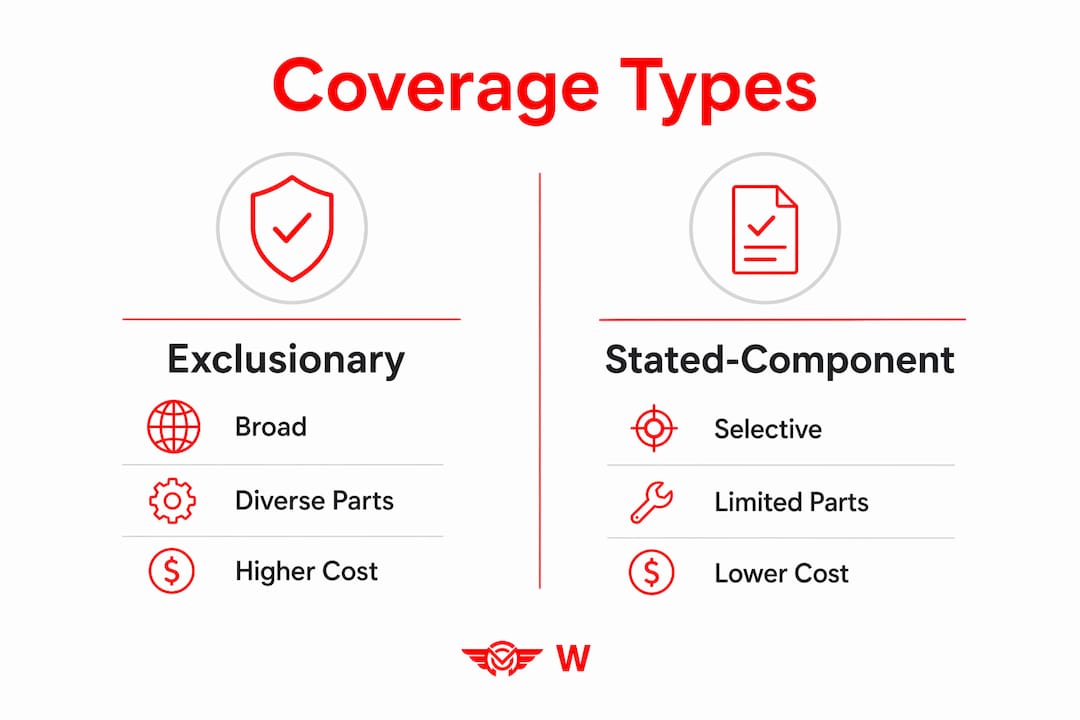
Vehicle protection levels split into two main types: exclusionary contracts and stated-component contracts. According to California Department of Insurance 2026 standards, exclusionary plans cover every mechanical part except what is explicitly listed as excluded, while stated-component plans cover only the parts named in the contract. Your vehicle's complexity, your driving habits, and the clarity of the contract language are the three factors that determine which level actually protects you.
Here is a quick orientation before the details:
- Exclusionary coverage: Best for luxury, high-tech vehicles like BMW, Mercedes-Benz, Range Rover, and Porsche
- Stated-component coverage: Suited for simpler, older, or lower-mileage vehicles like standard Honda or Ford models
- Key decision drivers: Vehicle complexity, repair cost risk, and contract transparency
- Cost trade-off: Broader coverage costs more upfront but can save thousands on a single repair
- Non-negotiable step: Read the full contract, not just a brochure, before you sign anything
## 1. How do exclusionary and stated-component plans actually differ?
The gap between these two protection types is wider than most owners realize. An exclusionary plan, often called bumper-to-bumper coverage, lists only what is NOT covered. Everything else is in. A stated-component plan works the opposite way: if a part is not named in the "Covered Parts" section, the claim gets denied.
That distinction hits hardest when something unexpected fails. Say your BMW 7 Series develops an issue with its Integral Active Steering module. Under an exclusionary plan, that repair is almost certainly covered unless the contract specifically excludes it. Under a stated-component plan, you need to find "Integral Active Steering" written in the contract or you pay out of pocket.
Key differences at a glance:
- Exclusionary: Broader by default; requires reading the exclusions list carefully
- Stated-component: Narrower by default; requires confirming every system you care about is listed
- Wear and tear definitions: Both plan types may exclude wear and tear, but the definition varies widely by provider
- Common exclusions in both types: Cosmetic damage, pre-existing conditions, maintenance items like filters and brake pads
- Claim denial risk: Higher with stated-component plans when contract language is vague or incomplete
Consumer Reports notes that the cheapest extended warranty plans often omit coverage for the most failure-prone systems in luxury vehicles, making them a poor choice despite the lower price.
## 2. Why your vehicle type should drive your coverage decision
The vehicle you own is the single biggest factor in choosing a protection level. A 2019 Honda Accord with a straightforward four-cylinder engine and minimal electronics is a very different risk profile than a 2020 Range Rover Sport with air suspension, terrain management electronics, and a turbocharged V6.
Consumer Reports data shows that European luxury brands including Land Rover, Mercedes-Benz, BMW, Porsche, and Audi cluster at the bottom of 10-year ownership cost rankings, with costs that can be multiples of what domestic brands like Honda or Ford require. Steven Elek, who oversees auto data analytics at Consumer Reports, puts it plainly: "Expensive luxury vehicles are often quite expensive to maintain over time."
- Range Rover: Air suspension systems are prone to compressor failure, bladder cracks, and valve block issues; air suspension repairs can run $5,000 to $9,000 for a full system replacement
- BMW 7 Series: Front and rear air springs, the Integral Active Steering module, and self-leveling headlights all carry meaningful failure probability after 60,000 miles
- Mercedes-Benz S-Class: AIRMATIC strut failures and ABC hydraulic pump issues are well-documented; full AIRMATIC replacement runs $4,000 to $7,000
- Porsche: Complex PDK transmissions and PASM suspension electronics demand exclusionary-level coverage
- Ford and Honda: More predictable repair profiles; a stated-component plan covering the powertrain and major systems often provides adequate protection
Pro Tip: If your vehicle has air suspension, a hybrid battery system, or advanced driver-assistance sensors, avoid stated-component plans. Those systems are rarely named explicitly in lower-tier contracts, and a single repair can exceed the entire cost of an exclusionary plan.
## 3. What criteria should you use to evaluate a warranty plan?
Selecting the right protection level is not just about picking exclusionary versus stated-component. The quality of the contract language and the provider's claims process matter just as much as the coverage category.
The California Department of Insurance advises owners to get a copy of the actual contract before purchasing, not a brochure or summary. Read the definitions section first. How the contract defines "mechanical breakdown" versus "wear and tear" directly determines whether your claim gets paid. If the definition is vague, the provider has room to deny.
- Contract transparency: A clear sample contract with plain-language examples of covered versus excluded failures is a strong quality signal
- Wear and tear definition: Look for specific examples in the definitions section, not just a general phrase
- Claim caps and labor hour limits: Some contracts cap labor hours per repair or set a maximum payout per claim; these limits can leave you exposed on complex repairs
- Provider reputation: Check whether the company offers a backup insurance guarantee, as required under California law for vehicle service contracts
- Maintenance requirements: Many contracts require proof of oil changes and fluid services at specified intervals; missing one can void a claim
Pro Tip: Ask the provider to show you a denied claim example in writing. A reputable company will explain exactly how they distinguish wear and tear from a covered mechanical failure. If they cannot or will not, that tells you everything.
Reading a plain-language sample contract before buying is the most reliable way to identify coverage gaps and avoid surprises, as NerdWallet's extended warranty guidance confirms.
## 4. How do warranty plan tiers compare in coverage and cost?
Most extended warranty providers structure their plans in tiers. Rpmwarranty offers three: Elite, Advanced, and Essential, each designed for a different budget and vehicle type.
- Elite: The broadest tier, closest to exclusionary coverage; covers engine, transmission, cooling system, electrical systems, suspension, and high-tech components; best suited for luxury vehicles like BMW, Mercedes-Benz, and Range Rover
- Advanced: Mid-tier coverage; includes major powertrain components plus key systems like air conditioning and steering; appropriate for vehicles with moderate complexity
- Essential: Entry-level coverage focused on core powertrain components; engine, transmission, and drivetrain; works well for older or simpler vehicles where the primary risk is powertrain failure
Cost scales with coverage breadth. A plan covering a Range Rover's air suspension and electronics will cost more than one covering a Honda Civic's engine and transmission. That gap reflects real repair cost differences. A single full air suspension replacement on a luxury vehicle can cost more than several years of Elite-tier premiums.
The right question is not "which plan is cheapest?" It is "which plan covers the systems most likely to fail on my specific vehicle?"
## 5. How do you match your vehicle to the right protection level?
Pulling everything together into a final decision comes down to five concrete steps.
- Step 1: Identify your vehicle's complexity level. Does it have air suspension, a hybrid battery, turbocharged engines, or advanced electronics? If yes, exclusionary-level coverage is the floor, not a premium option.
- Step 2: Pull the contract, not the brochure. Read the definitions section and the exclusions list in full. Confirm that the systems most likely to fail on your specific make and model are covered.
- Step 3: Assess your driving habits. High-mileage drivers, those in extreme climates, or owners who drive infrequently (which causes its own issues, particularly with air suspension) face elevated risk and benefit from broader coverage.
- Step 4: Verify the provider's claims process. Look for transparent sample contracts, a clear escalation path for disputed claims, and a backup insurance guarantee.
- Step 5: Match the tier to the vehicle value and repair risk. A used Land Rover Defender with higher mileage warrants Elite-level protection. A $12,000 Ford Focus with 40,000 miles may be well-served by an Essential plan covering the powertrain.
Personal risk tolerance matters here too. Owners who prefer predictable monthly costs over unpredictable repair bills get the most value from broader coverage, regardless of vehicle type.
Rpmwarranty covers the vehicles most warranty plans overlook
Most warranty providers offer one or two generic tiers and leave luxury and complex vehicle owners to figure out the gaps themselves. Rpmwarranty takes a different approach: three clearly structured plans, Elite, Advanced, and Essential, built to match real vehicle complexity rather than a one-size-fits-all template.
For owners of BMW, Mercedes-Benz, Range Rover, Porsche, or any vehicle with air suspension and advanced electronics, the Elite plan covers the systems that actually fail: engines, transmissions, cooling systems, electrical components, and high-tech parts. The contract language is transparent, the claims process is straightforward, and coverage extends nationwide. You can get a free quote based on your vehicle's year, make, and model, or explore all plan options to compare coverage tiers side by side before committing to anything.
Key takeaways
Selecting the right vehicle protection level depends on your vehicle's complexity, the contract's clarity, and your personal repair risk tolerance.
| Point | Details |
|---|---|
| Two core coverage types | Exclusionary plans cover everything except listed exclusions; stated-component plans cover only named parts. |
| Luxury vehicles need exclusionary coverage | BMW, Mercedes-Benz, Range Rover, and Porsche carry high repair costs that stated-component plans routinely fail to cover. |
| Contract language determines claims | How a contract defines wear and tear versus mechanical breakdown directly decides whether a claim is paid or denied. |
| Air suspension repairs are expensive | Full air suspension replacement on luxury vehicles can cost $5,000 to $9,000, making comprehensive coverage worth the premium. |
| Rpmwarranty offers three matched tiers | Elite, Advanced, and Essential plans are structured to fit different vehicle complexity levels and owner budgets. |