
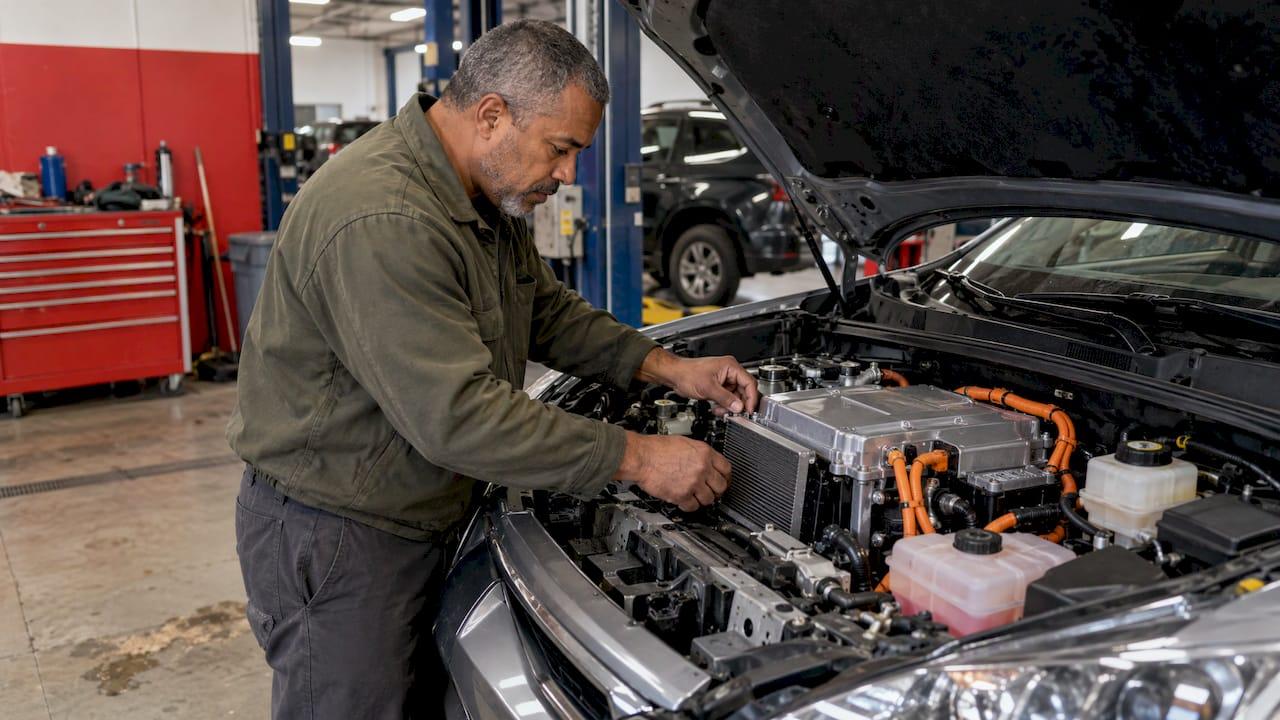
Hybrids usually cost the same or less to maintain than gas cars, but a major hybrid-system repair can be expensive. A replacement high-voltage battery typically runs about $1,000 to $6,000, and a plug-in luxury pack can cost far more. This guide covers the figures that matter, what drives them, how Range Rover, BMW, Mercedes, Ford, Honda and Porsche hybrids differ, and what a service contract should say before you rely on it.
TL;DR
- Routine hybrid upkeep is often cheaper than for a gas car. USA Today reports 35% to 45% lower annual maintenance and repair costs. Edmunds calls it roughly a wash, depending on vehicle and driving.
- Replacement batteries typically run $1,000 to $6,000, plus labor. Larger plug-in and luxury packs sit at the top of the range or above it.
- Federal rules require hybrid battery coverage of at least 8 years or 100,000 miles, so many first-owner battery failures are covered. Coverage after that, and for other components, is where a service contract matters.
- A contract only pays for what its written agreement lists. Read the covered-parts list, exclusions and claim steps before you buy.
Table of Contents
- What hybrid owners actually pay for day to day
- Hybrid battery replacement cost
- Other hybrid-system repairs and their costs
- How luxury and mainstream hybrids differ
- What the factory warranty already covers
- What to check before relying on a plan for hybrid repairs
- A worked example
- Perspective
- Get a quote for your hybrid
- Ways to keep hybrid repair bills lower
- FAQ
- Sources
What hybrid owners actually pay for day to day
Most of a hybrid is an ordinary car. The gasoline engine still needs oil changes and tune-ups, and the tires, suspension and cabin parts wear like any other. Edmunds notes that regenerative braking generally makes brake pads last longer, which offsets some of the cost of the extra hardware.
That is why routine numbers look good. USA Today puts hybrid annual maintenance and repair spending 35% to 45% below conventional gas cars. UK data points the same way: Which? found average annual servicing costs of £332 for full hybrids aged 0 to 4 years, rising to £369 for those aged 5 to 9 (a British survey, so use it for direction, not dollars).
The catch is the tail risk. Day-to-day costs are low, but the hybrid-specific parts are expensive when they fail. Industry data from CCC says hybrids need the most expensive parts on average per repair and had the highest frequency and cost of driver-assistance calibration. Budgeting for the rare large bill is the sensible approach.
Hybrid battery replacement cost
The high-voltage battery is the part owners worry about most, and the range is wide. CarBuzz reported in July 2026 that replacement batteries typically ranged from $1,000 to $6,000, depending on make, model, battery type, size and whether the pack is new OEM or refurbished. Its installed examples:
| Vehicle | Typical installed range |
|---|---|
| Toyota Prius | $1,400 to $5,000 |
| Honda Civic Hybrid | $1,400 to $2,000 |
| Lexus RX Hybrid | $5,000 to $6,000 |
AutoZone says packs commonly cost about $1,000 to $6,000, with installation labor adding roughly $500 to $1,500. It also explains the drivers: larger packs and lithium-ion chemistry generally cost more than older nickel-metal-hydride packs, and luxury-brand packs tend to cost more than mainstream equivalents.
Plug-in hybrids are a different tier. RepairPal estimates, as cited by Car and Driver, about $5,000 for the pack in a 2012 Toyota Prius and $10,000 to $12,000 for the larger pack in the 2012 Prius Plug-In. Those are older vehicles, but the lesson holds: more battery capacity means a bigger bill.
Why the same repair costs more on one car than another
- Pack size and chemistry. A mild-hybrid battery the size of a lunch box and a plug-in pack under the rear floor are not the same part.
- New, remanufactured or refurbished. The CarBuzz range reflects exactly this choice.
- Labor and access. Packs buried under seats or floors take longer to remove, and high-voltage work requires trained technicians.
- Brand positioning. Luxury nameplates carry higher parts prices across the board.
Other hybrid-system repairs and their costs
The battery gets the headlines, but it is not the only hybrid-specific component. Treat the figures below as shop-reported ballparks, because prices vary by region and by dealer versus independent shop.
Inverter or converter. The inverter converts battery power for the electric motor. NXT Motors, a repair shop, reports $1,800 to $3,500 for an inverter or converter assembly at a commercial facility. A Prius-focused independent shop reports $2,000 to $3,500 for an inverter, with dealer pricing 30% to 50% higher.
Inverter cooling pump. This one is the cautionary tale. The same shop reports a pump replacement at $500 to $800 installed, while letting it fail and overheat the inverter can push the bill to $3,000 to $4,500. A small warning light handled early is a far smaller repair.
Brake actuator. Hybrids use brake-by-wire hardware that blends regenerative and friction braking. Replacement is reported at about $2,000 to $4,000, with remanufactured units around $1,800 to $2,500.

Battery module repair. Sometimes only part of a pack is the problem. NXT Motors says cell-module balancing can cost $800 to $1,500 versus $3,000 to $6,000 or more for a full pack, and it puts typical pack life at 100,000 to 150,000 or more miles.

12-volt battery. Hybrids still have a conventional auxiliary battery, and a weak one can trigger a hybrid system warning. CarParts.com lists a blown fuse, defective battery cells, inverter problems and a worn 12-volt battery among common causes, and puts general hybrid system malfunction repairs at $2,000 to $8,000.
Reading a "hybrid system" warning
A hybrid warning does not automatically mean a $5,000 battery. It is a prompt to get a diagnosis from a technician trained on high-voltage systems. CarMD's repair data shows how the picture is shifting: the job "replace hybrid or EV high voltage battery" ranked no. 170 in 2022, up from no. 348 in 2021. As more hybrids age, these repairs get more common.
How luxury and mainstream hybrids differ
Brand matters more than the word "hybrid." Below is how the main makes tend to approach electrification, and where cost pressure comes from. No published price list exists for every model, so use these as a map of what to ask about, not as quotes.
Range Rover
Range Rover plug-in hybrids pair a gasoline engine with a large battery and electric motor, so the pack, the charging hardware and the cooling circuits all carry luxury-brand parts pricing. Add air suspension and a dense electronics suite, and a single fault can touch several systems. A contract that lists high-tech electronics, cooling and suspension alongside the hybrid components is worth far more than one that stops at the engine.
BMW
BMW offers plug-in models such as the 330e and X5 xDrive45e. The hybrid hardware sits on top of turbocharged engines and advanced driver-assistance sensors. CCC's finding that hybrids had the highest ADAS calibration frequency and cost matters here, because a windshield or bumper repair can trigger recalibration. Ask whether sensor and electronics failures are covered.
Mercedes-Benz
Mercedes-Benz sells plug-in hybrids including the E 350e and GLE 450e, with big infotainment and control-module architecture. Because many faults on these cars show up as software or module issues rather than a dead part, coverage of electrical and high-tech components is the line to check.
Ford
Ford's hybrid range includes the Escape Hybrid, the Maverick and the F-150 PowerBoost. Mainstream pricing generally means lower parts costs than luxury brands, but truck hybrids add towing loads and larger components. Cooling, transmission and electrical coverage matter most for the work trucks and family SUVs in this group.
Honda
Hondas such as the Accord and CR-V hybrids, and earlier the Civic Hybrid, sit at the affordable end. CarBuzz shows a Civic Hybrid replacement battery at $1,400 to $2,000 installed, well below the luxury range. The risk with a Honda is less one big failure and more the cumulative cost of an older car with a growing list of worn parts.
Porsche
Porsche's Cayenne E-Hybrid and Panamera E-Hybrid combine performance engines with plug-in packs. Larger packs plus luxury-brand pricing put these among the costliest hybrid repairs, consistent with AutoZone's note that luxury packs cost more than mainstream equivalents. Lexus is a useful reference point: its RX Hybrid pack runs $5,000 to $6,000 installed in CarBuzz's figures, so a performance plug-in can reasonably be expected to sit at or above that.
If you drive a Lexus, Audi or Tesla, we have dedicated pages: our Lexus warranty page, Audi warranty page and Tesla warranty page cover make-specific details.
What the factory warranty already covers
Before paying for anything, find out what the automaker still owes you. Kelley Blue Book says federal rules require hybrid and EV batteries to be covered for at least eight years or 100,000 miles, and notes that plug-in hybrid high-voltage batteries fall under an eight years or 80,000 miles requirement. Because these rules and individual automaker terms differ, confirm your exact term in the warranty booklet or with a dealer using your VIN.
Coverage is not uniform in scope. Capital One notes that some makers, Toyota for example, bundle the battery with other hybrid-related components such as the control module, while others cover only the battery. The same source says some hybrid battery warranties are transferable to a used-car buyer, which is worth confirming before you purchase a used hybrid.
The gaps that remain are these:
- Time and mileage. A used hybrid past eight years or 100,000 miles has no battery protection left from the factory.
- Components outside the battery warranty. Inverters, cooling pumps, brake actuators and the gasoline powertrain often follow the shorter general powertrain terms.
- Maintenance conditions. Skipped service can complicate a claim.
That is the space where an extended warranty fits. CCC reports the average U.S. vehicle is now 12.7 years old, so many hybrids on the road are past their factory protection.
What to check before relying on a plan for hybrid repairs
The California Department of Insurance is clear that a service contract covers only the parts and failures identified in the written agreement, and it advises reading both the covered-parts section and the exclusions rather than trusting verbal promises. It also tells buyers to check who is obligated to pay claims and whether the required backup insurer is named. The guide is from California, but the habits apply anywhere.
For a hybrid, use this checklist:
- Is the high-voltage battery listed by name? "Hybrid components" is vague. Look for the battery, battery modules, inverter, converter, motor-generator and control units.
- Are the cooling and electrical systems covered? Inverter cooling pumps and wiring are common failure points.
- What about high-tech electronics? Sensors, displays and driver-assistance modules are costly on newer cars.
- What are the exclusions? Normal wear, maintenance items, pre-existing conditions and gradual capacity loss are commonly excluded in service contracts, so read how the agreement words each one.
- What is the maintenance requirement? Keep service records so a claim is not delayed.
- How are claims handled? Look at the process, who authorizes repairs, and whether you can use a certified shop.
- Does it include roadside assistance and rental reimbursement? A hybrid that cannot be driven needs a tow and a ride.
A worked example
Say you own a ten-year-old hybrid crossover and the battery light comes on. A diagnosis shows a failing inverter cooling pump. Caught now, a shop-reported pump replacement runs $500 to $800. Ignored, overheating can damage the inverter, and the combined bill can reach $3,000 to $4,500. If the battery itself also needs work, add $1,000 to $6,000 plus labor of roughly $500 to $1,500.
The point is not that every hybrid will do this. It is that one fault can cascade, and the total can land in the thousands in a single week. A written agreement that names the cooling, electrical and hybrid components turns that unpredictable bill into a known process.
Perspective
We hear the same thing from hybrid owners: the car has been cheap to run, so the first big repair bill is a shock. That reaction is understandable, because routine costs really are low while a single hybrid-system failure can run into thousands.
Our view is that protection should match how these cars actually fail. That means looking past the engine and transmission to the cooling system, electrical system, steering, suspension, hybrid systems and the high-tech electronics that tie them together. Our Elite, Advanced and Essential plans are built with those tiers in mind, so you can choose broader coverage for a newer luxury hybrid or a more focused plan for an older commuter.
We also think you should understand the contract before you sign. Our four-step process (consultation, plan selection, customization and final agreement) is designed so you see the covered components and terms in writing, and our plans are designed with no hidden fees. Claims are handled through ASE-certified mechanics nationwide, and we aim for rapid approvals in 24 to 48 hours.
Whatever you drive, a Range Rover, a BMW, a Honda or a Ford, ask the same question: if the hybrid system fails after the factory coverage ends, who pays and how fast?
Kenneth
Get a quote for your hybrid
If your hybrid is out of factory coverage or close to it, we can build a plan around your year, make and model. Our Elite, Advanced and Essential plans offer different levels of component coverage, plus roadside assistance and rental reimbursement, and you can request a free quote online or by phone. Riding a motorcycle instead? See our Full Throttle motorcycle plan.

If you want to see how the process works first, our warranty FAQ answers the common questions about enrollment and claims.
Ways to keep hybrid repair bills lower
- Act on warnings early. The pump example shows how a small fix prevents a large one.
- Follow the service schedule. Hybrid gasoline engines still need oil changes and tune-ups, per Edmunds, and records support any later claim.
- Ask about repair options. Module-level battery repair or remanufactured parts can cost much less than a new pack, according to the shop figures above.
- Use technicians trained on high-voltage systems. The work is not the same as a standard repair.
- Know your factory terms. Note the date your battery coverage ends and set a reminder.
FAQ
Are hybrids more expensive to repair than gas cars?
Routine maintenance and repair costs are usually lower or about equal. USA Today reports 35% to 45% lower annual costs, while Edmunds describes the overall picture as roughly a wash. The exception is a major hybrid-specific failure, where parts like batteries and inverters cost more than conventional components.
How much does it cost to replace a hybrid battery?
Typically $1,000 to $6,000 depending on make, model, battery type and whether the pack is new or refurbished, with labor often adding about $500 to $1,500. Larger plug-in and luxury packs can cost considerably more.
Is the hybrid battery covered by the factory warranty?
Federal rules require at least eight years or 100,000 miles for hybrid batteries, with plug-in hybrid high-voltage batteries at eight years or 80,000 miles. Terms and transferability to a used-car buyer vary by automaker, so check your warranty booklet or ask a dealer with your VIN.
What should hybrid system coverage include?
Look for the high-voltage battery, inverter, converter, motor-generator, cooling components and control modules listed by name in the written agreement. Then read the exclusions and maintenance requirements so you know what a claim will involve.
Sources
- USA Today: Hybrid car maintenance costs compared to gas cars
- Edmunds: The Real Costs of Owning a Hybrid Car
- Which?: Car servicing and repair costs
- CCC Crash Course Q1 2025 report
- CarBuzz: Replacing a hybrid battery
- AutoZone: Hybrid battery replacement cost
- Car and Driver: Are hybrid cars worth the additional cost?
- NXT Motors: Are hybrid cars expensive to repair?
- Tucson Hybrids: Common hybrid failures explained
- CarMD 2023 Check Engine Repair Trends
- Kelley Blue Book: Warranty coverage for hybrid and EV batteries
- Capital One: Battery warranties for hybrid vehicles
- California Department of Insurance: Guide to automobile service contracts