

TL;DR:
- Hyundai's manufacturer-branded extended protection offers broad system coverage, but the value depends on your vehicle's risk profile and alternative options.
- Compare the coverage scope, contract language, and costs carefully to ensure the plan matches your needs before purchasing.
Hyundai's manufacturer-branded extended protection (VSP/EV Care) gives owners broad powertrain and system coverage with factory-level repair access — but whether it's worth the price depends entirely on your vehicle, your expected repair exposure, and how its cost stacks up against third-party options like Rpmwarranty.
Three things to know right now:
- Coverage scope: Hyundai's Vehicle Service Protection (VSP) extends coverage across major systems including the engine, transmission, drivetrain, steering, suspension, HVAC, and high-tech electronics. EV Care adds electric-specific protections for the high-voltage battery, electric drive unit, and thermal management systems.
- Term limits: Manufacturer-branded plans can extend protection up to 10 years or 100,000 miles on powertrain components, with some programs referencing terms up to high mileage limits depending on the plan tier and vehicle.
- Your next step: Request a sample contract from any provider before you pay a dollar. Compare the exclusion list, check EV battery degradation clauses if you drive a Hyundai IONIQ or Kona Electric, and get a competing quote from Rpmwarranty to benchmark the price.
Table of Contents
- What does Hyundai's manufacturer extended protection actually cover?
- What does Hyundai's factory warranty already include?
- How do VSP, EV Care, and pre-paid maintenance differ?
- What benefits come standard with Hyundai extended plans?
- How much do Hyundai extended warranty plans cost?
- When can you buy, and what are the eligibility rules?
- What exclusions and contract red flags should you watch for?
- How does the claims process work, and where can you get repairs?
- Is a Hyundai extended warranty worth buying?
- How Rpmwarranty's plan tiers work: Elite, Advanced, and Essential
- Key Takeaways
- What extended warranties for Hyundai owners actually come down to
- Getting a quote from Rpmwarranty is straightforward
- Sources and places to verify plan terms and consumer advice
What does Hyundai's manufacturer extended protection actually cover?
Hyundai's Vehicle Service Protection is structured as a stated-component plan on some tiers and an exclusionary plan on others. The distinction matters more than most buyers realize.
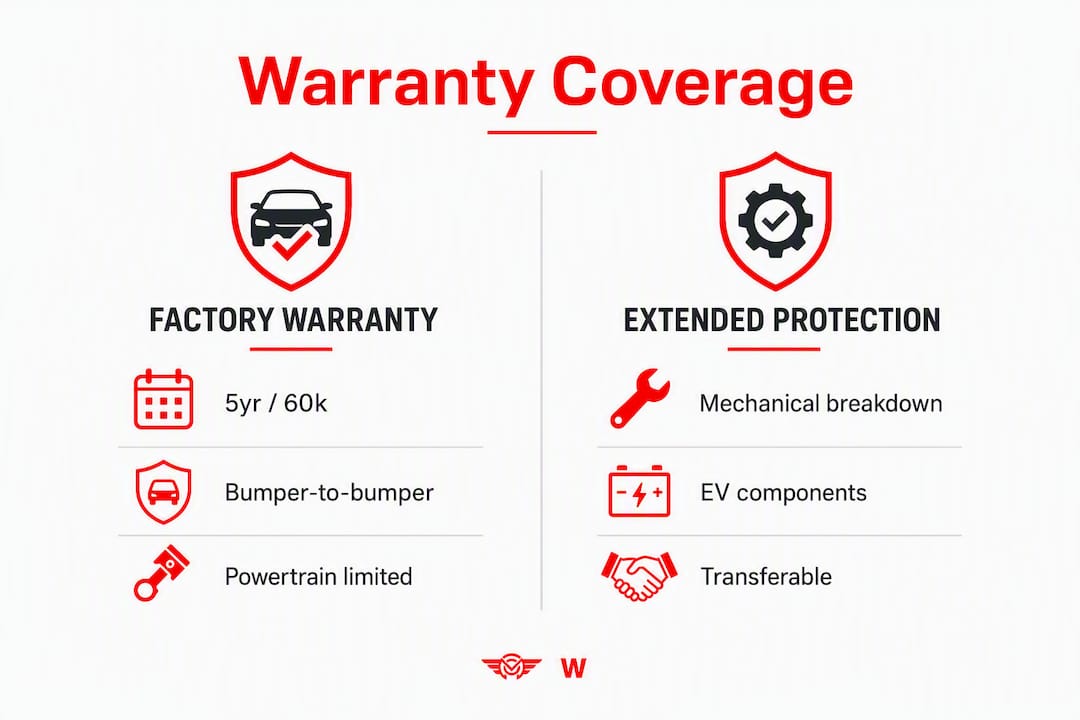
Stated-component coverage lists every part the plan will pay to repair. If a component isn't on the list, the claim is denied — full stop. Exclusionary coverage works the opposite way: everything is covered unless it appears on the exclusion list. Exclusionary plans are broader and generally more valuable, but they require careful reading because the exclusion list can run several pages.
Systems typically covered under VSP:
- Engine internals (pistons, crankshaft, camshaft, seals, gaskets)
- Transmission and transaxle components
- Drivetrain (driveshafts, CV joints, differentials)
- Steering (rack and pinion, power steering pump, electronic steering modules)
- Suspension (control arms, ball joints, struts — though wear items are usually excluded)
- HVAC (compressor, condenser, evaporator)
- Major electrical systems (alternator, starter, wiring harnesses)
- High-tech electronics (infotainment modules, driver-assist sensors, navigation hardware)
EV-specific systems under EV Care are covered separately and include the high-voltage battery pack, electric drive unit, on-board charger, and thermal management components. Battery degradation clauses vary significantly by contract — some plans cover failure but not gradual capacity loss, which is the more common EV complaint. Always verify this in the sample contract before signing.
Real-world examples of what VSP typically covers vs. what it doesn't:
| Repair scenario | Covered under VSP? | Notes |
|---|---|---|
| Engine timing chain failure | Yes | Major mechanical failure |
| Transmission solenoid replacement | Yes | Internal component |
| Brake pad replacement | No | Routine wear item |
| Infotainment screen failure | Usually yes | High-tech electronics tier |
| Wiper blades | No | Maintenance item |
| EV battery capacity loss (gradual) | Often no | Check EV Care contract language |
| Coolant hose failure | Depends on tier | Some tiers include, others exclude |
| Suspension strut wear | Usually no | Classified as wear-and-tear |
Pro Tip: Ask the provider to show you the exact exclusion list — not a summary brochure. The FTC advises buyers to assume a repair is excluded unless it is explicitly listed in the contract. A plan that sounds comprehensive in the sales pitch can have a two-page exclusion list that quietly eliminates half the repairs you'd actually need.
What does Hyundai's factory warranty already include?
Before spending money on extended coverage, you need to know what you already have. Hyundai's standard factory warranty — marketed as America's Best Warranty — is genuinely strong by industry standards, and understanding its terms prevents you from paying twice for protection you already own.
Core factory warranty terms:
- New Vehicle Limited Warranty: 5 years / 60,000 miles, bumper-to-bumper
- Powertrain Warranty: 10 years / 100,000 miles (original owner); transfers to subsequent owners at 5 years / 60,000 miles per Kelley Blue Book's warranty guide
- Anti-perforation (rust-through) Warranty: 7 years, unlimited mileage
- Roadside Assistance: 5 years / unlimited mileage
- Federal Emissions Warranty: 8 years / 80,000 miles (powertrain emissions components)
The powertrain transfer limitation is one of the most misunderstood aspects of Hyundai ownership. If you buy a used Hyundai, that 10-year/100,000-mile powertrain warranty drops to 5 years/60,000 miles from the original sale date. A 2022 Hyundai Tucson purchased used in 2026 may have very little factory powertrain coverage remaining.
What extended protection adds beyond the factory baseline:
| Coverage dimension | Factory warranty | Extended protection (VSP) |
|---|---|---|
| Bumper-to-bumper term | 5 yr / 60k mi | Varies by plan tier |
| Powertrain (original owner) | 10 yr / 100k mi | Can extend or supplement |
| High-tech electronics | Included in 5-yr term | Continues post-factory expiration |
| Roadside assistance | 5 yr / unlimited | Continues through plan term |
| Rental reimbursement | Not standard | Typically included |
| Trip interruption | Not standard | Typically included |
The CFPB recommends checking for overlap between factory coverage and any extended plan you're considering — paying for duplicate protection is a common and avoidable mistake.
How do VSP, EV Care, and pre-paid maintenance differ?
These three products solve different problems. Buying the wrong one — or assuming they overlap — is a costly mistake.

Vehicle Service Protection (VSP) is the manufacturer-branded mechanical breakdown plan. It picks up where the factory warranty leaves off (or runs concurrently to extend the term) and covers the systems listed above. VSP is what most people mean when they say "Hyundai extended warranty." It does not cover scheduled maintenance.
EV Care is purpose-built for Hyundai's electric and plug-in hybrid vehicles, including the IONIQ 5, IONIQ 6, and Kona Electric. It focuses on components that have no equivalent in a gas-powered car: the high-voltage battery pack, electric drive unit, on-board charger, DC fast-charge port hardware, and thermal management system. One important caveat: battery degradation (gradual capacity loss over time) is often treated differently from outright battery failure. Read the contract language on this point carefully, because it's where EV owners most often encounter claim disputes.
Pre-paid maintenance is not mechanical protection at all. It covers scheduled services — oil changes, tire rotations, multi-point inspections, filter replacements — at a fixed prepaid price. It complements VSP but cannot substitute for it. If your engine fails, pre-paid maintenance pays nothing.
| Plan type | What it covers | What it doesn't cover | Best for |
|---|---|---|---|
| VSP (Vehicle Service Protection) | Mechanical and electrical systems post-factory | Maintenance, wear items, pre-existing conditions | Owners extending mechanical coverage |
| EV Care | High-voltage battery, electric drive unit, charger, thermal systems | Battery degradation (often), routine charging costs | IONIQ, Kona EV, plug-in hybrid owners |
| Pre-paid maintenance | Scheduled services (oil, filters, rotations) | Any mechanical breakdown | Owners wanting predictable service costs |
What benefits come standard with Hyundai extended plans?
The core mechanical coverage gets the headlines, but the included benefits often determine whether a plan delivers real-world value between claims.
Standard benefits typically included:
- 24/7 roadside assistance: Towing, battery jump-start, flat tire service, lockout assistance, and fuel delivery
- Rental reimbursement: A daily allowance (amount varies by plan) while your vehicle is being repaired
- Trip interruption: Reimbursement for lodging and meals if a covered breakdown strands you more than a set distance from home (commonly 100+ miles)
- Towing to an authorized repair facility: Covered when the breakdown is a covered mechanical failure
Transferability is one of the most underappreciated financial benefits. A transferable extended warranty adds documented value to a private-party sale. A buyer who sees active coverage remaining on a Hyundai Santa Fe or Palisade is more likely to pay closer to asking price. The transfer process typically involves a small administrative fee and a formal transfer request to the plan administrator.
Add-on services sometimes bundled or sold alongside plans include tire and wheel protection, paintless dent repair, key fob replacement, and windshield repair. These are worth evaluating individually rather than as a package.
Pro Tip: Rental reimbursement caps matter more than most buyers check. A plan that pays $35/day sounds fine until a dealer repair takes two weeks and the cheapest rental in your area runs $60/day. Ask for the daily cap and the maximum number of days before you sign. If you drive frequently for work, trip interruption coverage is worth prioritizing over tire repair add-ons.
How much do Hyundai extended warranty plans cost?
Price is where manufacturer-branded plans and third-party options diverge most sharply, and where the most negotiating room exists.

Industry reporting from USA Today puts extended warranty costs in a range of roughly $70 to $180 per month, or $1,500 to $4,000 for a full contract, depending on coverage level and vehicle factors. Industry reporting from USA Today puts extended warranty costs in a range of roughly $70 to $180 per month, or $1,500 to $4,000 for a full contract, depending on coverage level and vehicle factors. Insurify's aggregated data shows an average near $90 per month, though that average masks wide variation by vehicle age, mileage, and plan tier. MarketWatch's secret-shopping research found a median annual extended warranty cost near $1,297 per year, with term contracts often priced more favorably than month-to-month arrangements.
The main variables that move your premium:
- Vehicle age and mileage: A 2023 Hyundai Tucson with 18,000 miles costs significantly less to cover than a 2019 Santa Fe with 72,000 miles
- Plan tier: Exclusionary (comprehensive) plans cost more than stated-component or powertrain-only plans
- Deductible: A $200 deductible per visit lowers the monthly premium; a $0 deductible raises it
- Term length: Longer terms spread risk over more time, which can lower the monthly cost but raise the total contract price
- Model repair-cost profile: Hyundai's mainstream models (Elantra, Tucson) tend to cost less to cover than higher-complexity vehicles like the IONIQ 5 or Palisade, which carry more expensive electronic systems
Cost-evaluation checklist before you sign:
- Total contract price (not just monthly payment)
- Deductible per visit vs. per claim
- Any enrollment or administrative fees
- Cancellation and refund terms (pro-rated vs. flat-fee penalty)
- Whether the plan is backed by an insurance company or the dealer's own reserve
Consumer Reports recommends buying while the vehicle is still under factory warranty to secure lower premiums. Waiting until after the factory coverage expires almost always means a higher price and fewer plan options. The CFPB also notes that extended warranty prices are often negotiable — both at the dealer and with third-party providers.
Common pricing questions:
Can I negotiate the price? Yes. Dealer-sold plans in particular carry significant markup. Third-party providers are also often willing to match or beat a competing quote.
Are payment plans available? Many providers offer monthly payment options, but check whether interest is charged. Paying the full contract upfront is usually cheaper in total.
Are there hidden fees? Watch for administrative fees, transfer fees, and cancellation penalties. These should be disclosed in the contract, not discovered later.
When can you buy, and what are the eligibility rules?
Timing your purchase correctly can save hundreds of dollars and keep more plan options open.
The best time to buy extended coverage is while the factory warranty is still active. Providers accept less risk when a vehicle is already under manufacturer protection, and that lower risk translates directly into lower premiums and broader eligibility. Waiting until the factory warranty expires narrows your options and raises your cost.
Typical eligibility restrictions:
- Maximum vehicle age at enrollment (commonly 10–12 years from model year)
- Maximum mileage at enrollment (commonly 100,000–150,000 miles, depending on plan tier)
- No pre-existing conditions (a mechanical inspection or waiting period may apply)
- Vehicles with salvage or rebuilt titles are typically ineligible
Buying channels:
- At the dealership during the sale — convenient but often the most expensive option; dealer F&I departments earn significant commission on warranty sales
- Post-sale within a manufacturer window — Hyundai typically allows VSP purchase within a defined mileage/time window after the original sale; check current terms directly with Hyundai Finance
- After the factory warranty expires — third-party providers like Rpmwarranty can often cover vehicles that no longer qualify for manufacturer-branded plans, subject to mileage and age limits
Step-by-step buying checklist:
- Pull your current factory warranty status (check your original purchase documents or Hyundai's owner portal)
- Confirm your current mileage and vehicle age against the plan's eligibility rules
- Request a sample contract from at least two providers — not a brochure, the actual contract
- Compare the exclusion lists side by side
- Get a free quote from Rpmwarranty at rpmwarranty.com/free-quotes to benchmark the price
- Confirm repair network flexibility (dealer-only vs. ASE-certified independent shops)
- Review cancellation and refund terms before signing
What exclusions and contract red flags should you watch for?
This is where most buyers get burned. The marketing materials describe what a plan covers; the contract describes what it doesn't. Those two documents can tell very different stories.
Common exclusions across most extended warranty contracts:
- Routine maintenance (oil changes, filters, brake pads, tires)
- Wear-and-tear items (belts, hoses, wiper blades, brake rotors)
- Pre-existing conditions at the time of enrollment
- Damage from accidents, floods, or improper maintenance
- Modifications or aftermarket parts that affect covered systems
- Cosmetic damage (paint, upholstery, trim)
- Certain electronic items (some infotainment components, cameras, and sensors vary by plan)
Contract red flags — read these clauses carefully:
- Vague component definitions: Phrases like "engine assembly" without specifying internal components leave room for denial
- "Reasonable wear" language: If the contract allows the administrator to deny claims on the basis of "reasonable wear," almost any mechanical failure can be reclassified as wear-and-tear
- Dealer-only repair restrictions: A plan that requires all repairs at a Hyundai dealership limits your options and can mean longer wait times
- High or hidden deductibles: Some contracts list a per-visit deductible in fine print that effectively makes small claims not worth filing
- Long waiting periods: Some plans impose a 30-day or 1,000-mile waiting period before coverage activates
- Limited transferability: A plan that cannot transfer to a new owner, or charges a high transfer fee, reduces resale value
The FTC's consumer guidance is direct on this point: assume a repair is excluded unless the contract explicitly lists it as covered. Marketing language and contract language are not the same document, and the contract is the only one that matters when you file a claim.
Pro Tip: Before you buy, ask the provider: "Can you show me an example of a claim denial letter and explain why that claim was denied?" A reputable provider will answer this without hesitation. One that deflects or pivots to marketing language is showing you something important about how they handle disputes.
How does the claims process work, and where can you get repairs?
Filing a claim is where the practical differences between manufacturer-branded and third-party plans become most visible.
Typical claim filing process:
- Contact the plan administrator (phone or online portal) before authorizing any repairs
- Provide your contract number, vehicle VIN, current mileage, and a description of the problem
- Take the vehicle to an authorized repair facility (dealer or ASE-certified shop, depending on your plan)
- The shop contacts the administrator for pre-authorization before beginning work
- Administrator approves covered repairs and labor rate
- Repairs are completed; the administrator pays the shop directly (or reimburses you, depending on plan terms)
- You pay only your deductible at pickup
Dealer network vs. independent ASE-certified shops:
| Factor | Dealer-only network | Independent ASE-certified shops |
|---|---|---|
| Parts sourcing | OEM parts standard | OEM or aftermarket (varies by contract) |
| Labor rate | Dealer rate (higher) | Shop rate (often lower) |
| Convenience | Limited to dealer locations | Nationwide flexibility |
| Wait times | Can be longer at busy dealers | Often faster |
| Familiarity with EV systems | Higher for Hyundai EVs | Varies by shop |
Plans that allow repairs at any ASE-certified shop give you significantly more flexibility, especially if you're traveling or live in an area without a nearby Hyundai dealer. Rpmwarranty's plans are built around nationwide ASE-certified repair access, which removes the dealer dependency entirely.
Documents to have ready when filing a claim:
- Your warranty contract and contract number
- Vehicle registration and VIN
- Maintenance records (to demonstrate the vehicle has been properly serviced)
- Description of symptoms and when they started
- Any prior repair invoices related to the issue
Common causes of claim delays include missing pre-authorization (the most avoidable), incomplete maintenance records, and disputes over whether a failure qualifies as mechanical breakdown vs. wear-and-tear.
Is a Hyundai extended warranty worth buying?
The honest answer is: it depends on three numbers — your plan cost, your vehicle's likely repair costs, and how long you plan to keep the car.
Decision framework:
- Assess your vehicle's repair-cost profile. A Hyundai Elantra with 40,000 miles has a different risk profile than an IONIQ 5 with 60,000 miles. EVs carry lower routine maintenance costs but higher component replacement costs when something does fail.
- Estimate your ownership horizon. Extended coverage makes more financial sense if you're keeping the vehicle 3–5+ more years past the factory warranty expiration.
- Calculate the break-even point. If a plan costs $2,500 total and your deductible is $100 per visit, you need roughly $2,600 in covered repairs over the plan term to break even. One transmission replacement or major electrical failure typically exceeds that threshold.
- Compare the plan cost against your savings buffer. If you have $5,000 set aside for car repairs, self-insuring may be rational. If you don't, a plan transfers that financial risk for a known monthly cost.
Sample calculation (adapt to your situation):
| Variable | Example values |
|---|---|
| Plan total cost | $1,500–$4,000 |
| Deductible per visit | $100 |
| Estimated ownership remaining | 4 years |
| Estimated repair risk (moderate) | $1,500–$4,000 |
| Break-even repair cost | $1,500 to $4,000 |
| Verdict | Consider / borderline |
When manufacturer-branded VSP makes more sense:
- You drive a Hyundai EV and want factory-level battery coverage with dealer-level EV expertise
- Your vehicle is still within the manufacturer's enrollment window and pricing is competitive
- You prefer all repairs handled at a Hyundai dealership
When a third-party plan like Rpmwarranty makes more sense:
- Your vehicle is past the manufacturer's enrollment window or mileage limit
- You want repair flexibility at independent ASE-certified shops nationwide
- You want to compare coverage and price without going through a dealer F&I office
- You drive a higher-complexity vehicle (like a Hyundai with advanced driver-assist systems) and want a plan that explicitly covers those electronics
The CFPB's guidance frames this as a direct cost comparison: total contract cost vs. expected repair costs over your planned ownership period. Reliability data and repair-cost profiles drive value more than any marketing promise.
How Rpmwarranty's plan tiers work: Elite, Advanced, and Essential
Rpmwarranty offers three plan tiers designed to match different vehicles, budgets, and coverage needs. All three include nationwide repair access through ASE-certified mechanics, which means you're not locked into a dealer network.
Plan tiers at a glance:
- Elite: The broadest coverage tier, designed for owners who want near-exclusionary protection. Covers engine internals, transmission, drivetrain, steering, suspension, HVAC, major electrical systems, and high-tech electronics including driver-assist and infotainment components. Best for higher-mileage vehicles or owners who want maximum protection.
- Advanced: Mid-tier coverage that includes the major mechanical systems (engine, transmission, drivetrain) plus electrical and cooling. A strong fit for owners who want solid mechanical protection without paying for every electronic component.
- Essential: Powertrain-focused coverage for owners who want protection against the most expensive failures (engine and transmission) at the lowest monthly cost. Best for vehicles with lower repair-risk profiles or owners on a tighter budget.
Rpmwarranty's four-step process:
- Consultation: Provide your vehicle's year, make, model, and mileage to get a tailored quote
- Plan selection: Choose between Elite, Advanced, and Essential based on coverage needs and budget
- Customization: Adjust deductible, term length, and any add-ons (roadside assistance is included across plans)
- Agreement: Review and sign the contract; coverage activates after any applicable waiting period
Customer-facing benefits across all Rpmwarranty plans:
- Nationwide ASE-certified repair network (no dealer-only restriction)
- 24/7 roadside assistance
- Rental reimbursement during covered repairs
- Transferable coverage (adds resale value)
- Dedicated customer support for claims and questions
For EV owners, Rpmwarranty also offers coverage options for electric vehicle systems. You can see how EV-specific plans are structured at rpmwarranty.com/best-extended-warranty-for-tesla as a reference for the type of EV coverage approach Rpmwarranty applies across electric vehicles.
Get a free quote in minutes by entering your VIN, mileage, and model year.
Key Takeaways
Hyundai's manufacturer-branded extended protection offers strong factory-level coverage, but third-party plans like Rpmwarranty often deliver comparable protection with more repair flexibility and competitive pricing.
| Point | Details |
|---|---|
| VSP covers major systems | Engine, transmission, drivetrain, steering, HVAC, and high-tech electronics are typically included. |
| EV Care needs careful review | Battery degradation is often excluded; verify the exact contract language before buying EV coverage. |
| Buy while factory warranty is active | Purchasing during the factory coverage period typically secures lower premiums and broader eligibility. |
| Extended warranty costs vary widely | Industry data shows full contracts ranging from roughly $1,500 to $4,000 depending on vehicle and plan tier. |
| Rpmwarranty offers three tiers | Elite, Advanced, and Essential plans cover vehicles nationwide through ASE-certified shops with no dealer restriction. |
What extended warranties for Hyundai owners actually come down to
Most buyers approach this decision backwards. They start with the plan and work toward the price, when the smarter move is to start with the vehicle's actual risk profile and work toward the plan.
A Hyundai Elantra or Sonata with under 60,000 miles and a clean service history is a genuinely reliable car. Hyundai's factory warranty is strong enough that the case for extended coverage during the factory period is mostly about locking in a lower price for future protection, not covering an imminent risk. The calculus shifts meaningfully once you're past 80,000 miles, past the factory bumper-to-bumper expiration, or driving an EV with expensive battery and drive-unit components.
The piece most buyers underestimate is the repair-network restriction. A plan that forces all repairs through a Hyundai dealership sounds reasonable until you're 200 miles from home with a broken transmission on a Sunday. Plans that allow any ASE-certified shop remove that vulnerability entirely, and that flexibility has real dollar value that doesn't show up in the monthly premium comparison.
The other thing worth saying plainly: the FTC's guidance about reading exclusion language isn't just bureaucratic caution. Extended warranty disputes almost always come down to contract language that the buyer never read. The sample contract is the product. Read it before you pay for it.
Getting a quote from Rpmwarranty is straightforward
If you've read this far, you already know what to look for. Rpmwarranty gives Hyundai owners a direct path to coverage that doesn't require sitting in a dealer F&I office or accepting a single quoted price. The Elite, Advanced, and Essential tiers are built to match real vehicles at real mileages, with nationwide ASE-certified repair access and no dealer-network lock-in.
To get started, have your VIN, current mileage, and model year ready. The quote process takes a few minutes online, and you can request a sample contract to review the actual coverage language before committing. That's the step most buyers skip, and it's the most important one.
Visit rpmwarranty.com to get your free quote, compare plan tiers, and see exactly what your Hyundai would be covered for.
This article provides general information about extended vehicle warranty options and is not a substitute for reviewing your specific contract terms or consulting a qualified consumer protection professional for your situation.
Sources and places to verify plan terms and consumer advice
Before purchasing any extended warranty, download the provider's sample contract and cross-reference it against these authoritative resources.
Consumer protection and legal guidance:
- Federal Trade Commission — Extended warranties and service contracts: The primary source for understanding your legal rights, exclusion language, and what questions to ask before signing
- Consumer Financial Protection Bureau — Manufacturer's warranty vs. extended vehicle warranty: Explains contract differences, cancellation rights, and negotiation advice in plain language
Cost benchmarking and market data:
- USA Today — Extended car warranty cost: Reported cost ranges across providers and plan levels
- MarketWatch — How much does an extended warranty cost?: Secret-shopping research with median annual cost data and term vs. monthly pricing analysis
Independent buyer guidance:
- Consumer Reports — Get an extended warranty for your car: Practical advice on timing, pricing, and what to look for in a plan
- Kelley Blue Book — Car warranty guide: Explains factory warranty terms, transfer rules, and how extended coverage fits in
- Cars.com — Best extended car warranty plans: Market benchmarking for common plan features and perks
Before you sign anything, download the actual sample contract from your provider. The brochure describes the plan. The contract is the plan. Those two documents are not always the same, and only one of them will matter if you ever need to file a claim.