

TL;DR:
- Limited mileage plans charge per mile over a fixed allowance, while unlimited plans offer flat rates with no overage fees. The choice depends on your total expected miles, vehicle class, and whether your contract caps miles daily or overall. Understanding these factors helps you select the most cost-effective option and avoid unexpected charges.
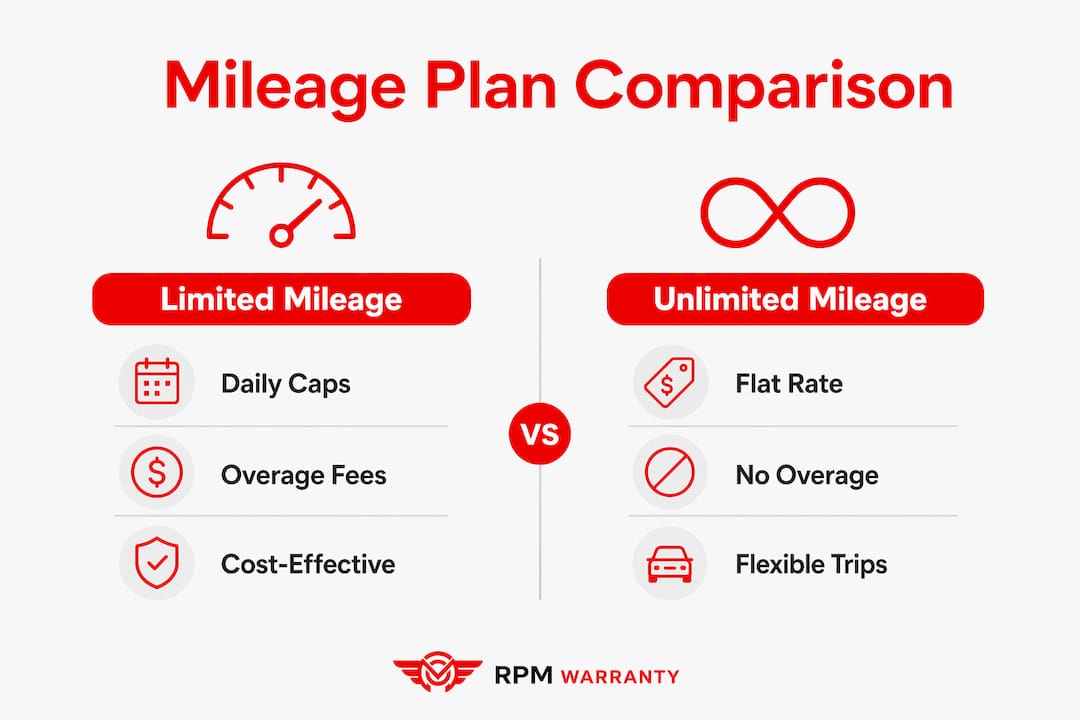
Limited mileage sets a fixed daily or total mile allowance with per-mile fees for any overage, while unlimited mileage lets you drive as far as you want for a flat rate with no extra charges. Understanding what is limited vs unlimited mileage is not just useful for rental decisions. It directly shapes how much protection you get from an extended vehicle warranty and how much an unexpected road trip could cost you. Whether you drive a Ford F-150, a BMW 5 Series, or a Range Rover Sport, the mileage terms in your contract determine your financial exposure from day one.
What are the financial differences between limited and unlimited mileage?
The core financial difference is simple. Unlimited mileage charges a flat rate with no per-mile fees, while limited mileage offers a lower base price but adds overage charges once you exceed your allowance.
Those overage fees add up faster than most car buyers expect. Overage fees typically run $0.10 to $0.25 per mile, which sounds small until you do the math. Drive 200 miles over a 300-mile daily cap on a week-long trip, and you could owe an extra $140 to $350 on top of your base cost.
The break-even point is the number that matters most. Calculating break-even mileage before you sign any contract tells you exactly when the cheaper limited plan becomes the more expensive option. If your expected mileage puts you near or above that threshold, unlimited mileage is the better financial choice every time.
Here is how to think through the numbers before you commit:
- Estimate your total miles. Add up your planned driving distance for the full rental or warranty period, not just one day.
- Identify your daily or total cap. Standard daily allowances typically fall between 100 and 500 miles. Know which structure your contract uses.
- Multiply overages by the per-mile rate. Use $0.15 per mile as a midpoint estimate if the exact rate is not listed.
- Add overages to the base price. If that total exceeds the unlimited plan price, choose unlimited.
- Build in a buffer. Road trips rarely go exactly as planned. Add 15% to your estimated mileage before comparing costs.
Pro Tip: Never assume the base price of a limited mileage plan is the final price. Run the overage calculation for your worst-case mileage scenario, not your best-case one.
Unlimited mileage is not always the cheapest option for short urban trips. If you are renting a Honda Civic for two days in Chicago and plan to drive 80 miles total, a limited plan with a 150-mile daily cap costs you nothing extra and saves you money upfront.
How do vehicle class and rental terms affect mileage options?
Vehicle class is the single biggest factor that determines whether unlimited mileage is even available to you. Economy and standard cars from brands like Honda and Ford almost always qualify for unlimited plans. Specialty and luxury vehicles operate under different rules entirely.

Luxury vehicles including Range Rover, BMW, and Mercedes frequently carry mileage caps even when the same rental company offers unlimited plans on economy cars. A BMW X5 or a Mercedes GLE on a rental or subscription plan will often come with a 200-mile daily cap or a total rental period limit, regardless of what the base plan advertises. Porsche and Range Rover models face similar restrictions because higher mileage accelerates depreciation on vehicles that cost significantly more to maintain and repair.
The table below shows how mileage policies typically break down by vehicle class:
| Vehicle class | Unlimited mileage available? | Typical daily cap (if limited) | Typical overage rate |
|---|---|---|---|
| Economy/compact (Honda, Ford) | Yes, commonly | 100–300 miles | $0.10–$0.15/mile |
| Standard/midsize sedan | Yes, commonly | 150–300 miles | $0.10–$0.20/mile |
| Full-size SUV | Sometimes | 150–250 miles | $0.15–$0.25/mile |
| Luxury sedan/SUV (BMW, Mercedes) | Rarely | 100–200 miles | $0.20–$0.25/mile |
| Specialty/exotic (Porsche, Range Rover) | Almost never | 100–150 miles | $0.25+/mile |
Beyond vehicle class, the structure of your mileage cap matters just as much as the number itself. Mileage limits may be calculated daily or for the entire rental period, and that distinction changes how you can use your allowance. A daily cap of 150 miles on a seven-day rental gives you 1,050 total miles, but you cannot shift unused miles from a slow day to a heavy driving day. A total period cap of 1,050 miles lets you drive 300 miles on day one and only 50 miles on day two without penalty.
Key contract terms to verify before signing:
- Whether your mileage cap is daily or covers the full rental period
- Whether unused daily miles carry over to the next day
- Whether one-way rentals have separate mileage restrictions
- Whether geographic limits apply, such as restrictions on crossing state lines or driving into Canada or Mexico
- Whether the mileage policy changes if you extend the rental period
Rental contracts differ significantly on these points, and the difference between a daily cap and a pooled total cap can mean hundreds of dollars in unexpected fees.
What are the practical advantages and drawbacks of each mileage type?
The right mileage plan depends almost entirely on how you drive and where you are going. Unlimited mileage wins on flexibility. Limited mileage wins on upfront cost for short, predictable trips.
Unlimited mileage provides psychological ease by removing the need to watch the odometer. That freedom is genuinely valuable on a multi-state road trip where detours, scenic routes, and unplanned stops are part of the experience. Checking your mileage every few hours adds stress that no driver needs on vacation.
Advantages of unlimited mileage:
- No odometer anxiety on long or unpredictable trips
- Fixed, predictable total cost regardless of distance driven
- Better suited for road trips across multiple states
- Ideal when travel plans are flexible or subject to change
- Removes the risk of unexpected charges at vehicle return
Advantages of limited mileage:
- Lower base price for short, predictable urban trips
- Cost-effective when you know your exact driving distance
- Useful for commuters or drivers with fixed daily routes
- Can save money significantly on trips under 100 miles per day
Limited mileage plans are cost-effective for short, predictable trips, while unlimited mileage suits long-distance, multi-city travel. A weekend rental in Boston where you plan to drive to two restaurants and one museum fits a limited plan perfectly. A two-week trip from Dallas to Denver with side trips to national parks fits unlimited mileage just as clearly.
The risk management angle is worth understanding. Mileage policies function as risk management tools that control fleet depreciation. With a limited plan, the renter assumes the risk of exceeding the allowance. With an unlimited plan, the rental company absorbs that risk at a premium price. Knowing which side of that risk you are on helps you make a clear-headed decision.
Pro Tip: If your trip involves any element of uncertainty, such as a flexible return date, potential detours, or driving a vehicle you are unfamiliar with, choose unlimited mileage. The peace of mind is worth the price difference.
How to avoid common pitfalls with mileage restrictions
Most mileage-related charges are avoidable. They happen because car buyers and renters misread their contracts or make assumptions that turn out to be wrong.
-
Confusing daily caps with total period caps. A contract that says "150 miles per day" and one that says "1,050 miles total" can look similar but behave very differently. Always ask which structure applies before you sign.
-
Assuming unlimited mileage applies to your vehicle class. Unlimited mileage is often advertised at the plan level, not the vehicle level. A promotional rate for unlimited mileage may only apply to economy cars. If you upgrade to a BMW 3 Series or a Range Rover Evoque, the mileage terms may change automatically.
-
Underestimating total trip mileage. Most drivers underestimate how far they actually travel. GPS routing, detours, parking lot loops, and side trips all add miles. Use a mapping tool like Google Maps to calculate your full expected route before booking.
-
Missing geographic restrictions. Some contracts prohibit driving across state lines or into neighboring countries. A road trip from San Diego to Tijuana or from Detroit to Windsor could violate your mileage agreement and void your coverage entirely.
-
Ignoring one-way rental rules. One-way rentals, where you pick up in one city and drop off in another, often carry separate mileage restrictions that differ from standard round-trip terms. Confirming whether mileage is pooled or daily limited prevents fees that catch most renters off guard.
Reading the fine print takes ten minutes. Paying an unexpected overage bill takes considerably longer to recover from financially.
Key Takeaways
The most cost-effective mileage choice depends on trip length, vehicle class, and whether your contract caps miles daily or over the full rental period.
| Point | Details |
|---|---|
| Unlimited mileage means flat rate | No per-mile fees apply, giving you a fixed, predictable total cost regardless of distance. |
| Limited mileage suits short trips | Daily caps of 100–500 miles work well when your driving distance is known and predictable. |
| Overage fees compound quickly | At $0.10–$0.25 per mile, exceeding your cap by 200 miles can add $20–$50 per day. |
| Luxury vehicles face stricter caps | BMW, Mercedes, Range Rover, and Porsche models often carry mileage limits even on unlimited plans. |
| Daily vs total cap changes everything | A daily cap locks each day's miles; a total period cap lets you shift miles between days. |
Why I always tell enthusiast drivers to do the math first
I have watched car buyers make the same mistake repeatedly. They see "unlimited mileage" and assume it is always the better deal. They see "limited mileage" and assume it is always the cheaper option. Neither assumption holds up under scrutiny.
The most expensive rental I ever heard about from a client involved a BMW 5 Series on a limited mileage plan. The driver assumed the daily cap was generous enough for a week-long trip through the Pacific Northwest. It was not. The overage bill at return was larger than the original rental cost. That is not a rare story. It is a predictable outcome when drivers skip the break-even calculation.
For enthusiast drivers who favor premium vehicles like a Porsche 911, a Range Rover Sport, or a Mercedes AMG, the mileage question carries even more weight. These vehicles almost never qualify for unlimited plans, and their overage rates sit at the top of the range. Knowing that before you book changes your entire planning approach.
My honest recommendation is this: treat the mileage calculation the same way you treat fuel cost. You would not rent a vehicle without knowing the gas tank size. Do not sign a mileage contract without knowing your break-even point. The mental freedom of unlimited mileage is real and worth paying for on long trips. On short trips, it is money left on the table.
Always verify whether the mileage policy in your contract applies to your specific vehicle, not just the plan category. That one check prevents the most common and most expensive mistake in this space.
— Kenneth
Rpmwarranty protection plans for high-mileage vehicle owners
Car buyers who drive premium vehicles know that mileage adds up fast, and so do repair bills once the manufacturer warranty expires.
Rpmwarranty offers extended warranty plans built for vehicle owners who want real protection beyond the factory coverage window. Whether you own a Volkswagen, a Hummer, or an Aston Martin, Rpmwarranty's Elite, Advanced, and Essential plans cover engines, transmissions, electrical systems, and high-tech components that matter most on high-mileage vehicles. You can get a free warranty quote in minutes, or compare vehicle protection plans by your specific make, model, and mileage profile. Nationwide coverage and straightforward claims processing make Rpmwarranty a practical choice for drivers who put real miles on real vehicles.
FAQ
What is the difference between limited and unlimited mileage?
Limited mileage sets a fixed daily or total mile allowance with per-mile overage fees of $0.10–$0.25, while unlimited mileage charges a flat rate with no per-mile fees regardless of distance driven.
When does unlimited mileage save you money?
Unlimited mileage saves money when your total trip distance exceeds the break-even point where overage fees on a limited plan would cost more than the flat unlimited rate.
Do luxury vehicles like BMW and Range Rover qualify for unlimited mileage?
Luxury and specialty vehicles including BMW, Mercedes, Range Rover, and Porsche almost never qualify for unlimited mileage plans, even when economy cars on the same rental platform do.
What is the difference between a daily mileage cap and a total rental period cap?
A daily cap restricts how many miles you can drive each day with no carryover, while a total period cap pools your full allowance across the entire rental so you can drive more on some days and less on others.
Can mileage restrictions affect extended vehicle warranties?
Yes. Extended vehicle warranties often include mileage thresholds that determine coverage eligibility and terms. Drivers who exceed those thresholds may face reduced coverage or higher premiums, making it critical to verify mileage terms before purchasing a plan.