

A MAP extended auto warranty, short for Motorist Assistance Plan, is a third-party vehicle service contract sold separately from your manufacturer's warranty. It is not a factory warranty. It is a private agreement between you and an administrator who pays for covered repairs once your original coverage ends. Most plans come in three tiers, ranging from powertrain-only to near-bumper-to-bumper exclusionary coverage, and many bundle roadside assistance, rental reimbursement, and trip interruption benefits.
Before you do anything else, know this:
- Call the administrator before authorizing any repair. Pre-authorization is required on most contracts.
- Have your VIN and contract number ready when you call.
- Ask the shop to hold the vehicle until you have written approval from the administrator.
- Skipping this step is the single most common reason claims are denied, even on legitimate failures.
Table of Contents
- What does a MAP-style plan actually cover?
- Who qualifies, what it costs, and how deductibles work
- How the claims process works, step by step
- Common exclusions and why claims get denied
- How to evaluate a MAP-type contract before you buy
- How to verify an existing contract on a vehicle you already own or are buying
- When does a MAP-style contract actually make financial sense?
- Key Takeaways
- Why the administrator is the product, not the contract name
- Rpmwarranty covers what the checklist demands
- Useful sources and next steps before you buy
What does a MAP-style plan actually cover?
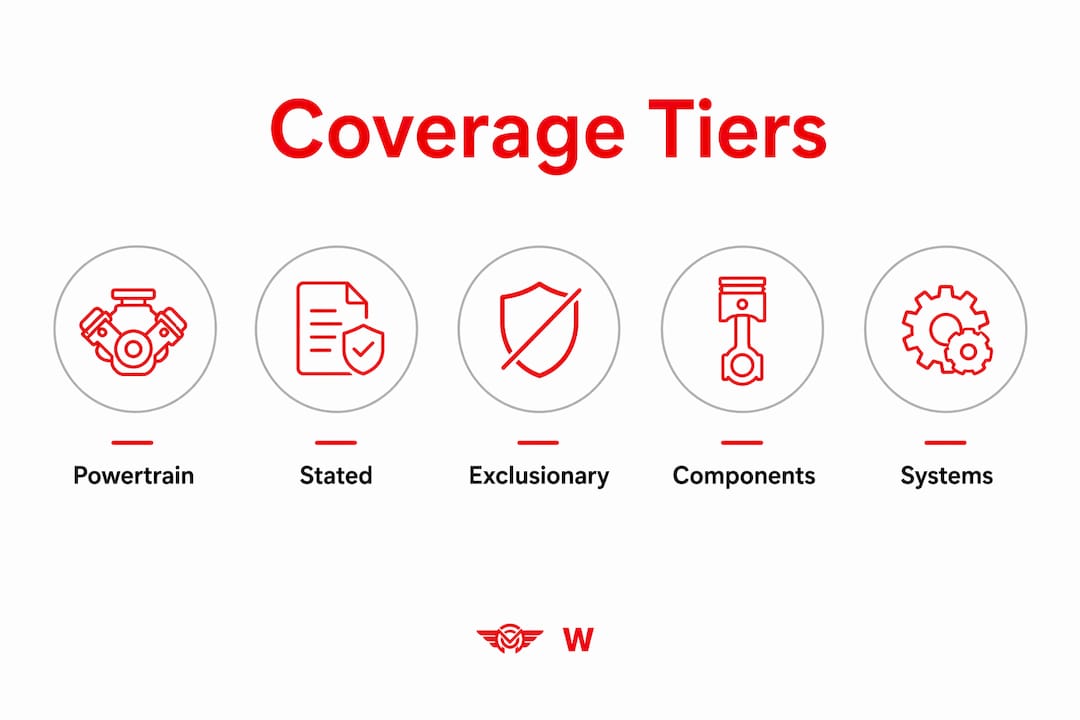
MAP-style vehicle service contracts generally fall into three tiers, and the differences between them are significant.
Powertrain coverage is the entry level. It covers the engine, transmission, and drive axles. That is it. A BMW 5 Series owner with powertrain-only coverage who blows an air suspension compressor or loses a transfer case module is paying out of pocket.
Stated-component coverage expands the list to named systems: cooling, electrical, steering, suspension, and sometimes infotainment electronics. You are covered only for what the contract explicitly lists, so reading the component schedule matters.
Exclusionary (bumper-to-bumper) coverage flips the logic. Everything is covered except what the contract specifically excludes. For a Range Rover Sport or a Mercedes-Benz GLE, this tier is the only one that realistically addresses the repair exposure those vehicles carry.
Systems commonly covered across mid-tier and exclusionary plans include:
- Engine internals (pistons, crankshaft, camshaft, seals)
- Transmission and torque converter
- Cooling system (water pump, radiator, thermostat housing)
- Electrical systems (alternator, starter, wiring harnesses)
- Steering (rack and pinion, power steering pump)
- Suspension (struts, control arms, wheel bearings)
- Hybrid and EV battery management systems
- High-tech electronics and infotainment modules
| System | Powertrain | Stated-Component | Exclusionary |
|---|---|---|---|
| Engine internals | ✓ | ✓ | ✓ |
| Transmission | ✓ | ✓ | ✓ |
| Cooling system | ✗ | ✓ | ✓ |
| Electrical/alternator | ✗ | ✓ | ✓ |
| Steering/suspension | ✗ | ✓ | ✓ |
| Hybrid battery systems | ✗ | Select plans | ✓ |
| Infotainment electronics | ✗ | Select plans | ✓ |
| Roadside/rental/trip interruption | Add-on | Add-on | Often included |
Pro Tip: Watch for mailers that look like manufacturer notices warning your warranty is expiring. State consumer protection offices flag these as a common misleading solicitation tactic from third-party sellers. Always verify any offer against your VIN and actual contract records.
Who qualifies, what it costs, and how deductibles work
Eligibility for MAP-style contracts typically depends on the vehicle's model year, current mileage, and condition. Most administrators set a mileage cap at enrollment, usually between 100,000 and 150,000 miles, and require that the vehicle pass an inspection or have no known pre-existing issues at the time of purchase.
Factors that drive your premium up or down:
- Vehicle make and model. A Porsche Cayenne or Land Rover Defender costs more to insure than a Honda Civic because parts and labor rates are higher.
- Age and mileage at enrollment. Older, higher-mileage vehicles carry more risk, so premiums rise accordingly.
- Coverage tier. Exclusionary plans cost more than powertrain-only plans.
- Deductible structure. Per-visit deductibles are usually lower per incident than per-component deductibles when multiple parts fail at once.
- Transferability. Contracts that transfer to a new owner at resale often carry a small fee but add real value to the vehicle.
- Add-ons. Roadside assistance, rental reimbursement, and trip interruption each add to the base premium.
Published estimates put most extended service contracts between $900 and $2,400 per year, depending on vehicle and coverage tier. That range reflects the substantial differences between, for example, a Ford F-150 powertrain plan and a Mercedes-Benz S-Class exclusionary plan.
On deductibles: a per-visit structure means you pay one flat amount per shop visit regardless of how many components are repaired. A per-component structure charges you separately for each failed part. If your Honda Accord's water pump and alternator both fail on the same trip, per-visit is almost always cheaper.

Direct-pay contracts let the administrator settle directly with the repair shop, so you never front the money. Reimbursement contracts require you to pay the shop first and submit for repayment later. For a $3,000 transmission job on a BMW 3 Series, that cash-flow difference is real.
How the claims process works, step by step
- Stop driving and assess. If a warning light or mechanical failure occurs, pull over safely. Continuing to drive a vehicle with a known failure can void coverage for related damage.
- Call the administrator before authorizing repairs. This is non-negotiable. Most contracts require pre-authorization, and skipping it is the fastest way to get a claim denied.
- Choose an eligible repair facility. Most MAP-style contracts require an ASE-certified shop. Confirm the shop is on the accepted list before dropping the vehicle.
- Provide your VIN, contract number, and maintenance records. The administrator will ask for documentation. Have your last several oil change receipts and any recent service records ready.
- Get the shop to submit a repair estimate. The administrator reviews the estimate and approves covered repairs. Ask for written confirmation of what is approved.
- Authorize the repair. Once the administrator approves, the shop proceeds. On a direct-pay contract, the administrator pays the shop directly minus your deductible. On a reimbursement contract, you pay and submit receipts.
- Keep all documentation. Retain the repair order, the administrator's approval, and your receipts. You may need them if a related issue surfaces later.
Pro Tip: Ask the administrator to email or text the pre-authorization confirmation. A verbal approval that cannot be verified later is worth nothing if there is a billing dispute.
For contract lookup, most administrators offer a VIN-based lookup tool on their website or a dedicated claims phone line. If you cannot locate your contract number, your VIN is usually enough to pull the record.
Common exclusions and why claims get denied
Claim denials most often come down to a short list of predictable issues. Knowing them in advance is the best way to avoid them.
Typical exclusions across most MAP-style contracts:
- Wear-and-tear items: brake pads, rotors, belts, hoses, wiper blades, tires
- Routine maintenance: oil changes, filters, fluid flushes, spark plugs
- Pre-existing conditions: any failure that existed before the contract start date
- Aftermarket modifications: performance chips, lift kits, non-OEM engine parts
- Oil neglect: sludge damage from missed oil changes, especially common on high-mileage BMW N54 and N63 engines
- Environmental damage: flood, hail, fire, road debris
- Exceeding coverage limits: repairs above the per-claim or aggregate cap
The most common denial scenarios in practice:
- A Porsche Panamera owner cannot produce oil change records for the past 18 months. The administrator denies an engine claim citing maintenance neglect.
- A Ford Mustang with a cold-air intake and tune has its ECU fail. The modification voids the electrical coverage.
- A Range Rover with a known air suspension fault at the time of purchase is denied because the failure is classified as pre-existing.
Prevention is straightforward: keep every maintenance receipt, get pre-authorization in writing, and read the exclusions list before signing anything.
How to evaluate a MAP-type contract before you buy

Administrator quality is the single strongest predictor of a good ownership experience. Marketing language on the contract cover means nothing if the administrator delays approvals or disputes every claim.
| Question to ask | Why it matters |
|---|---|
| Who administers the contract? | The administrator, not the seller, handles your claims. |
| What is explicitly excluded? | Vague exclusions protect the administrator, not you. |
| Does the plan pay the shop directly? | Direct-pay eliminates large upfront costs at the repair counter. |
| Can I see a sample contract now? | Refusal to provide one is a red flag. |
| What is the cooling-off period? | Most states require 10–20 days; some, like Florida, allow up to two months. |
| What is the deductible structure? | Per-visit vs. per-component changes your real out-of-pocket cost. |
| Is the contract transferable? | Transferability adds resale value; confirm the fee. |
Red flags to walk away from:
- High-pressure sales with a same-day deadline
- Exclusions described in vague, catch-all language
- Administrator name that cannot be verified independently
- No sample contract available before purchase
- Claims phone number that goes to voicemail or a general call center
Trust signals worth prioritizing: a published claims phone number, nationwide ASE-certified shop acceptance, a sample contract you can review before signing, and a clear written cancellation and refund policy.
Pro Tip: Search the administrator's name alongside "BBB" or your state attorney general's complaint database before committing. A pattern of unresolved complaints tells you more than any marketing brochure.
How to verify an existing contract on a vehicle you already own or are buying
If you purchased a vehicle with coverage included, or if you are buying used and the seller claims there is an active plan, verify it yourself before relying on it.
- Locate the physical contract paperwork. The contract should list the administrator's name, claims phone number, VIN, coverage start date, and expiration mileage or date.
- Call the administrator directly using the number on the contract, not a number the seller provides. Confirm the contract is active, the VIN matches, and coverage has not lapsed.
- Use the VIN-based lookup if the administrator offers one online. This is the fastest way to confirm status without waiting on hold.
- Ask for the sample contract and exclusions schedule. Even if coverage is active, you need to know what it actually covers.
- Confirm transferability. If you are buying the vehicle, ask whether the contract transfers to a new owner, what the transfer fee is, and what paperwork is required. Most contracts allow transfer for a fee, but the process must be completed within a set window after the sale.
- Check the cancellation and refund terms. If the contract does not suit your needs, most allow cancellation for a pro-rated refund after the cooling-off period, minus an administrative fee.
When does a MAP-style contract actually make financial sense?
The honest answer depends on the vehicle and the math.
-
Reliable mainstream vehicles with low mileage. A 2022 Honda CR-V with 35,000 miles and a clean service history is statistically unlikely to generate repair bills that exceed the cost of a multi-year service contract. Self-insuring, meaning setting aside the premium equivalent in a repair fund, is often the lower-cost path here.
-
High-mileage mainstream vehicles. A 2018 Ford Explorer at 90,000 miles is a different calculation. Transmission and electrical repairs on aging domestic vehicles can run $2,000–$4,000. A stated-component plan at $900–$2,400 per year, consistent with published estimates, starts looking reasonable.
-
European luxury vehicles. This is where exclusionary coverage earns its keep. A single air suspension repair on a Range Rover can run $2,500–$4,000. An electronic module failure on a Mercedes-Benz E-Class or a BMW 7 Series can exceed $3,000. For luxury vehicles, the cost of one major electronic or suspension repair often exceeds the multi-year premium of a top-tier exclusionary plan.
-
Vehicles with known failure patterns. The BMW N63 engine has documented oil consumption issues. The Porsche PDK dual-clutch transmission requires expensive service. The Land Rover air suspension is a near-certainty repair on high-mileage examples. For vehicles with documented weak points, a contract that covers those systems is a direct hedge against a known risk.
When the math is close, prioritize administrator quality and direct-pay capability over a slightly lower premium. A plan that pays the shop directly and accepts any ASE-certified mechanic nationwide removes the friction that makes claims painful.
Key Takeaways
A MAP extended auto warranty is a third-party service contract, not a manufacturer warranty, and the administrator behind it determines whether the plan actually works when you need it.
| Point | Details |
|---|---|
| Call before repairs | Pre-authorization is required; skipping it is the top reason claims are denied. |
| Tier selection matters | Powertrain covers engine and transmission only; exclusionary covers nearly everything except listed items. |
| Keep maintenance records | Missing service documentation is a leading cause of denied claims, even on unrelated failures. |
| Know your deductible type | Per-visit deductibles cost less when multiple components fail on the same repair visit. |
| Rpmwarranty plans | Elite, Advanced, and Essential tiers map directly to exclusionary, stated-component, and powertrain scopes with direct-pay claims and nationwide ASE-certified shop acceptance. |
Why the administrator is the product, not the contract name
Most buyers focus on the coverage list. The smarter question is who processes the claim when your BMW 5 Series drops a valve at 80,000 miles and the shop wants $6,000.
A contract with an impressive-sounding name and a vague exclusions list is worth less than a plain-language agreement backed by an administrator who pays shops directly, picks up the phone, and accepts any ASE-certified mechanic in the country. The coverage tier matters, but the administrator is the actual product you are buying.
Transparency is the tell. If a company will not hand you a sample contract before you sign, that is not a sales tactic. It is a preview of how they handle claims. The same logic applies to the claims phone number: if it is not published clearly, finding it at 7 PM when your Porsche Cayenne is on a lift will not be easy.
The vehicle-specific math reinforces this. A Range Rover LWB owner who buys an exclusionary plan from a well-administered provider and never needs it has spent money on peace of mind. The same owner who buys a cheap plan from an opaque administrator and gets denied on a $4,000 air suspension repair has paid for nothing. The premium difference between those two scenarios is usually a few hundred dollars per year.
Rpmwarranty covers what the checklist demands
Rpmwarranty structures its plans around the exact trust signals this article identifies as non-negotiable. The Elite tier delivers exclusionary-level coverage for high-exposure vehicles such as the Mercedes-Benz GLE, BMW X5, or Range Rover Sport. Advanced covers the major stated-component systems, including electrical, cooling, and suspension, for mid-range vehicles. Essential provides powertrain protection for owners who want core coverage at a lower premium.
Every plan includes direct-pay claims handling, so the shop gets paid and you pay only your deductible. Coverage is accepted at ASE-certified repair facilities nationwide, not a restricted dealer-only network. Sample contracts are available before you commit, and cancellation and transfer terms are published clearly.
Get a free quote at Rpmwarranty.com or visit the RPM FAQ page to review sample contracts and claims procedures before you decide.
Useful sources and next steps before you buy
Before signing any vehicle service contract, verify the details against primary sources:
- FTC Consumer Advice on Auto Warranties and Service Contracts: The authoritative federal source on the legal distinction between manufacturer warranties and service contracts, plus guidance on common scams and your rights.
- Minnesota Attorney General: Motor Vehicle Service Contract Offers: Practical state-level guidance on misleading mailers and how to verify a legitimate offer. Check your own state AG's website for jurisdiction-specific cooling-off rules.
- RPM Warranty Blog: Vehicle Service Contracts: Covers cooling-off periods, direct-pay vs. reimbursement, transfer and cancellation terms, and cost ranges in plain language.
Regulatory checklist before you sign:
- Confirm the cooling-off period in your state (typically 10–20 days; verify your state's specific window)
- Request and read the full sample contract and exclusions schedule
- Verify the administrator's name, claims phone number, and BBB standing independently
- Confirm whether the plan is direct-pay or reimbursement
- Understand the transfer fee and process if you plan to sell the vehicle
This article is general information, not legal or financial advice. Confirm current contract terms, state cooling-off rules, and coverage details with the administrator or a qualified professional before purchasing.