

TL;DR:
- Mechanical warranties, including factory warranties, Mechanical Breakdown Insurance, and vehicle service contracts, protect vehicle owners from unexpected repair costs after the original warranty expires.
- Choosing the right type involves understanding their coverage, costs, eligibility, and legal protections, with exclusionary contracts offering broader coverage than named-component plans.
Mechanical warranties are contracts that cover vehicle repair costs for mechanical breakdowns after the manufacturer's original warranty expires. The industry uses two primary products: Mechanical Breakdown Insurance (MBI), regulated by state insurance departments, and vehicle service contracts (VSC), sold by dealers or third-party providers under contract law. Both protect vehicle owners from unexpected four-figure repair bills, but they differ significantly in price, eligibility, and consumer rights. Understanding those differences is the single most important step any car owner can take before signing a coverage agreement.
What are the main types of mechanical warranties?
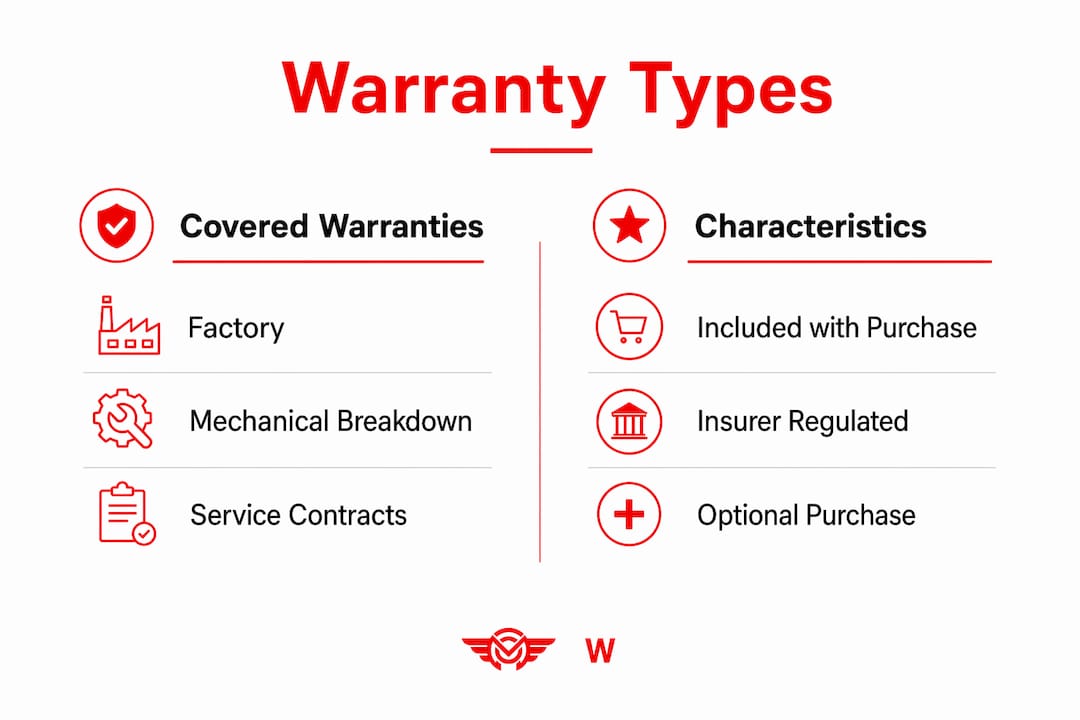
The term "mechanical warranty" covers several distinct products, and mixing them up costs vehicle owners money. The three main types are factory warranties, Mechanical Breakdown Insurance, and vehicle service contracts.
Factory warranties come included in the vehicle purchase price. They are governed by the Magnuson-Moss Warranty Act, a federal law that sets disclosure standards and gives consumers legal remedies when manufacturers fail to honor coverage. A BMW 3 Series, for example, ships with a 4-year/50,000-mile bumper-to-bumper warranty and a 4-year/50,000-mile roadside assistance plan. Once that window closes, the owner is on their own unless they purchase additional protection.
Mechanical Breakdown Insurance is an insurance product sold by licensed insurers and regulated by state insurance departments. MBI costs under $100 per year when bundled with an existing auto policy. That price point makes it the most affordable option on the market, but eligibility is strict. Most insurers require the vehicle to be relatively new and under a set mileage threshold. A 2024 Honda Civic with 15,000 miles qualifies easily. A 2018 Range Rover Sport with 80,000 miles almost certainly does not.
Vehicle service contracts are the most widely sold product in this category. VSCs are separate optional purchases governed by contract law and state consumer protection statutes, not federal warranty law. That legal distinction matters because VSC buyers have fewer automatic federal protections than buyers of true warranties. Dealers and third-party providers both sell VSCs, and their terms vary widely.
Pro Tip: Never call a vehicle service contract a "warranty" when reviewing its terms. The legal category determines which consumer protection laws apply and what remedies you have if a claim is denied.
| Coverage Type | Regulated By | Typical Eligibility | Average Annual Cost |
|---|---|---|---|
| Factory warranty | Magnuson-Moss Warranty Act | New vehicles only | Included in purchase |
| Mechanical Breakdown Insurance | State insurance departments | Newer, low-mileage vehicles | Under $100 |
| Vehicle service contract | Contract and state law | Broader, including older vehicles | $600–$4,600 |
What do mechanical warranties cover and exclude?
Coverage scope is where most vehicle owners get surprised, and not in a good way. A plan that sounds comprehensive at the dealership can turn out to be narrowly defined once a repair claim arrives.
Most VSCs and MBI policies cover the following core components:
- Engine: internal parts, cylinder heads, oil pump, timing chain
- Transmission: gears, torque converter, valve body
- Electrical systems: alternator, starter motor, power window motors
- Suspension: control arms, ball joints, wheel bearings
- Air conditioning: compressor, condenser, evaporator
- Cooling system: water pump, radiator, thermostat housing
- Braking system: master cylinder, calipers, ABS module (not pads or rotors)
Extended warranties commonly exclude wear items such as brake pads, clutches, bulbs, and filters. Cosmetic damage, routine maintenance, and pre-existing conditions are also excluded across virtually every plan. That exclusion list is where the fine print does the most damage.
Inclusionary vs. exclusionary contracts
The contract structure determines how coverage disputes get resolved. An exclusionary contract covers everything except what is specifically listed as excluded. An inclusionary (or "named component") contract covers only what is explicitly listed. Exclusionary contracts offer broader protection and are generally worth the higher price. Inclusionary contracts are cheaper but create more room for claim denials.
Luxury vehicles like the Mercedes-Benz GLE or Porsche Cayenne carry higher parts costs, so the contract structure matters even more for those owners. A named-component plan on a Porsche Cayenne might exclude the air suspension system entirely, leaving the owner with a $3,000 repair bill that a comprehensive exclusionary plan would have covered.
Pro Tip: Always ask the provider whether the contract is inclusionary or exclusionary before you sign. If the sales rep cannot answer that question immediately, treat it as a red flag.
Most states require written disclosure of all exclusions in VSC contracts. Read that disclosure document before signing, not after.
How much do mechanical warranties cost in 2026?
Price is the first question most vehicle owners ask, and the range is wide enough to cause real confusion. Comprehensive vehicle service contracts cost between $1,700 and $4,600, while powertrain-only coverage runs $600–$750 per year as of 2026. Those numbers reflect the full market, from a basic Honda Accord plan to a high-coverage contract on a BMW X5.
Four factors drive the final price:
- Vehicle age and mileage. A 2022 Ford F-150 with 30,000 miles costs significantly less to cover than a 2019 Range Rover with 65,000 miles. Older, higher-mileage vehicles carry more statistical risk, and providers price accordingly.
- Coverage tier. Powertrain-only plans protect the engine and transmission. Comprehensive plans extend to electrical, suspension, air conditioning, and more. The broader the coverage, the higher the premium.
- Provider type. Dealership warranties usually cost more but offer manufacturer-backed service and OEM parts. Third-party plans offer more flexibility and lower prices but vary in service quality.
- Deductible structure. A $0 deductible plan costs more upfront. A $200 per-visit deductible lowers the premium but increases out-of-pocket costs at repair time.
The financing trap
Financing a warranty increases total ownership costs because interest accrues on the financed amount. Many buyers roll the warranty cost into their auto loan without realizing they are paying interest on it for five or six years. Paying for a VSC upfront or through a monthly premium directly to the provider eliminates that interest cost.
Consumer Reports finds that most consumers pay more in premiums than they recover through covered repairs. The average large repair bill runs about $600. That figure puts the math in perspective: a $3,000 comprehensive plan needs to cover at least five major repairs to break even financially. The real value of a warranty is not a positive return on investment. It is protection against the one catastrophic repair that would otherwise derail a household budget.
When should you buy a mechanical warranty?
Timing a warranty purchase correctly separates good decisions from expensive mistakes. The best window to buy is when the factory warranty is approaching expiration or has just expired. Buying too early creates overlapping coverage with no added value.
Many experts recommend against buying extended warranties on new vehicles still covered by a manufacturer powertrain warranty. The overlap means you pay twice for the same protection. Wait until the factory coverage is within six months of expiring, then shop for a VSC or MBI.
MBI eligibility typically requires vehicles to meet strict age and mileage limits. Older vehicles that no longer qualify for MBI must turn to VSCs or self-insurance. A 2017 Mercedes-Benz C-Class with 90,000 miles falls outside MBI eligibility at most insurers but can still qualify for a third-party VSC.
Consider these factors when deciding whether to buy:
- Vehicle reliability history. Honda Civics and Toyota Camrys have strong reliability records. Range Rovers and BMW 7 Series vehicles carry higher repair frequency and cost. Owners of statistically unreliable vehicles benefit more from coverage.
- Your financial cushion. If a $2,500 transmission repair would create serious financial hardship, a warranty makes sense. If you have a dedicated repair fund, self-insuring may be the better call.
- Remaining mileage plans. If you plan to sell the vehicle in two years, a long-term VSC may not recoup its cost.
- Repair network access. Some VSCs restrict repairs to specific shops. If you live in a rural area, verify that covered repair facilities are within a reasonable distance.
Buying a warranty is not about expecting your car to break down. It is about deciding in advance how much financial risk you are willing to carry. The right answer depends on your vehicle, your budget, and your tolerance for uncertainty.
Scam warning: Legitimate providers never use high-pressure telemarketing tactics or falsely claim your factory warranty is about to expire. Cold calls warning of imminent warranty expiration are almost always fraudulent. Hang up and contact a licensed provider directly.
What practices maximize value from a mechanical warranty?
Getting full value from a warranty requires active management, not passive ownership. Most claims problems trace back to steps the vehicle owner skipped before or during the coverage period.
- Read the full contract before signing. Pay specific attention to the exclusions list, the claims authorization process, and the parts policy. Some plans require pre-authorization before any repair begins. Skipping that step voids the claim.
- Keep maintenance records. Claims denials commonly arise from failure to maintain the vehicle according to manufacturer specifications. An oil change log, tire rotation receipts, and service records protect your claim.
- Understand the parts policy. Some plans pay only for OEM parts. Others allow remanufactured or used parts. For a Porsche or BMW, OEM-only coverage matters because aftermarket parts can affect performance and future warranty claims.
- Verify repair shop flexibility. Third-party VSCs often allow repairs at any licensed facility. Dealer-backed plans may restrict you to the selling dealership's service center. Know your options before a breakdown happens.
- Avoid financing the warranty. Pay upfront when possible. The interest cost on a financed warranty adds hundreds of dollars to the total price over the loan term.
- Check cancellation terms. Most VSCs allow cancellation with a prorated refund. If you sell the vehicle, cancel the plan and recover the unused portion.
Pro Tip: Before buying any plan, call the claims department directly and ask how they handle a denied claim. A provider that cannot explain the appeals process clearly is one to avoid.
Rpmwarranty structures its plans with transparent claims processes and nationwide repair network access, which removes the guesswork from the authorization step.
Key Takeaways
A mechanical warranty's real value is financial protection against catastrophic repair costs, not a guaranteed return on premium paid.
| Point | Details |
|---|---|
| Know your contract type | Exclusionary contracts offer broader protection than named-component plans; always confirm which type you are buying. |
| Time the purchase correctly | Buy when the factory warranty is within six months of expiring to avoid paying for overlapping coverage. |
| Avoid financing the warranty | Rolling a VSC into your auto loan adds interest costs that can total hundreds of dollars over the loan term. |
| Keep maintenance records | Documented service history is the strongest defense against a denied claim under any warranty plan. |
| Match coverage to vehicle risk | High-repair-frequency vehicles like Range Rovers and BMW 7 Series benefit most from comprehensive exclusionary contracts. |
The fine print is the product
Most vehicle owners treat a warranty as a safety net they will never need. That mindset is exactly what leads to claim denials and buyer regret. After spending years reviewing warranty contracts and repair scenarios across vehicle categories, I have come to believe that the fine print is not a footnote. It is the actual product.
The biggest misconception I see is that all warranty plans are roughly equivalent. They are not. The difference between an exclusionary contract and a named-component contract on a 2021 BMW X7 can mean the difference between a covered $4,000 transfer case repair and a $4,000 out-of-pocket bill. The plan that costs $400 more per year is often the one that pays for itself on the first claim.
Luxury vehicle owners face a specific trap. The repair costs on a Mercedes-Benz GLS or a Porsche Panamera are high enough that even a single uncovered repair wipes out years of premium savings from a cheaper plan. For mainstream vehicles like a Ford Explorer or Honda Pilot, the math is closer, and self-insuring with a dedicated savings account is a legitimate alternative.
My honest recommendation for 2026: buy the exclusionary plan, pay upfront, and treat the premium as a fixed cost of ownership. Do not buy from a cold caller. Do not roll the cost into your loan. And read the claims authorization section of the contract before you need it, not after.
— Kenneth
Rpmwarranty has a plan built for your vehicle
Vehicle owners who want straightforward coverage without the guesswork have a clear option. Rpmwarranty offers nationwide extended warranty plans across three coverage tiers: Elite, Advanced, and Essential. Each plan covers core mechanical systems including engines, transmissions, cooling systems, electrical systems, and high-tech components.
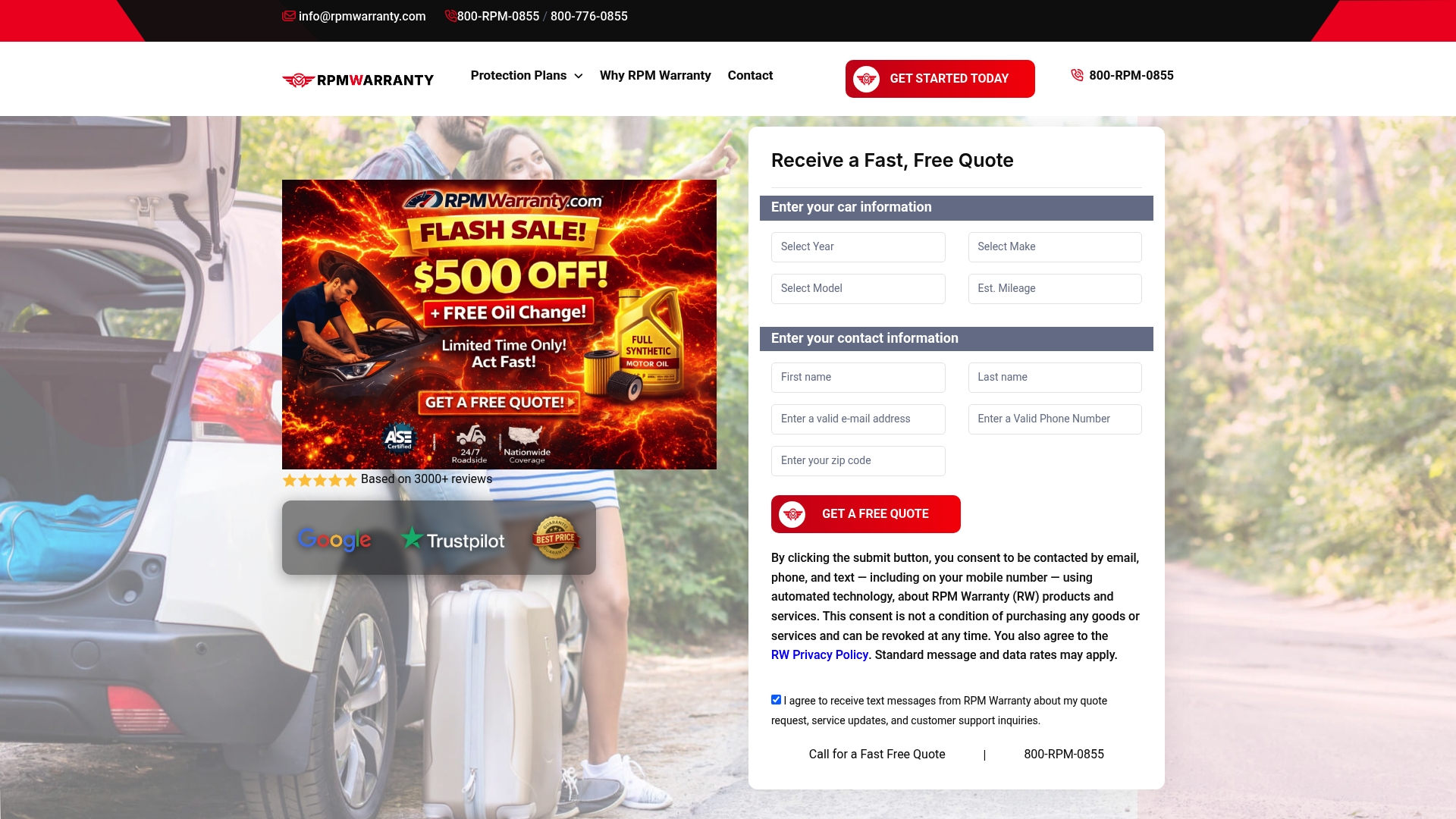
Whether you drive a Volkswagen, a Cadillac, or a high-mileage Ford, Rpmwarranty matches coverage to your vehicle's year, make, and model. The process takes four steps: consultation, plan selection, customization, and final agreement. Roadside assistance is included across all plans. Get a free warranty quote today and know exactly what your vehicle is covered for before the next repair bill arrives.
FAQ
What is the difference between MBI and a vehicle service contract?
Mechanical Breakdown Insurance is a state-regulated insurance product, typically cheaper and bundled with auto policies, while a vehicle service contract is a separate purchase governed by contract law with broader vehicle eligibility but fewer federal consumer protections.
How much does a mechanical warranty cost in 2026?
Comprehensive vehicle service contracts range from $1,700 to $4,600, while powertrain-only plans run $600–$750 per year. MBI costs under $100 annually when added to an existing auto insurance policy.
What does a mechanical warranty typically not cover?
Most plans exclude wear items like brake pads, clutches, and bulbs, as well as cosmetic damage, routine maintenance, and pre-existing conditions. Always read the exclusions list before signing any contract.
When is the best time to buy a mechanical warranty?
The best time is when the factory warranty is within six months of expiring or has just expired. Buying earlier creates overlapping coverage that adds cost without adding protection.
Can a warranty claim be denied?
Yes. Claims are commonly denied due to wear-and-tear classification, missing maintenance records, or repairs made without prior authorization. Keeping detailed service records and following the claims authorization process protects against denial.