
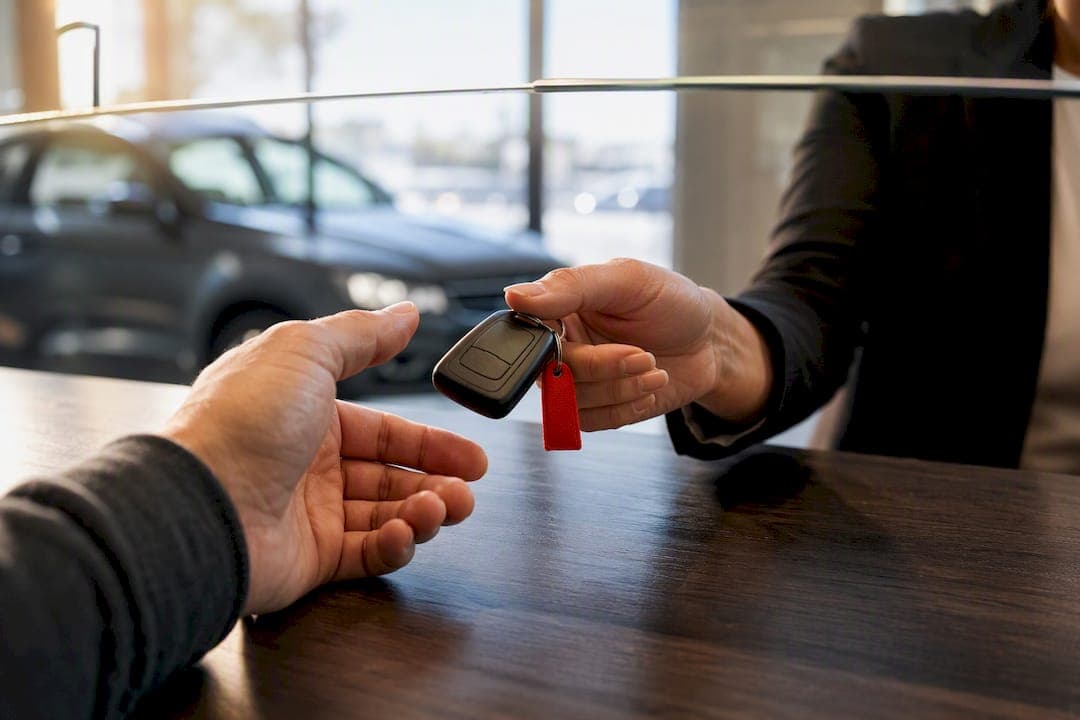
Rental reimbursement coverage pays for a temporary replacement vehicle after a covered collision or comprehensive claim, up to a daily limit and a per-claim cap. It doesn't cover mechanical breakdowns or vacation rentals. If you have one car and no backup, or you drive a Range Rover, Porsche, or other vehicle with high repair times, adding this coverage is a smart move given how low the premium runs compared to actual rental costs.
TL;DR:
- Rental reimbursement typically covers up to $30–$70 per day, with caps between $900 and $1,500, and costs $2–$15 monthly, depending on the policy.
- It applies only to sudden, covered events like collisions, theft, or hail damage, but not for mechanical breakdowns, routine maintenance, or vacation rentals.
- Longer repairs, especially for imports or luxury vehicles, can lead to rental costs exceeding policy limits, particularly with extended repair times over 17 days.
- For higher-value or complex vehicles, choosing higher daily limits ($60–$70) and caps ($1,500+) improves coverage against expensive rentals during prolonged repairs.
- Filing a claim for rental costs usually does not affect your premium unless caused by an at-fault accident, and direct billing options can simplify the rental process.
Table of Contents
- What Rental Reimbursement Coverage Actually Pays For
- How Much Rental Reimbursement Costs and Covers
- Filing a Rental Reimbursement Claim Step by Step
- Where Rental Reimbursement Falls Short
- Deciding on Daily Limits and Per-Claim Caps
- How Extended Warranty Coverage Fits Into the Rental Question
- Does Filing a Rental Reimbursement Claim Raise Your Premium?
- Rental Reimbursement vs. Ride-Sharing and Car-Sharing Apps
- Preferred Repair Shops vs. Your Own Mechanic
- A Simple Rule for Choosing Rental Reimbursement Limits
- Get a Rental-Ready Warranty Quote From Rpmwarranty
- Sources
What Rental Reimbursement Coverage Actually Pays For
Rental reimbursement only kicks in when the underlying damage is covered by your collision or comprehensive coverage. It rides on top of those coverages rather than standing alone, which means it doesn't apply to mechanical breakdowns or routine maintenance. A Honda Accord with a failed alternator or a BMW 5 Series needing a transmission rebuild for wear and tear won't trigger this benefit. It's built for sudden, covered events.
Covered situations typically include:
- Collision damage from an at-fault or not-at-fault accident
- Comprehensive claims like theft, fire, vandalism, or hail
- Total-loss situations while you shop for a replacement vehicle
- Flood or falling-object damage covered under comprehensive
Common non-covered situations:
- Mechanical breakdowns (a Mercedes-Benz E-Class with electrical gremlins, a Ford F-150 with transmission wear)
- Routine maintenance visits
- Vacation or personal-choice rentals unrelated to a claim
A hailstorm that dents your Honda CR-V's hood and roof triggers comprehensive coverage, and rental reimbursement follows automatically. A cracked timing belt on that same CR-V does not.
How Much Rental Reimbursement Costs and Covers
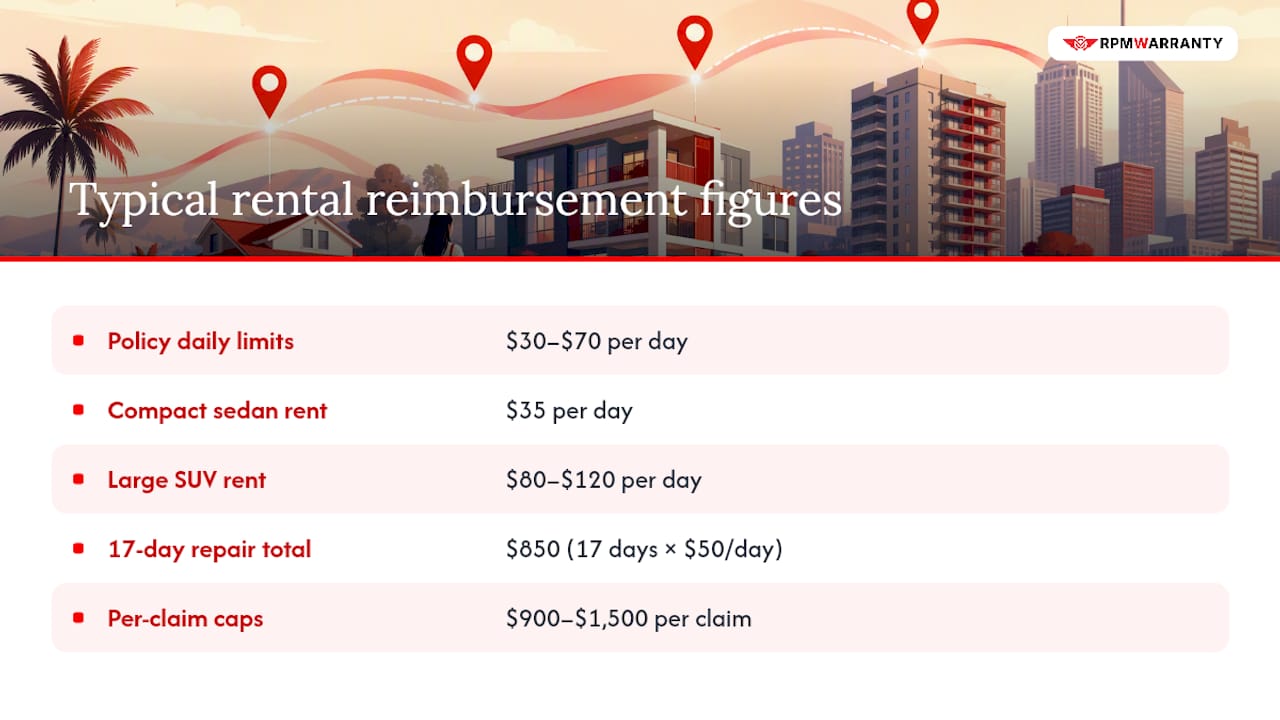
Most policies set daily limits between $30 and $70, with per-claim caps landing between $900 and $1,500, though some carriers push higher depending on your state and vehicle class. Premiums typically run $2 to $15 per month, which is almost nothing compared to what a two-week rental would cost out of pocket.
That gap between your daily limit and actual rental prices matters more than most drivers realize. A compact sedan rental might run $35 a day in a mid-size market, fitting neatly under a $40 daily limit. But rent a full-size SUV comparable to a Range Rover or a Porsche Cayenne while yours is in the shop, and you could easily see $80 to $120 a day. If your policy caps out at $50, you're covering the difference yourself.
Pro Tip: Check your daily limit against actual rental rates in your zip code, not a national average. Rental pricing swings hard by region and by season.
Statistic Callout: Repair times for collision damage commonly stretch to 17 days for parts-dependent repairs, which is especially relevant for imports and luxury models. A BMW or Mercedes-Benz waiting on a specialty part from overseas can sit at the shop well past two weeks, and at $50 a day, a 17-day rental adds up to $850, dangerously close to blowing through a $900 cap.
Rental reimbursement typically carries no separate deductible of its own. The deductible tied to your underlying collision or comprehensive claim still applies to the vehicle repair, but the rental benefit itself pays out without an additional deductible on top.
Filing a Rental Reimbursement Claim Step by Step
Getting reimbursed (or getting a rental billed directly) follows a fairly consistent process across most carriers:
- Report the accident or comprehensive loss and open a claim immediately.
- Get your claim number and confirm with your adjuster that rental reimbursement is active on your policy.
- Ask whether your insurer has a direct-billing arrangement with a rental company near you.
- If direct billing isn't available, rent the vehicle yourself and save every receipt.
- Submit receipts to your adjuster for reimbursement, typically processed within a normal claims cycle.
Direct-billing partnerships between insurers and rental companies mean you often walk into a rental counter, hand over your claim number, and drive off without paying anything upfront. Renting on your own and waiting for reimbursement works too, but it means fronting the cost and keeping meticulous documentation, including the rental agreement, daily rate, and return receipt.
Pro Tip: Ask your adjuster point-blank whether coverage starts the day you file the claim or only once your car is physically in the shop. That gap can leave you paying for a few days yourself if you rent early.
Where Rental Reimbursement Falls Short
Even solid rental reimbursement coverage has gaps that catch people off guard after they've already assumed they're covered. Common exclusions include:
- Vacation rentals or any rental not tied to an open, covered claim
- Mechanical breakdowns, including engine and transmission failures
- Routine maintenance visits, even multi-day ones
- Extras like fuel, GPS add-ons, rental deposits, or the counter agent's optional insurance upsell
Red flags to look for on your declarations page include a daily limit that's noticeably below your local rental market rate, a narrow vehicle-class restriction that won't let you rent anything comparable to what you drive, and a per-claim cap that would run out before a typical repair finishes. If you own a Porsche 911 or a Range Rover Sport, ask your agent directly whether your daily limit accounts for the cost of renting a comparable vehicle class, since standard economy-car limits often fall well short.
Deciding on Daily Limits and Per-Claim Caps
Rental reimbursement earns its premium fastest for single-car households, long commuters, and owners of vehicles that take longer to repair, think European imports and high-end SUVs where parts often ship from overseas. If you have a second car sitting in the driveway as backup, the math changes and a lower limit, or skipping it altogether, might make sense.
To pick the right numbers, compare your policy's daily limit against local economy rental rates, then set your per-claim cap high enough to cover your realistic repair window.
- Daily commuter with one vehicle: Local economy rentals run $45/day. A $50 daily limit with a $1,200 cap covers roughly 24 days, more than enough for most repairs.
- Two-car household with a Mercedes-Benz GLE: Backup vehicle available, so a lower $30 daily limit with a $900 cap is reasonable, since rental need is a convenience rather than a necessity.
| Driver profile | Suggested daily limit | Suggested per-claim cap |
|---|---|---|
| Single vehicle, daily commuter | $50–$70 | $1,200–$1,500 |
| Two-car household, backup available | $30–$40 | $900 |
| Owner of luxury/import SUV or sedan | $60–$70 | $1,500+ |
How Extended Warranty Coverage Fits Into the Rental Question
Rental reimbursement and an extended vehicle warranty solve two different problems, but they overlap more than most drivers expect. Rental reimbursement covers you after a collision or comprehensive event. An extended warranty reduces how often you end up needing a rental in the first place, by covering the mechanical failures that rental reimbursement specifically excludes.
Extended warranty providers often structure their plans with tiers that protect major systems such as engine, transmission, cooling, electrical, and high-tech components common in many vehicles. Roadside assistance services typically handle breakdown-related towing that auto insurance rental benefits won't cover. Streamlined claims processes are designed to accelerate repairs, shortening the time without a vehicle.
Think of it this way: rental reimbursement protects you from the insurance side of downtime, an extended warranty protects you from the mechanical side. Owners of higher-maintenance vehicles, a Range Rover with complex air suspension or a Mercedes-Benz with sensitive electronics, benefit from having both angles covered.
Does Filing a Rental Reimbursement Claim Raise Your Premium?
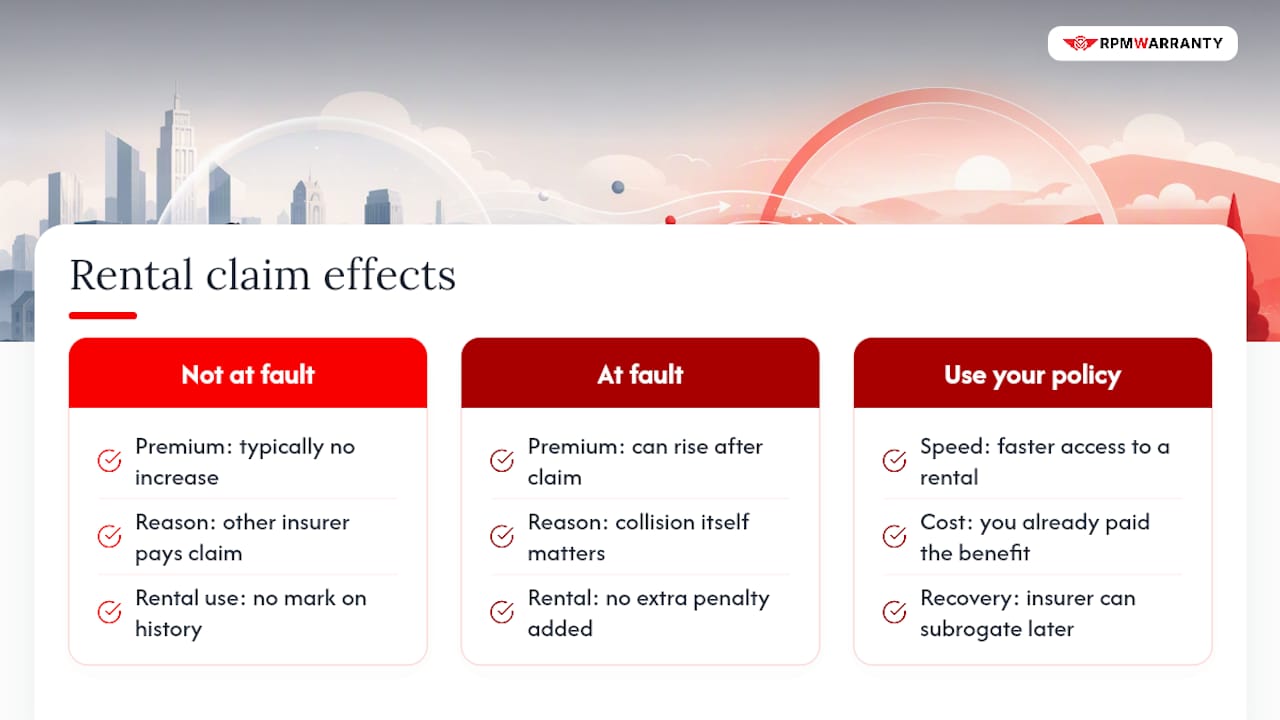
Filing a rental reimbursement claim by itself typically doesn't move your premium, because rate increases are tied to the underlying collision or comprehensive claim, not the rental benefit riding alongside it. If you're in a not-at-fault accident and the other driver's insurer is paying, your own claim history often stays clean regardless of whether you used your rental reimbursement coverage or waited on the other carrier.
Where it gets more nuanced is with at-fault collision claims. If you cause an accident and use both your collision coverage and rental reimbursement, the claim itself, not the rental piece, is what your insurer weighs when setting future rates. A single at-fault claim can raise premiums at renewal, but that increase reflects the accident, not the fact that you rented a car while your Honda Civic or Ford Escape sat in the shop. In other words, using rental reimbursement doesn't add a penalty on top of an existing claim; it simply uses a benefit you already paid for.
There's also a practical upside to using your own rental reimbursement rather than waiting on someone else's insurer. Filing under your own policy tends to move faster than waiting on an at-fault driver's carrier to approve a rental, and you can still pursue reimbursement from the other insurer through subrogation afterward. That means using the coverage you're paying for doesn't cost you anything extra down the line, it just gets you moving faster while the claims process sorts out fault behind the scenes.
Rental Reimbursement vs. Ride-Sharing and Car-Sharing Apps
Some drivers wonder whether they even need rental reimbursement when ride-sharing apps and car-sharing services are everywhere. The honest answer: it depends heavily on how long your repair takes and how far you drive.
Ride-sharing works fine for a day or two, a quick trip to the shop or a single errand run. But the math falls apart fast over a multi-week repair. If you commute 30 miles round trip daily, that's easily $25 to $40 a day in rideshare fares just for work, before factoring in groceries, appointments, or picking up kids. Over a 17-day repair window, that adds up to $425 to $680, often more than a rental reimbursement claim would have cost you in premium over several years combined.
Car-sharing services solve part of the problem but introduce a new one: availability. You're relying on someone else's schedule and a vehicle that may not be nearby when you need it, and hourly or daily rates can rival traditional rental agencies anyway without giving you the same predictability.
Rental reimbursement gives you a dedicated, insurer-backed vehicle with a fixed daily allowance you already know in advance. For anyone with a regular commute, kids to shuttle, or a job that requires reliable transportation, that predictability usually beats piecing together rides on an app, especially once a repair stretches past a few days.
Preferred Repair Shops vs. Your Own Mechanic
Where you take your vehicle for repairs can directly affect how your rental reimbursement plays out, even though the coverage itself doesn't change. Insurers that maintain preferred shop networks, sometimes called direct repair programs, often streamline the entire process: faster estimates, quicker parts ordering, and in many cases a direct line to the same rental companies handling your reimbursement.
Choosing a non-preferred shop, say an independent specialist who knows Porsche or Mercedes-Benz platforms better than a general body shop, doesn't void your rental benefit. But it can slow things down. Estimates may take longer to finalize, parts ordering isn't expedited the same way, and you may need to front rental costs yourself and submit receipts rather than getting the direct-billing convenience that preferred shops often unlock.
The trade-off is worth weighing carefully if you drive a specialty or luxury vehicle. A dealership or specialist familiar with your BMW's specific electronics or your Range Rover's air suspension system might take longer upfront but avoid a second repair down the line. If minimizing rental days is your top priority, ask your insurer directly which shops in their preferred network handle your vehicle's make, since not every network includes specialists for less common European imports.
A Simple Rule for Choosing Rental Reimbursement Limits
If you live somewhere economy rentals run $60 a day or more, or you commute daily with no backup vehicle, buy at least $40 a day in rental reimbursement, full stop. The premium difference between that and a bare-minimum limit is usually a few dollars a month, nothing compared to what you'd pay out of pocket during a two-week repair. Pull out your declarations page today and check what you're actually carrying.
— Kenneth
Get a Rental-Ready Warranty Quote From Rpmwarranty
Rental reimbursement handles the insurance side of vehicle downtime. Rpmwarranty handles the mechanical side, cutting the odds you're stuck arranging a rental in the first place because a covered component failed. Whether you drive a Ford, Honda, BMW, Mercedes-Benz, Porsche, or Range Rover, Rpmwarranty's Elite, Advanced, and Essential plans are built around protecting the systems most likely to fail as vehicles age: engine, transmission, cooling, electrical, and the high-tech components increasingly common in newer models. Roadside assistance comes standard, and claims support is designed to get repairs moving without the runaround.
Before you request a quote, have your VIN, year, make, model, and current mileage ready, that's what determines which coverage tiers fit your vehicle. If you drive a Volkswagen, check the dedicated coverage options built for that platform. Otherwise, head to the free quote page and see what tier fits your driving habits and your vehicle's repair history.
This article is general information, not a substitute for advice from a qualified financial advisor. Consult a qualified financial professional about your own circumstances before acting on anything here.