
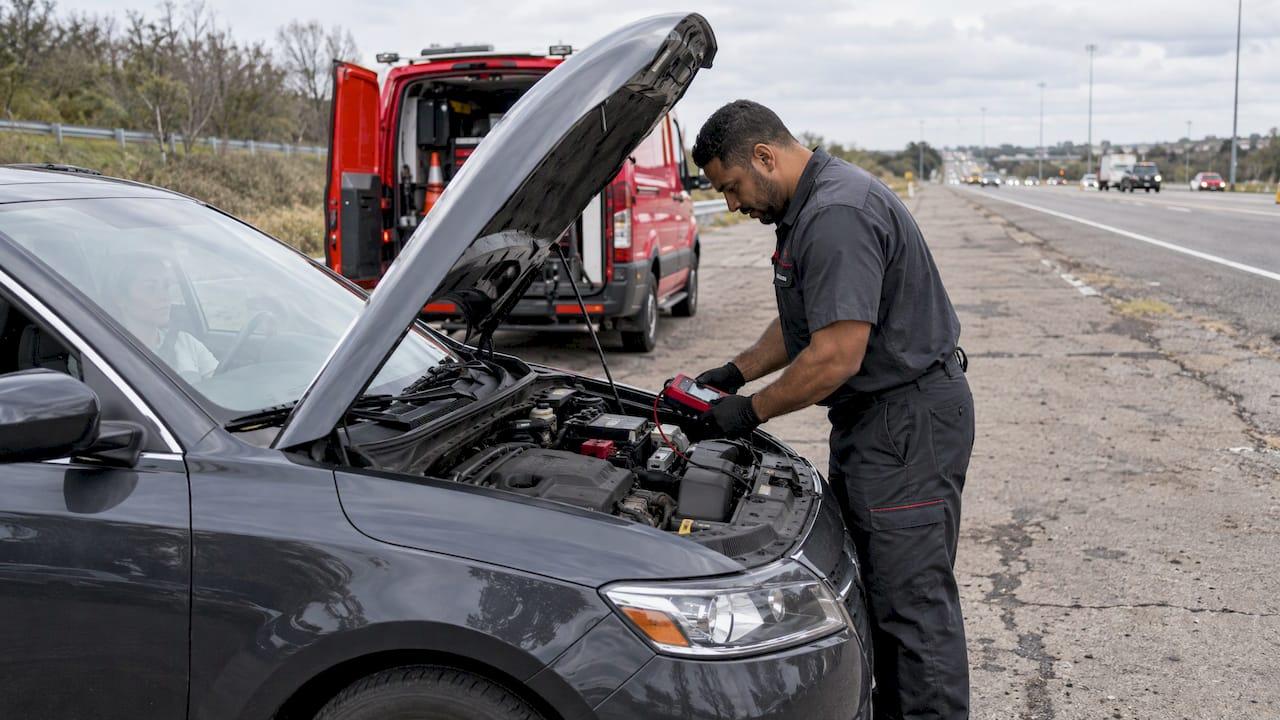
Roadside assistance sends a professional to you when your vehicle stops working: a jump start, a spare tire, fuel, a lockout fix or a tow. The main benefits are savings on a single bad day, safety away from live traffic, and one phone call in place of a scramble. Below, we cover what is usually included, what it costs without a plan, how it differs from towing, and where it matters most for owners of premium vehicles.
TL;DR
- Roadside assistance typically covers towing, jump starts, flat tire changes, lockouts and fuel delivery. Many plans add winching and some add help for electric vehicles.
- A single tow can cost about as much as a year of coverage, so one use can pay for the plan.
- Towing moves a car. Roadside assistance tries to fix the problem where you stopped, and tows only if that fails.
- Limits matter: towing distance, labor time, number of calls and vehicle age or mileage vary from plan to plan.
- Our extended warranty plans include roadside assistance and rental reimbursement, so one agreement covers the breakdown and the repair that follows.
Table of Contents
- What roadside assistance actually is
- The core benefits, one by one
- What does roadside assistance include?
- Roadside assistance vs. towing
- Roadside assistance vs. an auto club membership
- Who benefits most
- Premium and performance vehicles: why roadside help matters more
- How to pick a plan: a checklist
- When might you not need it?
- Where our plans fit
- Perspective: why we bundle roadside help with a warranty
- Get roadside help and repair coverage in one plan
- FAQ
- Sources
What roadside assistance actually is
Roadside assistance is an on-demand service for breakdowns that are not crashes. You call a number or use an app, and a dispatcher sends a local provider. A key point is that no covered loss has to happen first. Insurance guidance explains that running out of gas is not a covered loss under most auto policies, yet roadside assistance can still help.
You can get it in several places: as an add-on to car insurance, through an auto club, through a credit card, from the manufacturer on a new vehicle, or as part of a vehicle protection plan. NerdWallet notes that most insurers offer it as an optional add-on and that it can also come from a club, card issuer, carmaker or cell phone company.
The core benefits, one by one
Savings that can beat the annual price
The math is the simplest argument. Experian reports that hiring a tow truck can run an average of $75 to $125 out of pocket, so a membership could pay for itself in a single use. Longer tows climb quickly. According to a 2026 industry guide, a tow of 5 miles or less costs $35 to $125, a 40-mile tow costs $125 to $275, and a 100-mile tow can reach $600.

Plans are cheap by comparison. NerdWallet puts the range at $5 to more than $100 a year, and Consumer Reports says full-service club plans run about $40 to more than $160 annually.
Safety when you are exposed
A flat tire on a busy highway shoulder, or a dead battery in a place you do not know, is where roadside help earns its keep. Experian describes the security benefit as professional help that is a call away, so you are not changing a tire next to fast traffic. The best move in many situations is to get the vehicle as far off the road as you safely can, turn on your hazard lights, and wait with your seat belt on for the technician.
One call instead of many
Without a plan, you search for a tow company while stressed, compare quotes by phone and hope the truck is close. With a plan, one number handles the dispatch. That convenience is easy to undervalue until it is 11 p.m. and you are 40 miles from home.
Predictable costs
The last benefit is budgeting. Rather than facing a surprise bill, you pay a small known amount in advance. That is exactly how a protection plan works for bigger repairs too, which is why the two pair so naturally.
What does roadside assistance include?
The usual list is consistent across the industry. Consumer Reports lists towing, jump-starting, locksmith services, fuel delivery and help with a flat tire, with many plans adding winching and some adding mobile charging for electric vehicles.
| Service | What it usually means | Common limit to check |
|---|---|---|
| Towing | Moves the vehicle to a shop | Distance or dollar cap, nearest facility only |
| Jump start or battery help | Restarts a dead battery | Battery replacement cost is usually extra |
| Flat tire change | Installs your spare | You need a usable spare |
| Fuel delivery | Brings fuel to you | Often you pay for the fuel itself |
| Lockout | Gets you back into the car | Labor time or dollar limit |
| Winching or extrication | Pulls a stuck vehicle out | Must be near a public road |
| Trip extras | Lodging, meals, rental on some plans | Only where the plan includes them |
The Texas Office of Public Insurance Counsel explains these limits clearly. Towing may be restricted to the nearest repair facility with a distance or dollar limit. Tire changes and jump starts are generally limited by labor time, such as one hour. Fuel delivery usually covers the delivery but not the fuel. Lockout service may be capped by time or at a dollar amount. It also advises checking whether a plan drops coverage past a certain vehicle age or mileage, limits the number of claims, pays less without prior approval, or sets a deadline for submitting receipts.
The practical rule: call the number before you arrange anything on your own. Reimbursement for help you booked yourself is often not guaranteed.
Roadside assistance vs. towing
The two overlap, but the job is different. National Tow Connect explains that roadside assistance sends someone to fix the problem on the spot, while towing transports a vehicle that cannot or should not be driven, whether to a shop, a dealer, home or an impound yard. A tow driver's job is moving the car, not diagnosing it.
A simple test works well. Ask whether the problem can be made safe where you sit. If yes, a jump, a tire, fuel or a lockout service usually handles it. If the car cannot be made safe to drive, you need a tow. A Maryland service shop frames it the same way.
Cost is the other difference. SoFi's 2026 comparison says roadside assistance may cover all or part of the cost of help, whereas with emergency towing you can generally expect to pay the full bill. A good plan often includes towing, so the choice is not either-or. The plan makes the tow cheaper, and it handles the many cases where no tow is needed.
Roadside assistance vs. an auto club membership
There are two broad models, and the difference is who is covered.
- Coverage tied to your vehicle. Roadside help from an insurer or a protection plan usually covers the specific car named in the agreement. Industry commentary notes that insurance-based help typically covers the insured vehicle, and some limit towing distance or require the nearest approved facility.
- Coverage tied to you. Auto clubs follow the member into rentals and other people's cars, and they usually add discounts and perks. Policygenius notes that club memberships can cost more, with the cheapest tier covering limited towing mileage.
Neither is wrong. If you mostly drive one vehicle, especially a high-value one you want serviced at a specific shop, vehicle-based coverage that sits inside a protection plan is simple and efficient. If you borrow cars and travel by rental often, a personal membership solves a different problem. Some drivers use both. Check any plan for how it treats towing destination, call limits and what happens when you use it, since some insurers treat roadside calls as claims.
Who benefits most
Plans help everyone, but the value rises in certain situations. Experian lists people who drive long distances, drive older vehicles, are less comfortable with repairs, or often drive in remote areas. NerdWallet adds that you may not need another plan if you already have coverage from your manufacturer or credit card.
That last point is worth a close look with your own vehicle. NerdWallet reports that Ford offers roadside help free for up to 60,000 miles or five years, with other carmakers offering various free periods on new vehicles. What happens after that window closes is where owners get caught. A vehicle that is out of its factory coverage and out of its free roadside period is exactly the point where a protection plan with built-in roadside help makes sense.
Premium and performance vehicles: why roadside help matters more
A flat or a dead battery is the same event in any garage, but it does not feel the same in a $90,000 vehicle with unusual hardware. Below are practical considerations by brand. They are general ownership points, not diagnoses, so check your owner's manual for your exact model.
Range Rover
Large, heavy, luxury SUVs with big wheels and complex suspension systems can be awkward to recover. If a vehicle like this will not move, you want a provider who can arrange the right kind of transport, and you want the call to start without a debate about limits. Mud, snow and off-pavement spots are also where winching coverage matters, and its limits (usually it must be near a maintained road) are worth reading before you rely on it.

BMW
Many modern BMWs carry large infotainment and driver-assistance systems that rely on a healthy battery. A battery that dips low can trigger a long list of warning messages, so jump-start and battery testing coverage is worth having. Many performance cars also use low-profile tires, which can make a roadside tire change slower, and not every model carries a full-size spare. Know what your car has before you call.
Mercedes-Benz
Mercedes owners with air suspension, advanced electronics or hybrid systems often want their car moved on a flatbed rather than dragged. When you call, say what model you drive and describe the symptoms, and ask for the right equipment. Lockouts are another point: modern keyless entry systems can be tricky, and many plans limit lockout labor time.
Ford
Ford trucks and SUVs are everywhere, and many are towing or hauling. If your Ford has left its free roadside period, which NerdWallet says can last up to 60,000 miles or five years, you are suddenly on your own for the first tow. Heavy-duty trucks also cost more to tow, so check that your plan covers your vehicle's weight class.
Honda
Honda owners often keep cars for a long time, which is exactly where roadside help gets used more. An older vehicle brings more battery failures, worn tires and the occasional no-start. Plans that cap coverage by vehicle age or mileage deserve a close look, as the Texas guidance above warns.
Porsche
Porsche sports cars sit low, and many are rear- or mid-engine. That makes towing technique matter: a low car on the wrong truck can be damaged. If you own one, ask for a flatbed every time, and keep your own wheel lock key and any tire inflator or sealant instructions handy.
Hybrids, electric and high-tech vehicles
Consumer Reports notes that some plans now include mobile charging for electric vehicle owners. If you drive a hybrid or electric model, ask whether the plan covers it and what towing method it uses. Our plans are built to include protection for hybrid systems and high-tech electronics, so the breakdown and the repair sit in the same agreement.
How to pick a plan: a checklist
AAA suggests comparing providers on towing limit, whether you can tow to a destination you choose, battery services, fuel delivery, tire changes, lockouts, winching, mechanical repairs and electric vehicle service. Turn that into questions you can ask about any plan:
- How far will it tow? Five miles may not reach your shop. Ask for the mileage limit in writing.
- Can you choose the destination? If you have a trusted shop, this matters.
- How many calls per year? Some plans cap them.
- What are the labor limits? Tire changes, jump starts and lockouts are often capped by time or dollars.
- Is there an age or mileage cutoff?
- Does it cover your vehicle type? Trucks, motorcycles, hybrids and exotic cars can differ.
- What does it add? Rental reimbursement and trip costs reduce the second headache after a breakdown.
- How easy is the call? A 24/7 line and a clear process beat a long contract.
When might you not need it?
Be honest with yourself about your situation. If you drive a new vehicle that still carries free manufacturer roadside help, or your credit card already includes it, you may be covered for now. NerdWallet's view is that people who drive short distances or already have coverage might skip a separate plan. The point to watch is the end date of that free coverage. Mark it on your calendar so there is no gap, particularly for a vehicle that is about to leave its factory warranty.
Where our plans fit
Roadside assistance covers the breakdown. An extended warranty covers the repair bill that often comes next. A dead car that gets towed still needs a fix, and a stranded driver still needs a ride. That is why we put them in one place.
Our Elite, Advanced and Essential plans are designed for vehicles that have outlived the manufacturer's original warranty, with coverage for components such as the engine, transmission, cooling system, electrical system, steering, suspension, hybrid systems and high-tech parts. Roadside assistance and rental reimbursement are part of what we offer, and service goes through ASE-certified mechanics nationwide. Our claims process is designed for rapid approvals, which we describe as 24 to 48 hours.
Perspective: why we bundle roadside help with a warranty
We talk to owners every day who have the same story. The car did fine for years, the factory coverage ended, and then something small stopped it on a bad road at a bad hour. The tow was not the big problem. The repair that followed was.
That is why we think of roadside assistance as the front door of a good protection plan, not a separate product. When the car stops, you want one call to start the whole chain: get safe, get moved, get a rental if you need one, and get the repair approved without a fight.
We see the pattern most with premium vehicles. A Range Rover, a BMW, a Mercedes or a Porsche is a lot of technology under the hood. When something fails, you want a plan built for that kind of hardware, with clear terms and technicians who know it. Our four-step process, consultation, plan selection, customization and final agreement, is meant to put that in writing before you ever need it.
Our advice is simple. Do not wait for the breakdown to learn what you have. Read the limits, choose the coverage that matches your vehicle and your driving, and keep our number in your phone.
Kenneth
Get roadside help and repair coverage in one plan
If your vehicle is out of factory coverage, or soon will be, see how our Elite, Advanced and Essential plans compare. Each can be customized to your vehicle's year, make and model, and your budget.
Riders can look at our Full Throttle motorcycle plan. To see options for your own vehicle, request a free quote.
FAQ
Is roadside assistance worth paying for?
For most drivers, yes, because the price of a plan is small next to the cost of one tow. Estimates from an industry guide put a 40-mile tow at $125 to $275. It is most useful if you drive an older vehicle, take long trips or are not comfortable making roadside fixes yourself. If a free manufacturer or credit card benefit already covers you, confirm when it ends.
What does roadside assistance include?
Usually towing, jump starts, flat tire changes, lockout help and fuel delivery. Many plans also include winching, and some add rental, lodging or meals for trips. Fuel itself and replacement parts are commonly not included, as the Texas Office of Public Insurance Counsel points out.
Is roadside assistance the same as towing?
No. Roadside assistance aims to fix the problem where you stopped, and towing moves the car to another place. A plan usually includes both, with a limit on towing distance, so check the mileage before you buy.
Does using roadside assistance raise my insurance rates?
It can, depending on how your provider treats calls. Some insurers count roadside calls as claims. Ask your insurer how it handles them, and ask any other provider whether use of the service is recorded against your policy.
Sources
- Experian: What Does Roadside Assistance Cover?
- Amica: What Is Roadside Assistance?
- Texas Office of Public Insurance Counsel: Know Your Coverage, Roadside Assistance
- NerdWallet: Roadside Assistance, Do You Need It?
- Consumer Reports: How to Choose a Roadside Assistance Plan
- Guide to Roadside Assistance, 2026
- National Tow Connect: Roadside Assistance vs. Towing Service
- Automotive Services of Delmarva: Towing vs. Roadside Assistance
- SoFi: Emergency Towing vs. Roadside Assistance
- Policygenius: Auto Club vs. Roadside Assistance
- Auto club guidance: Roadside Assistance vs. Coverage Through Auto Insurance
- Auto club guidance: How to Compare Roadside Assistance Providers