
Most roadside towing plans fall into three mileage bands: basic plans cover 5 to 15 miles, mid-tier plans stretch to about 100 miles, and premium or RV-specific plans offer 200 miles or unlimited towing to the nearest qualified repair facility. Some insurers skip a mileage number entirely and just say "nearest qualified repair facility," which means your actual distance depends on where you break down, not a number printed on your card.
If your Range Rover throws a check-engine light on a rural highway 40 miles from the closest dealer, the difference between a 15-mile plan and a 100-mile plan is the difference between a free tow and a $150 bill. Before you need it, check four things in your policy:
- The exact mileage number or the "nearest facility" language
- Any waiting period after enrollment
- Whether coverage follows the vehicle or the driver
- Per-event dollar caps and how many calls you get per year
Key Takeaways
Roadside towing coverage miles range from 5 to 200-plus depending on plan tier, and checking your exact policy wording before a breakdown is the single most reliable way to avoid a surprise bill.
| Point | Details |
|---|---|
| Three mileage bands exist | Basic covers 5 to 15 miles, mid-tier around 100 miles, premium 200-plus or unlimited to nearest facility. |
| Policy language varies | "Nearest qualified facility" flexes with location, while fixed-radius plans like a 15-mile cap stay constant. |
| Overage fees add up fast | Expect $3 to $7 per extra mile plus a $50 to $75 hookup fee if you exceed your covered distance. |
| Nonstandard vehicles need checking | RVs, motorcycles, and EVs often require separate add-ons or higher tiers for adequate coverage. |
| RPM Warranty scales coverage by tier | Roadside assistance is included across Elite, Advanced, and Essential plans, with nationwide ASE-certified service. |
Table of Contents
- How Far Does Roadside Towing Coverage Go?
- How Do Insurers Phrase Towing Limits?
- What Happens When Your Tow Exceeds the Covered Miles?
- Do RVs, Motorcycles, and EVs Get the Same Coverage?
- How Do You Check Your Own Policy Right Now?
- How Does RPM Warranty's Roadside Assistance Handle Mileage?
- What Most Drivers Get Wrong About Towing Mileage
- Get Roadside Coverage That Matches How You Actually Drive
- Frequently Asked Questions
- Sources
How Far Does Roadside Towing Coverage Go?
Coverage bands break down consistently across the industry, and knowing which one you have changes how you plan a repair.
- Basic (5 to 15 miles). This tier shows up in entry-level memberships and some credit-card roadside perks. AAA's Classic tier caps towing at a short distance per call, with four calls allowed per year. That's fine for city driving, where a dealership or independent shop is rarely more than a few miles off your route. It falls apart fast on a highway breakdown outside a metro area.
- Mid-tier (around 100 miles). AAA's Plus membership allows towing for much longer trips per call. This band matters for regional travel: a Honda Accord commuter who drives between two cities for work, or a family road trip that puts you a couple hours from home when the alternator dies.
- Premium (200-plus miles or unlimited to nearest facility). AAA Premier includes a long-distance tow annually plus extended allowances on other calls. Good Sam and similar RV-focused providers often go further, offering unlimited towing to the nearest qualified service center. Owners of a Porsche 911 or Mercedes-Benz G-Wagon, whose nearest specialized service center might sit 80 or 90 miles away, need this tier or they'll pay the gap out of pocket.
Exceed your covered miles, and overage fees typically run several dollars per mile on top of a moderate hookup charge.
How Do Insurers Phrase Towing Limits?
Insurance companies and membership clubs don't all use the same language, and that inconsistency trips people up constantly.
- "Nearest qualified repair facility" is common insurer phrasing. State Farm uses this approach, meaning your covered distance flexes with your location. In a dense suburb, that might be three miles. In rural Montana, it could be 45.
- Fixed-radius policies work differently. Progressive's roadside add-on covers towing within a 15-mile radius, or to the nearest qualified facility if nothing exists within that radius. It's a hard number, not a moving target.
- Destination flexibility costs money. GEICO and similar insurers tie your choice of repair shop to policy wording; if you want your BMW towed to the dealership across town instead of the closest generic shop, you may cover the extra mileage yourself.
The practical effect: a "nearest facility" policy can leave rural drivers stranded further from help. Legal analysis of these plans notes that in sparsely populated areas, the nearest qualified shop may be many miles away, which is worth remembering if you live outside a metro area.
What Happens When Your Tow Exceeds the Covered Miles?
Go past your plan's mileage cap and you'll typically face a per-mile overage charge of $3 to $7, layered on top of a base hookup fee in the $50 to $75 range. On a 30-mile overage, that adds up to $90 to $210 beyond what your plan already covers.
At the roadside, you have three real options:
- Ask the dispatcher for a cost estimate before you authorize the tow. A confirmed number at the point of service beats guessing from policy language later.
- Accept the nearest covered facility if the mechanical issue is straightforward and any competent shop can handle it.
- Pay the difference if you specifically need a dealership that services your Ford F-150's warranty work or a specialist for your Range Rover's air suspension.
Trip-interruption benefits, where included, can offset some of this. They typically reimburse meals or lodging if a breakdown happens far from home, which softens the blow of an unplanned overage charge.
Pro Tip: Always get the dispatcher's mileage and cost estimate in writing (a text or email confirmation works) before the truck hooks up. Verbal quotes at the roadside have a way of changing once you're already on the flatbed.

Do RVs, Motorcycles, and EVs Get the Same Coverage?
Standard mileage bands assume a typical sedan or SUV. Nonstandard vehicles often need a different plan entirely.
- RVs and heavy-duty vehicles frequently require RV-specific plans or premium tiers, since standard tow trucks can't handle the weight or size. These plans often raise the mileage cap or waive it in favor of nearest-facility coverage.
- Motorcycles aren't always included in a standard auto plan. Many providers require a separate motorcycle add-on, and coverage may only apply on mid-tier or premium memberships.
- Electric vehicles introduce a new wrinkle: a tow might need to go to a charging station instead of a repair shop, and specialized flatbed handling for EV battery packs can trigger extra fees that a gas-powered tow wouldn't.
If you own a Porsche Taycan or any EV, confirm your provider's flatbed requirement specifically. Some tow operators still default to standard wheel-lift trucks, which can damage an EV's undercarriage.
How Do You Check Your Own Policy Right Now?
Five minutes with your policy documents can save you hundreds of dollars at the roadside later.
- Find the towing section on your declarations page, membership card, or online account portal. It's usually under "roadside assistance" or "emergency road service."
- Check for a waiting period. Many providers enforce a 48 to 72 hour delay after enrollment before towing benefits activate, so signing up the day before a road trip won't help you.
- Confirm whether coverage follows the vehicle or the driver. This matters if you drive a company car, a borrowed vehicle, or have multiple cars on one household plan.
- Locate per-event dollar caps and annual call limits. A $100 per-tow cap with a 100-mile allowance is a very different plan from one with no dollar ceiling.
- Call the dispatch line before you need it and ask directly what destination flexibility and extra-mile charges look like. Getting this answer during a calm moment beats getting it while stranded on the shoulder.
Pro Tip: Photograph your membership card and policy summary and store them in your phone. When you're on hold with a dispatcher at 11 p.m., you don't want to be digging through a glove compartment for a laminated card.
How Does RPM Warranty's Roadside Assistance Handle Mileage?
Roadside assistance comes built into every RPM Warranty plan tier, Elite, Advanced, and Essential, so towing coverage scales with the level of protection you choose rather than existing as a separate add-on you might forget to buy. That structure matters more for higher-end vehicles: a Range Rover Sport or Mercedes-Benz E-Class often needs a dealership or specialized independent shop, not just the nearest generic garage, and a clear tiered plan avoids the ambiguity of "nearest facility" language leaving you short.
Getting covered runs through four steps: a consultation about your vehicle, plan selection across the three tiers, customization for your specific make and model, and a final agreement you can review before committing. That sequence exists specifically to prevent the kind of surprise mileage gap this article has spent several sections explaining.
A driver who assumes "roadside assistance" means the same thing across every provider is the driver most likely to get stuck paying overage fees on a tow they thought was covered.
RPM Warranty backs its plans with nationwide service through ASE-certified mechanics, so coverage isn't limited to a small regional network, a real concern for BMW or Porsche owners who need technicians familiar with their vehicle. Quotes are free, plans are easy to compare side by side, and you can get a quote and compare coverage tiers directly.
Pro Tip: If you drive a European import like a BMW or Mercedes, ask specifically whether your RPM Warranty plan routes tows to manufacturer-trained shops. Not every generic tow destination has the diagnostic equipment these vehicles need.
What Most Drivers Get Wrong About Towing Mileage
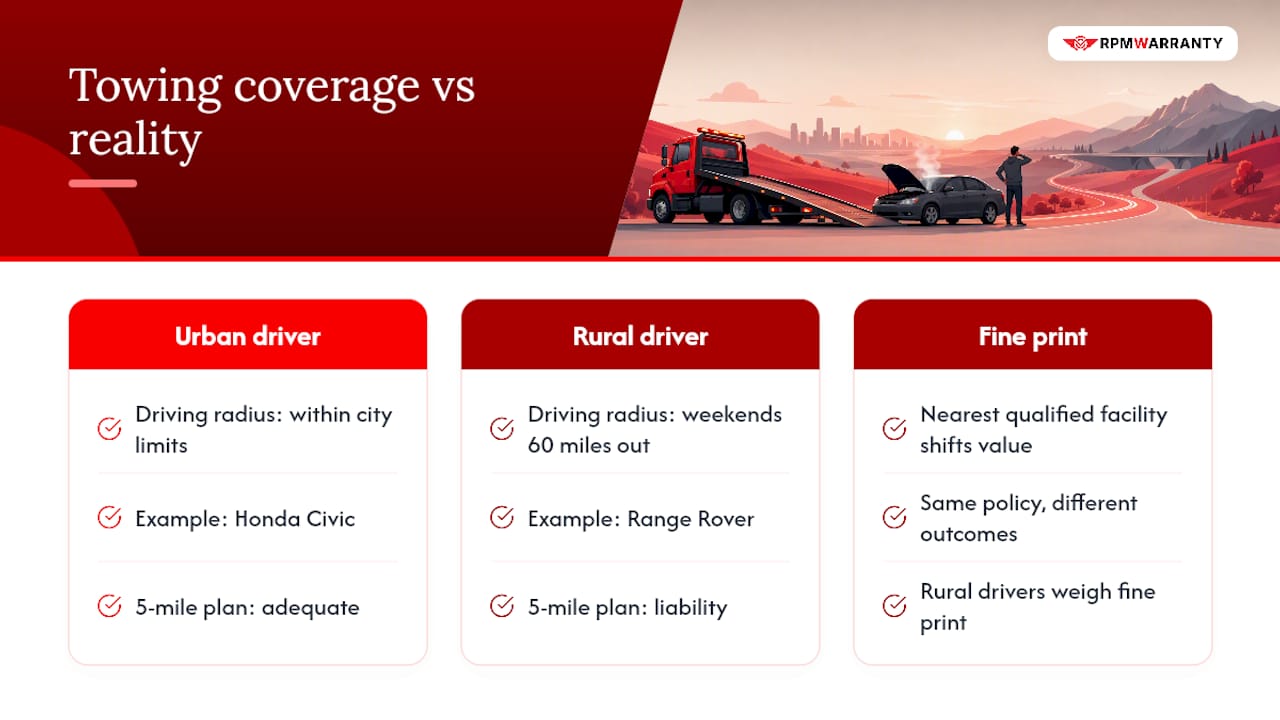
The conventional advice on roadside towing treats mileage as a single number you can shop for, like comparing gas prices. That's backwards. The real question isn't "how many miles do I get," it's "how many miles do I actually need given where I live and what I drive." A basic 5-mile plan is perfectly adequate for someone who drives a Honda Civic exclusively within city limits. That same plan is a liability for a Range Rover owner who spends weekends 60 miles outside town.
What gets underestimated is how much "nearest qualified facility" language shifts the real-world value of a plan. Two drivers with identical policies can have wildly different outcomes depending on whether they live near a dense service network or out where the nearest specialist is 50 miles off. Rural drivers should weigh this fine print more heavily than the marketing headline number.
My take: stop comparing mileage numbers in isolation. Compare them against your actual driving radius and your vehicle's service requirements first.
Get Roadside Coverage That Matches How You Actually Drive
RPM Warranty builds roadside assistance directly into every plan tier, so you're not stuck guessing whether a bare-bones add-on will actually reach you when your Ford Explorer breaks down two counties from home. Instead of hunting for a separate roadside membership and hoping its mileage cap lines up with your warranty coverage, you get both under one agreement, customized to your vehicle's year, make, and model from the start.
That matters most for owners of higher-end or specialty vehicles. If you drive a Porsche, a BMW, or a Range Rover, generic roadside plans built around Honda-and-Ford-level assumptions often leave gaps around specialized towing and dealership-level repair access. RPM Warranty's four-step process, consultation, plan selection, customization, and final agreement, walks you through exactly what's covered before you ever need a tow truck. Get a free quote and compare Elite, Advanced, and Essential coverage today, or check out tailored plans for specific models like the Volkswagen lineup to see how coverage adjusts by make.
Frequently Asked Questions
How many miles will roadside assistance tow my car? It depends on your plan tier. Basic plans typically cover 5 to 15 miles, mid-tier plans around 100 miles, and premium plans 200 miles or unlimited towing to the nearest qualified repair facility.
What does "nearest qualified repair facility" mean? It means your provider will tow you to the closest shop capable of handling the repair, rather than guaranteeing a fixed number of miles. Distance varies by how many qualified shops exist near your breakdown location.
What happens if my tow distance exceeds my plan's mileage limit? You'll typically pay $3 to $7 per additional mile plus a $50 to $75 hookup fee, though some drivers choose to accept the nearest covered facility instead of paying the difference.
Does roadside towing coverage follow the car or the driver? This varies by provider and plan. Membership-based coverage (like AAA) often follows the driver across any vehicle they occupy, while insurer-based coverage typically follows the insured vehicle. Check your specific policy.
Are RVs and motorcycles covered under standard roadside plans? Often not fully. RVs frequently need RV-specific or premium plans due to size and weight, and motorcycles may require a separate add-on rather than being included automatically.
Is there a waiting period before towing benefits start? Many providers enforce a 48 to 72 hour waiting period after enrollment before you can use roadside towing benefits, so don't sign up the day before a trip and expect immediate coverage.
Do electric vehicles need special towing consideration? Yes. EVs may require flatbed towing rather than standard wheel-lift trucks to avoid damaging the battery pack or drivetrain, and towing to a charging station versus a repair shop can involve different provider rules.
Does RPM Warranty include roadside assistance in all its plans? Roadside assistance is included across RPM Warranty's Elite, Advanced, and Essential tiers, with coverage details customized to your vehicle's make, model, and year during the plan selection process.