
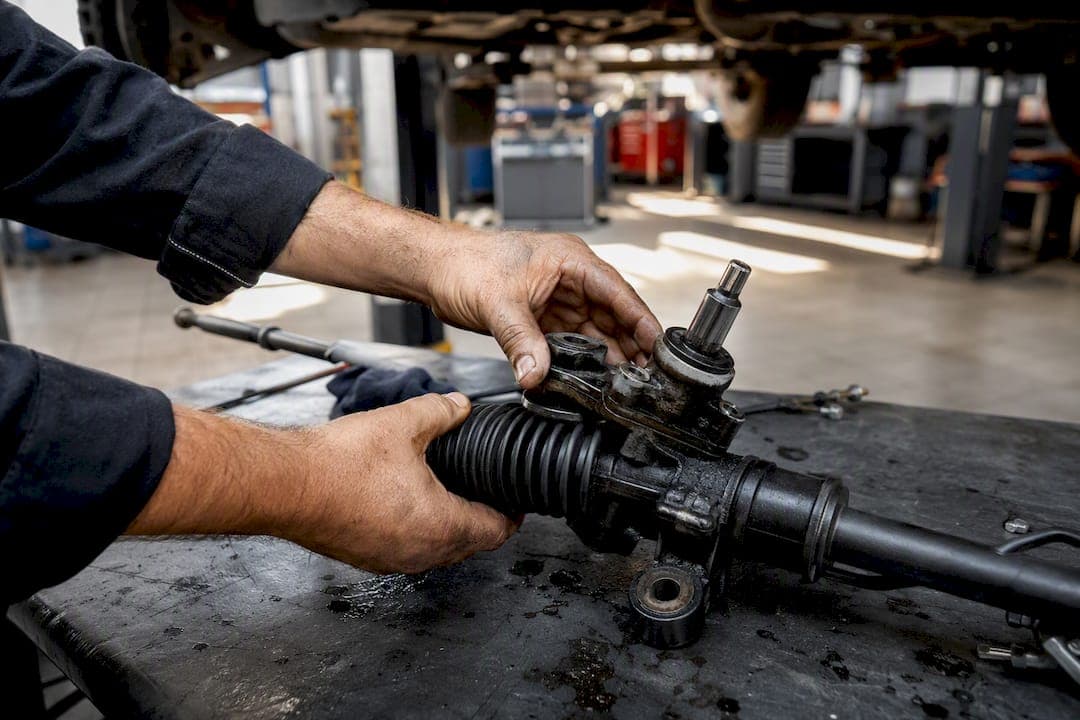
Steering components are usually excluded from a factory powertrain warranty but often covered under bumper-to-bumper protection or a well-written extended vehicle service contract (VSC). That's the short answer. The details, as usual, live in the fine print.
Watch for these common gaps before you assume you're protected:
- Wear-and-tear exclusions that deny worn tie-rod ends or boots regardless of mileage.
- Maintenance lapses, like skipped fluid flushes, that void a claim even on a covered part.
- Aftermarket modifications (lift kits, off-road tires) that shift steering geometry and give adjusters a reason to deny.
Before you assume your steering system is protected, open your contract to the covered-parts list and the exclusions section. That's where "covered" quietly turns into "covered, unless."
Key Takeaways
Steering coverage depends entirely on warranty type: powertrain plans almost always exclude it, while bumper-to-bumper and wrap VSCs are the ones that typically include it.
| Point | Details |
|---|---|
| Check the plan type first | Powertrain-only warranties usually exclude steering; bumper-to-bumper and wrap VSCs are far more likely to include it. |
| Know your parts list | Rack-and-pinion, EPS motor, pump, hoses, and seals should all be named explicitly in the contract. |
| Document everything before claiming | Photos, maintenance records, and fluid receipts strengthen a claim and counter wear-and-tear denials. |
| Budget for real repair costs | Rack-and-pinion replacement averages $2,248 to $2,506, more with EPS coding and calibration. |
| Close the coverage gap | Rpmwarranty's Elite and Advanced plans can be customized to include steering components after factory coverage ends. |
This article is general information, not a substitute for advice from a qualified financial advisor. Consult a qualified financial professional about your own circumstances before acting on anything here.
Table of Contents
- Does Your Steering System Warranty Actually Cover Repairs?
- What's Inside Your Steering System, and What Fails First?
- Which Warranty Plans Cover Steering Components?
- How to Read a Steering Warranty Contract in Five Minutes
- How to File a Steering Repair Claim the Right Way
- What Does Steering Repair Actually Cost Without Coverage?
- When Does an Extended Steering Warranty Make Sense?
- A Steering Claim That Actually Paid Off
- Get Steering Coverage Before You Need It
- Sources
Does Your Steering System Warranty Actually Cover Repairs?
Not all warranties are built the same, and steering coverage depends almost entirely on which type you're holding. Three main categories exist, and only two of them reliably help when a rack or pump fails.
Factory bumper-to-bumper (limited vehicle) warranties typically run 3 years/36,000 miles, sometimes stretched to 4/50,000 on brands like Honda or Mercedes-Benz. These plans cover most components, steering included, until the clock or odometer runs out.
Powertrain warranties last longer, often 5 years/60,000 miles or more, but they only cover the engine, transmission, and drivetrain. Steering gets classified as a chassis system, not a powertrain part, so a powertrain-only policy usually denies a power steering claim outright.
Extended warranties or vehicle service contracts (often marketed as "wrap" or "powertrain-plus" plans) fill that gap. Because they're built to cover more than the drivetrain, steering components frequently make the list, provided the plan explicitly names them.
What's Inside Your Steering System, and What Fails First?
A steering system is more than the wheel and column. Here's what a mechanic actually inspects when you report a "steering problem":
- Rack-and-pinion assembly (or steering gearbox on older/truck platforms)
- Rack boots and tie-rod ends — rubber and joints that wear from mileage and road grime
- Power steering pump on hydraulic-assist systems, plus hoses and lines
- Electric power steering (EPS) motor and steering-angle sensor on newer vehicles, including most BMW, Porsche, and Tesla models
- Steering column bearings and couplers
Common failure signs include fluid puddles under the front end, a whining noise when turning, stiff or unusually heavy steering, and a car that wanders or pulls without a clear cause. AAA's guide on common steering problems lists leaks and pump noise among the earliest, most reliable warning signs.
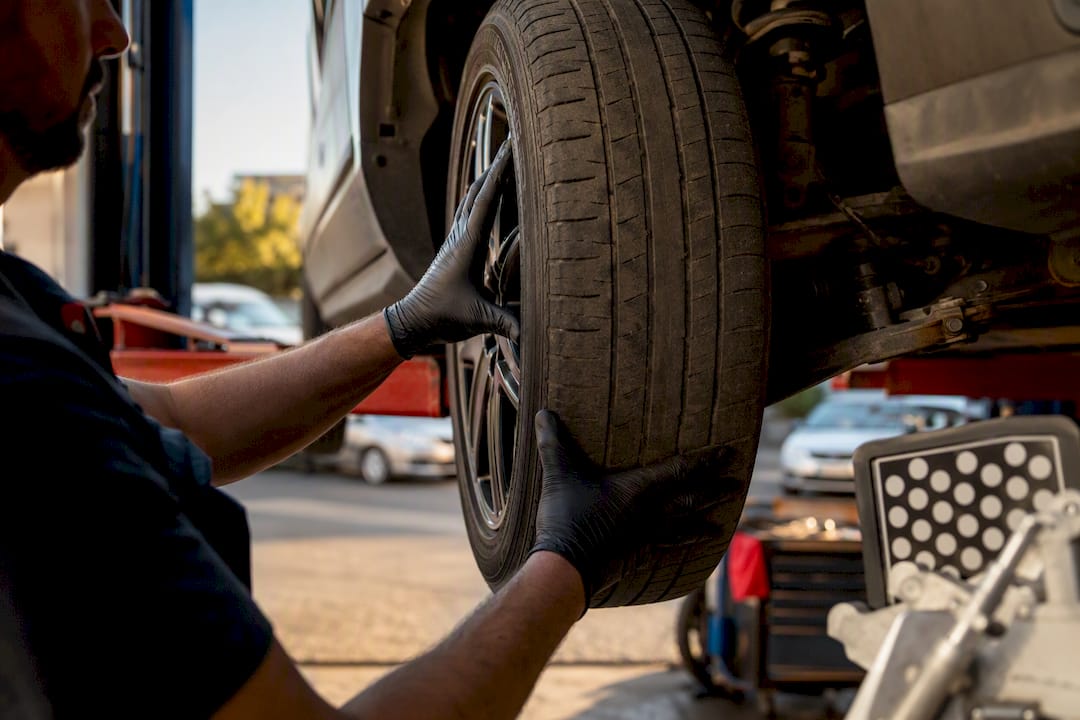
Pro Tip: Before filing any claim, have a shop confirm the issue isn't actually a bad alignment or worn tire. Both mimic steering failure and neither is typically covered under any warranty type.
Which Warranty Plans Cover Steering Components?
The rule of thumb: powertrain-only coverage excludes steering almost every time. Bumper-to-bumper and full wrap VSCs are your best bet, but only if the contract spells it out.
When reading a plan, look for these specific phrases in the covered-parts section:
- "Steering" or "steering gear"
- "Rack-and-pinion" or "steering rack assembly"
- "Electric power steering motor" or "EPS unit"
- "Steering pump and hoses"
Plans labeled "powertrain-plus" or "wrap" tend to bundle steering with suspension and electrical systems. Mileage and time eligibility still apply, so a 10-year-old vehicle with 120,000 miles may not qualify for every tier even if the plan technically lists steering parts.
How to Read a Steering Warranty Contract in Five Minutes
You don't need a law degree to figure out whether you're covered. You need to know where to look.
Start with the covered-parts list, usually near the front of the contract. Then jump to exclusions, and finally the limit of liability section, which caps what the provider will pay per repair or per term.
Search the document for these terms specifically: "steering," "rack," "pump," "electric motor," "chassis," "wear," "consequential damage," and "maintenance requirements." A denial almost always traces back to one of three lines: a wear-and-tear clause, a fluid maintenance requirement you can't document, or a mileage/time limit you've quietly passed.
How to File a Steering Repair Claim the Right Way
Filing a claim well is half the battle. Here's the sequence that actually works:
- Notify your provider first, before any repair work starts.
- Get pre-authorization in writing, not a verbal "should be fine."
- Use an approved shop or ASE-certified mechanic — unauthorized repairs are the single most common reason claims get denied.
- Get a written diagnosis and repair estimate before anything gets disassembled.
Bring documentation, not just the car. That means:
- Photos and video of leaks or damage
- Maintenance records and fluid receipts
- Recent alignment invoices
- Any prior inspection notes showing the issue was developing
Pro Tip: If a covered part failure caused your steering damage (say, a leaking transmission line degraded a nearby steering hose), that's consequential damage. Document the causal chain clearly, because some policies do cover this scenario, but only with clear evidence tying one failure to the other.
What Does Steering Repair Actually Cost Without Coverage?
Numbers make the coverage question real. A full rack-and-pinion replacement, one of the more expensive steering repairs, averages $2,248 to $2,506 depending on the vehicle and whether parts are new or remanufactured.
Reman hydraulic racks can run as low as a few hundred dollars in parts alone, while EPS racks and full-shop totals commonly land between $1,100 and $2,400, according to cost breakdowns from AmpAuto.
Several factors push costs higher:
- EPS coding and calibration — required on nearly every modern EPS rack swap
- Post-repair alignment, almost always necessary
- OEM vs. remanufactured parts — OEM racks on a Range Rover or Porsche cost meaningfully more than aftermarket
- Labor rates, which vary sharply by region and dealership vs. independent shop
Vehicles with lane-keep assist or adaptive steering, common on BMW, Mercedes, and Tesla models, often need scan-tool coding after any rack or sensor replacement, which adds labor hours a basic hydraulic system never required.
When Does an Extended Steering Warranty Make Sense?
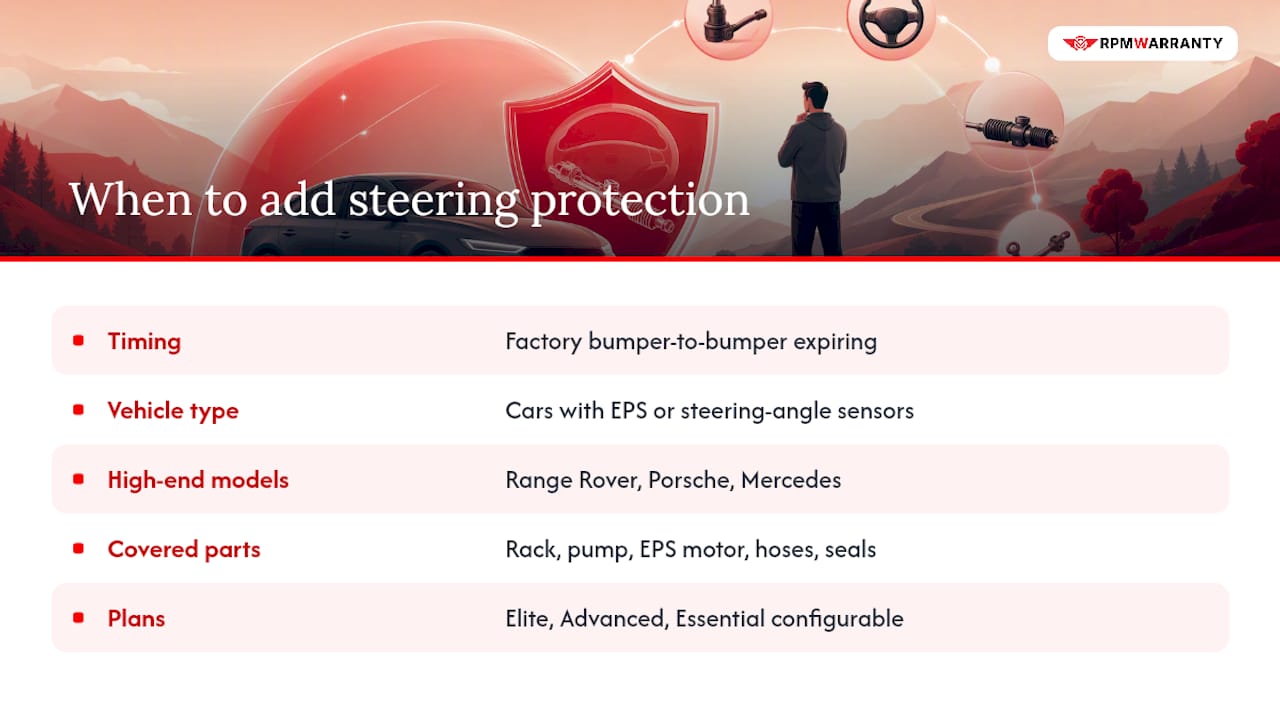
If your factory bumper-to-bumper is expiring and you're driving something with EPS or steering-angle sensors, an add-on is worth serious consideration. Ask yourself: how old is the vehicle, how many miles are left before the next major service interval, and what would a rack replacement cost on this specific make?
A typical steering add-on lists the rack, pump, EPS motor, hoses, and seals as covered parts, usually within a defined mileage or term window matching the rest of your plan.
For owners of higher-end vehicles like Range Rover, Porsche, or Mercedes models with electric power steering, the coverage gap between factory expiration and total ownership can be years long, and that's exactly where steering-specific add-ons earn their cost.
Rpmwarranty's Elite, Advanced, and Essential plans can each be configured to include steering protection, which matters most for EPS-heavy vehicles where a single motor replacement can rival a month's car payment.
A Steering Claim That Actually Paid Off
I've reviewed enough claim outcomes to know coverage gaps hit hardest on vehicles owners least expect, usually higher-end models loaded with EPS and driver-assist sensors. One case that stuck with me involved a Range Rover owner whose EPS motor failed at 58,000 miles, right after factory coverage lapsed. A wrap VSC with steering explicitly listed turned a four-figure repair into a copay.
Get Steering Coverage Before You Need It
Waiting until a rack starts whining is the expensive way to find out what your warranty actually covers. Rpmwarranty's Elite and Advanced plans can include steering components explicitly, rack-and-pinion, EPS motor, pump, hoses, and seals, so you're not guessing when a dashboard light comes on.
The process takes four steps: a quick consultation, plan selection, customization for your specific make and model, and a final agreement, all handled online or by phone. Coverage runs nationwide through ASE-certified shops, so a Porsche in Phoenix and a Ford F-150 in Ohio get the same claims process. If you're weighing options for an EV or EPS-heavy vehicle, the Tesla-specific coverage page breaks down what's typically included. Otherwise, start with a free quote and see what steering protection would actually cost for your vehicle.