
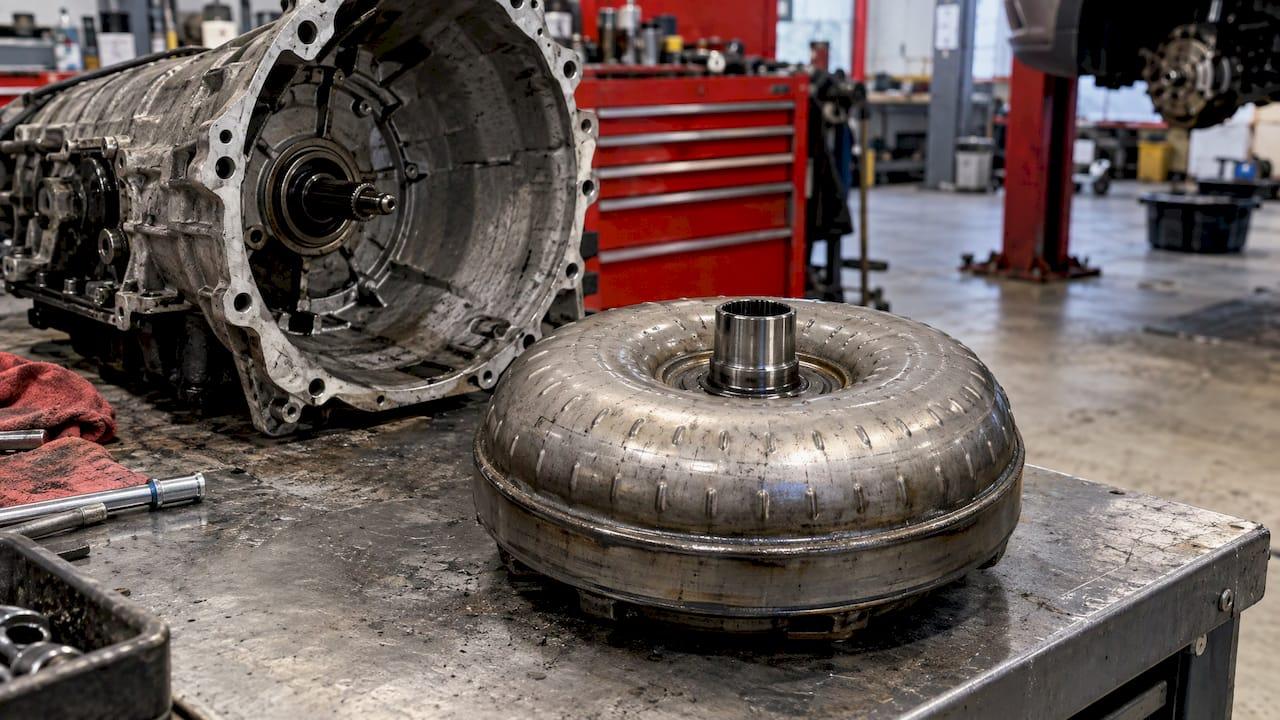
A torque converter is covered by a factory powertrain warranty when it fails from a defect, and most automakers list it by name. The catch is time: that coverage usually ends at 5 years or 60,000 miles, and torque converter and transmission problems tend to show up right after. An extended warranty is how you keep the same protection going, provided the contract lists the transmission and its internal parts. Below is what the factory terms say, what voids a claim, what to expect on BMW, Mercedes, Range Rover, Porsche, Ford and Honda, and how to pick coverage that fits.
TL;DR
- Automakers such as Ford and Chevrolet list the torque converter inside powertrain coverage, typically for 5 years or 60,000 miles, whichever comes first.
- Transmission mounts are listed in some factory warranties (Ford's, for example), but cooling lines, sensors, wiring and hoses are commonly excluded.
- Claims are denied for neglect, wrong or low fluid, misuse, racing and accident damage, so maintenance records matter as much as the contract.
- Once the factory term ends, an extended plan is the way to keep transmission protection. Our Elite, Advanced and Essential plans are built for that.
Table of Contents
- What a torque converter does, and why its failure is expensive
- Does a factory warranty cover the torque converter?
- What about transmission mounts?
- What is usually not covered
- Torque converter and transmission problems on higher-end vehicles
- How an extended warranty picks up where the factory leaves off
- How to file a torque converter or transmission claim
- Promo: coverage built for the years after the factory term
- Perspective
- FAQ
- Sources
What a torque converter does, and why its failure is expensive
In a conventional automatic, the torque converter is a fluid coupling that sits between the engine and the transmission. It lets the engine keep running while the car is stopped in gear, and it multiplies torque when you pull away. Most modern ones also contain a lock-up clutch that locks the engine to the transmission at cruising speed to save fuel.
Because it is bolted into the transmission bell housing, the converter is almost never repaired in isolation. A shop has to remove the transmission to reach it. That labor is the real cost, and it is why owners who learn their coverage has just expired feel it so sharply. It is also why a torque converter is treated as a transmission component by warranty writers, not as a stand-alone part.
The usual warning signs are a shudder at steady highway speeds, slipping or delayed engagement when you accelerate, unusual whining or rattling, and a transmission that runs hot. These symptoms overlap with other transmission faults, such as solenoids, software or a worn mount, so a proper diagnosis comes before any claim.
Does a factory warranty cover the torque converter?
Yes, in most cases. The factory powertrain warranty is the one that normally includes it. AAA's guide to car warranties describes the powertrain warranty as covering the engine, transmission and drivetrain, with the transmission portion including the housing, gears and torque converter. Here is how some of the largest automakers write it down:
| Automaker | Powertrain term | How the torque converter appears |
|---|---|---|
| Chevrolet (2025 manual) | 5 years / 60,000 miles | Listed within transmission/transaxle coverage with the case, internally lubricated parts, mounts, seals and gaskets |
| Ford (2025 F-150 guide) | 5 years / 60,000 miles | Listed by name, alongside the clutch cover, transmission case and front and rear transmission mounts |
| Hyundai (2025 booklet) | 10 years / 100,000 miles, original owner | Torque converter and converter housing listed |
| Acura (2025 basebook) | 6 years / 70,000 miles | Torque converter listed in transmission/transaxle coverage |
Kia's warranty page adds useful context: its 10-year/100,000-mile powertrain warranty is an exception, and the same page's comparison table shows Toyota, Honda, Nissan, Chevrolet and Ford at 5 years and 60,000 miles. So for most vehicles on the road, the clock runs out at a point when the car is still worth keeping.
"Whichever comes first" is the part people miss
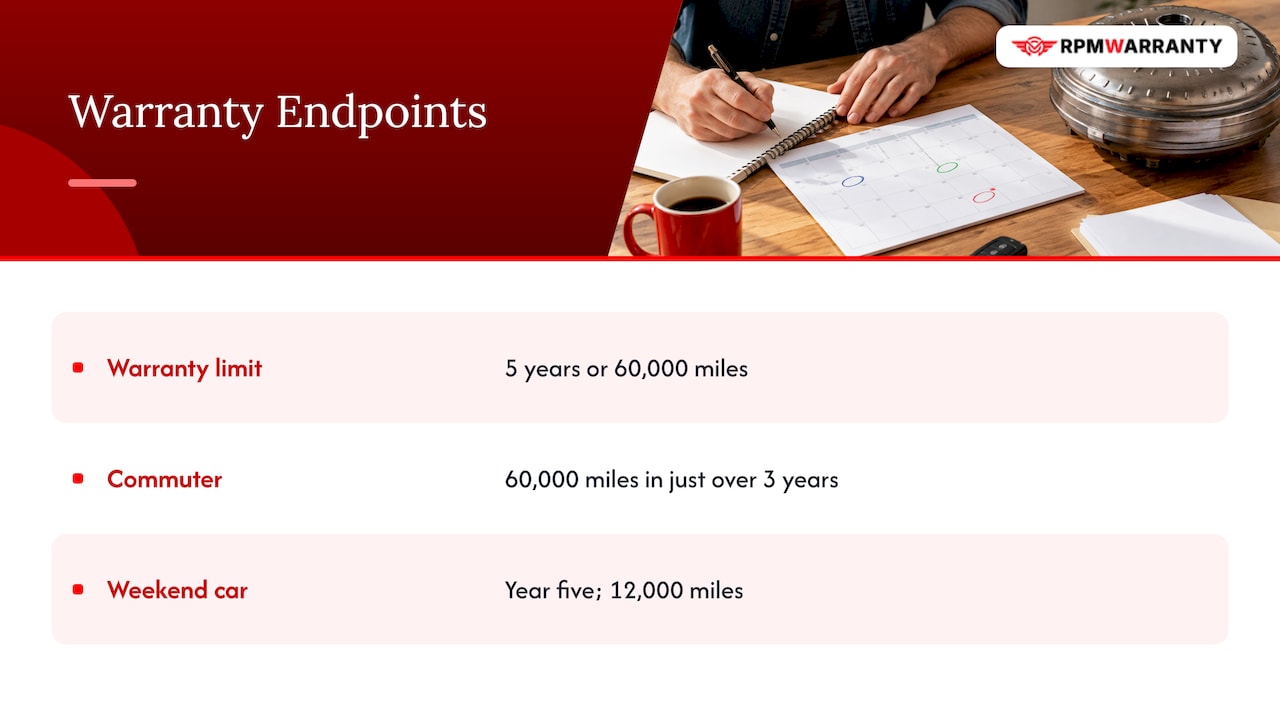
A 5-year/60,000-mile warranty ends at whichever milestone you reach first. A commuter who drives 18,000 miles a year hits 60,000 miles in a little over three years, long before the fifth birthday. A weekend car that has 12,000 miles at year five is out of coverage on time instead. Check both numbers on your own vehicle, and note the in-service date, which is the day the car was first sold or delivered, not the model year.
Powertrain versus bumper-to-bumper
The shorter bumper-to-bumper (comprehensive) warranty typically ends sooner, about three years or 36,000 miles according to AAA's explanation. Torque converter coverage sits in the longer powertrain warranty, so you usually have longer protection for it than for the electronics and accessories around it. After both end, you are paying out of pocket unless you hold another contract.
What about transmission mounts?
A transmission mount is a rubber and metal support that holds the transmission to the body or subframe and absorbs vibration. When one fails you get clunks when shifting from Park to Drive, vibration at idle, or a visible shift in the drivetrain under load. A badly worn mount can also stress linkages, cooling lines and electrical connectors.
Whether a mount is covered depends on how the contract words it. Ford's powertrain terms list transmission mounts as a covered item for five years or 60,000 miles, whichever occurs first, as stated on Ford's powertrain coverage page. Chevrolet's manual also names mounts within transmission coverage. Other makers may treat them as a chassis or general item. In any contract, read the transmission section for the word "mounts" before assuming.
The same applies to extended plans. If you want a mount covered, find the line that says so in the plan you are considering, and confirm it before you enroll. That one check separates a plan that pays the whole repair from one that pays only part.
What is usually not covered
Factory powertrain terms cover defects in materials and workmanship, not every problem near the transmission. Chevrolet's manual excludes transmission cooling lines, hoses, the radiator, sensors, wiring, electrical connectors, and the clutch and pressure plate. Chevrolet's owner page says similar things about coolant and radiators. Acura's basebook lists these exclusions:
- abuse, misuse and accidental damage
- improper maintenance
- low or incorrect fluid
- racing use
- an altered odometer
- salvage-title vehicles
Hyundai's booklet excludes commercial use such as taxi, route delivery and rental. AAA puts the principle simply: warranties address manufacturing defects, not the natural costs of ownership, and they exclude wear items, routine maintenance and damage from neglect, misuse or contaminated fluids.
The practical lessons are the same for any warranty you hold:
- Keep every service receipt, especially for transmission fluid changes.
- Use the fluid specification your owner's manual calls for.
- Do not let a warning light or a shudder run for weeks. Damage that is allowed to spread can be argued as neglect.
- Tell the service department about the symptom on the first visit, so the date is on record.
Torque converter and transmission problems on higher-end vehicles
Premium vehicles are where this topic matters most, because the transmissions are sophisticated and parts and labor are priced accordingly. What follows describes the design features that make these cars what they are, and why owners often protect them past the factory term. Individual experiences vary by model year and how the car was driven.
BMW and Mercedes-Benz
Both makers build smooth, multi-speed automatics with electronically controlled torque converter lock-up, tuned for quiet cruising and quick shifts. That sophistication is the appeal: the converter clutch engages early and often, which keeps revs low on the highway. It also means the converter, the valve body and the control module work as a team. A shudder or a delayed engagement can start in any one of them. Those parts are expensive, and repairs generally require a full transmission removal, so a contract that lists the transmission's internal parts and electronic controls is the one worth holding. Fluid service on these units follows the maker's schedule, and a documented history helps any claim.
Range Rover and Land Rover
A Range Rover pairs its automatic with a transfer case and four-wheel drive hardware, and often an air suspension that adds weight and load. The torque converter works hard at low speeds when towing or crawling off-road. The factory powertrain coverage on four-wheel and all-wheel drive vehicles generally extends to the transfer case, as the AAA guide notes, which is another reason to read the drivetrain list closely when you shop for extended coverage. Owners who tow or drive off-road should also make sure that use is not excluded.
Porsche
Many Porsche models use a dual-clutch gearbox instead of a torque converter, while others, including some Cayenne and Macan models, use a conventional torque converter automatic. That means two different answers to the same question. Look up whether your specific model has a converter before you read the contract, and make sure the contract names the type of transmission you actually have. Performance driving is also a place where exclusions for racing and track use matter, so read that wording.
Ford
Ford's trucks and SUVs are a good example of what a clear factory contract looks like: the 2025 F-150 warranty guide lists the torque converter, transmission case, clutch cover, seals, gaskets and both front and rear mounts. Trucks that tow regularly put more heat into the transmission, which makes fluid service history especially important. Once the 60,000-mile mark passes, owners with big payload or towing habits usually look for continued protection.
Honda and Acura
Honda and Acura are known for durable drivetrains, and Acura's 2025 basebook gives a longer-than-usual 6-year/70,000-mile powertrain term. That is a good starting point, but it still ends. Owners who keep a Honda to 150,000 miles and beyond are the ones who benefit most from a plan that begins when the factory coverage stops.
How an extended warranty picks up where the factory leaves off
An extended warranty, properly a vehicle service contract, is an agreement that pays for covered repairs after the manufacturer's coverage ends. It is a different product from the factory warranty, so you compare it by its contract language. For a torque converter, these are the lines to look for:
- Transmission internal parts: the contract should cover the transmission case and all internally lubricated parts, and name the torque converter.
- Mounts and seals: confirm whether mounts, seals and gaskets are included, since they are the items most likely to be written separately.
- Electronic controls: modern transmissions rely on control modules, so see whether they are part of the covered list.
- Fluid and diagnostic costs: find out how fluid, diagnosis and shop fees are handled in a covered repair.
- Claims process: know how a repair is authorized before work begins, and how fast approval comes.
- Where you can get service: nationwide coverage and access to certified mechanics matter if you travel.
Transmission repairs also come with extras. One repair-shop write-up notes that programming after a replacement can add $100 to $250 on many late-model vehicles, and recommends confirming exactly what a quote includes, such as fluid, programming, taxes and shop fees. Those are the line items to ask about when reading any plan's terms.
How to file a torque converter or transmission claim
The same sequence applies whether the claim is under a factory warranty or a service contract:
- Stop driving hard. If the transmission slips, shudders or overheats, limit driving to prevent further damage.
- Report the symptom. Contact the servicing shop or your coverage administrator promptly, and keep the date and mileage.
- Get a diagnosis in writing. A repair order should identify the failed part, the VIN, the date and the mileage. Factory documentation for parts, such as the one on a manufacturer's parts warranty, asks for the VIN, part number, serial number, date and mileage on the repair order.
- Wait for authorization. Do not approve teardown or replacement work on a service contract until the claim is approved.
- Keep maintenance records ready. Fluid change receipts are the most common request.
- Confirm what the approval covers. Parts, labor, fluid and any programming should be itemized.
Promo: coverage built for the years after the factory term
We sell extended vehicle warranty plans in three tiers, Elite, Advanced and Essential, so you can match coverage to your car and your budget. Our plans protect components such as the engine, transmission, cooling system, electrical system, steering, suspension, hybrid systems and high-tech electronics, and include roadside assistance and rental reimbursement. Service is nationwide through ASE-certified mechanics, and we aim for claim approvals within 24 to 48 hours.
Enrollment follows four steps: consultation, plan selection, customization and final agreement. You can start with a free quote based on your vehicle's year, make and model, and compare the Elite, Advanced and Essential plans side by side. Riders can look at Full Throttle coverage for motorcycles. If you drive a particular brand, we also have pages for makes such as Volkswagen and Hummer.
Perspective
The torque converter is the part owners rarely think about until it fails, and by then the factory warranty has often ended. The pattern is simple: the 5-year/60,000-mile mark arrives, and the first big drivetrain repair follows at some point after that. Most people only learn what their coverage excludes when they are standing at a service counter.
That is why we built our plans around clear terms. Our four-step process, consultation, plan selection, customization and final agreement, is designed so you know what your plan includes before you sign it. Our plans are designed with no hidden fees, and our claims process is designed for quick approvals, within 24 to 48 hours.
Higher-end vehicles are where this matters most. A BMW, Mercedes, Range Rover or Porsche carries a sophisticated drivetrain, and a transmission repair on one is a major expense. Coverage that you tailor to your make, model and year, backed by nationwide service from ASE-certified mechanics, turns that expense into a known quantity.
If you own a car you intend to keep, decide on coverage while the factory warranty still runs, and keep your service records in order. Those two habits make every claim go smoother.
Kenneth
FAQ
Is a torque converter covered under a powertrain warranty?
Usually yes. Automakers including Ford and Chevrolet list the torque converter as part of transmission coverage, typically for 5 years or 60,000 miles, whichever comes first. Exclusions such as neglect, misuse and wrong fluid still apply, so keep your maintenance records.
Does a warranty cover a transmission mount?
It depends on the contract. Ford's powertrain terms and Chevrolet's transmission coverage name mounts, while other makers may handle them differently. For an extended plan, look for mounts in the transmission section of the covered components list before you enroll.
What does a 5-year/60,000-mile warranty mean?
It means coverage lasts until your car reaches five years in service or 60,000 miles, whichever happens first. A driver who logs 20,000 miles a year reaches the mileage limit in three years. Coverage is counted from the date the car was first put into service.
Can I get an extended warranty after the factory coverage ends?
Yes. An extended plan is designed to protect your vehicle beyond the manufacturer's coverage. We offer quotes by year, make and model, so you can see plan options for your own vehicle and choose the tier that fits your budget.
Sources
- AAA: What Does a Car Warranty Cover? Repairs, Limits and Exclusions
- Chevrolet Owners: Warranty Information
- 2025 Chevrolet Limited Warranty and Owner Assistance Information
- Ford: What parts are covered by the powertrain warranty
- 2025 Ford F-150 Warranty Guide
- Hyundai 2025 Warranty Information
- Acura 2025 Warranty Basebook
- Kia Warranty Information
- Powertrain parts limited warranty documentation
- How much does it cost to fix a transmission?