
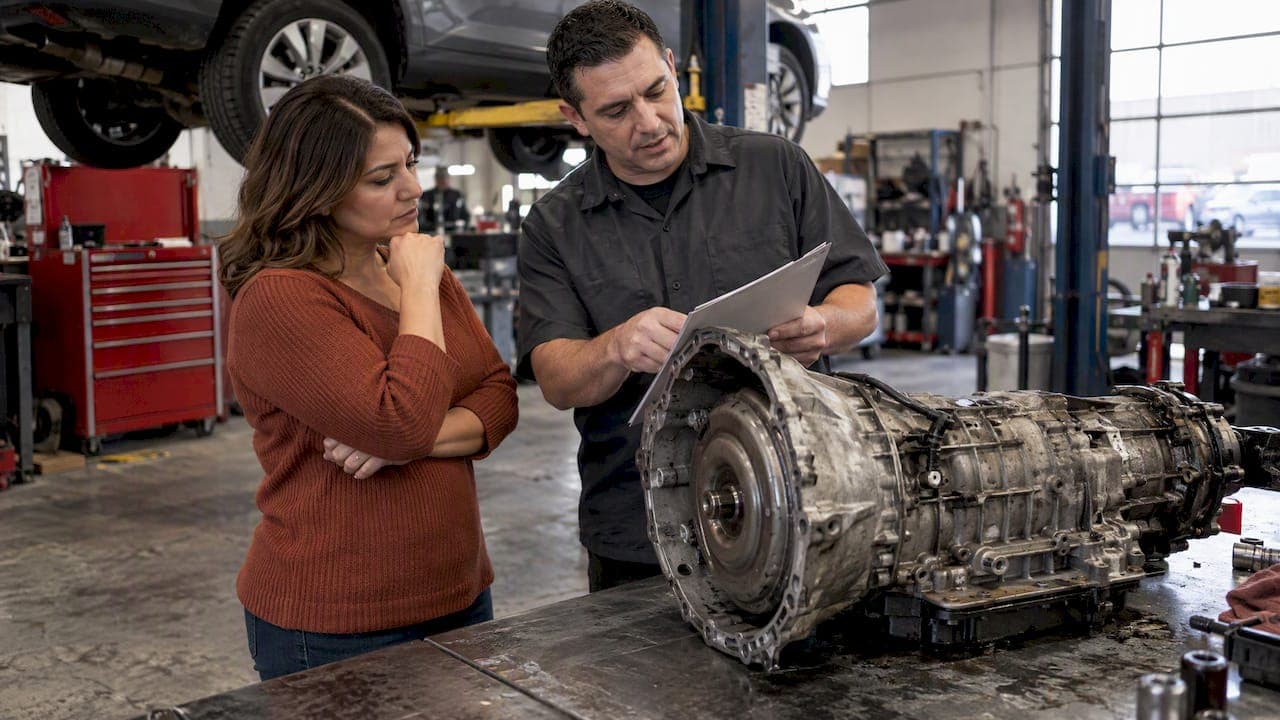
A transmission replacement usually costs somewhere between $2,900 and $7,100, and a full rebuild often lands between $1,800 and $5,500. A warranty or service contract that covers the transmission can turn that bill into a deductible. The catch is that coverage depends on mileage, maintenance records and the exact wording of your contract. This guide puts repair costs next to what warranties actually pay, then walks through the transmissions in Range Rover, BMW, Mercedes-Benz, Porsche, Ford and Honda vehicles.
TL;DR
- A new transmission averages $2,900 to $7,100, and a rebuild runs $1,800 to $5,500. Luxury and performance models sit at the top of those ranges or above them.
- Factory powertrain warranties cover the transmission, but they run from five years/60,000 miles up to 10 years/100,000 miles, depending on the brand. After that, you pay.
- An extended plan is a service contract, not a warranty under federal law. Read the exclusions, the deductible and the pre-approval rules before you sign.
- Skipped maintenance and driving on a warning light are the two most common reasons a transmission claim fails.
- The cheapest moment to decide is before the first slip or shudder, not after the shop quotes you.
Table of Contents
- What a transmission repair costs in the US
- What a factory warranty covers, and when it ends
- Extended coverage: what it is and what it is not
- Repair bill vs. coverage: a worked comparison
- Transmission trouble by make: what high-end owners should know
- Signs your transmission is asking for help
- Before you authorize the work: a checklist
- Our perspective: why we pair coverage with maintenance
- Choosing coverage for your transmission
- When coverage is worth it, and when it may not be
- FAQ
- Sources
What a transmission repair costs in the US
Transmission work is not one price. It is a ladder, and where you land depends on how much of the unit has to be touched.
| Job | Typical US range | Source |
|---|---|---|
| Fluid service | $150 to $400 | USA Today |
| Full rebuild | $1,800 to $5,500 | USA Today |
| New transmission | $2,900 to $7,100 | Kelley Blue Book |
Those are averages across the whole market. A mainstream sedan with a conventional automatic sits near the low end. A dual-clutch unit in a performance car, an eight- or nine-speed automatic in a luxury SUV, or a hybrid transmission with integrated electronics sits near the top, and sometimes past it.
Why two quotes for the same car can differ by thousands
A few variables drive the spread:
- Replace, rebuild or remanufacture. A rebuild repairs your own unit. A remanufactured unit is rebuilt to a set standard before it is installed. A new unit costs the most. Ask the shop which one is on the quote and what warranty comes with it.
- Transmission type. Conventional automatics, CVTs, dual-clutch units and hybrid drive units all have different parts costs and labor hours.
- Vehicle. A part that is routine on a compact car can be a special-order item on a luxury model. Labor also takes longer when the transmission sits under tight packaging, a subframe or an air suspension.
- Diagnosis. A bad sensor, a software fault or a leaking seal can mimic internal failure. Paying for a proper diagnosis before approving a replacement can keep you from buying a transmission you did not need.
- Where the work is done. Dealers and independent shops price labor differently. Under the Magnuson-Moss Warranty Act, companies generally cannot void a warranty just because you used independent repairs or third-party parts, unless they supply the part or service free or it caused the damage. Always keep the invoices.
Does the repair itself carry a warranty?
Usually yes, but the terms vary. One published example: an auto club repair center in Nevada offers 24 months/24,000 miles on parts and labor to members and 12 months/12,000 miles to nonmembers. Treat that as one data point, not a rule. Before you pay, get the repair warranty in writing: its length, whether it covers parts and labor, and whether you must return to the same shop for any fix.

What a factory warranty covers, and when it ends
Every new vehicle comes with a basic warranty and a longer powertrain warranty. The powertrain warranty is the one that matters here. According to AAA, it generally covers the major internal components of the transmission, engine and drive axles. Terms run from five years/60,000 miles to 10 years/100,000 miles for some brands.
Three points trip owners up:
- The clock is whichever comes first. A car with 62,000 miles at year four may already be out of a 60,000-mile powertrain term.
- Coverage may not follow the car equally. Some manufacturers shorten the powertrain term for second owners. Check your own paperwork or ask a franchised dealer with your VIN.
- Powertrain is not everything. Electronic modules, sensors, mounts, external cooling lines and similar parts that sit around the transmission may fall under a different, shorter warranty or no warranty at all.
So a 100,000-mile powertrain warranty does cover the transmission, but only inside its mileage and year limits and only for the covered components.
Extended coverage: what it is and what it is not
Once the factory term ends, an extended plan can fill the gap. The Federal Trade Commission is blunt about the vocabulary: a vehicle service contract is not a warranty under federal law. It is a separate agreement to pay for certain repairs. That is why the contract wording matters more than the marketing name.
Plans typically range from powertrain-only to broad component coverage. They also commonly exclude normal wear and tear, accident damage and failure to follow the manufacturer's maintenance schedule.
Exclusions that leave owners paying
- Normal wear. Clutch packs and friction material wear out over time. Some contracts treat that as wear, not failure.
- Neglect. If the manufacturer calls for a fluid change and there is no receipt, expect questions.
- Accident or outside damage. A transmission damaged in a collision is an insurance matter, not a service contract matter.
- Warning lights. The California Department of Insurance notes that continuing to drive after a dashboard light tells you to stop almost always results in a denied claim.
- Deductibles. A deductible may apply each time the vehicle is serviced or repaired, so ask whether it is charged per visit or per repair.
- Pre-approval and shop rules. Some repairs, and towing, need approval first. Ask which repair centers are authorized before the car goes on a lift.
Check the company behind the contract
A service contract is binding between you and the company obligated to pay, so the California Department of Insurance says it is essential to verify the provider's financial backing before you buy. In California, most contracts issued by providers must also carry backup insurance. Rules differ by state, so ask any seller who the obligor is and how claims get paid.
Repair bill vs. coverage: a worked comparison
Take a hypothetical out-of-warranty luxury SUV that needs a remanufactured transmission. The numbers below are illustrative, not a quote.
| Scenario | You pay |
|---|---|
| No coverage, quote at the middle of the new-unit range ($2,900 to $7,100) | Roughly $5,000 |
| Covered by a plan with a $100 deductible | $100, plus anything the contract excludes |
| Claim denied for missing maintenance records | The full repair bill |
The lesson is in the third row. A contract only protects you if you meet its conditions. Keep a folder, paper or digital, with every fluid change and service invoice.
Transmission trouble by make: what high-end owners should know
Every transmission fails differently. The notes below are general patterns owners and technicians discuss, not predictions for any individual car. Condition, mileage, towing, driving style and software updates all matter. Your own VIN-specific service history is the best guide.
Range Rover
Modern Range Rovers pair powerful engines with multi-speed automatics, and the vehicles carry a lot of electronics: air suspension, terrain-response systems and layered driver aids. A transmission fault here can be tied to software, a sensor or the electrical supply as often as to worn internals. That makes diagnosis the first line of the bill. Repairs on a heavy luxury SUV take more labor hours, so a replacement lands at the upper end of the price ranges above. Plans for these vehicles are worth reading closely for electrical and suspension coverage, since those systems can interact with drivability complaints.
BMW
Many BMW sedans and SUVs use a smooth multi-speed automatic that BMW has historically described as filled for life. Many independent specialists recommend a fluid and filter service well before the vehicle gets old, because heat degrades fluid over time. Common warning signs include harsh shifts when cold, delayed engagement and a flashing drivetrain message. Because BMW uses extensive electronics, a mechatronic or control-module issue can be billed separately from internal mechanical failure. Check whether your contract names electronic control parts.
Mercedes-Benz
Mercedes-Benz offers a long line of automatics with many gears, aimed at refinement and efficiency. Some earlier units have a reputation among independent shops for electronic control faults as they age. Symptoms include limp mode, a stuck gear and rough shifts that clear after a restart. Never ignore limp mode: driving on makes a small electronic fault into a costly mechanical one, and may leave a claim open to denial.
Porsche
Many Porsches use the PDK dual-clutch gearbox, which delivers rapid shifts and rewards performance driving. Dual-clutch units are mechanically more complex than a conventional automatic, with two clutches, a mechatronic unit and fluid that needs timely service. Track days, aggressive launches and heavy towing add stress. Because parts and specialist labor cost more, a replacement can quickly reach the top of the market range. If you plan to track the car, read the contract for any exclusion on racing or competition use.
Ford
Ford's range is wide, from trucks and SUVs with modern ten-speed automatics to older small cars. The best-known cautionary tale is the DPS6 PowerShift dual-clutch automatic in the 2011 to 2016 Fiesta and 2012 to 2016 Focus. A class action alleged a defect causing shuddering, bucking, hesitation and slipping, and the settlement received final court approval on March 5, 2020. If you own one of these cars, check recall and settlement status as well as coverage. For newer trucks that tow, fluid condition and towing history are what a claims adjuster will look at.

Honda
Hondas have a strong reputation for reliability, which is exactly why owners tend to skip transmission service on them. Many current models use a CVT or a newer multi-speed automatic. Honda recommends fluid changes on a schedule that depends on how you drive, and this is where a claim can come undone, since a CVT or automatic that runs low on clean fluid is a classic neglect argument. Your maintenance minder and owner's manual spell out the schedule. Follow them and keep the receipts.
Other makes
The same logic applies to Volkswagen and Hummer owners, and to most other brands. Volkswagen's dual-clutch units reward on-time fluid service, and large trucks and SUVs add towing and weight to the equation. If you drive one of these, we have a Volkswagen coverage page and a Hummer coverage page with model-specific detail.
Signs your transmission is asking for help
Catching trouble early often decides whether the bill is a $300 service or a $5,000 replacement. Watch for:
- Slipping gears or an engine that revs without matching acceleration
- Delayed or harsh shifts, shuddering or clunking
- A burning smell or fluid on the driveway (a reddish or brown leak is a reason to stop and check)
- A check-engine or drivetrain warning light
- Limp mode, where the car refuses to shift out of one gear
If a warning light says to stop, stop. Pull over safely and call roadside assistance or a tow. If you are covered by a service contract, call the claims line before authorizing any teardown. Starting repairs first is one of the most common ways to lose reimbursement.
Before you authorize the work: a checklist
- Read your coverage dates. Compare the manufacturer's warranty with any service contract and note the mileage and time limits on each.
- Call before the teardown. Ask whether pre-approval is required, which repair centers are authorized and how towing is handled.
- Request a written diagnosis. It should name the failed part and the cause, not just "transmission bad."
- Ask replace, rebuild or remanufacture. Then ask for the repair warranty's length, and whether it covers parts and labor.
- Gather your records. Fluid changes, service invoices and mileage proof show you followed the maintenance schedule.
- Confirm the deductible. Is it per visit or per repair?
- Get a second opinion on a big quote. A second look is cheap compared with a replacement you may not need.
Our perspective: why we pair coverage with maintenance
We talk to owners every day who ask the same thing: is the contract worth more than the repair? Our honest answer is that it depends on the car, the miles left and how much a surprise bill would hurt. A transmission is the part where the gap between the two numbers is widest. A small deductible on one side, a four- or five-figure invoice on the other.
Here is how we think about it. First, the plan should be clear. We build ours so the terms are easy to read and nothing is buried, because a contract you cannot understand is a contract you cannot use. Second, we like a short claims path: our goal is fast approvals, and we work toward 24 to 48 hours. Third, repairs happen at ASE-certified mechanics, with nationwide service, so a breakdown away from home is not a dead end.
We also tell people plainly that coverage is not a substitute for care. Change the fluid when the manufacturer says to, keep the receipts, and pull over when the car tells you to. Do those three things and a claim goes the way it should.
— Kenneth
Choosing coverage for your transmission
When you compare plans, put transmission coverage at the top of your list and read these lines first:
- Which transmission parts are listed. Look for internal parts, the torque converter, the housing and the electronic control components.
- How the plan treats wear. Some contracts cover failure but not gradual wear.
- Deductible. Per visit or per repair, and how much.
- Shop choice. Whether you can use the shop you trust, and whether it must be certified.
- Extras. Roadside assistance and rental reimbursement are worth real money when a transmission keeps your car in the shop for a week.
- Waiting period and mileage cap. Know when coverage starts and where it stops.
Our Elite, Advanced and Essential plans are tiered so you can match coverage to your vehicle and budget. They include protection for the transmission and other major systems such as engine, cooling, electrical, steering and suspension, plus hybrid and high-tech components, depending on the plan you pick. You can get a free quote online by entering your vehicle's year, make and model. Riders can look at Full Throttle motorcycle coverage. Plan prices are quoted per vehicle, so we do not publish a single number here.
When coverage is worth it, and when it may not be
Coverage tends to make sense when:
- Your factory powertrain warranty has ended or is close to ending
- You drive a luxury, performance or tech-heavy model where a single repair costs thousands
- You plan to keep the car several more years
- A surprise $5,000 bill would force you into debt
It may make less sense when:
- The car is old, low in value and cheap to fix
- You have a healthy repair savings fund
- The factory warranty still has years left and you will sell before it ends
If you are on the fence, ask for the contract itself and read the exclusions before you decide. A good seller will hand it over without hesitation.
FAQ
Is a bad transmission expensive?
Yes. Transmission work is among the costliest repairs a driver faces, with replacements averaging $2,900 to $7,100. Luxury, performance and hybrid models often cost more. Catching problems early, and servicing the fluid on schedule, is the cheapest protection.
Does a 100,000-mile warranty cover the transmission?
A powertrain warranty typically covers the major internal transmission components, with terms running from five years/60,000 miles to 10 years/100,000 miles for some brands. It ends at the mileage or the age limit, whichever comes first. External or electronic parts may not be included, so read the booklet.
Can I use an independent shop without voiding my warranty?
In general, yes. Under the Magnuson-Moss Warranty Act, companies generally cannot void a warranty solely because you used independent service or third-party parts. The exception is when the part or service damaged the vehicle. A service contract may have its own shop rules, so confirm authorized repair centers first.
Why would a transmission claim be denied?
The usual reasons are missing maintenance records, normal wear, accident damage and driving after a warning light told you to stop. Some repairs also need pre-approval before work starts. The FTC's consumer guidance lists these exclusions, so check them in your own contract.
Should I replace the transmission or buy a new car?
Compare the quote with the car's value and the miles left in it. If the repair is covered by a warranty or contract, the answer is usually to fix it. If you would pay the full bill on an older, low-value car, a replacement may not make financial sense, and a second opinion is worth the small cost.
Sources
- Kelley Blue Book: Transmission repair and replacement cost estimates
- USA Today: Signs your transmission is about to fail
- AAA: What does a car warranty cover?
- FTC: Auto warranties and auto service contracts
- FTC: Warranty restrictions were illegal
- California Department of Insurance: Vehicle service contracts guide
- AAA Sparks Auto Repair Center
- Berger Montague: Vargas v. Ford Motor Co.