

TL;DR:
- Vehicle assurance is a third-party vehicle service contract that covers repairs after your factory warranty ends. It is regulated by state insurance authorities, with plan tiers tailored to vehicle age, mileage, and owner needs. A good plan offers direct-pay claims, nationwide ASE-certified repair shops, and solid financial backing from high-rated underwriters.
Vehicle assurance is a vehicle service contract (VSC), a third-party protection plan that pays for specified repairs after your factory warranty expires. If your manufacturer's coverage is winding down and you plan to keep the car, the smart move is to get a quote, compare plan tiers, check the underwriter's A.M. Best rating, and confirm how claims are paid before you sign anything.
Here is what to look for at a glance:
- Plan tiers: Elite (exclusionary/comprehensive), Advanced (stated-component plus extras), Essential (powertrain-focused)
- Repair network: ASE-certified shops nationwide, not dealer-only
- Cancellation protection: 30-day money-back window and pro-rata refunds after that
- Claims payment: direct-pay to the shop, not reimbursement-only
Table of Contents
- What is a vehicle service contract and how does it differ from a warranty?
- What do coverage tiers actually include?
- How much does vehicle assurance cost?
- How does the claims process work?
- What does a VSC not cover?
- How do you choose the right vehicle service contract?
- What are the key contract terms to understand before you sign?
- Key Takeaways
- When a VSC actually makes sense
- Rpmwarranty covers the vehicles that cost the most to fix
- Where to verify what you read here
What is a vehicle service contract and how does it differ from a warranty?
A vehicle service contract is legally distinct from a manufacturer's warranty. The factory warranty is included in the purchase price of a new vehicle and is governed by federal law under the Magnuson-Moss Warranty Act. A VSC, by contrast, is an optional contract you buy separately, and state insurance commissioners regulate it, not federal warranty law. That distinction matters when you file a claim or dispute a denial.
Three parties are involved in every VSC: you (the buyer), the administrator who handles claims, and the underwriter who backs the financial obligation. The underwriter is the entity that actually pays when a covered repair is approved. Before you sign, ask for the underwriter's name and look up its A.M. Best rating. An A- or higher rating is the threshold worth targeting because it signals the underwriter can pay claims even in a down market.
Practical eligibility points to know:
- VSCs can be purchased for new or used vehicles, but most providers set mileage and age limits (commonly under 150,000 miles and 10–15 model years)
- Coverage typically begins after a short waiting period (often 30 days or 1,000 miles) to prevent pre-existing condition claims
- State licensing affects your dispute rights; a licensed administrator in your state gives you access to your state's insurance commissioner if a claim is wrongly denied
What do coverage tiers actually include?
Tiered VSC plans let you match coverage to your vehicle's risk profile and your budget. The three main structures are:
Powertrain / Essential: Covers the engine, transmission, and drive axles. Good for high-mileage commuters on a tight budget who primarily worry about catastrophic drivetrain failure. Excludes electronics, suspension, and most accessories.
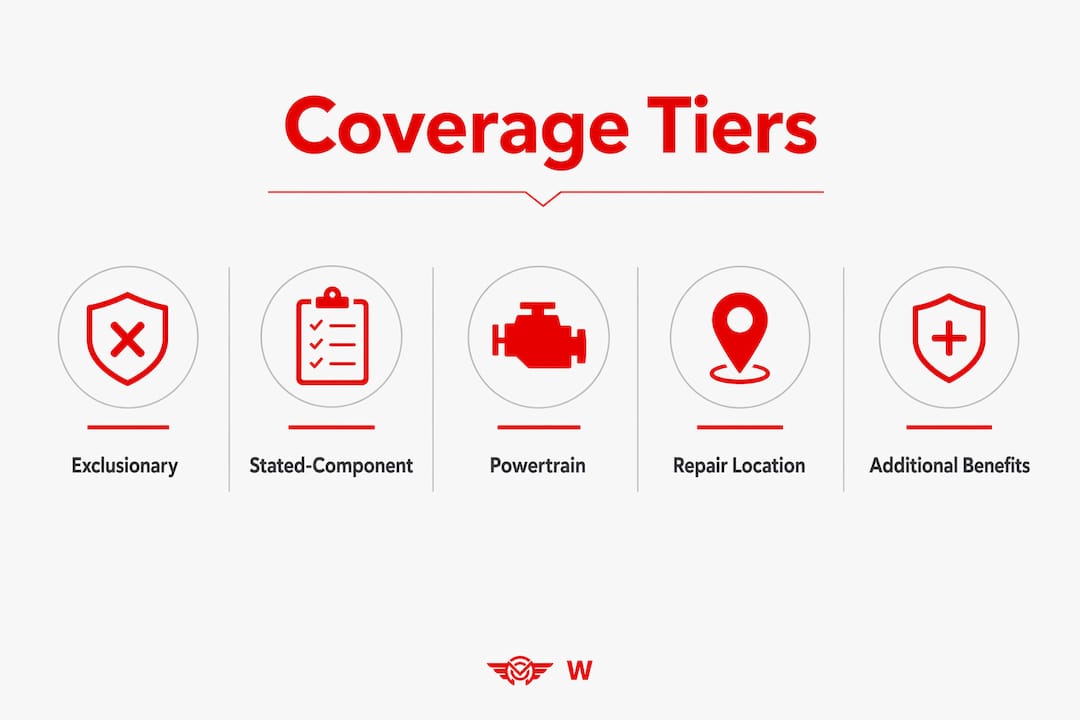
Stated-component / Advanced: Adds cooling systems, electrical components, steering, and suspension to the powertrain base. A practical middle ground for vehicles like the Honda CR-V or Ford F-150 that carry a mix of mechanical and electronic complexity.

Exclusionary / Elite: Covers everything except a listed set of exclusions. This is the closest equivalent to a bumper-to-bumper plan and is the right call for vehicles like a BMW 5 Series, Mercedes-Benz GLE, Range Rover Sport, or Porsche Cayenne, where a single sensor failure can cascade into a $3,000+ diagnostic and repair event. Owners of complex European models often treat exclusionary coverage as a catastrophe hedge precisely because diagnostic and labor costs spike fast.
| Coverage Type | Typical Inclusions | Best For |
|---|---|---|
| Powertrain / Essential | Engine, transmission, drive axles | High-mileage commuters, tight budgets |
| Stated-component / Advanced | Above + cooling, electrical, steering, suspension | Mid-range vehicles, mixed risk profiles |
| Exclusionary / Elite | All components except listed exclusions | Luxury, European, high-performance vehicles |
Bundled perks that commonly come with mid-to-upper tier plans:
- Roadside assistance (towing, flat tire, lockout, fuel delivery)
- Rental car reimbursement during covered repairs
- Trip interruption coverage if a breakdown strands you more than 100 miles from home
- Key-fob replacement
On repair location: many VSCs allow any ASE-certified shop, which matters if you have a trusted independent mechanic. Dealer-only contracts limit your options and sometimes cost more per repair.
How much does vehicle assurance cost?
Price is driven by six variables: vehicle age, mileage, make and model, plan tier, deductible amount, and contract length. A 3-year-old Honda Civic with 35,000 miles will cost significantly less to cover than a 7-year-old Range Rover with 80,000 miles, even at the same plan tier.
Core pricing drivers:
- Vehicle make and model: Luxury and European brands (BMW, Mercedes-Benz, Porsche, Land Rover) carry higher premiums because parts and labor rates are higher
- Deductible: A $100 deductible per visit costs more monthly than a $200 deductible; zero-deductible options exist but push premiums up further
- Term length: Longer terms spread cost but increase total outlay; shorter terms cost less overall but leave you unprotected sooner
- Transferability: Plans that transfer to a new owner at resale typically cost slightly more upfront but can add real value when you sell
Cost context: Major provider bumper-to-bumper VSC pricing typically runs between $100 and $150 per month, though that range shifts considerably based on vehicle type, mileage, and plan level.
To put the math in perspective: engine replacement typically ranges from $3,500 to $9,500 and transmission replacement from $2,500 to $7,500. A single major drivetrain failure can exceed what most owners pay in VSC premiums over a multi-year contract. That cost gap is the core argument for coverage on any vehicle you plan to keep past 100,000 miles.
Monthly financing is available from most providers, but financing a VSC increases total cost. If you can pay upfront, it is almost always cheaper.

How does the claims process work?
The sequence is straightforward when you know it in advance. Surprises usually happen because owners skip a step or lack documentation.
- Contact the administrator as soon as a covered issue appears. Do this before authorizing any repair work.
- Get a diagnostic report from the shop. The administrator needs fault codes, a written diagnosis, and the shop's repair estimate.
- Wait for repair authorization. The administrator reviews the claim and approves or disputes the repair scope. This can take a few hours to a couple of days.
- Confirm parts policy. Ask whether OEM or aftermarket parts are approved. Some plans default to aftermarket; others guarantee OEM on request.
- Repair is completed. The shop performs the authorized work.
- Payment is settled. On a direct-pay plan, the administrator pays the shop directly and you pay only your deductible. On a reimbursement plan, you pay the shop in full and submit receipts for repayment.
- Close out the claim. Keep all repair orders and invoices for your records.
Pro Tip: Confirm that your preferred shop is willing to work with your VSC administrator before you buy the plan. Some independent specialists resist warranty work because administrators may dispute labor hours or require aftermarket parts. A quick phone call to the shop saves a painful surprise later.
One diagnostic reality worth knowing: vehicles with complex CAN-bus electrical architectures, like a Mercedes-Benz C-Class or BMW 3 Series, can produce multiple warning lights from a single failed module. Without factory-level scanning tools, shops sometimes swap parts by trial and error, which multiplies the repair bill. An exclusionary VSC limits your exposure to exactly these diagnostic cascades.
Documentation checklist for a smooth claim:
- Maintenance records (oil changes, fluid services, inspections)
- Diagnostic trouble codes and written shop diagnosis
- Repair orders from previous service visits
- Photos of the issue if visible
- Prior-service invoices showing you met maintenance requirements
What does a VSC not cover?
Every contract has exclusions. The ones that catch owners off guard most often:
- Wear-and-tear items: Brake pads, rotors, tires, wiper blades, and clutch discs are almost universally excluded
- Routine maintenance: Oil changes, filters, coolant flushes, and scheduled services are not covered
- Pre-existing conditions: Damage or deterioration present before the contract's effective date is excluded, which is why some providers require a vehicle inspection
- Modifications: Aftermarket lifts, performance tunes, or non-factory parts can void coverage for related components
- Collision and environmental damage: A VSC is not auto insurance; it does not cover accident damage, flood, hail, or fire
- Cosmetic items: Paint, trim, upholstery, and glass are typically excluded
Limit types to watch for:
- Mileage caps that end coverage at a set odometer reading regardless of contract term
- Per-component dollar caps (e.g., a $1,500 cap on any single electrical component)
- Labor-hour caps that pay only a set number of hours regardless of actual shop time
- Aggregate limits that cap total payouts over the life of the contract
Read this clause type carefully: A contract that covers only "mechanical breakdowns" and excludes "gradual deterioration" can deny a claim on a worn timing chain because the adjuster argues it deteriorated over time rather than broke suddenly. The FTC advises reading every limitation clause before signing and getting answers to coverage questions in writing.
How do you choose the right vehicle service contract?
Start with these five checks before comparing price:
- Underwriter identity and A.M. Best rating. Ask for the underwriter's name. An A- or better rating means the financial backing is solid.
- Direct-pay vs. reimbursement. Direct-pay plans eliminate cash-flow risk. Reimbursement-only contracts can leave you fronting thousands of dollars while waiting for repayment.
- Network flexibility. Can you use any ASE-certified shop, or are you locked into a dealer network?
- Transferability. A transferable contract adds resale value and typically costs a modest transfer fee.
- Deductible structure. Per-visit deductibles are more predictable than per-component deductibles, which can stack on a complex repair.
Questions to ask any seller:
- Who is the underwriter, and what is their A.M. Best rating?
- Do you pay the repair shop directly, or do I pay and get reimbursed?
- Are OEM parts guaranteed, or does the plan default to aftermarket?
- Is there a diagnostic or labor-hour cap?
- What is the transfer fee if I sell the vehicle?
Red flags that should stop you:
- Seller cannot or will not name the underwriter
- Reimbursement-only payment with no direct-pay option
- Vague or missing cancellation and refund language
- High-pressure tactics pushing you to decide before reading the contract
- Unlimited-denial clauses buried in the fine print
How vehicle type changes the recommendation:
- Long-term keeper with moderate mileage (Honda Accord, Ford Fusion): A stated-component Advanced plan covers the most common failure points without the premium of exclusionary coverage.
- High-mileage commuter (150,000+ miles): Powertrain-focused Essential coverage protects against the most expensive failures at the lowest monthly cost.
- Luxury European or high-performance vehicle (BMW X5, Porsche Macan, Range Rover Velar, Mercedes-Benz E-Class): Exclusionary Elite coverage is worth the premium. Diagnostic costs alone on these platforms can exceed $500 before a single part is replaced.
What are the key contract terms to understand before you sign?
Transferability is one of the most undervalued contract features. A transferable VSC can increase a vehicle's resale appeal because the buyer inherits remaining coverage. Transfer fees vary but are typically modest. Confirm the transfer process is simple and documented in the contract.
Cancellation and refunds follow a common pattern across most state-regulated contracts:
- A full refund is usually available within 30–60 days of purchase if no claims have been filed
- After that window, most contracts use a pro-rata refund formula: remaining term divided by total term, multiplied by the original price, minus a cancellation fee
- If you financed the VSC into an auto loan, the refund goes to the lender, not directly to you
Trial guarantees: Confirm the money-back window in writing. Verbal assurances are not enforceable. Ask specifically: "Is the 30-day cancellation policy in the contract, and does it apply even if I've driven the car?"
The underwriter's financial stability matters for long-term contracts. A 5-year plan is only as good as the underwriter backing it. If the underwriter goes insolvent, your contract may be worthless. An A.M. Best rating of A- or higher is a reasonable minimum standard.
Pricing reminder: VSC monthly costs typically run $100–$150 for comprehensive coverage from major providers, but that figure shifts based on vehicle age, mileage, and plan tier. Always get a personalized quote.
Key Takeaways
A vehicle service contract is worth buying when the cost of a single major repair, like an engine or transmission replacement averaging $3,500–$9,500, exceeds what you would pay in premiums over the contract term.
| Point | Details |
|---|---|
| VSC vs. manufacturer warranty | A VSC is a separate, state-regulated service contract, not a federal warranty extension. |
| Most important contract check | Verify the underwriter's A.M. Best rating (A- or higher) and confirm direct-pay claims before signing. |
| Plan tier by vehicle type | Economy commuters fit powertrain coverage; luxury European vehicles (BMW, Mercedes-Benz, Range Rover) need exclusionary plans. |
| Cancellation protection | Most state-regulated contracts offer a 30-day full refund window and pro-rata refunds after that. |
| Rpmwarranty | Offers Elite, Advanced, and Essential tiers with nationwide ASE-certified repair access and a free online quote process. |
When a VSC actually makes sense
The conventional wisdom says extended warranties are a bad deal because statistically most cars don't need major repairs during the coverage window. That framing misses the point. A VSC is not a bet on probability. It is a hedge against a specific financial outcome: a $6,000 repair bill arriving in the same month as a mortgage payment.
For owners who plan to keep a vehicle past 100,000 miles, especially one with a history of expensive component failures, a predictable monthly cost beats an unpredictable catastrophic expense. That calculus gets sharper with luxury and performance vehicles. A Porsche Cayenne's air suspension system, a Range Rover's transfer case, or a BMW's VANOS unit can each generate repair bills that dwarf the cost of an exclusionary plan. One failed module on a Mercedes-Benz with a complex CAN-bus system can trigger a diagnostic chain that costs more than the repair itself.
The one thing a VSC does not replace is maintenance. Skipping oil changes or ignoring service intervals gives an administrator a legitimate reason to deny a claim. A VSC supplements a maintenance routine; it does not substitute for one.
Rpmwarranty covers the vehicles that cost the most to fix
When a BMW 5 Series needs a new transfer case or a Range Rover Sport's air suspension fails, the repair bill rarely comes in under $3,000. Rpmwarranty's protection plans are built for exactly that scenario. The Elite plan covers components exclusionary-style, the Advanced plan adds electrical and suspension to a powertrain base, and the Essential plan keeps costs low for owners who want drivetrain protection without paying for coverage they don't need.
Every plan includes nationwide access to ASE-certified mechanics, direct-pay claims so you never front a large repair bill, roadside assistance, and rental reimbursement. The quote process takes four steps: consultation, plan selection, customization, and agreement. When you call or request a quote online, ask for the sample contract, the underwriter's name and A.M. Best rating, and written confirmation of the direct-pay policy. Get a free quote and know exactly what your vehicle is covered for before the next repair bill arrives.
Where to verify what you read here
These sources are worth consulting directly for regulatory guidance, pricing context, and contract evaluation:
- FTC Consumer Advice on Auto Service Contracts: The authoritative federal resource on your rights, common scams, and what sellers must disclose.
- CFPB on warranties vs. service contracts: Clear breakdown of legal differences and cancellation rights.
- Your state insurance commissioner's website: VSCs are state-regulated; your state's office can confirm whether a provider is licensed and handle dispute complaints.
- A.M. Best (ambest.com): Look up the underwriter's financial strength rating before you commit to any multi-year contract.
- Rpmwarranty free quote page: Enter your vehicle's year, make, model, and mileage to get a personalized plan comparison across Elite, Advanced, and Essential tiers.
This article is general information, not legal or financial advice. Confirm current contract terms, state licensing, and coverage details directly with the provider and your state's insurance commissioner for your specific situation.