

TL;DR:
- Vehicle extended warranty prices vary widely from $600 to $4,600 annually, depending on coverage and vehicle type. Luxury brands and high-tech vehicles cost more to insure, with premiums influenced by age, mileage, and repair history. Adjusting deductibles and contract terms allows owners to manage monthly payments and out-of-pocket costs effectively.
Vehicle extended warranty prices range from approximately $600 to $4,600 per year depending on coverage type, vehicle make, mileage limits, and deductible choices. The industry term for these products is "vehicle service contract," though most owners search for and buy them as extended warranties. Annual costs vary widely, with monthly premiums running anywhere from $40 to over $100. Knowing what drives those numbers puts you in control before you sign anything. This guide breaks down every pricing factor so you can match the right plan to your vehicle, your budget, and your risk tolerance.
What are the main types of extended warranty coverage and their typical price ranges?
Coverage level is the single biggest driver of what you pay. Three tiers define the market, and each one protects a different set of components.

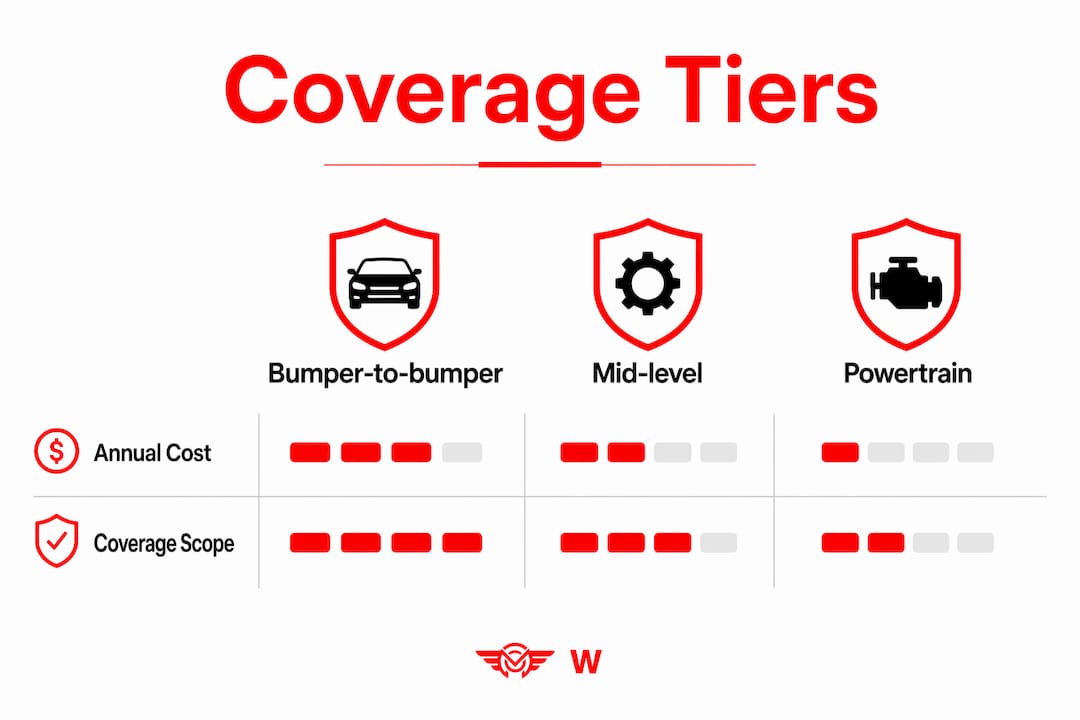
Bumper-to-bumper plans cover nearly every mechanical and electrical component in the vehicle. They mirror the factory warranty in scope and carry the highest price tag. Bumper-to-bumper plans typically cost between $1,700 and $4,600 per year. That range reflects the difference between a standard sedan and a luxury vehicle loaded with advanced driver-assistance systems.
Mid-level plans sit between bumper-to-bumper and powertrain coverage. They protect major systems like the engine, transmission, electrical components, and cooling system, but exclude wear items and some electronics. Pricing for mid-level plans generally falls between $1,500 and $2,500 per year. This tier suits owners who want meaningful protection without paying for coverage they are unlikely to use.
Powertrain plans cover the engine, transmission, and drivetrain only. Powertrain plans commonly range from $600 to $750 per year. That low price reflects the narrower scope. A powertrain plan will not cover your air conditioning, infotainment system, or suspension components.
| Coverage tier | Typical annual cost | What it covers |
|---|---|---|
| Bumper-to-bumper | $1,700–$4,600 | Nearly all mechanical and electrical parts |
| Mid-level | $1,500–$2,500 | Major systems: engine, transmission, electrical, cooling |
| Powertrain | $600–$750 | Engine, transmission, drivetrain only |
Higher-end vehicles push prices toward the top of every range. A BMW 5 Series or Mercedes-Benz E-Class carries more sophisticated components than a Ford F-150, and repair labor rates at authorized dealerships are significantly higher. That cost difference flows directly into warranty pricing. Rpmwarranty offers three named tiers, Elite, Advanced, and Essential, that map closely to these three market categories, giving owners a clear starting point when comparing auto extended warranty quotes.
How do vehicle make, model, age, and mileage affect extended warranty prices?
Your vehicle's identity shapes its warranty price more than most owners expect. Two cars with identical mileage can carry very different premiums based on brand alone.
Luxury and performance brands command higher premiums. BMW, Mercedes-Benz, Porsche, and Range Rover all use proprietary electronics, air suspension systems, and turbocharged powertrains that cost significantly more to repair than mainstream components. A Porsche Cayenne's air suspension repair, for example, can exceed $2,000 at a dealership. Luxury vehicle warranty plans carry the highest per-month prices in the market. That premium is not arbitrary. It reflects real repair cost data.
Age and mileage raise prices and restrict options. Younger cars with lower mileage generally incur lower warranty prices. An average extended warranty costs about $90 per month, but that figure climbs as a vehicle ages and accumulates miles. Providers view older, higher-mileage vehicles as higher-risk, so they charge more or limit the coverage they will offer.
Key vehicle factors that affect your extended car warranty quote:
- Make and model: Luxury brands and vehicles with complex electronics cost more to insure against repairs.
- Vehicle age: Older vehicles face higher premiums and sometimes coverage caps.
- Current mileage: Higher odometer readings push prices up and may disqualify certain plans.
- Repair history: Some providers review service records before finalizing pricing.
- Technology level: Vehicles with advanced driver-assistance systems, electric powertrains, or air suspension carry higher repair costs and higher warranty prices.
Honda Accord and Ford Escape owners typically pay toward the lower end of the pricing spectrum. Mercedes-Benz GLE, BMW X5, and Range Rover Sport owners should expect to pay toward the top. Porsche owners, particularly those with Porsche Active Suspension Management, often face the steepest premiums of all. Understanding where your vehicle sits in that spectrum helps you set realistic expectations before you request an extended auto warranty quote.
Pro Tip: Pull your vehicle's repair history from a service like Carfax before requesting quotes. Providers may ask for it, and knowing your history in advance helps you anticipate where your pricing will land.
What role do deductibles and contract terms play in vehicle extended warranty pricing?
Deductibles and contract length are the two levers you control most directly. Adjusting either one changes both your monthly payment and your total out-of-pocket exposure.
How deductibles work
A deductible is the amount you pay per repair visit before the warranty covers the rest. Deductibles commonly range from $100 to $250 or more per repair event. Choosing a $250 deductible instead of $100 lowers your monthly premium, but it increases what you pay each time you file a claim. That tradeoff matters most if you drive a vehicle with a history of frequent smaller repairs.
Paying a higher deductible reduces your monthly premium but raises your costs during actual repairs. The math works in your favor only if you file claims infrequently. For a BMW 3 Series owner who expects to visit the dealership once a year, a higher deductible makes sense. For a Range Rover owner whose air suspension or transfer case may need attention multiple times, a lower deductible often saves money overall.
How contract terms affect total cost
- Contract length: Most plans run 12 to 60 months. Longer contracts spread the total cost over more payments, lowering the monthly figure, but they also commit you to a provider for years.
- Mileage caps: Many plans cover 60 months or 100,000 miles, whichever comes first. If you hit 100,000 miles in 36 months, your coverage ends early even though you paid for 60 months.
- Coverage start point: Some contracts begin at the purchase date; others begin after the factory warranty expires. The start point changes when you actually benefit from the plan.
- Cancellation terms: Early cancellation often triggers a penalty fee or a prorated refund that does not fully recover your payments.
Pro Tip: Calculate your average monthly mileage before signing any contract. Divide your current odometer reading by the vehicle's age in months. That number tells you exactly when a mileage-capped plan will expire, so you can choose a contract that actually covers the period you need.
How to budget for an extended vehicle warranty
Budgeting for a warranty means comparing the monthly cost against the realistic financial risk of going without one. The numbers favor coverage more often than most owners assume.
Over half of Americans (54%) lack the emergency savings to cover a $2,000 vehicle repair. That statistic reframes the warranty decision entirely. A $90 monthly premium is a predictable, manageable expense. A $2,500 transmission replacement on a Mercedes-Benz C-Class is not.
"Extended warranties function as a budgeting tool. They convert an unpredictable, potentially large expense into a fixed monthly cost that fits inside a household budget."
Payment structures vary and affect how you plan:
- Monthly payments: Most providers offer monthly billing, making coverage accessible without a large upfront cost. Monthly payments typically run $40–$100+ depending on coverage tier and vehicle.
- Lump sum payments: Paying the full contract cost upfront often reduces the total price. Providers sometimes offer discounts for full payment at signing.
- Down payment plus monthly: Some contracts require a down payment of $100–$300 followed by monthly installments. This structure lowers the ongoing monthly cost.
The self-insurance argument, setting aside the monthly warranty cost in a savings account instead, works only if you have the discipline to save consistently and the luck to avoid a major repair before the fund grows. A Porsche Macan owner who skips coverage and faces a $3,800 PDK transmission service in year two has not saved enough to cover it. For owners of Ford F-150s or Honda CR-Vs with strong reliability records, self-insurance is a more defensible strategy. For luxury and performance vehicle owners, the math almost always favors coverage.
What are common hidden costs in extended warranty contracts?
The advertised price of a warranty plan is rarely the full story. Several contract details can increase your real cost well beyond the monthly premium.
Extended warranties often carry hidden costs, including fees for unauthorized repairs and charges for non-covered components. These fees surface at the worst possible time, when your vehicle is already in the shop and you are expecting coverage to kick in.
Watch for these specific contract details:
- Exclusions list: Every contract lists what it does not cover. Wear items like brake pads and tires are standard exclusions, but some contracts also exclude specific sensors, software updates, and aftermarket parts.
- Authorized repair network: Some plans require you to use a specific network of repair shops. Taking your BMW to an independent mechanic instead of an authorized facility can void a claim entirely.
- Claim processing delays: Contracts that require pre-authorization before repairs can delay service. If a provider takes 48 hours to approve a claim, your vehicle sits in the shop at your expense.
- Per-mile overage fees: Contracts with mileage caps sometimes charge a fee if you exceed the limit rather than simply ending coverage.
- Early cancellation penalties: Canceling a 48-month contract after 12 months rarely returns 75% of your money. Read the cancellation clause before signing.
Pro Tip: Ask the provider to walk you through a sample claim scenario before you buy. A trustworthy provider will explain exactly what happens from the moment you call to the moment your car is repaired. Vague answers at this stage are a warning sign.
The fine print also determines whether your coverage transfers if you sell the vehicle. Transferable warranties add resale value to a Mercedes-Benz GLE or a BMW X7. Non-transferable contracts disappear the moment ownership changes hands.
Key Takeaways
Vehicle extended warranty prices depend on coverage tier, vehicle make, mileage limits, and deductible choices, with annual costs ranging from $600 for basic powertrain plans to $4,600 for bumper-to-bumper coverage on luxury vehicles.
| Point | Details |
|---|---|
| Coverage tier drives base price | Powertrain plans start at $600/year; bumper-to-bumper plans reach $4,600/year. |
| Luxury brands cost more to cover | BMW, Mercedes-Benz, Porsche, and Range Rover carry higher premiums due to repair costs. |
| Deductible choice affects total cost | A higher deductible lowers monthly payments but raises out-of-pocket costs per claim. |
| Mileage caps can end coverage early | Calculate your monthly mileage before signing to avoid paying for unused coverage. |
| Hidden fees increase real cost | Unauthorized repair fees, cancellation penalties, and exclusions raise total ownership cost. |
Why I think most owners underestimate the value of getting this right
People spend hours comparing trim levels on a new BMW X5 or a Mercedes-Benz GLE and then spend 10 minutes on the warranty decision. That imbalance costs them money.
The deductible choice is where I see the most avoidable mistakes. Owners pick the highest deductible to get the lowest monthly payment, then feel the pain when they file three claims in a single year. On a Range Rover Sport, three separate repair visits at a $250 deductible each adds $750 in out-of-pocket costs that a $100 deductible would have reduced to $300. The monthly savings rarely justify that exposure on a vehicle with a complex air suspension or a turbocharged V8.
The mileage estimation piece is equally underappreciated. I have seen owners buy a 100,000-mile plan on a vehicle they drive 18,000 miles per year, only to exhaust the mileage cap in under five years on a 60-month contract. Doing the math takes five minutes and can save hundreds of dollars by choosing the right contract length upfront.
My honest advice: match your coverage tier to your vehicle's repair profile, not just its sticker price. A Ford F-150 with a naturally aspirated V8 and 40,000 miles is a different risk than a BMW 7 Series with a twin-turbocharged engine and 60,000 miles. Both owners deserve coverage, but they need different plans. Getting an extended warranty quote online costs nothing and gives you a real number to work with before you commit to anything.
— Kenneth
Rpmwarranty: extended warranty plans built for real vehicles
Rpmwarranty provides nationwide extended warranty coverage for a wide range of vehicles, from everyday Ford and Honda models to premium brands like BMW, Mercedes-Benz, Porsche, and Range Rover. Plans are structured across three tiers, Elite, Advanced, and Essential, so you can match coverage depth to your budget and your vehicle's specific repair risk.
Getting started takes minutes. Rpmwarranty's four-step process covers consultation, plan selection, customization, and final agreement, with no pressure and no guesswork on pricing. Coverage includes engines, transmissions, cooling systems, electrical systems, and high-tech components, plus roadside assistance. Get your free warranty quote today and see exactly what coverage for your vehicle costs before you decide anything.
FAQ
What is the average cost of a vehicle extended warranty?
Extended warranty costs average about $90 per month, though annual totals range from $600 for basic powertrain coverage to $4,600 for bumper-to-bumper plans on luxury vehicles.
Does the vehicle make affect extended warranty pricing?
Yes. Luxury brands like BMW, Mercedes-Benz, Porsche, and Range Rover carry higher warranty prices because their components cost more to repair and require specialized labor at authorized dealerships.
How do mileage limits work in extended warranty contracts?
Many contracts cap coverage at 60 months or 100,000 miles, whichever comes first. Owners who drive more than average can exhaust their mileage limit years before the contract's time limit expires.
Is a higher deductible always the better choice?
Not always. A higher deductible lowers your monthly premium but increases what you pay per repair visit. Owners of vehicles prone to multiple repairs per year often save more overall with a lower deductible.
Can I get an extended warranty quote online without committing?
Yes. Providers like Rpmwarranty offer free online quotes based on your vehicle's year, make, model, and mileage, with no obligation to purchase. Getting multiple quotes is the fastest way to compare real pricing for your specific vehicle.