

TL;DR:
- A vehicle service contract is a legally binding agreement that covers repairs and maintenance costs beyond the manufacturer's warranty. These contracts are governed by state law and fully negotiable, unlike manufacturer warranties, which are included in the purchase price. Reading the exclusions, dispute resolution clauses, and keeping detailed records are essential for effective management and protection.
A service contract is a formal, legally binding agreement that defines the specific repairs, maintenance services, and protections a vehicle owner receives beyond the manufacturer's original warranty. Unlike a standard product warranty, a service contract is governed by state common law rather than the Uniform Commercial Code, which means the terms must be written with greater precision to hold up in court. Vehicle owners who drive BMW, Mercedes-Benz, Porsche, Range Rover, Honda, or Ford face repair bills that can reach thousands of dollars when major components fail. A well-structured service agreement transfers that financial risk away from you and onto the coverage provider.
What is a service contract for a vehicle?
A vehicle service contract is a written agreement that specifies which components are covered, which are excluded, how claims are filed, and what you pay out of pocket. The industry also uses the terms "extended warranty" and "vehicle protection plan," but these describe the same core product: a contract for services that kicks in when your factory warranty expires or runs out.

Service contracts differ from manufacturer warranties in one critical way. A manufacturer warranty is a promise bundled into the purchase price. A service contract is a separate financial product you buy, and its terms are fully negotiable before you sign. That distinction matters because service contracts are governed by common law, not the UCC, which demands higher specificity in every clause.
State consumer protection statutes add another layer. Arizona's ARS §20-1095.06, for example, sets disclosure and licensing requirements for vehicle service contract providers. Most states have similar rules. Knowing your state's framework tells you what a provider must disclose before you sign.
The core elements every vehicle service contract must include are: a clear scope of covered components, the contract term and mileage limits, the deductible amount per claim, exclusions and limitations, and the dispute resolution process. Missing any one of these creates ambiguity that almost always favors the provider, not you.
What coverage options are typically included?
Vehicle service contracts cover a wide range of components, but the exact list varies by plan tier. Entry-level plans typically cover the powertrain: engine, transmission, and drive axles. Mid-tier plans add cooling systems, fuel systems, and electrical components. Top-tier plans extend to turbochargers, advanced driver assistance systems, and infotainment hardware.
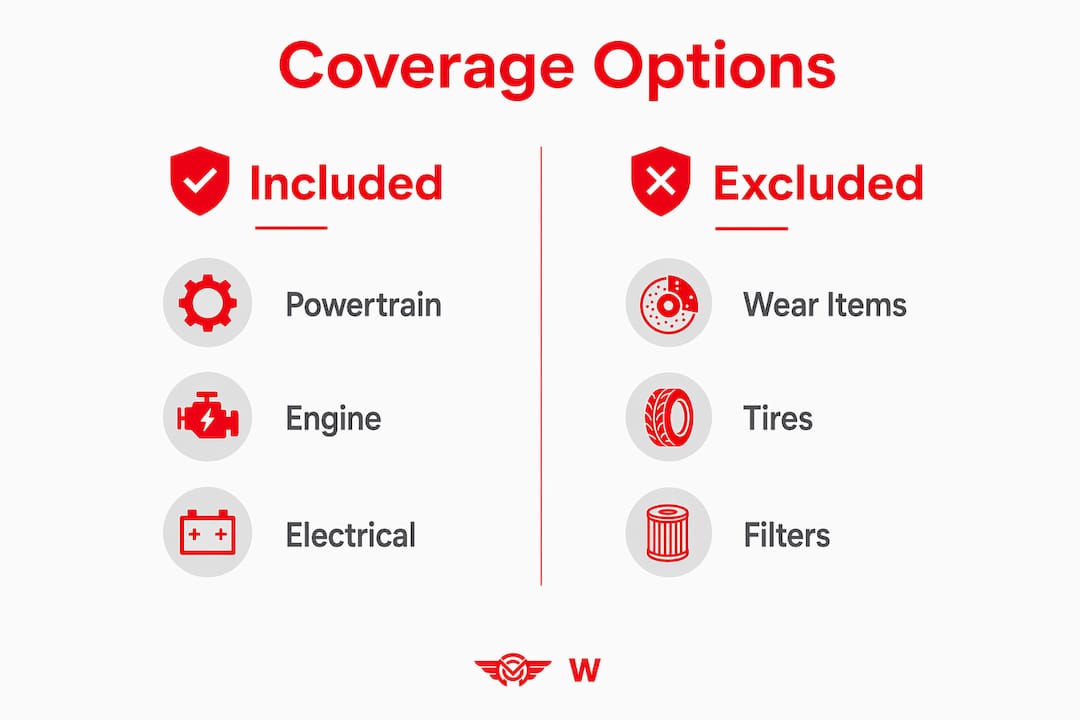
For owners of vehicles like the BMW 5 Series or Mercedes-Benz E-Class, electrical and electronic coverage is not optional. These vehicles carry complex control modules, air suspension systems, and proprietary software that cost far more to repair than a standard engine component. A service agreement that excludes electronics leaves you exposed to your largest repair risks.
Common covered components across most plans include:
- Engine internals: pistons, crankshaft, camshaft, and seals
- Transmission: gears, torque converter, and valve body
- Cooling system: water pump, radiator, and thermostat housing
- Electrical system: alternator, starter motor, and wiring harnesses
- High-tech parts: navigation modules, backup camera systems, and sensor arrays
Typical exclusions are equally important to understand. Wear items such as brake pads, tires, wiper blades, and filters are almost never covered. Pre-existing conditions and damage from neglected maintenance are also standard exclusions. Porsche and Range Rover owners should pay close attention to air suspension exclusions, since those systems are expensive and frequently excluded in basic plans.
Multi-unit discounts of 10% are common when contracting for multiple vehicles at the same location. That figure matters for fleet owners or households with two or more vehicles on a single plan. Member benefits in stronger plans often include priority scheduling, waived diagnostic fees, and parts and labor discounts that reduce your total cost of ownership over time.
Pro Tip: Ask the provider for a sample contract before you pay anything. Read the exclusions section first, not the benefits section. The exclusions tell you what the contract actually does.
How do service contracts structure pricing and renewals?
Service contract pricing follows two main structures: a fixed annual fee paid upfront or in installments, and a pay-per-service model where you pay a set amount each time you use the contract. Fixed annual fees give you predictable costs. Pay-per-service models work better if your vehicle is newer and unlikely to need frequent repairs.
Payment terms in most contracts follow this standard structure:
- Upfront payment or financing. Many providers offer monthly payment plans, often with a small interest charge built in.
- Deductible per claim. You pay a set amount ($100 to $200 is typical) each time you file a claim.
- Late payment fees. Standard contracts impose 1.5% per month on overdue balances. That rate compounds quickly if you miss a payment.
- Auto-renewal terms. Most maintenance contracts renew automatically unless you cancel in writing at least 30 days before the renewal date.
- Cancellation refunds. Many contracts offer a prorated refund if you cancel early, minus an administrative fee.
Auto-renewal is the clause vehicle owners most often overlook. Renewal notices are typically sent at least 45 days before the contract expires. If you do not respond within the cancellation window, the contract renews and you owe another full year's fee.
| Pricing Element | Typical Terms |
|---|---|
| Annual fixed fee | Paid upfront or in monthly installments |
| Deductible per claim | $100–$200 per repair visit |
| Late payment fee | 1.5% per month on overdue balance |
| Cancellation notice | 30 days written notice before renewal date |
| Prorated refund | Available on early cancellation, minus admin fee |
Pro Tip: Set a calendar reminder 60 days before your contract renewal date. That gives you time to compare options and cancel in writing if needed, without missing the 30-day window.
What legal considerations should vehicle owners understand?
Service contracts carry real legal weight, and understanding the framework protects you from costly surprises. Service contracts are legally binding when they meet four requirements: offer, acceptance, consideration, and mutual intent. Most states do not require notarization, but automotive service contracts often carry additional licensing and disclosure requirements under state insurance or consumer protection law.
The Statute of Frauds is the most important legal rule to know. Written contracts are required when the service term extends beyond one year. An oral agreement for a three-year vehicle protection plan is unenforceable in court. Get everything in writing, every time.
The scope of work clause is the most critical section of any service contract. Vague language about what is "covered" creates disputes. Specific task outlines, listed components, and defined service frequencies reduce litigation risk significantly. A contract that says "engine coverage" without listing covered parts is an invitation to a denied claim.
Key legal clauses to review before signing any vehicle service agreement:
- Scope of work. Vague language leads to disputes; specific component lists and service frequencies protect you.
- Force majeure. This clause excuses the provider from performance during events outside their control, such as natural disasters or supply chain failures.
- Severability. If one clause is found unenforceable, the rest of the contract remains valid.
- Entire agreement clause. Boilerplate clauses like this nullify any verbal promises made during the sales process. What is written is what counts.
- Liability limits. Most contracts cap the provider's total payout at the vehicle's actual cash value or a fixed dollar amount.
- Dispute resolution. Arbitration or mediation requirements before court action are standard. They reduce litigation costs but also limit your options if a dispute escalates.
Dispute resolution clauses deserve special attention. Consumers often overlook these clauses entirely, focusing instead on coverage lists. A contract that requires binding arbitration in a distant state effectively makes it impractical to challenge a denied claim. Read the jurisdiction and venue clauses carefully before you sign.
Honda and Ford owners dealing with standard repair disputes rarely need to escalate to court. But BMW, Porsche, and Range Rover owners facing denied claims on $8,000 air suspension repairs or $12,000 engine replacements have far more at stake. The dispute resolution clause determines how you fight back.
How can vehicle owners select and manage service contracts effectively?
Selecting the right vehicle service contract starts with an honest assessment of your vehicle's age, mileage, and known failure points. A 2019 Range Rover Sport with 60,000 miles carries very different risks than a 2022 Honda Civic with 25,000 miles. Match the coverage tier to the actual risk profile of your specific vehicle.
Before you sign any contract for services, work through this checklist:
- Confirm the contract is written and signed by both parties.
- Verify the provider is licensed in your state to sell vehicle service contracts.
- Read the exclusions list in full, not just the covered components list.
- Check whether the contract covers original equipment manufacturer (OEM) parts or only aftermarket parts.
- Confirm which repair shops are authorized. Some contracts restrict you to a specific dealer network.
- Ask whether roadside assistance is included or sold separately.
- Clarify the claims process: who you call, how long approval takes, and whether you pay upfront and get reimbursed.
Documentation is the most underrated part of managing a service contract. Keep every service record, oil change receipt, and repair invoice. Providers can deny claims if they suspect maintenance neglect, and your records are the only defense. Mercedes-Benz and BMW owners especially need to document fluid changes and software updates, since these vehicles have strict maintenance schedules that providers use to evaluate claims.
Pro Tip: Take photos of your vehicle's odometer and condition at the start of every contract term. If a dispute arises over a pre-existing condition, dated photos are powerful evidence.
Common misunderstandings cost vehicle owners money every year. Many owners assume "bumper-to-bumper" coverage means everything is covered. It does not. Wear items, cosmetic damage, and components damaged by neglect are excluded in virtually every plan. Read the definition of "mechanical breakdown" in your contract. That definition controls what qualifies for a claim.
Key Takeaways
A vehicle service contract is only as strong as its written terms, and reading the exclusions, dispute resolution, and renewal clauses before signing is the single most effective way to protect your investment.
| Point | Details |
|---|---|
| Written contracts are required | Any service term over one year must be in writing to be legally enforceable. |
| Exclusions define real coverage | Read the exclusions list first; it reveals what the contract actually covers. |
| Auto-renewal catches owners off guard | Cancel in writing at least 30 days before renewal to avoid automatic charges. |
| Dispute resolution affects your options | Binding arbitration clauses limit how and where you can challenge a denied claim. |
| Documentation protects your claims | Keep all maintenance records to prevent denials based on alleged neglect. |
Why I think most vehicle owners sign service contracts the wrong way
The most common mistake I see is vehicle owners buying a service contract based on the benefits summary, not the contract document itself. Sales materials highlight what is covered. The actual contract defines what is not covered, and those two documents rarely tell the same story.
I have reviewed contracts for Porsche Cayenne and BMW X5 owners where the word "electronic" appeared in the benefits summary but the actual contract excluded "software, firmware, and control modules." Those are the most expensive components on both vehicles. The gap between the marketing language and the legal language was enormous.
My honest advice: treat the exclusions list as the real product description. If a provider cannot give you the full contract document before you pay, that is a red flag. Reputable providers give you the contract upfront because they stand behind what is written in it.
Negotiating terms is also more possible than most owners realize. Deductible amounts, covered shop networks, and even specific component inclusions can sometimes be adjusted before signing. Ask. The worst answer is no, and the best answer saves you thousands.
— Kenneth
Extended warranty options worth knowing about
Vehicle owners who have read this far understand what a service contract should contain. The next step is finding a provider whose written terms match their coverage promises.
Rpmwarranty offers extended vehicle warranty plans built around transparency and specific coverage tiers. The Elite, Advanced, and Essential plans cover engines, transmissions, cooling systems, electrical systems, and high-tech components across a wide range of vehicles, including BMW, Mercedes-Benz, Porsche, Range Rover, Honda, and Ford. Coverage is accepted at authorized repair shops nationwide, and the claims process is straightforward. Vehicle owners can request a free quote based on their vehicle's year, make, and model, or review common warranty questions before committing to a plan.
FAQ
What is a service contract for a vehicle?
A vehicle service contract is a written agreement that covers the cost of specific repairs and maintenance after the manufacturer's warranty expires. It is a separate financial product, not a manufacturer promise, and its terms are governed by state contract law.
Is a vehicle service contract the same as an extended warranty?
The terms are used interchangeably in the automotive industry, but technically a service contract is a separate purchase while a warranty is included with the vehicle. Both serve the same function: covering repair costs beyond the factory coverage period.
What does a vehicle service contract typically exclude?
Most contracts exclude wear items like brake pads, tires, and filters, as well as pre-existing conditions and damage caused by neglected maintenance. Luxury vehicle owners should check specifically for exclusions on air suspension, software, and control modules.
Can I cancel a vehicle service contract after signing?
Most contracts allow cancellation with a prorated refund, minus an administrative fee. You must provide written notice, typically at least 30 days before the renewal date, to avoid being charged for another term.
Are verbal promises from a service contract salesperson legally binding?
No. The entire agreement clause in most service contracts states that the written document is the only binding agreement. Verbal promises are nullified by this clause, which is why reading the full contract before signing is the only way to know what you are actually buying.