

Most extended vehicle warranties exclude mechanical or electrical problems that existed before the contract's effective date, and providers enforce that exclusion using OBD-II diagnostic logs, service records, and inspection reports. Coverage for a pre-existing issue is possible only when a contract or a documented inspection specifically states otherwise. If a fault shows up early and you can't prove when it started, expect a denial letter, not a repair check.
TL;DR:
- Most extended warranties exclude pre-existing mechanical or electrical issues unless explicitly documented before coverage begins with a dated inspection or service record.
- Diagnostic trouble codes, repair invoices, physical inspections, and vehicle history reports are used by providers to detect pre-existing conditions, often leading to claim denials within the first 30 days or 1,000 miles.
- Building a comprehensive paper trail before purchasing coverage, including pre-purchase inspections and timely maintenance records, significantly reduces the risk of claim denial due to pre-existing issues.
- Claim denials are often based on specific contractual exclusions or burden-of-proof clauses, making it crucial to review and document the exclusion schedule thoroughly before signing.
- Choosing providers that incorporate inspection and documentation review into their quoting process, like Rpmwarranty, improves the chances of a claim being paid if a pre-existing fault arises.
Table of Contents
- What Does "Pre-Existing Condition" Mean in an Extended Warranty?
- How Do Providers Detect Pre-Existing Conditions?
- What Waiting Periods and Contract Clauses Should You Watch For?
- How Can You Avoid a Pre-Existing Condition Denial Before You Buy Coverage?
- What Should You Do If a Claim Is Denied as Pre-Existing?
- How RPM Warranty Handles Pre-Existing Condition Concerns
- Do New and Used Vehicles Get Different Pre-Existing Condition Treatment?
- What Legal Protections Exist If Your Claim Is Denied?
- How Do Manufacturer, Extended, and Third-Party Warranties Differ Here?
- Get a Warranty Quote That Accounts for Your Vehicle's Real Condition
- Balancing Risk, Cost, and Documentation When Buying Coverage
- Sources
What Does "Pre-Existing Condition" Mean in an Extended Warranty?
A pre-existing condition, in warranty language, is a fault that existed, or can reasonably be shown to have existed, before your coverage's start date. That's close to the standard legal definition of a pre-existing fault, and it's the phrase you'll find buried in most service contracts.
Watch for the words "known or unknown." Providers add that phrase so it doesn't matter whether you knew about the transmission slip or the oil leak when you signed up. If the fault predates the policy, it's excluded, period, regardless of your intent.
Real examples make this concrete:
- A BMW with a persistent oil leak from a valve cover gasket that started weeping before the policy's effective date.
- A Range Rover with an air suspension fault that intermittently threw a warning light before coverage began.
- A Mercedes with an electrical short in a control module that predates the contract but wasn't diagnosed until after enrollment.
Higher-end vehicles are especially prone to these disputes because their electronics and air suspension systems mask symptoms until a diagnostic scan catches them. That's exactly why documentation matters more on a Porsche or Range Rover than on a basic commuter car.
How Do Providers Detect Pre-Existing Conditions?
Warranty administrators don't guess. They build a timeline, then match it against your coverage start date. If the fault traces back earlier, they deny it.
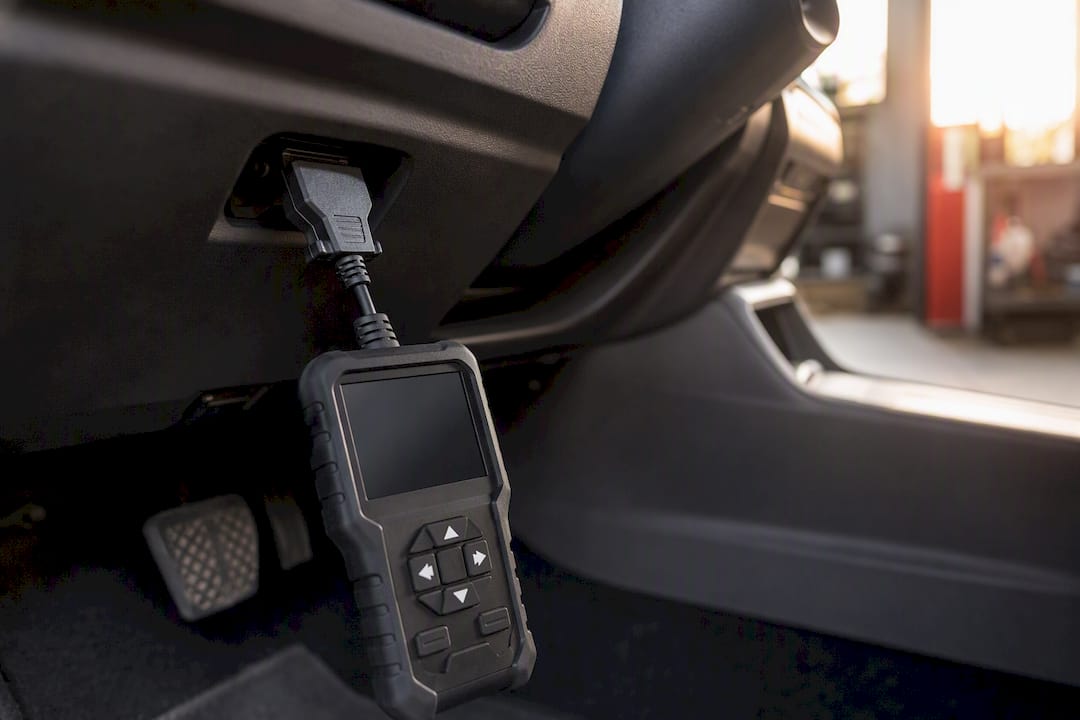
- OBD-II trouble codes and stored timestamps. Every modern vehicle logs when a diagnostic trouble code first triggered. If that timestamp predates your policy, the provider treats it as evidence the problem existed first.
- Service history and repair invoices. A prior mechanic's note about a "rough shift" three months before you bought coverage becomes proof the transmission issue isn't new.
- Physical inspection findings. Metal shavings in transmission fluid, contaminated coolant, or abnormal wear patterns tell a trained inspector how long a problem has been developing.
- Vehicle history reports. These cross-reference odometer readings and prior claims to build a fuller picture of the car's mechanical past.
Industry practice treats early failures with suspicion. Coverage denials cluster around the first 30 days or 1,000 miles of a policy, because providers presume anything that fails that fast was already broken. That presumption is rebuttable, but only with paperwork that predates or contradicts it.
Pro Tip: Ask your mechanic for a printed OBD-II scan report, with date and mileage, every time you have service done. That single habit creates a paper trail that can save a claim later.
What Waiting Periods and Contract Clauses Should You Watch For?
Every extended warranty has a waiting period, and most owners never read the specific terms until they're filing a claim. That's a mistake.
- Time and mileage thresholds. A common structure requires 30 days and 1,000 miles before coverage activates, during which any failure is presumed pre-existing.
- Pre-coverage inspection requirements. Some providers require a physical inspection before the policy starts, documenting mileage, fluid condition, and warning lights present at signing.
- Exclusion schedules versus blanket denials. A well-drafted contract lists a specific known issue as excluded while covering everything else. A poorly drafted one can be used to deny an entire claim over one unrelated symptom.
- Burden-of-proof clauses. Many contracts place the responsibility on you, the owner, to prove a failure happened after the effective date, not on the provider to prove it happened before.
That last point is the one buyers underestimate most. If the contract shifts the burden to you, your defense is documentation you gathered before the dispute started, not anything you can produce after a denial letter arrives.
Pro Tip: Read the exclusion schedule line by line before signing. If it lists a component vaguely ("suspension system") rather than a specific part ("front left air strut"), ask the provider to narrow it in writing.
How Can You Avoid a Pre-Existing Condition Denial Before You Buy Coverage?
The strongest defense against a denial is a paper trail that exists before you ever file a claim. Build it in this order:
- Get an independent pre-purchase inspection that specifically tests the engine, transmission, electrical system, cooling system, and, for hybrids, the battery pack. Request a dated written report, not a verbal summary.
- Collect maintenance records and receipts. Ask for OBD-II code printouts from your last several service visits if the shop kept them.
- Time your coverage start date carefully. Avoid gaps between a manufacturer warranty's expiration and your extended plan's effective date. Overlap is fine; a lapse is not.
- Push for pre-sale fixes. If an inspection flags a problem, ask the seller to repair it before you finalize the purchase, and get that repair documented.
- Log test-drive symptoms. Note any warning light, odd noise, or hesitation, with the date and mileage, even if it seems minor.
| Step | What It Protects Against |
|---|---|
| Pre-purchase inspection report | Disputes over what condition the vehicle was in at signing |
| Maintenance receipts and OBD-II printouts | Claims that a fault predates coverage |
| Careful effective-date timing | Coverage gaps that create ambiguity |
| Test-drive symptom log | "You knew about this" denial arguments |
What Should You Do If a Claim Is Denied as Pre-Existing?
A denial letter will usually cite a specific clause, often the pre-existing fault definition or an exclusion schedule item. Read that clause first; your appeal has to respond directly to it, not to the claim in general.
- Request the specific reasoning. Ask the provider to identify exactly what evidence, an OBD-II timestamp, a service note, an inspection finding, led to the denial.
- Submit contradicting evidence. A pre-coverage inspection report showing the component was sound, a maintenance receipt with a later date, or an independent mechanic's opinion can all shift the timeline.
- Request a reinspection if you believe the original assessment misread physical evidence like fluid contamination or wear.
- Escalate if needed. If the internal appeal fails, state insurance and consumer protection offices handle complaints about service contract denials, and an attorney becomes worth consulting once the repair cost is significant.
Appeals that succeed almost always hinge on new documentation, not on arguing the provider's judgment. Expect the process to take a few weeks at minimum, longer if it escalates.
How RPM Warranty Handles Pre-Existing Condition Concerns
Rpmwarranty structures its Elite, Advanced, and Essential plans around specific vehicle systems, engine, transmission, electrical, cooling, and high-tech components, rather than vague catch-all language. That specificity matters because it narrows what "pre-existing" can even mean for your contract.
The quote process runs through four steps: consultation, plan selection, customization, and final agreement. During consultation, Rpmwarranty can factor in a pre-purchase inspection report or documented maintenance history, which lets known issues get scheduled as specific exclusions instead of triggering a broader denial down the line.
- Submitting an inspection report during quoting helps limit exclusions to the actual documented problem, not the whole vehicle.
- Customization by year, make, and model means a Porsche or Range Rover owner isn't stuck with generic terms written for a basic sedan.
- Roadside assistance and rental reimbursement apply regardless of the exclusion schedule, so a documented pre-existing issue doesn't strip away every other benefit.
Pro Tip: If your vehicle has a known quirk, an aging BMW iDrive module, a Range Rover suspension sensor that occasionally flickers, disclose it and ask for it to be listed as a narrow, specific exclusion rather than leaving the contract vague.
Do New and Used Vehicles Get Different Pre-Existing Condition Treatment?
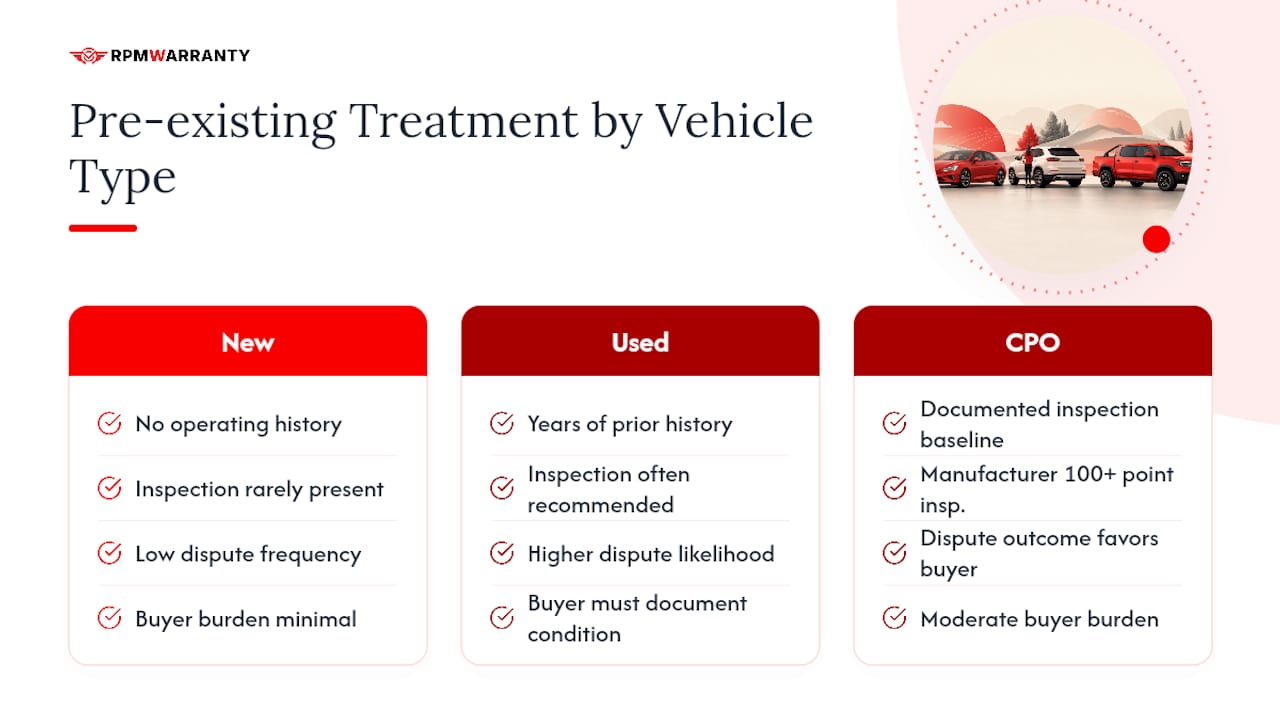
Yes, and the difference comes down to how much history exists to scrutinize. A new vehicle has essentially no operating history, so there's little for a provider to point to as evidence of a pre-existing fault. Coverage disputes on new cars are rare, mostly limited to a defect present at the factory that shows up almost immediately.
Used vehicles carry more risk on both sides. A Honda with 60,000 miles has years of prior ownership, prior repairs, and prior symptoms that a provider can investigate. That's why used-vehicle warranty applications often come with, or strongly recommend, a pre-purchase inspection. Some providers require one before binding coverage on higher-mileage vehicles specifically because the pre-existing condition risk is so much higher.
Certified pre-owned programs sit in between. A manufacturer-backed CPO inspection, often 100 or more points, creates a documented baseline at the point of sale. If you later buy an extended warranty on a CPO Mercedes or Ford, that inspection record can work in your favor during a dispute, because it establishes what condition the vehicle was in before your extended coverage even started.
The practical takeaway: the older and higher-mileage the vehicle, the more the burden shifts onto you to document its condition at the moment your coverage began. A used vehicle without any inspection paperwork is the weakest position a buyer can be in in the event of a dispute.
What Legal Protections Exist If Your Claim Is Denied?
Extended warranties and service contracts are private agreements, not manufacturer warranties, which means the protections that apply differ from what you might expect under new-car warranty law. The FTC's consumer guidance makes clear that these are separate contracts you should compare carefully, since coverage terms vary widely between providers.
That said, you're not without recourse. Every state has a consumer protection or insurance regulatory office that accepts complaints about service contract denials, and many treat unfair claims-handling practices as an actionable issue. If a provider denies a claim without pointing to specific evidence, or refuses to explain its reasoning at all, that's the kind of pattern regulators look at.
Get every denial in writing, and get the specific clause cited in writing too. A vague verbal denial ("that's not covered") gives you nothing to appeal against. A written denial that cites a policy section gives you something concrete to challenge, either with new evidence or through a formal complaint.
If the dollar amount is large enough, for example a transmission replacement on a Range Rover or Porsche, consulting an attorney who handles consumer contract disputes is a reasonable next step once internal appeals fail. Small claims court is also an option for disputes that don't justify a full legal engagement.
How Do Manufacturer, Extended, and Third-Party Warranties Differ Here?
Manufacturer warranties rarely deal with pre-existing conditions at all, because they start the moment a car is built and sold new. There's no "before coverage" period to dispute in most cases.
Extended warranties sold through a dealer, or offered by an independent provider like Rpmwarranty, are a different animal. These are the contracts where pre-existing condition clauses do the most work, because there's always a gap between when the vehicle was manufactured and when this coverage begins. That gap is exactly where disputes happen, and it's why documentation dated at or before the policy's effective date carries so much weight.
Third-party warranties purchased independently, sometimes without any inspection requirement, tend to carry the broadest exclusion language and the least buyer-friendly burden-of-proof terms. Without a required inspection, the provider has more room to argue any early failure was pre-existing, and you have less paperwork to counter that argument.
The practical difference for you as a buyer: a provider that builds an inspection or documentation review into the quoting process, rather than treating pre-existing exclusions as boilerplate, gives you a clearer picture of what's actually covered before you ever need to file a claim.
Get a Warranty Quote That Accounts for Your Vehicle's Real Condition
Rpmwarranty runs nationwide through a network of ASE-certified mechanics, with Elite, Advanced, and Essential plans you can customize by year, make, and model, whether that's a Honda daily driver or a Porsche you're protecting long term.
The single best way to reduce your exposure to a pre-existing condition dispute is to bring documentation to the quote itself. If you have a recent pre-purchase inspection report, submit it during consultation. Rpmwarranty can factor known issues into the plan as specific, narrow exclusions instead of leaving broad language that creates confusion later. That's a meaningfully better position than signing a generic contract and hoping nothing surfaces.
Roadside assistance and rental reimbursement come standard across the plan tiers, so even a documented exclusion on one component doesn't strip away the rest of your protection. Start a free quote and have your inspection paperwork ready. It's the fastest way to know exactly what's covered before you need to find out the hard way.
Balancing Risk, Cost, and Documentation When Buying Coverage
Extended coverage earns its cost when a vehicle's complexity outpaces what you can comfortably self-insure against, which is exactly the position most owners of a BMW, Mercedes, or Range Rover find themselves in once the manufacturer warranty lapses. The math changes for a Honda with a simpler drivetrain, where the repair bills you're protecting against are smaller to begin with.
For higher-end makes, the inspection you get before buying coverage matters as much as the plan you choose. A thorough pre-purchase inspection on a Porsche or Range Rover isn't optional diligence, it's the evidence that determines whether a future claim gets paid or denied.
Insist on written confirmations for anything a provider tells you verbally about exclusions. Keep every inspection report, receipt, and diagnostic printout in one file. The owners who avoid denial disputes aren't the lucky ones. They're the ones who kept the paperwork.
— Kenneth