

TL;DR:
- A manufacturer’s warranty covers defects in materials and workmanship for a limited time or mileage, excluding accidents and neglect. Once the warranty expires or if repairs involve high costs, an extended warranty becomes a practical financial option.
A manufacturer's warranty covers defects in materials and workmanship for a set time or mileage — not accidents, neglect, or normal wear. The FTC draws a clear line: factory warranties come included with a new vehicle's price and are distinct from service contracts, which are sold separately.
What a factory warranty typically pays for:
- Parts and labor to correct eligible manufacturing defects
- Safety-related recall repairs, regardless of warranty status or title branding
- Towing to an authorized service facility when the vehicle is inoperable due to a covered defect
The bottom line: If your vehicle is still within its factory coverage window and the failure traces to a manufacturing defect, you're protected. Once that window closes — or if you drive a high-repair-cost vehicle like a BMW, Range Rover, or Porsche — an extended warranty becomes a practical financial hedge worth evaluating.
Table of Contents
- What does a manufacturer's warranty actually cover?
- What factory warranties usually don't cover
- How long does a warranty last, and how do you check yours?
- How a warranty claim actually works
- Recalls vs. warranty claims: what's the difference?
- Buying or selling a used vehicle: what transfers?
- When does an extended warranty make sense?
- How to avoid voiding your factory warranty
- Key Takeaways
- The gap most owners don't see coming
- Extended coverage after your factory warranty expires
- Useful sources and next steps
What does a manufacturer's warranty actually cover?
Factory coverage isn't a single blanket policy. It's a stack of separate warranties, each with its own scope and duration.
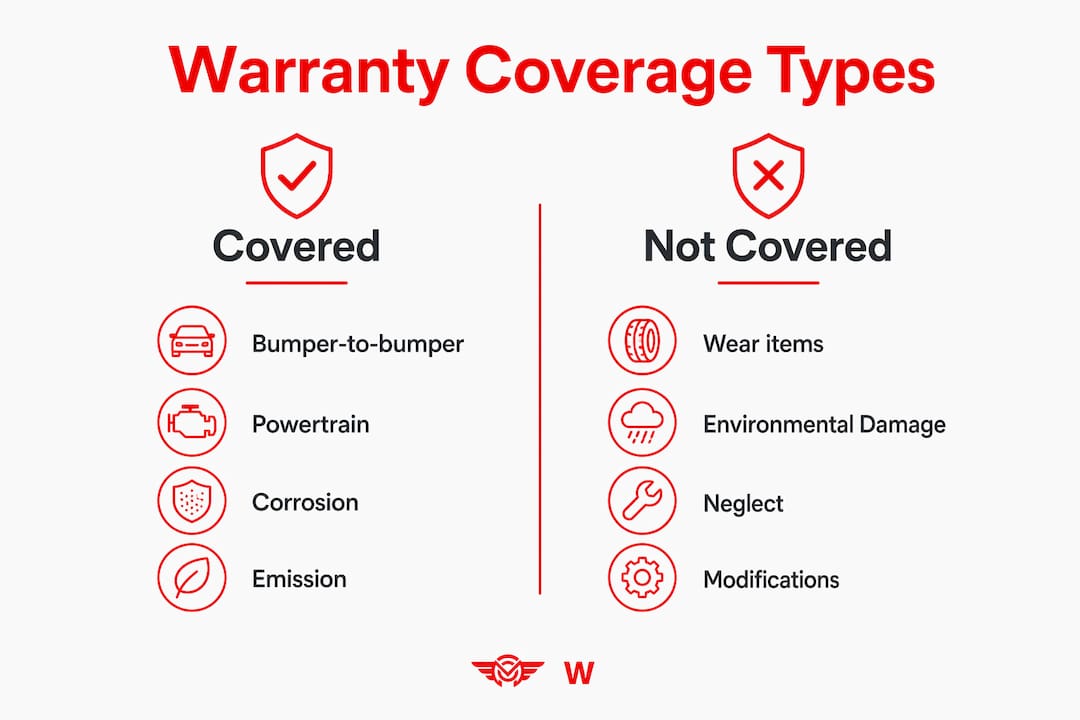
Bumper-to-bumper (limited) warranty covers nearly every factory-installed component — engine internals, transmission, electrical systems, air conditioning, steering, suspension, and high-tech electronics. Toyota's basic coverage runs for a few years and limited mileage; Chevrolet's New Vehicle Limited Warranty matches that duration. The name is slightly misleading: it doesn't mean literally every part, since wear items and maintenance are excluded.
Powertrain warranty runs longer and focuses on the engine, transmission, and drive systems. A common powertrain term describes several years and a set mileage, though some brands extend further. Hyundai's powertrain coverage is notably longer for original owners.
Corrosion/perforation warranty covers rust holes that form from the inside out through body sheet metal. Toyota covers rust-through for several years with no mileage cap. Hyundai's anti-perforation warranty runs for multiple years with unlimited miles. Surface rust and cosmetic corrosion are typically excluded.

Emissions warranty is federally regulated and covers specific emissions components. Major parts like the catalytic converter and engine control module often carry federally mandated coverage lasting several years and mileage. California-spec vehicles get additional state-mandated protection.
EV and hybrid battery coverage is its own category. Hyundai covers its hybrid, plug-in hybrid, and electric batteries for a lengthy coverage period including a mileage limit, and guarantees the battery won't degrade below 70% of original capacity during that time. If you own a Tesla or another EV, electric vehicle battery coverage terms vary significantly by brand, so checking your specific warranty booklet matters.
Supplemental Restraint System (SRS) and roadside assistance round out most factory packages. Roadside assistance typically mirrors the bumper-to-bumper term.
What factory warranties usually don't cover
The factory warranty covers defects in origin, not the consequences of ownership. That distinction matters more than most owners realize.
Routine wear items are excluded by design: brake pads, tires, wiper blades, filters, and bulbs all degrade through normal use. Kelley Blue Book confirms these items are standard exclusions across virtually every manufacturer's policy. Hyundai's warranty booklet lists them explicitly as owner maintenance responsibility after the first 12 months.
Environmental and collision damage falls outside coverage too. Road salt corrosion, hail, acid rain, tree sap, flood damage, and stone chips in paint are all excluded. A failure must trace back to a factory defect, not a post-sale event.
Neglect and misuse void claims fast. Skip the oil changes on your Mercedes-Benz GLE or ignore the BMW maintenance minder, and the manufacturer has grounds to deny a related engine claim.
Pro Tip: Aftermarket modifications don't automatically void your entire warranty. Under the Magnuson-Moss Warranty Act, a manufacturer must demonstrate a causal link between the modification and the specific failure to deny that claim. Installing a cold-air intake doesn't void your transmission warranty — but it could void a claim on a failed mass airflow sensor.
How long does a warranty last, and how do you check yours?
Coverage begins on the in-service date — the day the vehicle was first delivered, leased, or put into service — not the day you bought it used.
| Warranty Type | Typical Duration | What It Covers |
|---|---|---|
| Bumper-to-bumper | 3 years / 36,000 miles | Nearly all factory components |
| Powertrain | 5 years / 60,000 miles | Engine, transmission, drive systems |
| Corrosion/perforation | 5 years / unlimited miles | Rust-through of body sheet metal |
| Emissions (federal major parts) | — | Catalytic converter, ECM, OBD-II |
| EV/hybrid battery | — | Battery capacity and system components |
To check your exact terms: locate your warranty booklet in the glove box, run a VIN lookup through the manufacturer's website or customer service line, and for used vehicles, ask the dealer to pull CPO documentation if applicable. The VIN also tells you whether any open recalls exist at NHTSA's recall database.
How a warranty claim actually works
The process is straightforward, but documentation is what separates a smooth repair from a disputed one.
- Document the failure with photos, a written description, and the mileage at the time it appeared.
- Gather maintenance records — dated receipts showing oil changes, fluid services, and scheduled inspections. Manufacturers require proof of proper maintenance when they suspect neglect contributed to a failure.
- Take the vehicle to an authorized service center. For a BMW, that means a BMW-authorized dealer. For a Ford F-150, any authorized Ford dealer qualifies. Third-party shops generally cannot authorize warranty repairs.
- Request a written repair authorization before work begins. Confirm the repair is being submitted as a warranty claim, not a customer-pay job.
- Keep all paperwork after the repair: the repair order, parts used, and technician notes. These matter if a related issue surfaces later.
Bring to the service appointment: your VIN, purchase documentation, maintenance receipts, and photos of the failure. If a claim is denied, ask for the denial in writing and request the specific reason. You can escalate to the manufacturer's customer relations line or, for significant disputes, consult your state's consumer protection office.
Recalls vs. warranty claims: what's the difference?
A recall is a manufacturer's legal obligation to fix a safety-related defect at no cost. A warranty claim is a contractual right to repair a defect within a time or mileage window.
The key difference: recalls don't expire. Safety recall repairs are free even if the vehicle has a branded title, the warranty has long expired, or you're the third owner. The manufacturer bears the cost regardless.
Check your vehicle's recall status by entering the VIN at the NHTSA website. If an open recall exists, contact an authorized dealer to schedule the repair. You pay nothing.
Buying or selling a used vehicle: what transfers?
Factory warranties generally travel with the vehicle, not the original owner. The clock, however, stays tied to the original in-service date.
Buyer and seller checklist:
- Confirm transferability in the warranty booklet — some brands, like Hyundai, reduce powertrain coverage for second and subsequent owners (from 10 years to 5 years/60,000 miles).
- Run a VIN check to see how much time and mileage remain.
- Ask the selling dealer for written confirmation of remaining coverage.
- Evaluate CPO (Certified Pre-Owned) programs, which often extend or supplement factory coverage with additional inspections and backing.
- Note that branded or salvage titles typically void remaining factory warranty coverage, though recall repairs may still be performed.
When does an extended warranty make sense?
The decision comes down to three factors: vehicle age and mileage, how long you plan to keep it, and the cost exposure of the systems most likely to fail.
A vehicle service contract functions as a financial hedge — most valuable for high-repair-cost systems like transmissions, modern electronics, and turbocharged engines once factory coverage ends. A Range Rover Sport owner facing a $4,000 air suspension repair or a Porsche Cayenne owner staring at a $6,000 transfer case job understands this immediately. Honda Civic owners face lower average repair costs, but even a failed CVT or infotainment system can run well over $2,000.
| Factor | Factory Warranty Sufficient | Extended Warranty Worth Considering |
|---|---|---|
| Vehicle age | Within original term | Approaching or past factory expiration |
| Ownership horizon | Short-term / plan to sell | Keeping the vehicle 3+ more years |
| Vehicle complexity | Standard drivetrain | Turbocharged, hybrid, EV, luxury electronics |
| Repair cost tolerance | Comfortable paying out of pocket | Prefer predictable monthly cost |
When comparing service contracts, evaluate: component coverage list, deductible amount, reimbursement method (direct-pay vs. reimbursement), roadside assistance inclusion, rental reimbursement, and whether repairs must go through a specific network.
How to avoid voiding your factory warranty
Most warranty voids are preventable. The habits that protect coverage are the same ones that protect the vehicle.
- Follow the manufacturer's maintenance schedule exactly — not a generic interval, but the one in your owner's manual for your specific model and driving conditions.
- Keep every receipt: oil changes, tire rotations, fluid flushes, and inspections. Date, mileage, and parts used should appear on each one.
- Use manufacturer-approved fluids and parts where specified. A BMW N55 engine running the wrong oil viscosity gives the manufacturer a documented basis to deny a related claim.
- Avoid modifications that affect covered systems. If you modify a Range Rover's suspension, document the installer's credentials and the parts used.
Pro Tip: If a third-party shop performs maintenance, ask for a detailed invoice that lists the specific parts, fluids, and labor performed. Generic receipts that say only "oil change" are harder to defend if a claim is disputed.
Key Takeaways
A manufacturer's warranty covers factory defects for a defined time and mileage — once that window closes, an extended service contract is the only contractual protection left.
| Point | Details |
|---|---|
| Coverage scope | Factory warranties cover defects in materials and workmanship, not accidents, wear, or neglect. |
| Time and mileage limits | Bumper-to-bumper typically lasts a few years with a mileage limit; powertrain warranty usually extends longer but also has mileage restrictions. |
| Recalls never expire | Safety recall repairs are free regardless of warranty status, title branding, or ownership number. |
| Documentation protects you | Dated maintenance receipts are your primary defense if a claim is disputed or denied. |
| Rpmwarranty fills the gap | When factory coverage ends, Rpmwarranty's tiered plans (Elite, Advanced, Essential) cover engine, transmission, electronics, and more through a nationwide ASE-certified network. |
The gap most owners don't see coming
The factory warranty feels permanent until the day it isn't. A BMW 5 Series owner at 37,000 miles is one month past bumper-to-bumper coverage. A Mercedes-Benz GLC driver at 61,000 miles has no powertrain protection left. These aren't edge cases — they're the exact moment when a $3,000 repair lands with no warning and no coverage.
Luxury and high-tech vehicles make the math clearest. Range Rover air suspension, Porsche PDK transmission electronics, and BMW iDrive modules are expensive to diagnose and expensive to fix. Honda and Ford owners face lower average repair bills, but a failed transmission or advanced driver-assistance system still runs thousands of dollars. The question isn't whether something will eventually fail. It's whether you want a predictable monthly cost or an unpredictable repair bill.
Factory coverage is excellent while it lasts. The problem is that most owners plan to keep their vehicles well past the expiration date. An extended service contract from Rpmwarranty, with tiered plans matched to your vehicle's year, make, and model, is the most direct way to close that gap.
Extended coverage after your factory warranty expires
When your factory warranty ends, Rpmwarranty offers extended vehicle warranty plans built for exactly this moment. Three tiered options — Elite, Advanced, and Essential — let you match coverage depth to your vehicle and budget, whether you drive a Ford F-150, a Mercedes-Benz E-Class, or a Honda Pilot.
Coverage includes engine, transmission, cooling systems, electrical systems, steering, suspension, and high-tech electronics. Every plan comes with roadside assistance and rental reimbursement. Repairs go through ASE-certified mechanics nationwide, so you're not locked into a single dealer.
Getting a quote takes minutes. Enter your vehicle's year, make, and model at Rpmwarranty.com and get a customized plan recommendation with no obligation.
Useful sources and next steps
Verify your coverage and recall status:
- FTC: Auto Warranties and Service Contracts — the authoritative federal explanation of the legal difference between warranties and service contracts, and your rights under each.
- NHTSA Recall Database — enter your VIN to check for open safety recalls. Free, takes 30 seconds.
- Your manufacturer's customer service line — call with your VIN to get remaining coverage confirmed in writing.
- Your owner's manual warranty booklet — the primary source for your vehicle's exact terms, exclusions, and maintenance requirements.
Suggested next steps:
- Find your warranty booklet and note your in-service date and current mileage.
- Run your VIN at NHTSA to check for open recalls.
- Call your manufacturer's customer service line to confirm remaining coverage in writing.
- If your factory coverage is within 12 months or 15,000 miles of expiring, request a free quote from Rpmwarranty before the gap opens.
This article is general information, not legal or professional advice. Confirm your vehicle's specific warranty terms with your manufacturer or a qualified professional.