

TL;DR:
- A basic car warranty is the manufacturer's promise to repair or replace defects at no cost, included with new vehicle purchases. Extended warranties are paid agreements that cover repairs beyond factory coverage and have different claims processes regulated separately. Knowing the remaining factory coverage and choosing a transparent, suitable plan can help owners avoid costly repairs, especially on high-tech luxury vehicles.
A basic car warranty is the manufacturer's written promise to repair or replace defects in materials or workmanship at no cost to you, automatically included when you buy a new vehicle. The Federal Trade Commission draws a clear line between this factory coverage and the optional paid service contracts sold separately, which are regulated differently and work through entirely different claims processes. Most factory warranties run a few years or tens of thousands of miles for bumper-to-bumper coverage, with powertrain protection often extending further. Understanding where that coverage ends is exactly where smart ownership decisions begin.
Table of Contents
- What does a manufacturer's basic warranty actually cover?
- What is an extended warranty, and how does it differ from factory coverage?
- Common warranty terms decoded
- When does an extended warranty make sense for your vehicle?
- How to compare extended plans before you buy
- How claims work under factory vs. extended coverage
- How Rpmwarranty structures plans and what a transparent provider looks like
- Key Takeaways
- The coverage decision most owners get wrong
- Useful sources and where to verify your warranty status
What does a manufacturer's basic warranty actually cover?
Factory warranties come in layers, and knowing which layer applies to your repair determines whether you pay or the automaker does.
Bumper-to-bumper coverage (also called a comprehensive or new-vehicle limited warranty) protects nearly every component between the front and rear bumpers against manufacturing defects. Rather than listing everything included, the contract lists a short set of exclusions. Everything else is covered. Powertrain coverage is narrower, focused on the engine, transmission, and drivetrain, but it typically lasts longer.
Common covered components include:
- Engine and transmission internals
- Electrical systems and wiring
- Air conditioning and heating
- Infotainment and navigation systems
- Suspension and steering hardware
- EV battery packs (often under a separate federal-minimum 8-year/100,000-mile guarantee)
Standard exclusions across virtually every factory contract:
- Tires and brake pads (wear items covered by the tire manufacturer)
- Routine maintenance: oil changes, filters, fluid top-offs
- Cosmetic damage and upholstery
- Damage from accidents, misuse, or environmental causes
| Coverage type | Typical duration | Typical mileage limit |
|---|---|---|
| Bumper-to-bumper | 3–5 years | 36,000–60,000 miles |
| Powertrain | up to 10 years | up to 100,000 miles |
| Corrosion/rust-through | several years | unlimited (varies) |
| Emissions components | several years | tens of thousands of miles |
| EV battery | federal minimum of 8 years | about 100,000 miles |
Data ranges reflect common factory warranty structures across major North American automakers.
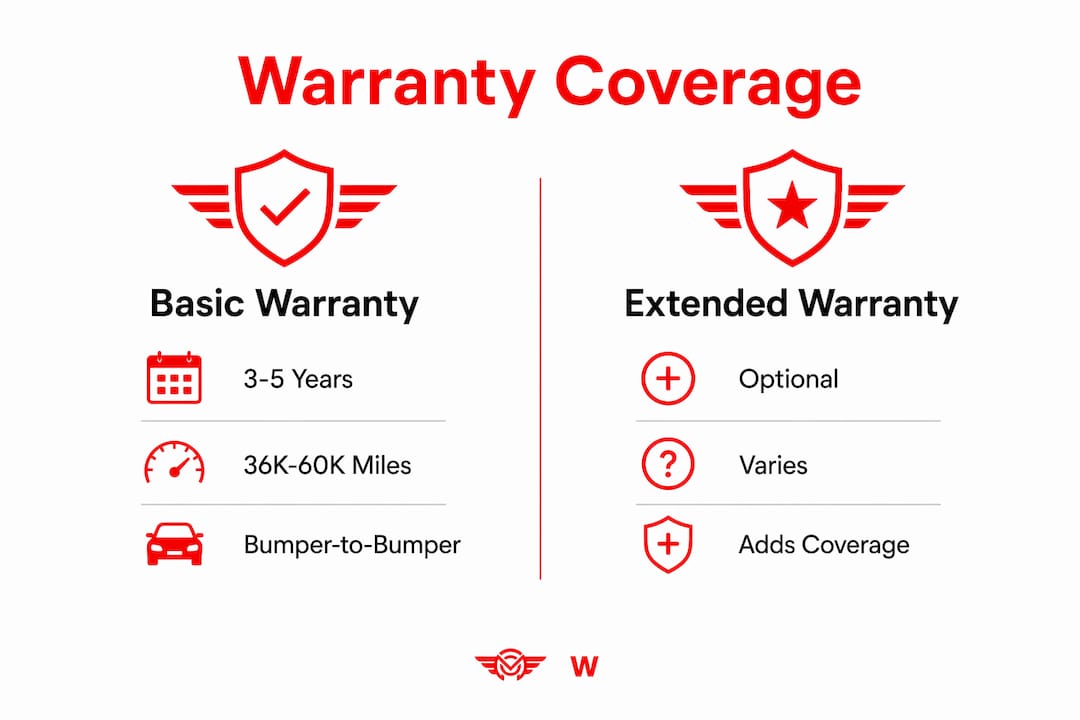
Pro Tip: Verify your remaining factory coverage by running your VIN through the manufacturer's owner portal or asking a franchised dealer to pull the warranty status. Keep every oil change receipt and service record in one folder. Automakers can and do deny claims when maintenance records are missing, so documentation is your first line of defense.
What is an extended warranty, and how does it differ from factory coverage?
A vehicle service contract (VSC) is a paid, optional agreement, sold by a dealership, automaker, or independent provider, that covers certain repairs after (or sometimes alongside) the factory warranty. Legally and operationally, it is not a warranty at all.
The FTC is explicit on this point:
The practical differences matter. Under a factory warranty, the dealer handles authorization and bills the manufacturer directly. You drop off the car and pick it up. Under many VSCs, you may pay the repair shop first and submit for reimbursement, or the administrator pre-authorizes the shop before work begins. The CFPB notes that extended contracts are often negotiable and that you are not required to buy one at the point of sale.
Three scenarios where the distinction becomes real money:
- A high-mileage owner at 55,000 miles on a BMW 5 Series, with powertrain coverage expiring soon, faces sensor and ADAS repair bills that can run well into four figures.
- A Range Rover buyer who knows the vehicle's air suspension and terrain-response electronics are expensive to fix may want coverage in place before the factory period closes.
- A short-term owner planning to sell in two years might skip a VSC entirely, since the factory warranty may still be active and transferable to the next buyer.
Common warranty terms decoded
Reading a warranty contract without a glossary is how people get surprised at the service counter. Here are the terms that actually matter:
- Bumper-to-bumper: Covers most components; lists exclusions rather than inclusions. The name is misleading because the bumpers themselves are typically excluded.
- Powertrain: Engine, transmission, drivetrain. Narrower scope, longer duration.
- Exclusionary policy: The contract lists what is not covered. Anything absent from the exclusion list is covered. This is the format consumer advocates recommend.
- Inclusionary (named-parts) policy: Only the parts explicitly listed are covered. If your part is not on the list, the claim is denied.
- Deductible: The amount you pay per repair visit before coverage kicks in. Can be per-visit or per-repair-item.
- Corrosion warranty: Covers rust-through on body panels, not surface rust.
- Emissions warranty: Federally mandated coverage for emissions-related components; duration varies by state and component.
- Transferability: Whether the remaining warranty passes to a new owner if you sell the vehicle privately or to a dealer.
- Pre-existing condition clause: Broad language that lets a VSC provider deny claims for any issue that existed before the contract started.
"Bumper-to-bumper coverage, despite its name, does not include all auto repairs or replacements. Each such warranty includes a short list of automotive parts that are not covered, including the bumpers themselves." — USA TODAY automotive coverage analysis
Watch for these contract red flags: vague exclusion lists that reference "related components," reimbursement-only language with no direct-pay option, and pre-existing condition clauses written broadly enough to cover any prior symptom.
When does an extended warranty make sense for your vehicle?
The honest answer depends on four factors: how long you plan to keep the car, how many miles you drive annually, the vehicle's reliability profile, and how expensive its technology is to repair.

Consumer Reports is direct about luxury and high-tech models: sensors, ADAS systems, and infotainment components in vehicles like the BMW 7 Series, Mercedes-Benz S-Class, Porsche Cayenne, and Range Rover Sport carry repair costs that can dwarf those of a conventional commuter car. A single air suspension compressor replacement on a Range Rover can cost more than a year of VSC premiums. Mercedes' MBUX infotainment and driver-assistance modules are similarly expensive when they fail out of warranty.
By contrast, a Honda Civic or Ford F-150 with a strong reliability record and a straightforward powertrain presents a different calculation. The repair exposure is lower, and the math on a VSC may not favor buying one.
Timing matters. Buying a VSC at the point of sale means you may be paying for coverage that overlaps with remaining factory protection. The CFPB confirms you can buy later, which lets you assess actual repair history first. If the factory warranty has two years left, waiting until year one is almost over often makes more financial sense.
For certified pre-owned (CPO) vehicles, the manufacturer's CPO warranty typically extends the original factory coverage and may include a powertrain component. Check whether that CPO warranty is transferable before you buy, since it directly affects resale value.
Pro Tip: If you drive more than 15,000 miles per year, you will burn through mileage-based factory coverage faster than the calendar suggests. A five-year/60,000-mile warranty may effectively expire in four years at that pace. Factor your actual annual mileage into the coverage-gap calculation.
How to compare extended plans before you buy
| Dimension | What to ask |
|---|---|
| Coverage type | Exclusionary or named-parts? |
| Length | Years and miles; how much factory coverage remains? |
| Cost structure | Single payment or monthly? Is it prorated if canceled? |
| Deductible | Per visit or per repair item? |
| Repair shop | Any licensed shop or network-only? OEM parts required? |
| Claims process | Direct pay to shop or reimbursement to you? |
| Transferability | Does coverage follow the car to a new owner? |
| Extras | Roadside assistance, rental car, trip interruption? |
| Cancellation | Full refund window? Pro-rated after that? |
| Arbitration | Required before litigation? Which arbitration body? |
Top questions to ask any plan seller before signing:
- Is this an exclusionary or named-parts contract?
- Who authorizes repairs, and how long does pre-authorization take?
- Does the shop receive direct payment, or do I pay and get reimbursed?
- Are ADAS components, infotainment, and EV battery systems explicitly covered or excluded?
- What happens to my contract if I sell the vehicle?
- Is there a waiting period before I can file a claim?
- What documentation do I need to keep to avoid a denied claim?
Before you sign, request a sample contract and check for: the full exclusion list, the cancellation and refund terms, the administrator's name and state registration, and whether the provider carries insurance backing the contract.
How claims work under factory vs. extended coverage
Under a factory warranty, the process is straightforward. You bring the car to a franchised dealer, the service advisor diagnoses the issue, and the dealer submits the claim directly to the manufacturer. You pay nothing for covered repairs beyond any applicable deductible. Authorization typically happens the same day.
Extended plan claims are more variable. A third-party administrator usually handles authorization, and the shop may need to call in the claim before beginning work. Some plans pay the shop directly; others require you to pay and submit receipts for reimbursement. Waiting periods of 30 days or a set mileage threshold after purchase are common.
"An extended warranty or service contract won't cover all situations or repairs. If it isn't listed in the contract, assume that it's not covered." — FTC Consumer Advice
Common denial reasons and how to avoid them:
- Maintenance gaps: Keep dated receipts for every oil change, fluid service, and inspection.
- Pre-existing conditions: Get a pre-purchase inspection and document the vehicle's condition before the contract starts.
- Excluded parts: Read the exclusion list before you buy, not after the repair estimate arrives.
- Unauthorized repairs: Always get pre-authorization before the shop begins work on a covered claim.
How Rpmwarranty structures plans and what a transparent provider looks like
Rpmwarranty's process is a useful benchmark for what a straightforward extended coverage provider should look like in practice. The four steps:
- Consultation: Discuss your vehicle's year, make, model, and mileage to identify coverage gaps.
- Plan selection: Choose from three tiers based on budget and coverage needs.
- Customization: Adjust deductibles, term length, and add-ons to match your ownership situation.
- Final agreement: Review written contract terms, cancellation policy, and claims process before signing.
The three plan tiers reflect different risk profiles:
- Elite: Broadest coverage, suited for high-tech or luxury vehicles (think BMW, Mercedes, Porsche, Range Rover) where component repair costs are highest.
- Advanced: Mid-range coverage for vehicles with moderate tech complexity and owners who want powertrain-plus protection.
- Essential: Focused powertrain and core-systems coverage for budget-conscious owners or higher-mileage vehicles.
Pro Tip: A reputable provider will always give you a free quote, show you the full exclusion list before you commit, and confirm nationwide repair-shop access. If a provider resists sharing sample contract language upfront, treat that as a signal to keep looking.
Rpmwarranty offers free quotes matched to your specific vehicle, with coverage options for engines, transmissions, electrical systems, cooling, and high-tech components.
Key Takeaways
A basic car warranty is the automaker's defect-repair promise, and knowing exactly where it ends determines whether extended coverage is worth buying for your vehicle.
| Point | Details |
|---|---|
| Factory warranty scope | Bumper-to-bumper covers most components via exclusion lists; powertrain covers engine, transmission, and drivetrain. |
| Typical duration | Bumper-to-bumper runs 3–5 years or 36,000–60,000 miles; powertrain up to 10 years or 100,000 miles. |
| VSC vs. factory warranty | A vehicle service contract is a paid, optional, separately regulated agreement, not a manufacturer's warranty. |
| High-tech vehicles carry more risk | Luxury models (BMW, Mercedes, Porsche, Range Rover) face higher post-warranty repair costs for sensors and ADAS systems. |
| Timing and records matter | You can buy a VSC after purchase; keep all service records to prevent denied claims under either coverage type. |
The coverage decision most owners get wrong
Most people treat the extended warranty decision as a binary: buy it or skip it. The smarter frame is: when and what kind.
The owners who get burned are rarely the ones who skipped coverage on a reliable Honda Accord. They are the ones who bought a Range Rover or a Mercedes-Benz EQS, let the factory warranty expire without a plan in place, and then faced a $4,000 air suspension repair or a $3,500 ADAS module replacement. The repair cost on a single high-tech component in a luxury vehicle can exceed what a multi-year VSC would have cost in total.
The other mistake is buying a named-parts contract without reading the exclusion structure. If ADAS, infotainment, or EV battery components are not explicitly listed as covered, assume they are not. Exclusionary policies reduce that ambiguity considerably, and consumer protection professionals consistently recommend them over named-parts contracts for exactly that reason.
For vehicles like the Ford F-150 or Honda CR-V with strong reliability records, the math is genuinely different. Self-insuring with a dedicated savings buffer may outperform a VSC over a typical ownership period. But if you drive a Porsche Cayenne, a BMW X5, or a Range Rover Defender past 60,000 miles, the question is not whether to have coverage. It is whether you have the right kind.
Verify your factory warranty status now, pull your service records, and check the exclusion list on any contract before you sign. Transferability is worth confirming too: an active, transferable warranty on a BMW or Mercedes adds real resale value that a private buyer will notice.
Useful sources and where to verify your warranty status
- FTC Consumer Advice on Auto Warranties: Explains the legal difference between manufacturer warranties and service contracts, including reimbursement rules and your rights.
- CFPB Extended Warranty Explainer: Covers cancellation rights, negotiation, and when to buy.
- Consumer Reports Car Warranty Guide: Reliability-based guidance on which vehicles carry higher post-warranty repair risk.
- USA TODAY Bumper-to-Bumper Explainer: Plain-language breakdown of what "bumper-to-bumper" actually means in contract terms.
- MarketWatch Factory Warranty Overview: Summarizes warranty layers, typical lengths, and CPO differences.
- Manufacturer VIN lookup portals: Every major automaker (Ford, Honda, BMW, Mercedes-Benz, Porsche, Land Rover) offers a VIN-based warranty status check through their owner portal or a franchised dealer service department.
- Rpmwarranty.com: Free quotes matched to your vehicle's year, make, and model, with written contract terms and nationwide coverage for extended plans.