

TL;DR:
- Part-specific coverage protects designated vehicle components rather than entire systems, making the covered parts list crucial for claims. It is more affordable than bumper-to-bumper plans but requires careful attention to exclusions, OEM endorsement clauses, and maintenance compliance. Owners of premium vehicles benefit most from OEM parts endorsements due to higher repair costs and the importance of calibration and resale value.
Part-specific coverage is a type of vehicle protection that guarantees repair or replacement of designated components rather than the entire vehicle system, giving owners a targeted way to manage repair costs. Unlike bumper-to-bumper plans that cover nearly everything, part-specific coverage names the exact components protected under the contract. This distinction matters enormously when you own a BMW 5 Series, a Mercedes-Benz GLE, or a Porsche Cayenne, where a single sensor or transmission component can cost thousands of dollars to replace. Understanding what is part-specific coverage, how it works, and where its limits lie helps you choose the right extended warranty plan before a repair bill surprises you.
What is part-specific coverage and how does it work?
Part-specific coverage is defined as a warranty or protection plan provision that specifies, by name or category, which vehicle components qualify for repair or replacement at the insurer's or warranty provider's expense. The industry also refers to this as "named-component coverage" or "scheduled parts coverage," and those terms appear frequently in extended warranty contracts. The core mechanism is straightforward: the contract lists covered parts, and only those parts qualify for a claim.

This structure differs sharply from an exclusionary warranty, which covers everything except a listed set of items. Part-specific plans are more restrictive by design, but they are also more affordable. A vehicle owner who primarily wants protection for the engine, transmission, and drivetrain can purchase a plan that covers exactly those systems without paying for coverage on components they consider low-risk.
The coverage activates when a listed part fails due to a mechanical defect or breakdown, not due to an accident or collision. You file a claim, the repair shop confirms the failed part is on the covered list, and the warranty provider pays for the part and, depending on the contract, the associated labor. The practical experience of part-specific coverage explained this way makes it clear that the covered parts list is the single most important document in your warranty contract.
Pro Tip: Before signing any extended warranty contract, request the full covered parts schedule as a separate document. If the provider cannot supply it, that is a red flag worth taking seriously.
What parts are commonly covered under part-specific plans?
The covered components in a part-specific plan typically fall into the highest-cost repair categories. Engine internals, transmission assemblies, transfer cases, and differential components appear on most plans because those repairs routinely run from $2,000 to $8,000 or more. Electrical systems, including alternators, starter motors, and control modules, are also common inclusions. Cooling system components such as water pumps and radiators frequently appear on mid-tier and premium plans.
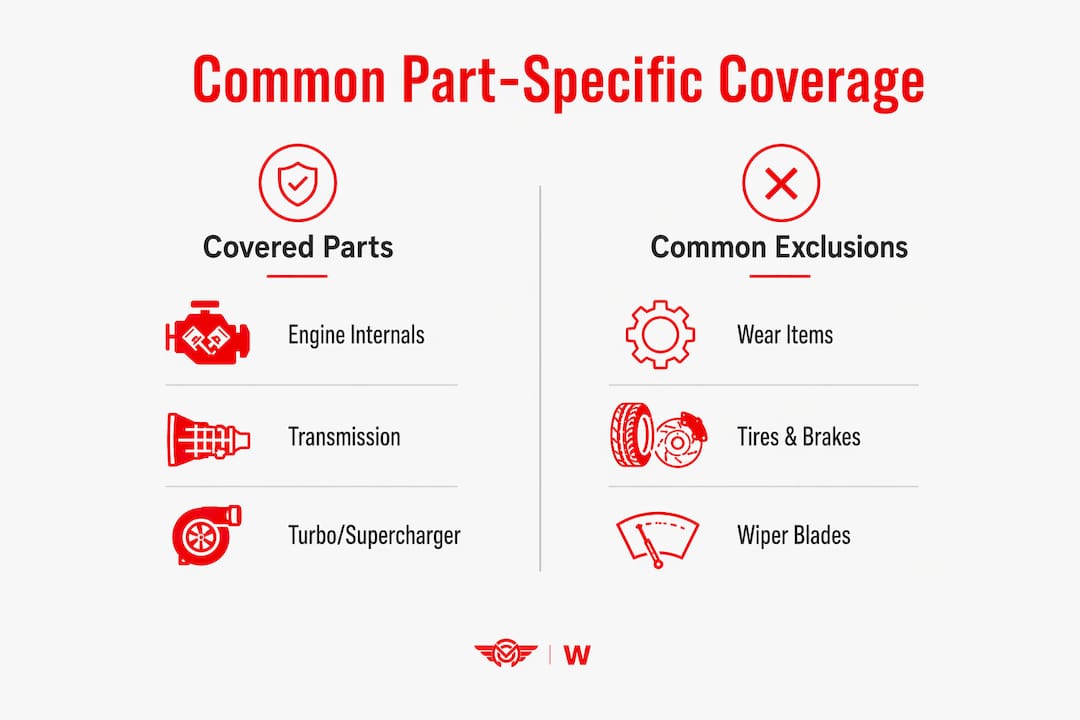
For owners of Range Rover, Mercedes-Benz, and BMW vehicles, the electronics coverage is especially significant. These vehicles rely on dozens of control modules that communicate across proprietary networks. A failed adaptive suspension control unit on a Range Rover Sport, for example, can cost over $1,500 for the part alone before labor. Part-specific plans that include electronic control units provide real financial protection for these vehicles.
Common covered parts across most plans include:
- Engine components: pistons, crankshafts, camshafts, and cylinder heads
- Transmission: gears, torque converters, and valve bodies
- Drivetrain: axle shafts, CV joints, and differentials
- Electrical: alternators, starter motors, and ECU modules
- Cooling: water pumps, thermostats, and radiator assemblies
- Fuel system: fuel injectors and fuel pumps
Common exclusions are equally important to understand. Wear items such as brake pads, rotors, tires, wiper blades, and filters are excluded from virtually every part-specific plan. Cosmetic components including upholstery, paint, and trim panels are also excluded. Consequential damages such as secondary engine damage caused by a failed water pump are excluded under standard warranties, meaning the owner absorbs those additional repair costs unless the contract explicitly states otherwise.
Pro Tip: Ask your warranty provider specifically whether consequential damage is covered. Many owners discover this gap only after a repair bill arrives for secondary damage that followed the original failure.
How does OEM parts endorsement relate to part-specific coverage?
OEM parts coverage is an optional endorsement that specifies repairs must use original equipment manufacturer parts when those parts are available, rather than aftermarket or recycled alternatives. This endorsement layers on top of a part-specific or broader warranty plan and directly affects the quality of the repair you receive. OEM parts coverage is distinct from mechanical breakdown warranties and is primarily associated with collision damage insurance, but the concept applies equally to extended warranty repairs when written into the contract.
The distinction between OEM, aftermarket, and recycled parts matters more than most owners realize. OEM parts are manufactured to the exact specifications of the original component, whether produced by the automaker directly or by a certified third-party supplier. OEM parts often come from reputable third-party suppliers without the car brand's logo but still meet original equipment specifications, which is critical for safety systems that require precise calibration. Aftermarket parts are produced independently and may fit and function adequately, but quality varies widely across manufacturers. Recycled parts are salvaged from other vehicles and may carry unknown wear history.
The table below compares the three part types across the factors that matter most to vehicle owners:
| Factor | OEM parts | Aftermarket parts | Recycled parts |
|---|---|---|---|
| Specification match | Exact original spec | Varies by manufacturer | Matches original model |
| Safety system calibration | Fully supported | May require recalibration | Unknown history |
| Warranty coverage | Typically 12 months | Varies widely | Usually limited or none |
| Cost | Highest | Lower than OEM | Lowest |
| Resale value impact | Neutral to positive | Neutral to negative | Negative |
One critical clause to understand is the "when available" provision. Most OEM endorsements allow insurers or warranty providers to substitute aftermarket or recycled parts if the original manufacturer part is unavailable. For owners of older BMW 3 Series or discontinued Porsche models, this clause can mean OEM parts are substituted more often than expected. Reading the exact language of this clause before purchase prevents disputes later.
Eligibility for OEM endorsements also depends on vehicle age and model. OEM endorsements vary widely by insurer and vehicle eligibility, so a five-year-old Mercedes-Benz C-Class may qualify while an older model may not. Confirming eligibility at the time of plan selection saves significant frustration during a claim.
Pro Tip: When a repair shop submits a claim, ask for written documentation of which parts were approved and whether they are OEM, aftermarket, or recycled. Adjusters often use "like kind and quality" standards to approve non-OEM parts, and requesting that documentation is the only way to verify what was actually installed.
What are common limitations and exclusions in part-specific coverage?
Part-specific coverage carries several limitations that owners frequently misunderstand until they file a claim. The most consequential limitation is the exclusion of consequential damages. If a failed fuel injector on a Honda Accord causes the engine to run lean and damages the catalytic converter, the warranty covers the injector but not the catalytic converter unless that part is also listed in the covered components schedule. Standard warranties typically exclude labor and consequential damages, so owners should factor these potential costs into their financial planning.
Labor cost coverage is another variable that catches owners off guard. Some plans cover labor alongside the part replacement, while others reimburse only the part cost. The difference can be $300 to $800 per repair event depending on the vehicle and the complexity of the job. A transmission replacement on a Ford F-150 or a BMW X5 involves significantly more labor hours than a simple sensor swap, making labor coverage a meaningful financial consideration.
Policy language is the most underappreciated factor in coverage disputes. Coverage headings on policy pages are not definitive. The actual coverage depends on contract wording, definitions, exclusions, and endorsements. A heading that reads "Engine Coverage" may exclude specific internal components that are listed as exclusions three pages into the contract. Consumers frequently misunderstand insurance coverage labels, assuming coverage is broader than the actual contract terms allow.
Common limitations to verify before purchasing any part-specific plan:
- Deductibles: Most plans carry a per-visit or per-claim deductible ranging from $0 to $200.
- Coverage caps: Some plans limit total reimbursement per claim or per contract term.
- Maintenance requirements: Failure to document regular oil changes or scheduled service can void coverage even when a covered part fails from a manufacturing defect.
- Approved repair facilities: Many plans require repairs at authorized shops, which may not include your preferred independent mechanic.
- Waiting periods: Most extended warranty plans include a 30-day or 1,000-mile waiting period before coverage activates.
Proper installation and compliance with maintenance schedules are conditions that can void warranties entirely even when the parts themselves fail from manufacturing defects. Keeping detailed service records is not optional for warranty holders. It is the primary evidence you present when a claim is disputed.
How does part-specific coverage work for premium vehicle owners?
Premium vehicle owners face a different calculus when evaluating part-specific coverage because the cost of individual components is dramatically higher and the technology involved is more complex. A single adaptive headlamp assembly on a Mercedes-Benz S-Class can cost $2,500 or more. A transfer case on a Range Rover Sport runs $3,000 to $5,000 in parts alone. For these vehicles, the benefits of part-specific coverage are not theoretical. They are the difference between a manageable repair bill and a financial crisis.
Repair quality directly impacts lease returns, resale value, and the functionality of sensitive systems on luxury vehicles. Repair disputes on premium brands often center on parts like bumper covers, sensors, and headlamps where fit and finish affect both function and resale price. This is why OEM parts endorsements carry more weight for BMW, Porsche, and Range Rover owners than for owners of standard vehicles.
Here is a practical framework for premium vehicle owners evaluating part-specific coverage decisions:
- Identify your highest-risk components. Review your vehicle's known reliability issues. BMW N63 engines have documented oil consumption concerns. Porsche PDK transmissions require specific fluid maintenance. Range Rover air suspension systems are a frequent repair item. Match your coverage to these known vulnerabilities.
- Confirm OEM parts eligibility. Contact the warranty provider directly and ask whether your specific year, make, and model qualifies for OEM parts endorsement. Get the answer in writing before purchasing.
- Verify labor coverage. Ask for a sample repair scenario, such as a transmission replacement, and confirm exactly what the plan would pay versus what you would owe out of pocket.
- Check the repair network. Confirm that authorized repair facilities in your area include dealers or specialists familiar with your vehicle's brand. A Porsche Cayenne requires different expertise than a Ford Explorer.
- Document everything from day one. Keep digital copies of all service records, receipts, and warranty documents. When a claim arises, documentation speed determines how quickly you get back on the road.
Vehicle age and planned usage also shape the decision. An owner planning to sell a three-year-old Mercedes-Benz GLC in 12 months has different coverage needs than someone keeping a six-year-old BMW X3 for another five years. Resale plans favor OEM parts endorsements because non-OEM repairs can reduce trade-in value at certified pre-owned inspections.
Pro Tip: When your vehicle goes in for a covered repair, ask the service advisor to note on the repair order which parts are being used and whether they are OEM. This creates a paper trail that protects you if a future buyer or dealer questions the repair history.
Key takeaways
Part-specific coverage protects named vehicle components rather than the whole system, and the covered parts list is the single document that determines whether your claim succeeds or fails.
| Point | Details |
|---|---|
| Definition of part-specific coverage | Coverage applies only to components explicitly listed in the contract, not the entire vehicle. |
| OEM parts endorsement value | OEM endorsements matter most for premium brands where fit, calibration, and resale value are at stake. |
| Consequential damage gap | Secondary damage from a covered part failure is typically excluded unless the contract states otherwise. |
| Policy language over headings | Coverage labels on plan summaries do not define actual coverage. Only the full contract wording does. |
| Documentation protects claims | Maintaining service records and repair orders is the primary defense against disputed warranty claims. |
Why the fine print on part-specific coverage deserves more attention than it gets
Most vehicle owners spend more time comparing monthly premium costs than reading the actual covered parts schedule. That is the wrong priority. The monthly cost difference between two plans might be $15. The difference between a plan that covers your BMW X5's transfer case and one that does not could be $4,000 out of pocket.
What I have found working with vehicle warranty decisions is that the "when available" clause in OEM endorsements creates more post-claim frustration than almost any other provision. Owners purchase an OEM endorsement believing every repair will use factory parts, then discover that a specific component is classified as unavailable and a recycled part is substituted instead. The endorsement did not fail. The owner simply did not read the clause carefully enough before signing.
The other pattern worth flagging is the maintenance compliance trap. Warranty voidance due to maintenance non-compliance is more common than most owners expect, and it applies even when the failed part has nothing to do with the missed service. An owner who skips an oil change and later files a claim for a failed alternator may find the claim denied on maintenance grounds. Keep every receipt.
My honest recommendation for owners of Range Rover, Porsche, Mercedes-Benz, or BMW vehicles is to treat the OEM parts endorsement as non-negotiable if you plan to keep the vehicle beyond its manufacturer warranty period. The repair quality difference between OEM and aftermarket parts on these vehicles shows up in resale inspections, in the behavior of calibrated safety systems, and in long-term reliability. The endorsement costs more. It is worth it.
— Kenneth
Protect your vehicle with the right extended warranty plan
If reading through part-specific coverage details has made one thing clear, it is that the plan you choose matters as much as having coverage at all. Rpmwarranty offers extended warranty plans built around the specific components that matter most to vehicle owners, from engine and transmission protection to electrical systems and high-tech parts.
Rpmwarranty's Elite, Advanced, and Essential plans cover a range of vehicles and budgets, with options that include OEM parts endorsements for owners of premium makes. The four-step process, from consultation through final agreement, is designed to match your vehicle's year, make, and model to the right level of component protection. Get a free quote today and confirm exactly which parts your plan covers before you need to use it.
FAQ
What is the definition of part-specific coverage?
Part-specific coverage is a warranty provision that protects only the vehicle components explicitly named in the contract, rather than covering the entire vehicle or system. The covered parts schedule in the contract determines which repairs qualify for reimbursement.
Does part-specific coverage include OEM parts?
Not automatically. OEM parts coverage is a separate endorsement that must be added to a plan, and it includes "when available" clauses that allow substitution of aftermarket or recycled parts if the original manufacturer part cannot be sourced.
Are labor costs covered under part-specific plans?
Labor coverage varies by contract. Many warranties exclude labor or consequential damage costs entirely, so owners should confirm labor reimbursement terms before purchasing a plan.
Can a warranty claim be denied even if the part is covered?
Yes. Failure to comply with maintenance requirements or improper installation can void coverage even when the failed component is listed in the covered parts schedule. Keeping documented service records is the primary protection against this outcome.
Why does part-specific coverage matter more for BMW or Porsche owners?
Premium vehicle components cost significantly more to replace, and repair quality directly affects resale value and the calibration of sensitive safety systems. Repair disputes on luxury vehicles frequently involve parts like sensors and headlamps where fit and finish carry financial consequences beyond the immediate repair.