

TL;DR:
- Negotiating warranty pricing can significantly reduce vehicle protection costs by exploiting dealer markups that range from 50% to over 200%.
- Timing negotiations at month-end and presenting competing quotes strengthen your leverage, especially when treating warranties as standalone products.
Negotiating warranty pricing is the single most effective way to cut hundreds or even thousands of dollars from your vehicle protection costs. Most car buyers accept the first number a finance and insurance (F&I) manager quotes, not realizing that dealer markups on extended warranties range from 50% to upwards of 200%. That gap between cost and sticker price is your negotiation room. Whether you drive a BMW 5 Series, a Mercedes-Benz GLE, a Porsche Cayenne, or a Honda Pilot, the same principles apply: know the markup, time your ask, and come armed with competing quotes.
Why dealer markups create room to negotiate warranty prices
The markup structure on extended warranties is unlike almost any other product you buy at a dealership. OEM-backed warranty markup runs 10 to 40%, while third-party plans sold through the F&I office carry markups of 50 to 200%. That means a third-party warranty quoted at $3,000 may cost the dealer $1,000 to $1,500. The profit margin built into that quote is your negotiation buffer.
This matters especially for luxury vehicle owners. A Range Rover Sport or a BMW X5 carries higher repair costs, so dealers push premium warranty packages aggressively. The sticker price on those plans often reflects maximum markup, not fair market value. Knowing that gives you the confidence to push back without hesitation.
Here is a breakdown of typical markup ranges by warranty type:
| Warranty Type | Dealer Cost Estimate | Typical Markup | Your Discount Potential |
|---|---|---|---|
| OEM extended plan (e.g., BMW Protection) | $1,500 | 10–40% | 10–25% off quote |
| Dealer-sold third-party plan | $800–$1,200 | 50–200% | 30–50% off quote |
| Finance-rolled warranty package | Varies | Often 100%+ | 40–60% off quote |
Several factors drive the markup higher or lower on any given deal:
- Vehicle brand and repair cost profile. Porsche, Mercedes-Benz, and Land Rover warranties carry higher base costs, which dealers use to justify larger dollar markups even at similar percentage rates.
- Coverage tier. Bumper-to-bumper or "exclusionary" plans cost more to underwrite and carry higher markups than powertrain-only plans.
- Finance office pressure. When a warranty is bundled into your monthly payment, the true cost hides inside the loan. That concealment is intentional.
- Monthly premiums for extended warranties typically range from $40 to over $100, depending on vehicle age, mileage, and coverage level. Knowing this range tells you when a quote is inflated before you even sit down.
Understanding markup is the foundation of every warranty pricing negotiation tip that actually works. Without it, you are negotiating blind.
When is the best time to negotiate warranty costs?
Timing your negotiation correctly can be as valuable as the tactics you use. Negotiating at the end of the month or quarter gives you leverage because sales staff face pressure to hit volume targets. A finance manager who needs one more deal to hit a bonus is far more likely to discount a warranty than one who closed the month strong last week.
Beyond calendar timing, the sequence of your negotiation matters just as much. Follow this order to protect yourself from cost concealment:
- Agree on the vehicle price first. Lock in the out-the-door number on the car before the F&I office mentions a single warranty product. This prevents the dealer from adjusting the car price to offset warranty discounts.
- Enter the F&I office with a clear budget. Tell the finance manager you have a fixed amount available for add-ons. This sets a ceiling before any anchoring begins.
- Decline everything on the first pass. Declining all F&I products initially prevents bundled pricing traps. When you say no to everything upfront, you create a clean slate for focused negotiation on only the warranty.
- Return to the warranty conversation separately. Ask the finance manager to present the warranty as a standalone product with its own contract, pricing, and terms.
- Use end-of-month timing for post-sale negotiation. If you already bought a car, call back near month-end to discuss adding a warranty. The dynamic shifts in your favor.
Pro Tip: Most extended warranty contracts carry a 30 to 60-day cancellation window with a full refund. This means you can sign at the dealership to avoid pressure, then shop for better pricing and cancel within the refund period if you find a lower rate elsewhere.
What are the most effective tactics for negotiating warranty pricing?
Practical tactics separate buyers who get real discounts from those who walk away paying full price. The following strategies form the core of any solid warranty coverage pricing guide.
Request the spec sheet before discussing price
Asking for the warranty contract spec sheet before any price discussion slows the process and shifts power to you. The spec sheet reveals deductible amounts, covered components, exclusions, and the claims process. When you read it carefully, you often find coverage gaps that justify pushing for a lower price or a better plan tier.

For a Mercedes-Benz C-Class or a Honda CR-V, the spec sheet will show whether electrical systems, infotainment components, and turbochargers are covered. Those are high-cost repair items, and their inclusion or exclusion changes what the plan is actually worth.
Use third-party quotes as direct leverage
Showing competing quotes from credible providers forces dealers to lower prices or risk losing the sale entirely. Before you walk into the F&I office, get at least two written quotes for comparable coverage on your specific vehicle. Present those quotes calmly and directly.
The script is simple: "I have a quote for comparable coverage at $X. Can you match or beat that?" This transforms the conversation from guesswork into a data-backed discussion. Dealers know their markup exists. When you prove you know it too, the negotiation becomes real.
Pro Tip: Get your competing quotes in writing and on company letterhead or official email. A verbal quote carries no weight in a dealership negotiation.
Ask the direct question every time
"What is your absolute best price on this warranty today?"
That question, asked calmly and without flinching, prompts a real response. Most F&I managers expect buyers to accept the first or second number. When you ask for the best price directly, you signal that you are not that buyer. Follow up with silence. Let the manager respond before you speak again.
Be prepared to walk away and revisit
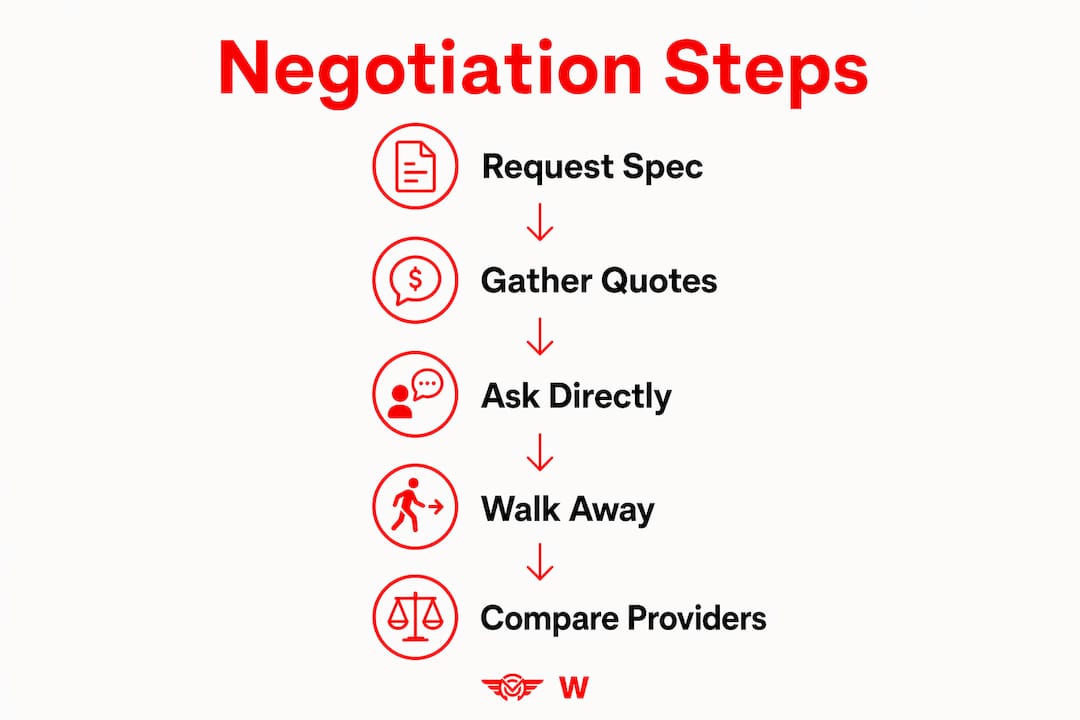
Delaying the warranty purchase beyond the initial F&I visit often leads to 40 to 60% savings compared to at-desk deals. Walking away is not a failure. It is a strategy. Tell the finance manager you want to think it over and will call back. In many cases, a follow-up call within a week results in a significantly lower offer.
For Porsche and BMW owners, this is especially worth doing. Warranty plans on those vehicles can run $4,000 to $7,000 at sticker. A 40% discount on a $5,000 quote saves $2,000. That is worth one phone call.
Dealer extended warranties vs. direct third-party providers
One of the most overlooked strategies for warranty discounts is bypassing the dealership entirely. Direct-buy warranty providers often price plans 40 to 60% below what a dealer charges for comparable coverage. The table below compares the two channels across the factors that matter most.
| Factor | Dealer-Sold Warranty | Direct Third-Party Provider |
|---|---|---|
| Price | Higher due to markup (50–200%) | Lower, often 40–60% less |
| Coverage quality | OEM plans are strong; third-party dealer plans vary | Varies; read exclusions carefully |
| Flexibility | Limited to dealer's partner providers | Multiple plan tiers and providers |
| Cancellation policy | 30–60 day refund window typically | Varies; confirm before purchase |
| Convenience | Purchased at point of sale | Requires separate research and purchase |
| Repair network | Often tied to dealer network | Usually nationwide, any licensed shop |
The right choice depends on your priorities. If you own a Ford F-150 or a Honda Accord and want the simplest process, a dealer OEM plan may be worth the slight premium. If you own a Range Rover Defender or a Porsche Macan and want to control costs, a direct-buy plan from a reputable provider is worth the extra research time.
The key insight: use direct-buy pricing as your benchmark even if you ultimately buy from the dealer. Walk in knowing what comparable coverage costs outside the dealership. That knowledge alone shifts the negotiation in your favor.
Common mistakes to avoid when negotiating warranty pricing
Even well-prepared buyers make avoidable errors that cost them money. These are the mistakes that appear most often and the ones that are easiest to prevent.
- Bundling the warranty into the car price. When a dealer says "I can roll it into your payment for just $30 more a month," that $30 adds up to $1,800 over a 60-month loan, often for a warranty worth $900. Always evaluate the total cost, not the monthly addition.
- Believing the "offer expires when you leave" line. This pressure tactic is almost always a bluff. Nearly all warranty contracts can be added or canceled within legal refund windows after purchase. Do not let urgency override your judgment.
- Skipping the contract before signing. The exclusions section of a warranty contract determines its real value. A plan that excludes electrical systems on a BMW 7 Series or a Mercedes-Benz S-Class is nearly worthless given those vehicles' repair profiles.
- Ignoring deductible structure. A $200 deductible per visit versus $0 deductible changes your out-of-pocket cost significantly over the life of the plan. Factor this into your price comparison.
- Not knowing your cancellation rights. Most states require a minimum 30-day cancellation window with a prorated refund. Confirm this before you sign. It gives you a safety net if you find better pricing after the fact.
The best practices for warranty negotiations always start with the same principle: treat the warranty as a standalone financial product, not a dealership formality.
Key takeaways
Separating warranty negotiation from the car purchase price is the single most effective tactic for reducing your extended warranty cost.
| Point | Details |
|---|---|
| Markup creates discount room | Dealer markups of 50–200% mean you can realistically negotiate 30–40% off the first quote. |
| Timing improves your leverage | Negotiating at month-end or quarter-end exploits dealer pressure to hit sales targets. |
| Third-party quotes are your best tool | Written competing quotes force dealers to match or beat pricing in real time. |
| Separate the warranty from the car deal | Keeping warranty pricing isolated prevents cost concealment inside monthly payments. |
| Cancellation windows protect you | A 30–60 day refund period lets you sign under pressure and shop for better pricing afterward. |
What I've learned after years of watching buyers overpay for warranties
Kenneth here. After years of watching car buyers walk out of dealerships having paid full sticker price on warranties, the pattern is always the same. They were focused on the car. The warranty felt like a small add-on. By the time they were in the F&I office, they were mentally exhausted and just wanted to finish.
That exhaustion is exactly what the finance office is designed to exploit. The F&I manager is not your enemy, but they are not your advocate either. Their job is to maximize revenue from every product they present. Knowing that changes how you walk into that room.
The single shift that changes everything is treating the warranty as its own purchase decision, completely separate from the car. When I see buyers do that, they almost always get a better price. When they let it get bundled into the deal, they almost always overpay.
I also want to say something that most articles skip: walking away is not rude. It is not aggressive. It is the most rational thing you can do when the price is not right. Dealers sell warranties every day. They will still sell you one tomorrow, next week, or after you call back. The "today only" pressure is theater.
For luxury vehicle owners specifically, the stakes are higher. A Porsche extended warranty or a Range Rover protection plan at full dealer markup can cost $5,000 to $8,000. Negotiating that down by 35% saves you $1,750 to $2,800. That is not a rounding error. That is a real financial outcome worth 30 minutes of uncomfortable conversation.
Arm yourself with quotes, read the spec sheet, separate the negotiation, and be willing to leave. Those four moves will serve you better than any script.
— Kenneth
Get trustworthy warranty coverage without the dealership markup
If you want to benchmark dealer pricing or skip the F&I office entirely, Rpmwarranty offers extended warranty plans covering a wide range of vehicles including BMW, Mercedes-Benz, Range Rover, Porsche, Ford, and Honda. Their Elite, Advanced, and Essential plans cover engines, transmissions, electrical systems, and high-tech components with nationwide repair network access.
Getting a quote takes minutes and gives you a real number to bring into any dealership negotiation. Rpmwarranty's protection plans are built for buyers who want transparent pricing and coverage that actually matches their vehicle's repair profile. Use it as your benchmark, your backup, or your primary plan.
FAQ
How much can you negotiate off a dealer warranty quote?
Most buyers can negotiate 30 to 40% off the initial quote by presenting competing prices and separating the warranty from the car purchase. Dealers with 50 to 200% markup have significant room to discount without losing money.
Is it better to buy a warranty at the dealership or directly?
Direct-buy warranty providers typically price plans 40 to 60% below dealer-sold equivalents for comparable coverage. The dealership option offers convenience, but the cost premium is substantial, especially on luxury vehicles like BMW or Mercedes-Benz.
Can you negotiate a warranty after buying the car?
Yes. Most extended warranty contracts include a 30 to 60-day cancellation and refund window, which means you can purchase at the dealership and then shop for better pricing. If you find a lower rate, cancel within the refund period and buy direct.
What is the biggest mistake buyers make when negotiating warranty pricing?
Bundling the warranty into the monthly car payment is the most common and costly mistake. It hides the true cost of the plan inside the loan and removes your ability to evaluate the warranty as a standalone product.
Does timing really affect warranty negotiation outcomes?
Negotiating at the end of the month or quarter consistently produces better results because sales staff face pressure to meet volume targets. That pressure translates directly into greater willingness to discount add-on products like extended warranties.