

TL;DR:
- Warranty gaps are coverage limitations that leave specific repairs unprotected and may lead to unexpected costs. Identifying these gaps through VIN verification and understanding warranty exclusions helps prevent costly repairs not covered by your factory or extended warranty.
Warranty gaps are defined as coverage limitations in your vehicle's factory or extended warranty that leave specific repairs unprotected, exposing you to unexpected out-of-pocket costs. Knowing how to identify warranty gaps before a breakdown occurs is the single most effective way to avoid a four-figure repair bill you thought was covered. Most factory warranties follow a standard structure: 3 years/36,000 miles for bumper-to-bumper coverage and 5 years/60,000 miles for powertrain protection, with the clock starting at the in-service date and mileage. The industry term for this process is "warranty coverage analysis," and it applies equally to factory warranties, extended service contracts, and certified pre-owned programs.
How to identify warranty gaps using your VIN
The Vehicle Identification Number, or VIN, is the starting point for any warranty coverage analysis. Every vehicle carries a 17-character VIN stamped on the driver's side dashboard, visible through the windshield, and repeated on the door jamb sticker and your title documents. That number unlocks the exact in-service date, which is the day the vehicle was first sold or put into use, not the model year or the assembly date. The distinction matters because a BMW 5 Series or Mercedes-Benz C-Class purchased in december of one year but manufactured months earlier still starts its warranty clock on the purchase date.

To check your factory warranty status, contact your manufacturer's customer service line or visit an authorized dealership with your VIN in hand. Many automakers, including Ford, Honda, and Porsche, provide online VIN lookup portals that display remaining warranty time and mileage. Third-party VIN check services can give you a preliminary read, but always confirm the result with the manufacturer or dealer directly, since third-party databases sometimes lag behind updated records.
Mileage limits are just as binding as time limits. Coverage ends when either threshold is reached first, whichever comes sooner. A Range Rover owner who drives 40,000 miles in two years has already exhausted bumper-to-bumper coverage, even though the three-year window has not closed. Verifying your current odometer reading against the warranty mileage limit is a non-negotiable step.
Factory warranties also transfer with the vehicle to subsequent owners, but coverage durations can shrink. A 10-year powertrain warranty on a Hyundai, for example, drops to 5 years when the car is resold. The coverage clock does not reset for the new owner.
Pro Tip: Before buying a used BMW, Mercedes, or Honda, ask the seller for the original purchase date and verify it against the VIN through the manufacturer's portal. A one-year discrepancy in the in-service date can mean the difference between active coverage and none at all.
Key steps for a VIN-based warranty check:
- Locate the VIN on the dashboard, door jamb, or vehicle title
- Contact the manufacturer or an authorized dealer with the VIN
- Confirm the in-service date, not the model year
- Compare current mileage against the warranty mileage limit
- Ask specifically about powertrain versus bumper-to-bumper limits
- Request written confirmation of remaining coverage
What common warranty exclusions create coverage gaps
Exclusions are where most warranty surprises live. Every factory warranty contains a list of components and conditions it will not cover, and reading that list carefully is the core of detecting warranty exclusions before they cost you money.
Routine maintenance and wear items are always excluded from factory coverage. Brake pads, wiper blades, tires, air filters, and fluids fall into this category regardless of the vehicle's age or mileage. A Porsche Cayenne owner who replaces brake pads at 20,000 miles pays out of pocket every time. That is by design, not an oversight.
Environmental and external damage sit outside warranty coverage as well. Hail damage on a Ford F-150, flood damage on a Honda Pilot, or road salt corrosion on a Range Rover are all excluded from factory warranties. Auto insurance, not the manufacturer, is the correct vehicle for those claims.
Vehicle use is another major exclusion trigger. Commercial use such as rideshare driving, delivery work, or fleet operation voids factory warranty coverage under standard terms. A salvage or rebuilt title cancels the warranty entirely. Buyers of used vehicles should always run a vehicle history report to check title status before assuming any coverage remains.
Aftermarket modifications create a more nuanced situation. The Magnuson-Moss Warranty Act protects consumers from blanket warranty denial based on modifications. A manufacturer cannot void your entire warranty because you installed aftermarket wheels on your Mercedes GLE. They can only deny coverage for the specific failure caused by that modification. Knowing this distinction prevents dealers from using modifications as a broad excuse to reject legitimate claims.
"The exclusions section of a warranty contract is the primary source of denied claims. A long, complex exclusions list is not just fine print. It is a direct signal of how narrow your actual coverage is. Read it before you sign, not after you file a claim."
Warranty booklets and service contracts carry legal weight. The exclusions listed in those documents are enforceable, which is why reading them before purchase is the only reliable way to identify warranty limitations.
How to analyze extended warranties for hidden coverage gaps
Extended warranties are technically called vehicle service contracts, or VSCs, and the distinction matters legally. A factory warranty is a manufacturer's promise. A VSC is a separate contract sold by a third party or dealership, and it operates under different rules.
The most important structural difference in VSCs is the coverage model. Exclusionary contracts cover everything on the vehicle except what is specifically listed as excluded. Inclusionary contracts, also called "stated component" plans, cover only the parts explicitly named in the contract. The Federal Trade Commission notes that most service contracts are stated component plans, meaning major systems can remain completely unprotected unless they are named. An exclusionary plan is almost always the stronger choice.
| Contract type | Coverage approach | Risk level |
|---|---|---|
| Exclusionary VSC | Covers all parts except listed exclusions | Lower risk, broader protection |
| Inclusionary VSC | Covers only named components | Higher risk, frequent gaps |
Red flags in VSC documents signal real financial exposure. Key warning signs include labor rate caps set below local market rates, aggregate payout limits that cap total claims over the contract's life, and consequential damage exclusions that refuse to pay for secondary failures caused by a covered breakdown. A Volkswagen owner whose transmission fails and causes engine damage may find only the transmission covered if consequential damage is excluded.
Provider legitimacy is a separate but equally critical check. The California Department of Insurance advises buyers to verify the license, obligor, and backup insurer of any VSC provider before signing. An administrator who controls claim approvals without a clear payment standard, and without insurance backing, is a major red flag. Contracts that rely on administrator discretion rather than defined coverage standards are prone to unjust denials.
Pro Tip: Ask the VSC provider for the name of their obligor and their backup insurer in writing. If they cannot provide both within 24 hours, walk away from the contract.
The warranty claims process itself is another gap source. Many VSCs require pre-authorization before any repair begins. Skipping that step, even in an emergency, can void the claim entirely. Read the claims procedure section as carefully as the coverage section.
Step-by-step approach to spotting coverage gaps before they hit your wallet
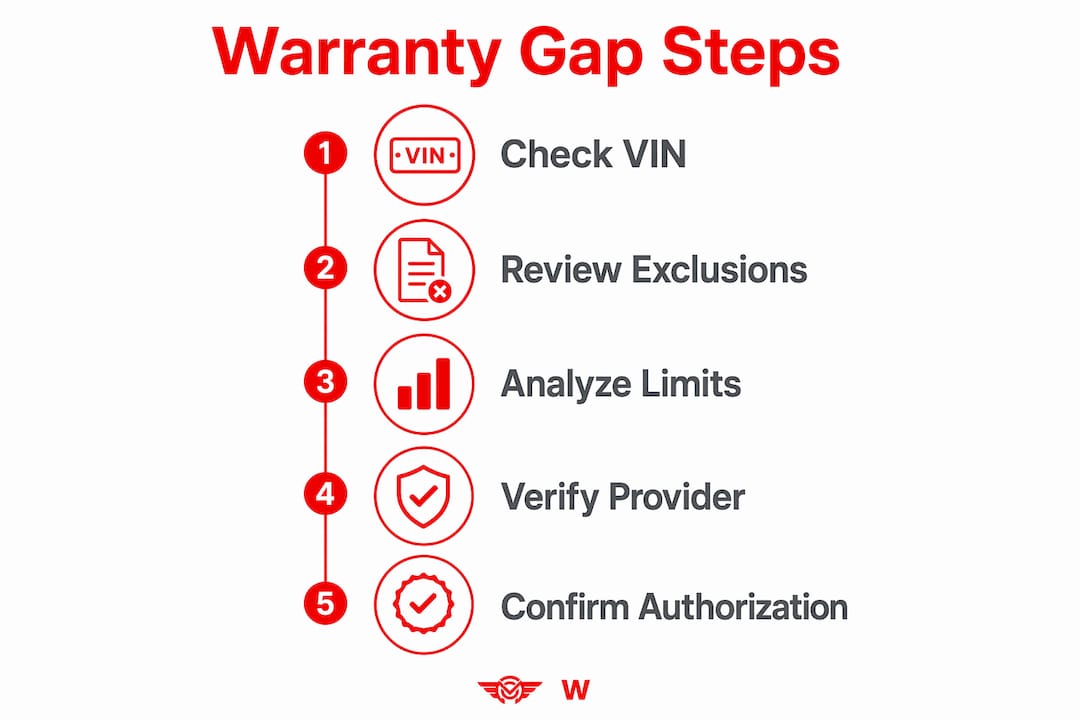
A structured process removes guesswork from warranty coverage analysis. Follow these six steps whether you are buying a new vehicle, purchasing used, or reviewing an existing extended service contract.
-
Obtain your VIN and verify factory warranty limits. Pull the 17-character VIN and contact the manufacturer or an authorized dealer to confirm the in-service date, current mileage, and remaining time under both bumper-to-bumper and powertrain coverage. Write these numbers down. Do not rely on memory or the seller's word.
-
Read every warranty and service contract document in full. Focus first on the exclusions section. For VSCs, identify whether the contract is exclusionary or inclusionary. Flag any vague language like "subject to administrator approval" or "at our discretion," since those phrases create gaps that are nearly impossible to challenge later.
-
Verify the vehicle's maintenance history. Warranty claims can be denied when maintenance records are missing or when service intervals were not followed. A Honda CR-V owner who cannot prove timely oil changes may face a denied engine claim even within the warranty period. Request service records from the seller or dealership and compare them against the manufacturer's recommended schedule.
-
Confirm the claims process requirements before you need them. Know whether pre-authorization is required, which repair shops are approved, and what documentation you must submit. For a Range Rover or BMW, authorized dealer repairs are often required to keep the factory warranty intact.
-
Check the VSC provider's credentials. Verify the obligor's name, their state license, and the identity of their backup insurer. A quick search of your state's department of insurance website confirms whether the provider is licensed to operate in your state.
-
Negotiate or add supplemental coverage where gaps exist. If your factory warranty is within six months of expiration, or if a VSC review reveals major uncovered systems, act before the factory coverage lapses. Certified pre-owned programs sometimes layer additional coverage on top of remaining factory protection, but their terms vary and must be verified separately. If gaps remain after CPO review, a reputable extended service contract from a licensed provider fills the space.
Key Takeaways
Identifying warranty gaps requires verifying your factory coverage limits by VIN, reading exclusions carefully, and confirming that any extended service contract uses an exclusionary coverage model backed by a licensed obligor.
| Point | Details |
|---|---|
| VIN verification is the starting point | Use the VIN to confirm in-service date and remaining factory warranty time and mileage. |
| Exclusions drive most denied claims | Read the exclusions section first in any warranty or VSC document to spot coverage holes. |
| Exclusionary VSCs offer broader protection | Contracts that cover everything except listed exclusions are safer than stated component plans. |
| Maintenance records protect your claim | Keep proof of all service intervals to prevent denial based on missed maintenance. |
| Provider legitimacy prevents scams | Verify the obligor's license and backup insurer before signing any extended service contract. |
What I've learned after years of watching warranty claims go wrong
The most common mistake I see vehicle owners make is treating the warranty as a safety net without ever reading what it actually catches. A BMW 3 Series owner once told me he assumed his extended service contract covered everything "except the obvious stuff." The contract excluded electrical systems. His infotainment system failed at 80,000 miles, and the repair cost him $3,200 out of pocket.
Verbal assurances from dealership finance managers are not coverage. I have seen buyers walk out of a dealership convinced their Porsche Macan was "fully covered" because a salesperson said so. The written contract said otherwise. The rule is simple: if it is not in writing, it does not exist.
Maintenance records are undervalued until the moment they are needed. Keeping a folder, physical or digital, with every oil change receipt, tire rotation record, and dealer service invoice takes almost no effort. That folder is your defense if a manufacturer or VSC administrator tries to deny a claim based on alleged neglect.
One more thing most articles skip: if a claim is denied, demand a written explanation citing the specific exclusion or evidence used to justify the denial. Vague responses like "wear and tear" or "not covered" are insufficient and legally challengeable. A specific written denial gives you something to work with, whether that means escalating to the manufacturer, filing a complaint with your state's department of insurance, or consulting a consumer protection attorney.
Buy extended coverage before you need it. Waiting until the factory warranty expires limits your options and raises your cost. The best time to evaluate a reputable extended service contract is while the factory warranty is still active.
— Kenneth
Rpmwarranty's extended plans close the gaps factory warranties leave open
Factory warranties cover a lot, but they stop at a defined mileage and date, and they exclude more than most vehicle owners realize. Rpmwarranty offers extended protection plans built to pick up exactly where factory coverage ends, with options tailored to your vehicle's make, model, and usage.
Rpmwarranty's Elite, Advanced, and Essential plans cover engines, transmissions, cooling systems, electrical systems, and high-tech components, with nationwide dealer trust and a straightforward claims process. Whether you drive a Hummer, a Volkswagen, or anything in between, you can get a free quote in minutes and compare plans side by side. Locking in coverage while your factory warranty is still active typically means better terms and lower cost. The process takes four steps: consultation, plan selection, customization, and final agreement.
FAQ
What does a warranty gap mean for vehicle owners?
A warranty gap is a specific repair or condition that falls outside your factory or extended warranty's coverage, leaving you responsible for the full repair cost. Gaps most often appear in exclusions for wear items, environmental damage, or commercial vehicle use.
How do I check if my car is still under factory warranty?
Contact your vehicle's manufacturer or an authorized dealership with your VIN to confirm the in-service date and current mileage against the warranty limits. Most brands set bumper-to-bumper coverage at 3 years/36,000 miles and powertrain coverage at 5 years/60,000 miles.
What is the difference between an exclusionary and inclusionary service contract?
An exclusionary contract covers all vehicle components except those specifically listed as excluded, offering broader protection. An inclusionary contract covers only the parts named in the document, which creates more coverage gaps.
Can aftermarket parts void my entire warranty?
No. The Magnuson-Moss Warranty Act prevents manufacturers from voiding your entire warranty because of aftermarket parts. They can only deny coverage for the specific failure directly caused by the modification.
What should I do if a warranty claim is denied?
Request a written denial that cites the specific exclusion or evidence used to reject the claim. Vague denials are legally insufficient and can be challenged with your state's department of insurance or a consumer protection attorney.