

TL;DR:
- Most new vehicle buyers assume their factory warranty covers all repairs, but it only protects against defects in materials and workmanship for a limited time.
- Extended warranties are separate contracts with different terms and exclusions, often excluding normal wear, damage, or modifications.
- To maximize coverage, owners should verify warranty details, keep thorough service records, and understand what voids their warranty before making modifications or neglecting maintenance.
Most car buyers assume their new vehicle is covered against anything that goes wrong in the first few years. That assumption has cost a lot of people serious money. Understanding what is original manufacturer warranty coverage actually includes, and where it stops, is one of the most practical things you can do before signing a purchase agreement or filing a claim. This article breaks down the original warranty definition, explains what typical factory coverage includes and excludes, and gives you concrete steps to make the most of your coverage, whether you drive a Ford F-150 or a Porsche Cayenne.
Table of Contents
- Key takeaways
- What is original manufacturer warranty on a vehicle
- Original vs. extended warranties: what is actually different
- Common limitations and exclusions you need to know
- How to verify and use your factory warranty effectively
- My take: what years of watching warranty claims taught me
- Protect your vehicle when factory coverage ends
- FAQ
Key takeaways
| Point | Details |
|---|---|
| Original warranty is automatic | A manufacturer warranty comes included with every new vehicle and requires no separate purchase. |
| Coverage targets defects only | Factory warranties cover defects in materials and workmanship, not wear, accidents, or maintenance. |
| Duration varies by brand | Most warranties last 3 years or 36,000 miles, but luxury brands like BMW often offer different terms. |
| Extended warranties are separate | Auto service contracts are optional purchases and carry different terms from the original factory warranty. |
| Maintenance protects your coverage | Skipping scheduled maintenance or making unauthorized modifications can void your factory warranty entirely. |
What is original manufacturer warranty on a vehicle
An original manufacturer warranty is the automaker's written promise to repair or replace parts that fail due to defects in materials or workmanship within a set period after purchase. It comes with the vehicle automatically. You do not pay extra for it, and it takes effect from the moment you drive off the lot.
The manufacturer's warranty covers defects for a specific number of months or miles, whichever comes first. A typical arrangement is 3 years or 36,000 miles for bumper-to-bumper coverage, though factory warranty terms vary considerably by brand and model. BMW offers a 4-year/50,000-mile limited warranty on new vehicles. Mercedes-Benz provides a 4-year/50,000-mile basic warranty as well. Ford's standard powertrain warranty goes to 5 years or 60,000 miles. These numbers matter because they directly affect what protection you have on day one.
Most factory warranties include several layers:
- Bumper-to-bumper (basic) warranty: Covers most mechanical and electrical components from the front to the rear of the vehicle, excluding specific items like tires and wiper blades.
- Powertrain warranty: Covers the engine, transmission, drivetrain, and related parts. This typically outlasts the bumper-to-bumper term.
- Corrosion/rust-through warranty: Protects against structural rust perforation, often extending 5 to 7 years.
- Emissions warranty: Federally mandated coverage for emissions-related components, required by the EPA.
- Roadside assistance: Many brands include complimentary roadside coverage during the initial warranty period.
The manufacturer warranty meaning, at its core, is protection against the manufacturer's own mistakes. If a component fails because of how it was designed or built, the automaker is responsible. If something fails because you drove it hard without oil changes, that is a different situation entirely.
Pro Tip: Keep a copy of your warranty booklet in the glove box and photograph the coverage terms page with your phone. When something goes wrong, you want that information immediately, not while you are searching a filing cabinet at home.
Federal law backs up your rights here. The Magnuson-Moss Warranty Act requires automakers to disclose warranty terms in clear, understandable language and prohibits them from conditioning your warranty on the use of specific branded parts or services unless those parts or services are provided free of charge. That means a dealer cannot legally void your BMW warranty simply because you had routine oil changes done at an independent shop, as long as you used qualifying oil specifications and kept records.
Original vs. extended warranties: what is actually different
This is where most buyers get genuinely confused, and the confusion is understandable. Both involve warranty coverage for your vehicle. But they are fundamentally different products.
The FTC draws a clear line between manufacturer warranties and extended warranties: the original comes included with your purchase and is federally regulated, while an extended warranty (technically an auto service contract) is an optional purchase with its own separate terms, exclusions, and pricing. Extended warranties are not federally guaranteed in the same way. They are contracts between you and the seller, whether that is a dealer, a manufacturer, or a third-party provider.
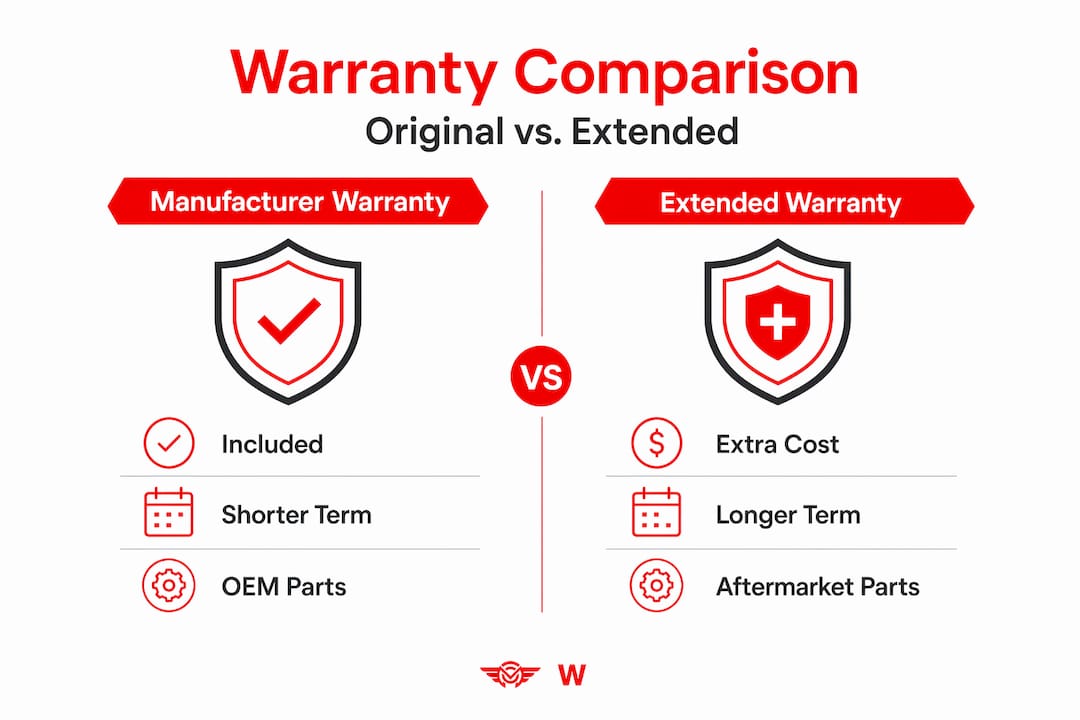
Here is how the two compare directly:
| Feature | Original Manufacturer Warranty | Extended Warranty / Service Contract |
|---|---|---|
| Cost to consumer | Included with vehicle purchase | Purchased separately, varies in price |
| Legal backing | Magnuson-Moss Warranty Act | Contract law; varies by state and provider |
| Coverage trigger | Defects in materials or workmanship | Depends on contract; often mechanical breakdown |
| Exclusions | Wear, accidents, maintenance | Typically broader; may exclude pre-existing conditions |
| Duration | Set by manufacturer; usually 3-5 years | Varies; can extend 1 to 10+ years beyond factory coverage |
| Transferability | Often transfers to new owner | Depends on contract terms |
Auto service contracts often exclude damage from accidents and wear and tear and can carry significant costs. That does not make them a bad idea. It just means you need to read what you are actually buying.
Before purchasing an extended contract, compare the exclusions side by side with your factory warranty. The benefits of original warranty coverage are straightforward because defects are the manufacturer's problem, no negotiation needed. With an extended contract, you are the one responsible for understanding what the policy actually covers. You can learn more about these distinctions in this factory vs. extended warranty guide.
Common limitations and exclusions you need to know
Here is the part most buyers do not read until it is too late. Factory warranties focus narrowly on defects. They are not a general mechanical guarantee. Manufacturer warranties exclude normal wear and tear, accidents, misuse, and routine maintenance items regardless of your vehicle's brand or price point.
What typically falls outside factory coverage:
- Normal wear and tear: Brake pads, rotors, clutch components, tires, wiper blades, and filters wear out over time. That is expected. No warranty covers it.
- Routine maintenance: Oil changes, fluid top-offs, spark plug replacements, and scheduled service are your responsibility.
- Accidental or collision damage: A cracked bumper, bent wheel, or shattered window is a job for your auto insurance, not your warranty.
- Weather or environmental damage: Hail damage, flood damage, and sun-faded paint are excluded.
- Misuse and abuse: If you took a Range Rover Defender off-road and bent a control arm, that is unlikely to qualify as a manufacturing defect.
- Unauthorized modifications: Aftermarket tuning, lift kits, performance exhaust installations, and similar modifications can void coverage on the affected systems.
This last point is worth taking seriously. Improper maintenance or modifications can void your warranty entirely, not just the component you modified. Installing a performance tune on a Porsche 911 engine could void your powertrain warranty. Adding a non-approved trailer hitch to a Mercedes GLE could void coverage on affected rear suspension components.
Many Range Rover owners are surprised to discover that their extended factory coverage on air suspension does not include wear-related failures of the air compressor, only defects. Given how frequently those systems develop issues after 60,000 miles, that distinction becomes expensive.
Pro Tip: Document every maintenance appointment with dated receipts and service records. If you ever need to file a warranty claim, a dealership or manufacturer will look at your service history first. Gaps in that record make it easier for them to deny coverage.
Understanding what voids your car warranty before you make changes to the vehicle is one of the simplest ways to protect thousands of dollars in potential coverage.
How to verify and use your factory warranty effectively
Knowing you have a warranty and knowing how to actually use it are two different things. Here is a practical process for staying covered and getting the most from your protection.
-
Confirm your current coverage. To check if your vehicle is still under factory warranty, locate the original purchase date and odometer reading at sale, then compare against the manufacturer's published warranty terms. Most automakers also allow you to enter your VIN on their website to confirm active coverage. For used vehicles, this step is non-negotiable. Warranties can transfer to new owners, but coverage terms and conditions vary by brand. Some manufacturers transfer the full remaining warranty. Others prorate it or limit what the second owner can claim.
-
Read the actual warranty document. Not the brochure. The actual terms. The Magnuson-Moss Warranty Act requires that warranty terms be written in clear, simple language and that they be available before you purchase. If the dealer cannot provide the full warranty booklet before you sign, that is a red flag.
-
Know where to get warranty service. Factory warranty repairs must typically be performed at an authorized dealership for the brand. Taking your BMW to a general mechanic does not automatically void your warranty, but getting that repair covered under the factory warranty will almost always require an authorized BMW service center. Federal law prohibits conditioning warranty coverage on exclusive use of dealer services, but the practical reality is that warranty claim processing flows through authorized networks.
-
Keep all maintenance records. Service receipts, oil change records, dealer inspection notes. Preserve these in a folder or digitally. This is your evidence file if a claim dispute arises.
-
Document problems as they appear. If a warning light appears and then disappears before you can get to a dealer, note the date, conditions, and any accompanying symptoms. Intermittent issues are notoriously difficult to warranty without supporting documentation.
-
Plan ahead for when coverage ends. Factory coverage expires whether you notice it or not. If you plan to keep your vehicle past the original warranty period, start comparing extended coverage options before the factory warranty lapses. Waiting until something breaks means you are already paying out of pocket.
The benefits of original warranty coverage are real, but only if you understand the terms well enough to actually claim them when the time comes.
My take: what years of watching warranty claims taught me

I've worked with enough vehicle owners to know that the original manufacturer warranty is genuinely valuable and widely misunderstood at the same time.
What I've seen happen most often is this: a buyer purchases a new vehicle, puts the warranty booklet in a drawer, and then assumes they are fully covered for three to five years. When something breaks, they call the dealership expecting a free repair, only to find out that what failed is either excluded from coverage or was voided by a modification they made six months after purchase.
With luxury vehicles, this gap between expectation and reality gets expensive fast. A Range Rover Sport owner once told me they expected their air suspension system to be fully covered under the factory warranty at 45,000 miles. The compressor failure was ultimately classified as a wear-related issue, not a defect, and the repair cost exceeded $2,000 out of pocket. The Porsche owners I've spoken with face similar situations with their PDK transmission systems. The original factory warranty covers defects. It does not cover the bill for everything that happens to a high-performance drivetrain.
My honest view is that the original warranty is a floor, not a ceiling. It protects you from the manufacturer's mistakes during the most critical ownership period. What it cannot do is protect you from the mechanical reality of owning a vehicle for 8 to 10 years.
I've also noticed that owners who read their warranty documents carefully and maintain meticulous service records almost never lose a legitimate claim. The people who get burned are the ones who assumed coverage without verifying it. Read the terms. Keep your records. And start planning your next layer of protection before the factory coverage runs out, not after.
— Kenneth
Protect your vehicle when factory coverage ends
Once your original manufacturer warranty expires, your vehicle does not become any less expensive to repair. Engines, transmissions, electrical systems, and high-tech components all continue to age, and the repair bills that come with them can be significant.
Rpmwarranty offers extended warranty plans designed to pick up where factory coverage leaves off, with options for vehicles ranging from everyday Hondas and Fords to high-end vehicles like Tesla and Lexus. Plans cover engines, transmissions, cooling systems, electrical systems, and more, with nationwide coverage and straightforward claims processing. Whether you are approaching the end of your factory warranty or already past it, you can explore tailored protection plans and get a free quote based on your specific vehicle's year, make, and model.
FAQ
What does original manufacturer warranty cover?
An original manufacturer warranty covers defects in materials and workmanship for a specified period or mileage. It does not cover normal wear and tear, accidents, or routine maintenance items like brakes and tires.
How long does a factory warranty typically last?
Most factory warranties last 3 years or 36,000 miles for bumper-to-bumper coverage, though powertrain warranties often extend further. Luxury brands like BMW and Mercedes-Benz commonly offer 4-year terms.
Does the original warranty transfer when I buy a used car?
Many factory warranties transfer to subsequent owners, but the terms and conditions differ by manufacturer. Always verify the active coverage through the manufacturer's VIN lookup tool before purchasing a used vehicle.
What is the difference between a manufacturer warranty and an extended warranty?
A manufacturer warranty is included with a new vehicle and is federally regulated under the Magnuson-Moss Warranty Act. An extended warranty is an optional service contract purchased separately, with different terms, exclusions, and no federal guarantee of coverage.
Can modifications void my factory warranty?
Yes. Unauthorized modifications can void warranty coverage on affected systems. However, federal law prohibits manufacturers from voiding your entire warranty simply because you used a non-dealer service provider for routine maintenance.