

TL;DR:
- Most owners pay more for extended warranties than they benefit from repair coverage.
- Factory warranties are free, covering specific components for a set time or mileage.
- Extended warranties may be worthwhile for luxury, high-tech, or unreliable vehicles, but often lack value.
Most vehicle owners assume extended warranties are a smart safety net, but the reality is more nuanced. Consumer Reports finds that most owners pay more for extended warranties than they ever receive in repair benefits, and a large share never use them at all. That single fact should make you pause before signing anything at the dealership. This article breaks down exactly what factory and extended warranties cover, where they differ, and how to decide whether extra coverage is a smart investment for your specific vehicle and situation.
Table of Contents
- What is a factory warranty?
- What is an extended warranty?
- Factory vs. extended warranty: Key differences
- Is an extended warranty actually worth it?
- Our take: Rethinking extended warranties for modern drivers
- Explore your extended warranty options
- Frequently asked questions
Key Takeaways
| Point | Details |
|---|---|
| Factory covers basics | A factory warranty provides essential protection for new vehicles for a limited period or mileage. |
| Extended is optional | Extended warranties cover repairs after factory coverage but are often not cost-effective for reliable cars. |
| Know your needs | High-tech, high-mileage, and luxury vehicles benefit most from extended coverage. |
| Always compare terms | Review coverage, costs, and contract details carefully before committing to an extended plan. |
What is a factory warranty?
With factory warranties so commonly bundled with new vehicles, it's important to clarify what exactly they offer. A factory warranty, also called a manufacturer's warranty, is a promise from the automaker that they will repair or replace certain defective parts within a defined period. It comes standard with every new car purchase at no extra cost to you.
Most brand-new cars come with a factory warranty covering a set period or mileage, typically 3 years or 36,000 miles, whichever comes first. Some automakers offer longer coverage on specific components, particularly the powertrain. For example, many brands now advertise 5-year or 60,000-mile powertrain warranties as a selling point.
Here is what a typical factory warranty covers:
- Bumper-to-bumper coverage: Protects most vehicle components from defects, including electronics, air conditioning, and suspension parts
- Powertrain warranty: Covers the engine, transmission, and drivetrain, often for a longer term than bumper-to-bumper
- Corrosion warranty: Protects against rust and body panel perforation
- Emissions warranty: Required by federal law, covering emissions-related components
- Roadside assistance: Many manufacturers include this for the duration of the bumper-to-bumper period
Understanding car warranty by year helps you track exactly when each layer of coverage expires, which is critical for planning ahead.
Factory warranties do have real limitations. They exclude wear-and-tear items like brake pads, tires, and wiper blades. Damage from accidents, misuse, or neglected maintenance is also not covered. If you modify your vehicle, certain repairs may be voided.
Important: Factory warranty coverage expires based on time or mileage, whichever milestone you reach first. A driver who racks up miles quickly may lose coverage far sooner than expected.
For anyone new to vehicle ownership, reviewing the auto warranties basics is a great starting point before evaluating any additional coverage options.
What is an extended warranty?
Once the factory warranty ends, owners are often presented with extended coverage options. An extended warranty, sometimes called a vehicle service contract, kicks in to cover repair costs after the manufacturer's coverage expires. It is not technically a warranty in the legal sense since it is sold separately, but the term is widely used.
You can buy extended coverage from two main sources:
- Manufacturer extended warranties: Sold by the automaker or dealership, these tend to mirror factory coverage but come at a premium price
- Third-party extended warranties: Offered by independent companies, these are often more flexible and less expensive, though coverage quality varies widely
Extended warranties cost between $1,500 and $4,000 total, or $70 to $180 per month, with factory-extended plans typically running higher than third-party alternatives. Payment options vary too. Some plans require full upfront payment, while others allow monthly installments rolled into your car payment or billed separately.
Timing matters. You can often purchase an extended warranty while your factory coverage is still active, or shortly after it expires. Waiting too long can limit your options or raise your cost. Some providers also require a vehicle inspection before approving coverage on older cars.
The main types of extended warranty plans include:
- Comprehensive (bumper-to-bumper): Covers nearly everything except a short exclusion list
- Powertrain only: Covers engine, transmission, and drivetrain at a lower price point
- Exclusionary plans: List what is NOT covered rather than what is, offering the broadest protection
Knowing why to get warranty after factory coverage helps you understand the timing and logic behind these decisions. If you are unsure whether your vehicle qualifies or whether you actually need it, reviewing the signs you need an extended warranty can give you a clearer picture.
Pro Tip: Always read the exclusion list before purchasing any extended warranty. A plan that sounds comprehensive may still exclude the exact components most likely to fail on your vehicle model.
Factory vs. extended warranty: Key differences
To make an informed choice, let's see how factory and extended warranties compare across the features that matter.
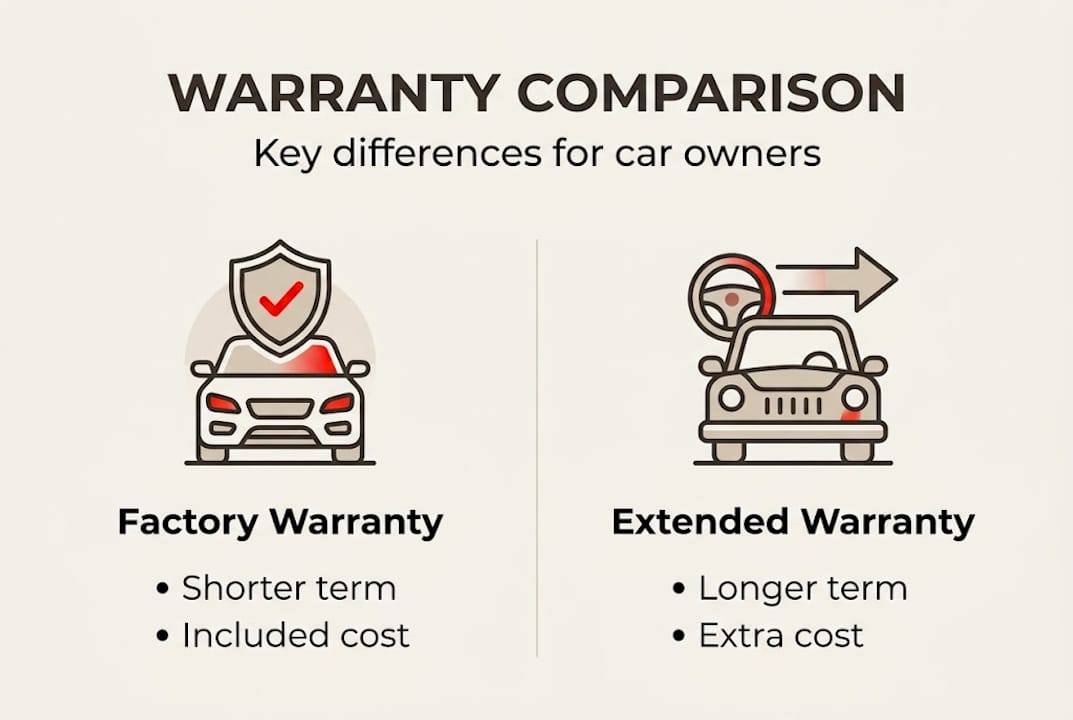
| Feature | Factory warranty | Extended warranty |
|---|---|---|
| Who provides it | Automaker | Manufacturer or third party |
| Cost to buyer | Included with purchase | $1,500 to $4,000+ |
| Coverage start | Day of purchase | After factory warranty expires |
| Coverage type | Bumper-to-bumper and powertrain | Varies by plan |
| Repair network | Authorized dealerships | Varies, often any licensed shop |
| Transferable | Often yes, to next owner | Depends on contract |
| Cancellable | No | Usually yes, with refund |
| Deductibles | None | $0 to $200 per visit |
Here are the four biggest practical differences to keep in mind:
- Who handles repairs: Factory warranties typically require you to visit an authorized dealership. Many extended warranties allow repairs at any licensed mechanic, which can be more convenient.
- What is excluded: Factory warranties exclude wear items and damage. Extended warranties add their own exclusion lists, which can be lengthy depending on the plan.
- Cost structure: Factory coverage is free upfront. Extended warranties involve real out-of-pocket spending, sometimes before you ever file a claim.
- Flexibility: Extended warranties often let you customize deductibles, coverage tiers, and payment terms. Factory warranties offer no such flexibility.
Consumer Reports research consistently finds that extended warranties are often not worth it financially for most owners, with the exception of luxury vehicles, high-mileage drivers, and owners of less reliable brands. Understanding warranty exclusions in detail is essential before committing to any plan.

Statistic to note: The average repair bill for a major engine or transmission failure can exceed $4,000, which is roughly equal to the maximum cost of an extended warranty. That math only works in your favor if you actually need that repair.
Is an extended warranty actually worth it?
Now that you know the differences, is buying extended coverage a smart choice for your situation?
CR surveys show that owners consistently pay more for extended warranties than they receive back in repair benefits. For most drivers of reliable, well-maintained vehicles, the math simply does not add up. The peace of mind is real, but it comes at a financial cost.
That said, there are specific situations where extended coverage genuinely makes sense:
- Luxury vehicles: High-end brands carry repair costs that can dwarf standard vehicle repairs. A single electronic module replacement can cost thousands.
- High-tech vehicles: Cars loaded with advanced driver assistance systems, touchscreen interfaces, and complex sensors are expensive to fix when something goes wrong.
- Older or high-mileage vehicles: Once a car crosses 100,000 miles, failure rates climb across multiple systems simultaneously.
- Unreliable models: Some brands and model years have documented reliability issues. If you own one, the odds of needing repairs are higher than average.
- Owners without emergency savings: If an unexpected $3,000 repair would create real financial hardship, the predictable monthly cost of a warranty may be worth it for budgeting purposes.
"The best financial move for most owners is buying a reliable car and keeping up with maintenance. Extended coverage is the exception, not the rule."
Before purchasing, ask yourself these questions. Does your vehicle have a history of reliability problems? Are you planning to keep it beyond 100,000 miles? Could you cover a $2,000 to $4,000 repair without financial stress? If the answer to the first two is yes and the last is no, extended coverage deserves serious consideration.
Learning who needs an extended warranty helps you match your situation to the right decision. You should also review key warranty features to know what to look for, and explore customized warranty coverage if a one-size-fits-all plan does not fit your needs.
Pro Tip: Before buying an extended warranty, get a reliability report on your specific vehicle model and year. If it scores well, your money may be better spent in a dedicated car repair savings account.
Our take: Rethinking extended warranties for modern drivers
Let's be direct about something the dealership finance office rarely tells you. Extended warranties are sold on emotion, specifically the fear of a large, unexpected repair bill. That fear is legitimate. But fear-based decisions are rarely the most financially sound ones.
Buying a reliable vehicle and maintaining it consistently saves most drivers more money than any extended warranty contract ever will. The data backs this up repeatedly.
However, we also recognize that modern vehicles are genuinely more complex than they were a decade ago. Turbocharged engines, hybrid battery systems, and advanced electronics have made certain repairs extraordinarily expensive. For owners of these vehicles, especially if reliability ratings are mixed, extended coverage is not a gimmick. It is a rational financial tool.
The real danger is not the warranty itself. It is the high-pressure sales environment where you are asked to decide in minutes, often on a vehicle you just purchased. Take your time. Compare providers. Read the auto warranty insights available to you. The right plan, purchased thoughtfully, can absolutely be worth it for the right driver.
Explore your extended warranty options
Ready to compare real extended warranty options or see how coverage works for your vehicle? RPM Warranty makes it straightforward to find a plan that fits your car and your budget.
Browse the available protection plans to compare Elite, Advanced, and Essential coverage tiers side by side. If you want to see actual numbers for your specific vehicle, you can get a free quote in minutes with no obligation. Still have questions about how coverage works or what is included? The RPM warranty FAQ answers the most common questions clearly and without the sales pressure. Getting informed costs nothing.
Frequently asked questions
Can I buy an extended warranty after my factory warranty expires?
Yes, you can typically purchase extended warranties after your factory warranty ends, though coverage after expiration may come with different pricing and fewer plan options than buying earlier.
What does an extended warranty usually cover that a factory warranty doesn't?
Extended warranties pick up where factory coverage leaves off, covering repairs on aging components. You can even tailor your coverage to include specific systems that factory plans never addressed.
How much does an extended warranty really cost?
Extended warranties range from $1,500 to $4,000 total or $70 to $180 per month, with manufacturer plans generally costing more than third-party alternatives.
Are extended warranties a good value for most owners?
For most owners, extended warranties rarely pay off unless the vehicle is unreliable, high-tech, or a luxury model with expensive repair costs.
Is an extended warranty transferable if I sell my car?
Many extended warranties are transferable to a new owner for a fee, but you should always check the contract terms. The basics of auto warranties explain what to look for in your agreement before assuming transferability.
Recommended
- Why get a warranty after factory coverage ends in 2026
- Signs you need an extended warranty for your vehicle
- Car warranty myths debunked: 5 costly mistakes to avoid
- Choosing a car warranty by year for smarter protection
- Mantenimiento del coche: qué revisiones necesita y cada cuánto tiempo | EcoMoving | Autogás en Barcelona: una alternativa de combustible sostenible y rentable