

TL;DR:
- Exclusionary warranties cover nearly all vehicle parts unless explicitly excluded.
- Proper maintenance records and documentation are critical to prevent claim denials.
- These plans are ideal for high-mileage, complex, or older vehicles needing broad coverage.
Most car owners hear the word "exclusionary" and assume it means their warranty covers less. That instinct is completely backward. Exclusionary warranties actually cover nearly everything on your vehicle unless a specific item is listed as excluded. The confusion comes from the name itself, which sounds restrictive when it's actually the broadest type of extended coverage available. This article walks you through exactly how these plans work, what they leave out, and the documentation habits that separate owners who win claims from those who don't.
Table of Contents
- How exclusionary car warranties really work
- What's actually excluded in an exclusionary warranty?
- Why claims get denied: Common pitfalls and how to avoid them
- Who should consider an exclusionary warranty, and when does it make sense?
- The real story: What most owners miss about exclusionary warranties
- Protect your investment with proven coverage
- Frequently asked questions
Key Takeaways
| Point | Details |
|---|---|
| Broader coverage | Exclusionary warranties cover most parts except those specifically listed as excluded. |
| Hidden exclusions | Wear items, maintenance, and modifications are almost always not covered—read the fine print. |
| Denied claims risk | Missing service records and neglect lead to over 18 percent claim denial rates. |
| Documentation is vital | Keep every maintenance receipt to support claims and improve your appeal chances. |
| Fits high-risk vehicles | Exclusionary warranties offer best value for older or high-mileage cars or in harsh conditions. |
How exclusionary car warranties really work
An exclusionary warranty flips the standard coverage model. Instead of listing every part that's covered, it covers your entire vehicle and then lists the exceptions. That's a meaningful difference. With a named-component or inclusionary plan, if a part isn't on the list, it's not covered. With an exclusionary plan, if a part isn't on the exclusions list, it is covered.
As Car Talk explains, exclusionary warranties provide broader coverage by assuming everything is included unless explicitly excluded. That's a fundamentally different starting point, and it matters when your car develops a problem with an obscure sensor or a module that a basic plan would never mention.
Here's how the three main types of extended warranty coverage compare:
| Coverage type | How it works | Best for |
|---|---|---|
| Exclusionary | Covers everything except listed items | High-mileage, complex vehicles |
| Inclusionary (named component) | Covers only listed parts | Budget-conscious buyers |
| Powertrain only | Engine, transmission, drivetrain | Older, simpler vehicles |
The key advantages of exclusionary coverage include:
- Broader protection for modern vehicles loaded with electronics and sensors
- Fewer gaps in coverage compared to named-component plans
- Peace of mind when driving high-mileage or older vehicles in demanding conditions
- Simpler decision-making since you only need to review what's excluded
One thing worth clearing up early: exclusionary coverage is not the same as bumper-to-bumper coverage. The manufacturer's original bumper-to-bumper warranty is often used as a comparison point, but third-party exclusionary plans have their own exclusions lists that vary by provider. Always read those lists carefully. You can also explore warranty myths debunked to avoid common misunderstandings before you sign anything, and review warranty coverage clarity to understand how providers communicate what's actually included.
"The biggest mistake owners make is assuming 'exclusionary' means restricted. It's actually the most inclusive type of third-party warranty available."
What's actually excluded in an exclusionary warranty?
But what's not covered can matter as much as what is, so let's break down what's most often excluded.
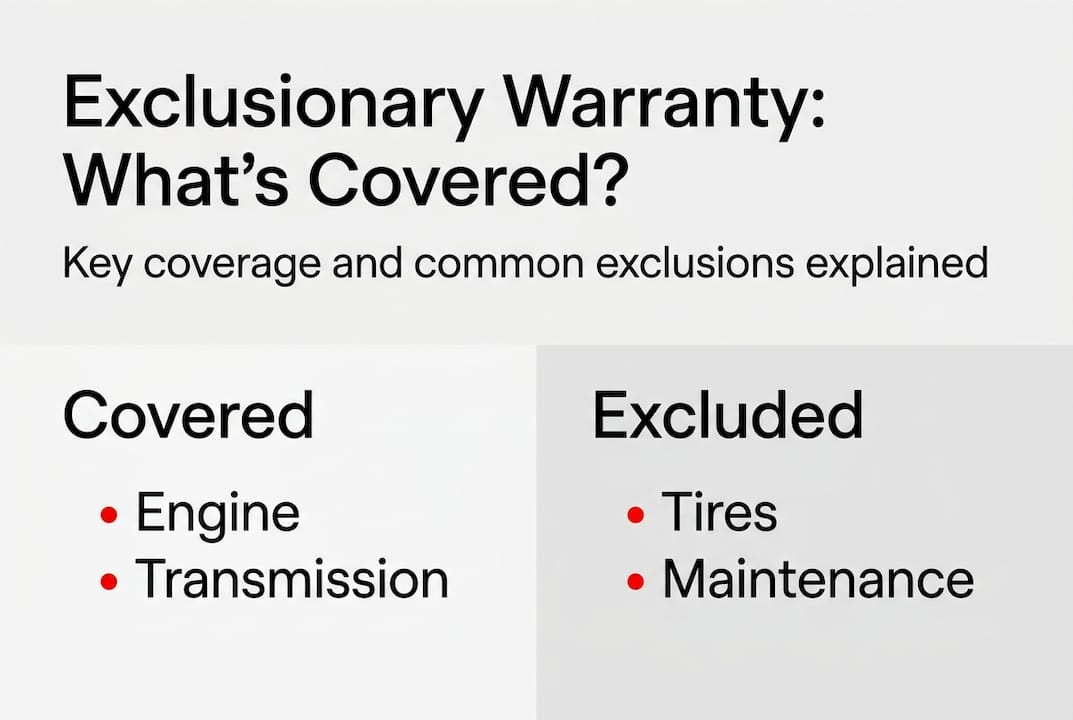
Even with the broadest exclusionary plan, certain categories are almost always off the table. Knowing them in advance prevents the frustration of filing a claim and getting denied on something you thought was covered.
Here are the most common exclusion categories:
- Routine maintenance: oil changes, filter replacements, fluid top-offs
- Wear-and-tear items: tires, brake pads, rotors, wiper blades, belts
- Accidental damage: collision-related repairs belong to auto insurance, not warranties
- Environmental damage: rust, corrosion, weather-related deterioration
- Aftermarket modifications: parts or systems not installed by the manufacturer
- Pre-existing conditions: problems that existed before your coverage started
The more surprising exclusions involve behavior and documentation. Missing oil change receipts can trigger a denial even under an exclusionary plan if the provider determines neglect contributed to the failure. Off-road use, towing beyond rated capacity, and racing are also common triggers that void coverage.
Here's a quick reference for gray areas many owners miss:
| Situation | Typically covered? | Why it matters |
|---|---|---|
| Sensor failure from normal use | Yes | Exclusionary plans shine here |
| Brake failure from worn pads | No | Wear items are excluded |
| Engine damage from missed oil change | No | Neglect clause applies |
| AC compressor failure | Usually yes | Not a wear item |
| Aftermarket stereo causing electrical issue | No | Modification clause |
The fine print that trips people up most often involves the phrase "resulting damage." Some providers deny coverage for a covered component if they can argue the damage resulted from a non-covered cause, like deferred maintenance. That's why a sample contract is not optional reading. It's essential.

Pro Tip: Before you sign any extended warranty, request the full exclusions list in writing. Compare it line by line against your vehicle's known issues and driving habits. Understanding what voids a car warranty can save you thousands in denied claims.
Why claims get denied: Common pitfalls and how to avoid them
Once you know what's excluded, it's critical to understand how real-world claim issues play out.
The data here is sobering. 1 in 5 warranty claims are denied due to lack of maintenance records, with overall auto warranty denial rates sitting around 18%. That means nearly one in five people who file a claim walk away with nothing, often not because of what their contract says, but because of what they failed to document.
The top reasons claims get denied:
- Missing service records: No receipts for oil changes, fluid services, or inspections
- Aftermarket parts: Non-OEM components installed anywhere on the vehicle
- Unauthorized repairs: Work done at a shop not approved by the warranty provider
- Delayed reporting: Waiting too long after a failure to file the claim
- Continued driving after a warning: Ignoring a check engine light and causing further damage
Key stat: Auto warranty denial rates hover around 18%, meaning nearly 1 in 5 claims are rejected, most often due to documentation gaps.
The good news is that denials aren't always final. 40% of appeals succeed when owners provide complete documentation. That's a meaningful number. It means if you get denied, you have a real shot at reversing it, but only if you've kept your records.
Pro Tip: Create a simple folder, physical or digital, where every oil change receipt, inspection report, and repair invoice goes immediately. Date each one. If you ever need to appeal a denial, this folder is your most powerful tool. Reviewing must-have warranty features before you purchase can also help you choose a provider with a fair claims process from the start. And if you're new to extended coverage, the auto warranties explained guide is a solid starting point.
Who should consider an exclusionary warranty, and when does it make sense?
Knowing the pitfalls makes it easier to decide if exclusionary coverage is right for you.
Not every driver needs the broadest possible coverage. But for certain situations, exclusionary coverage is hard to beat. Experts recommend exclusionary plans for peace of mind in high-mileage or harsh driving conditions, particularly when the cost of a single major repair could exceed the total cost of the warranty itself.
Exclusionary coverage tends to make the most sense when:
- Your vehicle is between 5 and 12 years old with significant mileage
- You drive in extreme climates, heavy traffic, or on rough roads regularly
- Your car has complex electronics, turbocharged engines, or advanced driver-assist systems
- You can't absorb a large unexpected repair bill without financial strain
- You plan to keep the vehicle for several more years rather than trading it in soon
On the other hand, exclusionary coverage may not be necessary if your vehicle is still under the manufacturer's warranty, or if you're comfortable self-insuring against repair costs with savings.
The cost-to-benefit calculation is personal. A transmission replacement can run $3,000 to $5,000. An engine rebuild can exceed $8,000. If your vehicle has the kind of complexity where those repairs are realistic possibilities, exclusionary coverage often pays for itself with a single claim.
Pro Tip: Ask the provider for a sample contract before committing. Read the exclusions section first, then ask specific questions about your vehicle's known vulnerabilities. Use resources like choosing a car warranty and signs you need an extended warranty to sharpen your decision before you talk to any sales representative.
The real story: What most owners miss about exclusionary warranties
Here's the part most articles skip. The label "exclusionary" is genuinely misleading, and that confusion benefits no one. But the bigger issue isn't the name. It's the passive relationship most owners have with their warranty once they sign it.
We've seen it repeatedly: owners buy a solid exclusionary plan, feel protected, and then stop paying attention to maintenance records. They assume the breadth of the coverage will carry them through any claim. It won't. The contract is only half the equation. What you do as a vehicle owner is the other half.
Think of an exclusionary warranty as a partnership. The provider agrees to cover almost everything. You agree to maintain the vehicle properly and document that maintenance. When both sides hold up their end, claims get paid. When one side doesn't, things fall apart. That's not fine print trickery. It's a reasonable expectation that's clearly stated in every contract.
The owners who get the most value from exclusionary coverage are not necessarily the ones with the best plan. They're the ones who treat documentation as seriously as they treat the coverage itself. Read more about warranty after factory coverage to understand why this mindset matters even more once the manufacturer steps out of the picture.
Protect your investment with proven coverage
You now know how exclusionary warranties work, what they exclude, and what separates owners who get claims paid from those who don't. The next step is finding a plan that matches your vehicle and your driving reality.
At RPM Warranty, we offer vehicle protection plans designed with transparency at the center. Whether you're looking for Elite, Advanced, or Essential coverage, our team walks you through exactly what's excluded before you sign. If you drive a Volkswagen and want to see how exclusionary coverage applies to your specific model, check out our Volkswagen exclusionary warranty page. Get a free quote today and take the guesswork out of protecting your vehicle.
Frequently asked questions
Are exclusionary car warranties better than named component warranties?
Exclusionary warranties usually offer broader coverage since they cover everything except items specifically listed as excluded, while named component plans only cover what's explicitly listed.
What repairs are never covered by exclusionary warranties?
Routine maintenance, wear-and-tear parts such as tires and brakes, accidental damage, and aftermarket modifications are nearly always excluded regardless of the plan's breadth.
Can a claim be denied if I miss an oil change?
Yes, missing oil change receipts can lead to a denied claim even under exclusionary coverage if the provider determines that neglect contributed to the component failure.
Is it possible to appeal a denied warranty claim?
Absolutely. About 40% of appeals succeed when owners provide complete maintenance records and documentation supporting their claim.